 Tiếng
Việt
 Tiếng
Anh
 Tiếng
Nhật




 Tiếng Anh

Vietnam’s green transportation roadmap: Driving the development of the electric motorcycle industry and supporting industries

Vietnam’s green transportation roadmap is becoming one of the key strategies for building a modern, sustainable, and environmentally friendly transportation system amid increasingly severe climate change and growing global pressure to reduce greenhouse gas emissions. This roadmap focuses on gradually replacing fossil fuel-powered vehicles with electric vehicles and other clean-energy alternatives. It also aims to develop a comprehensive transportation ecosystem that includes charging infrastructure, renewable energy sources, modern public transportation systems, and green industrial supply chains. This strong growth also creates opportunities for the supporting industries and drives transformation across the entire industrial sector. Businesses capable of investing in automation, improving product quality, and meeting new standards will have greater opportunities to participate more deeply in domestic and international value chains. So, what benefits will Vietnam’s green transportation roadmap bring, and how can CNC VINA contribute to this development trend? In this article, let’s explore the topic in more detail with CNC VINA!
1. Why is Vietnam accelerating its transition to green transportation?
Vietnam’s green transportation roadmap is driven not only by the goals of reducing emissions and protecting the environment but also by the need to promote the development of the electric vehicle industry. The following factors form an important foundation for shaping this transition strategy and creating numerous opportunities for businesses in manufacturing, automation, and the electric motorcycle supporting industries.

1.1. Vietnam’s green transportation roadmap fulfills its emissions reduction commitments
At the COP26 Conference, Vietnam committed to achieving net-zero emissions by 2050, marking a significant shift in its sustainable development strategy. To achieve this goal, the transportation sector, one of the major sources of greenhouse gas emissions, needs to accelerate its transition to greener modes of transport.
Accordingly, Vietnam will gradually reduce the number of vehicles powered by internal combustion engines, promote electric vehicles, develop public transportation, and expand the use of renewable energy. These are essential foundations for reducing emissions, improving environmental quality, and building a modern, sustainable transportation system.
1.2. The global development trend of electric motorcycles
The transition to green transportation is gaining strong momentum worldwide. Many countries have introduced roadmaps to gradually phase out or end the production and sale of gasoline- and diesel-powered vehicles in the coming decades, alongside various policies to encourage the development and adoption of electric vehicles.
The rapid development of electric motorcycles, electric cars, next-generation battery technologies, fast-charging systems, and smart energy management solutions is transforming the entire vehicle manufacturing industry. This trend is creating significant growth opportunities not only for vehicle manufacturers but also for businesses operating in the electric motorcycle supporting industry.

For Vietnam, this is a favorable time to accelerate electric vehicle manufacturing, increase the localization rate, develop supporting industries, and participate more deeply in global supply chains rather than continuing to serve primarily as a processing and assembly hub. This will also help strengthen the competitiveness of the domestic industrial sector as the green transportation trend continues to grow.
1.3. Improving air quality in urban areas
In major cities such as Hanoi and Ho Chi Minh City, the rapid increase in the number of private vehicles over the years has placed significant pressure on the environment, particularly in terms of air pollution and traffic congestion. In this context, developing green transportation is considered an important solution to improving environmental quality and promoting sustainable development.
The wider adoption of electric vehicles is expected to reduce CO₂ emissions, limit PM2.5 fine particulate matter, decrease traffic noise, and contribute to a better quality of life for residents. In addition to environmental benefits, green transportation can also reduce dependence on imported fossil fuels, strengthen energy security, and drive the development of Vietnam’s domestic electric vehicle industry.
1.4. Promoting the development of domestic manufacturing industries
One of the key objectives of Vietnam’s green transportation roadmap is to comprehensively develop the domestic electric vehicle industry, rather than simply encouraging people to use green vehicles. This will not only help increase the localization rate but also strengthen the competitiveness of Vietnamese businesses in global supply chains.

This transition creates numerous opportunities in fields such as electric motorcycle and electric car manufacturing, lithium battery production, electric motors, controllers, electronic systems, charging equipment, and production automation solutions. These include assembly lines, quality inspection systems, traceability systems, and industrial robots. All of these are essential components in building a modern electric vehicle manufacturing ecosystem that can meet domestic market demand and expand into export markets.
2. The impact of Vietnam’s green transportation roadmap on the electric motorcycle manufacturing industry
Vietnam’s green transportation roadmap is not only transforming the consumer market but also having a significant impact on the entire value chain of the electric vehicle manufacturing industry. As demand for green vehicles increases, businesses will need to strengthen their production capabilities, invest in technology, and meet increasingly stringent standards for quality, safety, and traceability. For the electric motorcycle industry, this transition opens up development opportunities across multiple areas.

2.1. Increasing demand for investment in modern production lines
As market demand grows and quality requirements become increasingly stringent, many electric motorcycle manufacturers are shifting from semi-manual production models to automated production lines to increase productivity and optimize costs. This is also an inevitable trend for fulfilling large-scale orders and strengthening competitiveness.
Priority investment areas include electric motorcycle assembly lines, quality inspection lines, auxiliary machines, and product traceability systems. Implementing these solutions helps businesses increase productivity, reduce dependence on manual labor, minimize production errors, and ensure consistent product quality before products leave the factory.
2.2. Increasingly stringent quality standards
The development of electric vehicles brings higher requirements for product quality, safety, and consistency. In addition to mechanical standards, businesses must also strictly control critical components such as batteries, electric motors, controllers, charging systems, control software, and electrical safety features. Even a minor defect in any of these components can affect vehicle performance and operational safety.

Therefore, the end-of-line (EOL) inspection line is becoming an indispensable stage in the electric vehicle manufacturing process. A modern inspection system typically integrates multiple testing items, including electrical system checks, braking force, speed, lights and signals, charging capability, motor operation, and water resistance. It also records and stores all inspection data to support quality management and product traceability.
This enables businesses to detect and address defects directly at the factory, ensuring that every product meets the required technical and safety standards before being delivered to customers.
2.3. Electric motorcycle traceability is becoming essential
As production volumes increase and supply chains continue to expand, traceability has become an important requirement in electric vehicle manufacturing. Each motorcycle may be assembled from hundreds of components supplied by different manufacturers. Therefore, if a defect occurs, businesses need to quickly identify the faulty component, production date, production batch, and relevant supplier so that appropriate corrective action can be taken promptly.

To meet these requirements, many factories have adopted frame number marking machines, QR codes, Data Matrix codes, and production data management software to track information for each product throughout the manufacturing process. In addition, integration with MES or ERP systems enables businesses to manage the entire product lifecycle, from manufacturing and quality inspection to warranty services and product recalls when necessary. This helps improve management efficiency and ensure product quality.
3. CNC VINA’s role in the green transportation transition
As Vietnam’s green transportation roadmap continues to gain momentum, the electric motorcycle manufacturing industry is entering a new stage of development with higher requirements for productivity, quality, and traceability. To adapt to these changes, businesses need to invest not only in their products but also in building smart factories equipped with modern, flexible production systems that can scale according to market demand.
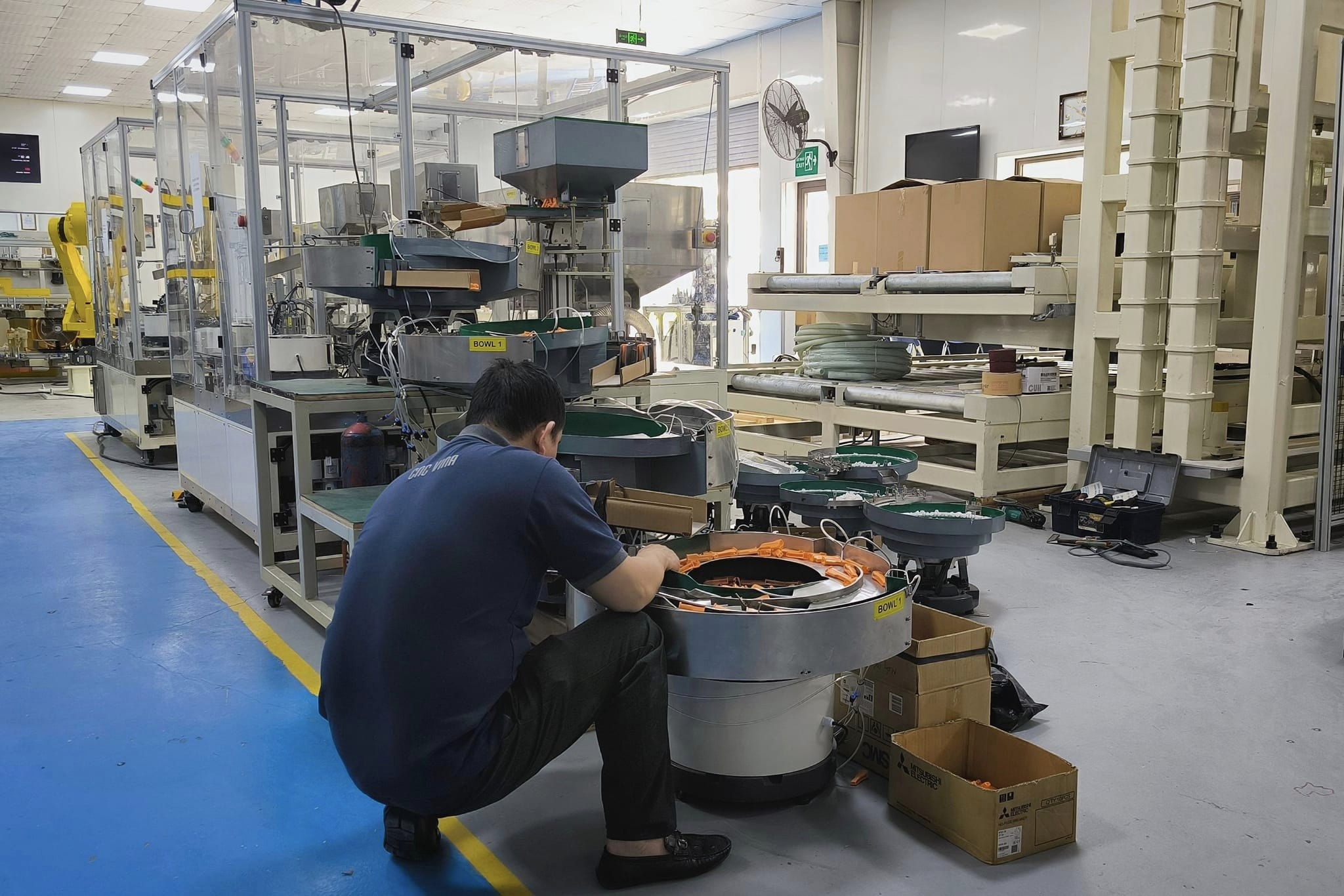
With many years of experience in industrial automation, CNC VINA provides comprehensive solutions for electric motorcycle manufacturing plants, ranging from electric motorcycle factory assembly lines and end-of-line (EOL) quality inspection lines to standalone machines. Each solution is designed to meet the specific requirements of individual businesses, ensuring compatibility with their production scale and development objectives.

Through the application of modern automation technologies, CNC VINA helps businesses increase productivity, implement real-time quality control, optimize operating costs, and improve data traceability throughout the entire production process. This not only provides a foundation for meeting the increasingly stringent standards of the electric motorcycle industry but also strengthens business competitiveness and prepares companies to participate more deeply in global supply chains.
Vietnam’s green transportation roadmap sets the direction for sustainable transportation development and serves as a driving force behind the transformation of the entire electric vehicle manufacturing industry. Promoting the adoption of green vehicles will create greater demand for investment in technology, infrastructure, and modern manufacturing solutions. This presents an opportunity for businesses to strengthen production capabilities, increase localization rates, and participate more deeply in global supply chains. At the same time, increasingly stringent requirements for quality, safety, and traceability present new challenges in investing in automated production lines and quality control systems. Manufacturers' growing focus on investment also creates opportunities for the supporting industries to expand and develop. In this context, building smart factories and adopting automation solutions are no longer just emerging trends but have become essential requirements. With its experience in industrial automation, CNC VINA is ready to partner with businesses in implementing manufacturing solutions that align with the development direction of the electric motorcycle industry. From assembly lines and quality inspection systems to traceability solutions, CNC VINA helps businesses optimize production processes and improve operational efficiency. These solutions also provide an important foundation for businesses to capitalize on the opportunities offered by Vietnam’s green transportation roadmap and move toward sustainable development in the future.