 Tiếng
Việt
 Tiếng
Anh
 Tiếng
Nhật




 Tiếng Anh

Classification of motion systems for automatic assembly machines

The transfer system for automatic assembly machines is an important component that connects production processes across different workstations. It is responsible for transporting products or component assemblies throughout the assembly process from one position to the next according to a predefined sequence. Depending on product characteristics, productivity requirements, and equipment configuration, transfer systems can be designed with various transportation methods. Choosing the right method not only affects operating speed but also determines the positioning capability, accuracy, and stability of the entire production line. Currently, transfer systems in automatic assembly machines are commonly classified into continuous, intermittent, or operator-assisted transportation systems. So, how are transfer systems for automatic assembly machines classified? In this article, let's explore this topic in detail with CNC VINA.
1. Overview of transfer systems in automatic assembly machines
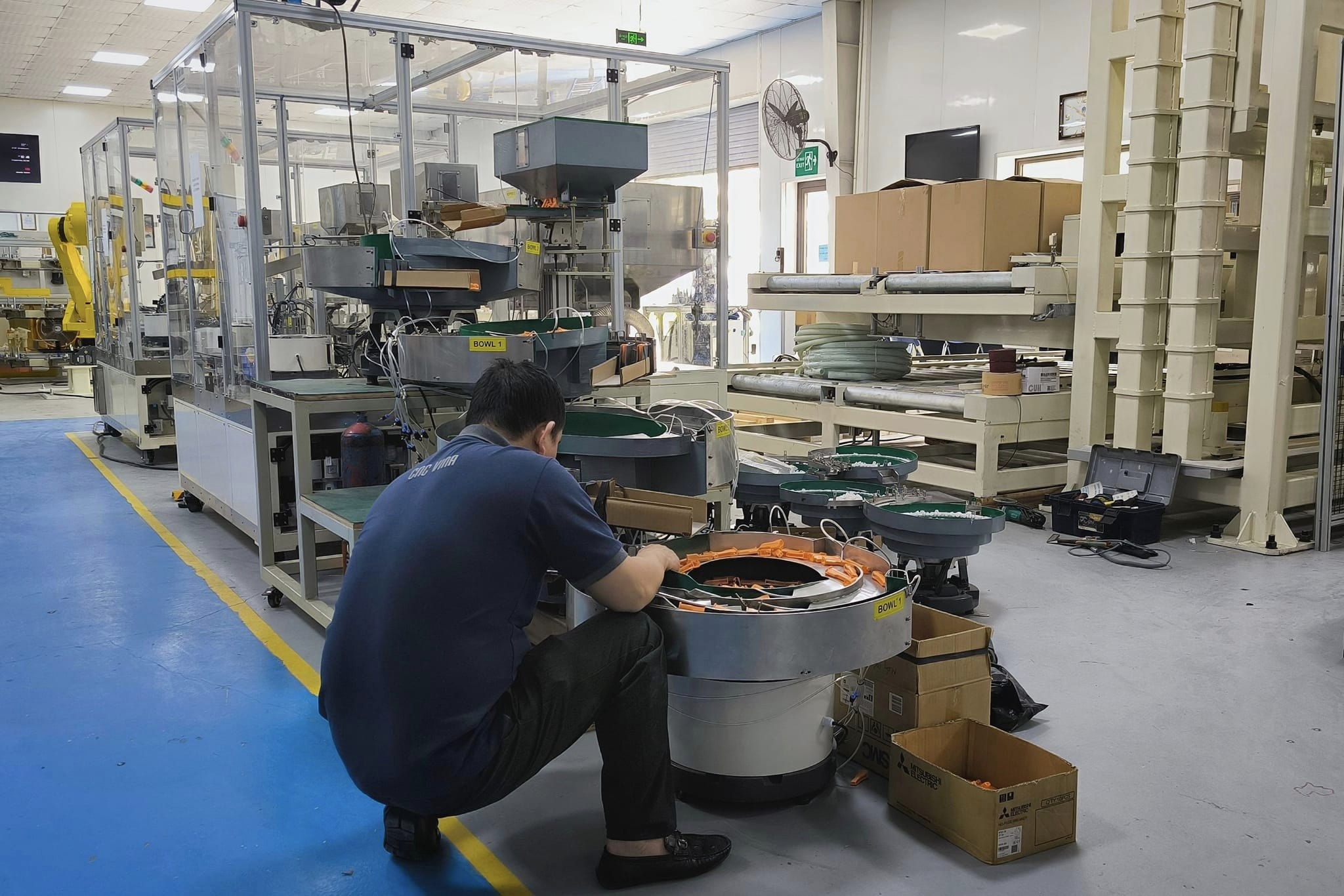
The transfer system is responsible for moving products or assemblies through different workstations so that each production step can be completed in sequence. Instead of performing the entire process at a single location, the machine is divided into multiple separate stations, each handling a specific operation such as part feeding, positioning, press-fitting, screw tightening, inspection, or product unloading (in other words, using a bowl feeder feeding system to perform automated feeding operations).
To ensure that products maintain the correct position and condition throughout the transfer process, components are usually placed on dedicated fixtures or pallets. These fixtures hold the products securely, maintain their assembly orientation, and provide suitable positioning references for each operation. The machine system then transfers these fixtures from one workstation to another according to the designed sequence.
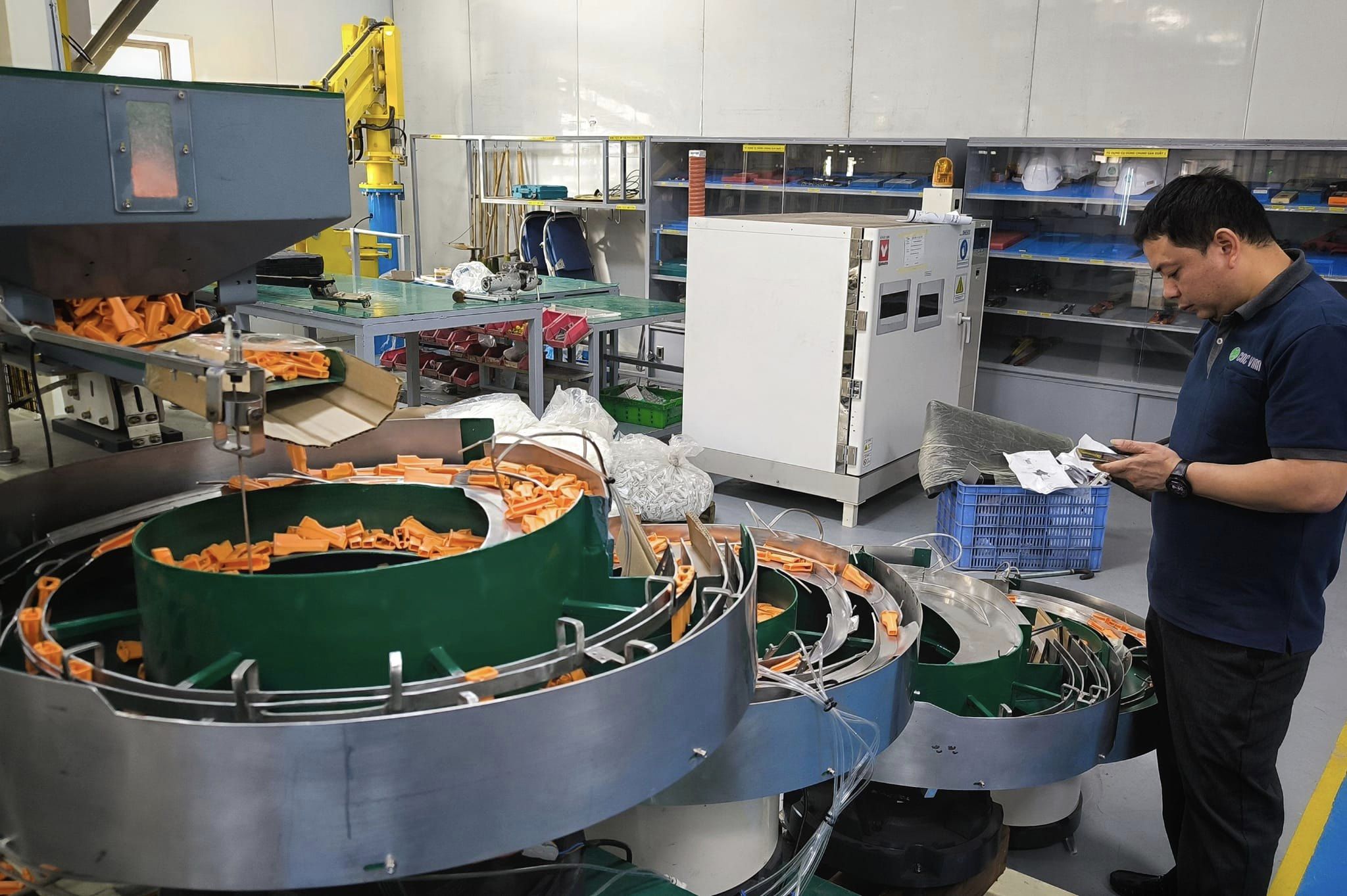
Depending on the structure and layout of the transfer path, transfer systems in automatic assembly machines can be divided into two main types:
-
Linear transfer systems: Product fixtures are transported along one or more linear guideways, passing through assembly stations arranged in a row.
-
Rotary transfer systems: Fixtures are arranged on a rotary table and move along a circular path in sequence, bringing products to different workstations.
In addition to the transfer path layout, transfer systems can also be classified according to their operating methods, including continuous transfer, intermittent transfer, and free or asynchronous transfer. Each method has its own characteristics and is suitable for different production requirements.
2. Continuous transfer systems
A continuous transfer system is a method in which product fixtures remain in motion at a constant speed throughout the operating cycle. As products pass through the stations, the working heads must move synchronously with or track the fixtures to perform assembly operations within the required time.
Two motion configurations are commonly used in this type of system. In the first configuration, the working head moves parallel to the product fixture over a certain travel distance. After completing the operation, the working head returns to its initial position to prepare for the next cycle. In the second configuration, the working head moves along a circular path tangent to the direction of fixture travel, allowing the operation to be performed while the two components move synchronously.
2.1. Operating principle of continuous transfer systems
During operation, product fixtures are continuously transported through the assembly stations at a preset speed. The working head must keep pace with the fixture to maintain the required relative position throughout the operation.
After completing the process, the working head disengages from the fixture and returns to its standby position. Meanwhile, the product continues moving to the next station for the subsequent operation. This process takes place continuously, without requiring the fixtures to come to a complete stop at each station.
2.2. Characteristics and applications
Continuous transfer systems offer the advantage of maintaining a steady product flow, reducing waiting time between operations, and supporting high-speed production lines. However, this approach also has certain limitations when applied to automated mechanical assembly.
Since working heads and related equipment are often relatively heavy, designing synchronized motion mechanisms can be more complex. In addition, maintaining accurate positioning between the working head and the product fixture becomes more challenging when both are moving simultaneously. This can affect the stability of operations that require precise positioning, such as press-fitting, machining, or component assembly.
Therefore, continuous transfer systems are more commonly used in industries with high-speed production processes and repetitive operations, such as food processing, cosmetics filling, bottling, and liquid product packaging.
3. Intermittent transfer systems
Unlike continuous transfer, an intermittent transfer system transports fixtures in defined steps. After each movement, the fixture stops at a workstation so that the machine heads can perform assembly operations.
This method is widely used in automatic assembly machines, particularly for processes that require high precision. Once the fixture reaches the correct position, a positioning mechanism secures the product before the working head begins its operation.
Depending on the arrangement of the workstations, intermittent transfer systems are generally divided into two main types: rotary indexing machines and linear transfer lines.
3.1. Rotary indexing transfer systems
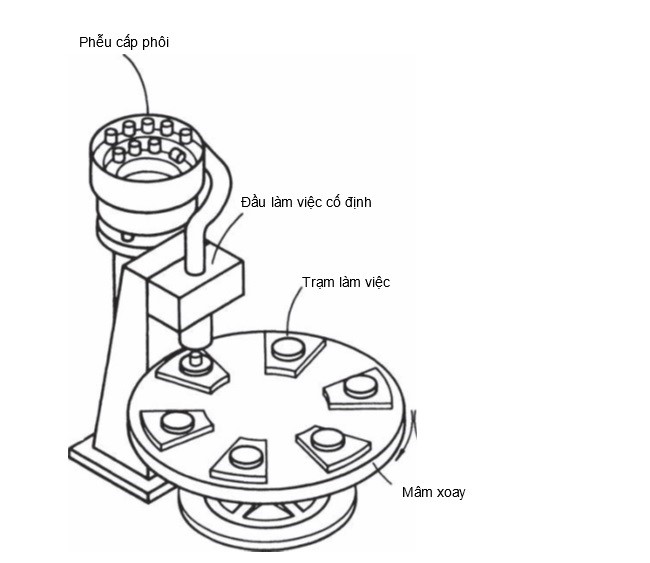
An indexing rotary table automatic assembly machine uses a rotary table divided into multiple product-holding positions. Each position corresponds to a specific workstation or assembly operation.
During operation, the rotary table sequentially moves products to the working heads arranged around it. After each indexing movement, the table stops so that the mechanisms can perform their operations according to the control program. Once all operations at the corresponding position are completed, the rotary table moves to the next indexing position.
With this configuration, the product assembly process is completed after one full rotation of the rotary table. At the final station, the finished product is removed from the machine, while the empty fixture position is prepared to receive the next product.
The main advantage of a rotary table system is that all workstations are arranged within a relatively compact space. Assembly heads can be positioned around the rotary table, reducing product transfer distances and facilitating the synchronization of operations.
However, the number of stations and the dimensions of the rotary table must be carefully calculated based on product size, operation time, and installation space. In addition, the indexing and positioning mechanisms must ensure sufficient accuracy so that products remain correctly positioned during each assembly operation.
3.2. Intermittent in-line transfer system
An in-line transfer system arranges assembly stations along one or more linear conveying paths. Product fixtures are sequentially transported through each station to complete the manufacturing process.
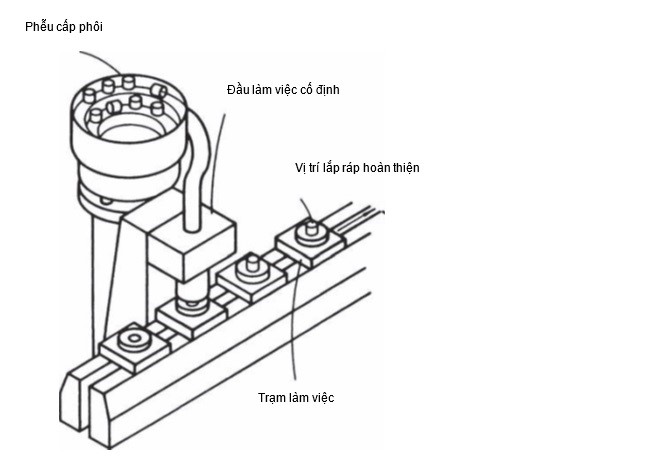
Typically, the length of each fixture is designed according to the standard transfer pitch of the system. At the beginning of each cycle, the transfer mechanism pushes or pulls the fixtures forward by a predetermined distance. Once they reach their working positions, each fixture is secured to ensure stability during the assembly process.
After the operations at one station are completed, the system moves the fixtures to the next station. At the end of the production line, the finished products are removed, and the empty fixtures are returned to the beginning of the line to continue the production cycle.
To optimize the transfer process, in-line assembly machines are often equipped with an empty pallet return system. Depending on the installation space and machine configuration, pallets can be returned either vertically or horizontally.
3.2.1. Vertical-plane fixture return system
In this configuration, after the product is removed at the end of the production line, the empty fixture is transferred downward to a lower conveying level. A conveyor system or drive mechanism then transports the fixture back to the beginning of the line along a separate return path.
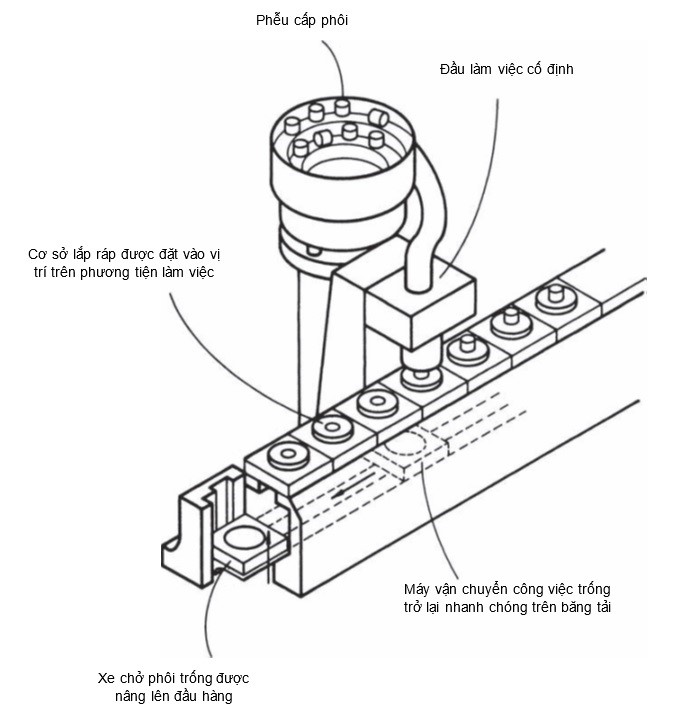
This configuration makes efficient use of vertical space, reducing the need to expand the floor area. At the same time, the product transfer path and fixture return path are clearly separated, helping maintain a continuous material flow between workstations.
However, the design must account for the lifting and lowering stroke, transfer mechanisms, and synchronization between the two conveying paths. Transfer points must also be designed to prevent collisions or misalignment as the fixtures move.
3.2.2. Horizontal-plane fixture return system
In this configuration, after completing its travel along the assembly line, the empty fixture is transferred to a separate return conveyor located on the same horizontal plane. The fixture then moves in the opposite direction to return to the original loading position.
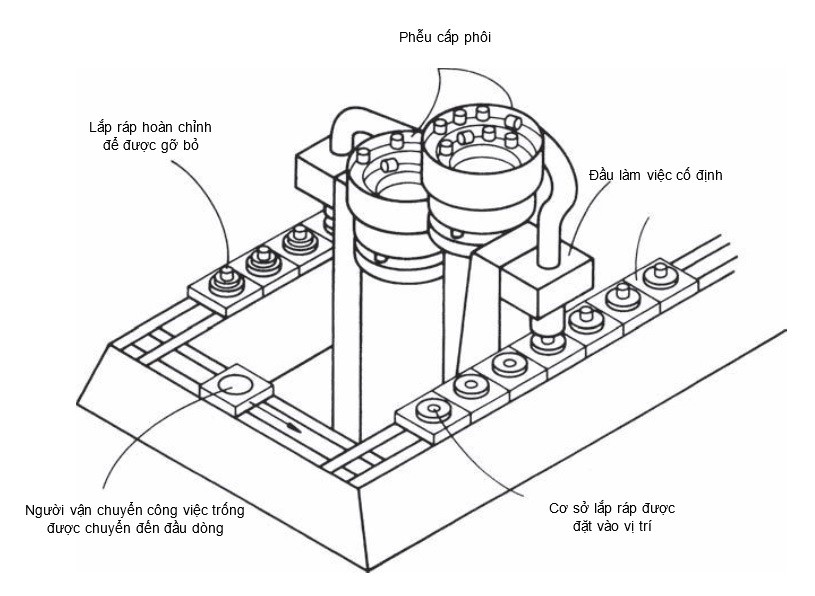
The main advantage of this configuration is that the transfer between the assembly line and the fixture return path is relatively simple. Assembly heads and conveying equipment can also be conveniently arranged at predefined working positions.
However, this system generally requires more floor space than the vertical-plane fixture return configuration. In addition, the conveying paths must be arranged to avoid interfering with the operator's working space and access to machine stations.
3.3. Accuracy and positioning requirements for product fixtures
In in-line transfer systems, the accuracy of the fixtures and positioning mechanisms directly affects assembly quality. Fixtures must be manufactured to precise dimensions to ensure stable product holding and maintain the relative positioning between workstations.
If dimensional tolerances of individual fixtures are not properly controlled, deviations may accumulate along the production line. For example, if each fixture has a dimensional deviation of 0.025 mm and the system consists of 20 stations, the theoretical cumulative deviation could reach 0.5 mm if all errors occur in the same direction. This level of deviation may cause difficulties for working heads, particularly in operations requiring high precision.
To minimize this issue, transfer systems are often equipped with end-of-travel positioning mechanisms. After a fixture is transported to a workstation, a locating pin or positioning piston brings it into the correct reference position and locks it in place before the operation begins.
As a result, errors generated during transportation have less influence on the actual working position, helping maintain the accuracy and stability of the entire production line.
4. Automatic transfer systems combined with operator involvement
In addition to systems operating according to fixed cycles, automatic assembly machines can also use transfer configurations that involve operator participation. In these systems, the timing of movement between stations may depend on signals confirming task completion rather than being triggered according to a fixed time cycle.
This is the basis of free transfer or asynchronous transfer systems (Free Transfer / Asynchronous Transfer).
4.1. Operating principle of free transfer systems
In a free transfer system, each workstation can independently complete its operation and release the fixture. Once the assembly operation is finished, the fixture is transferred to the next station via a conveyor or transfer mechanism, provided that the receiving position is vacant and ready for operation.
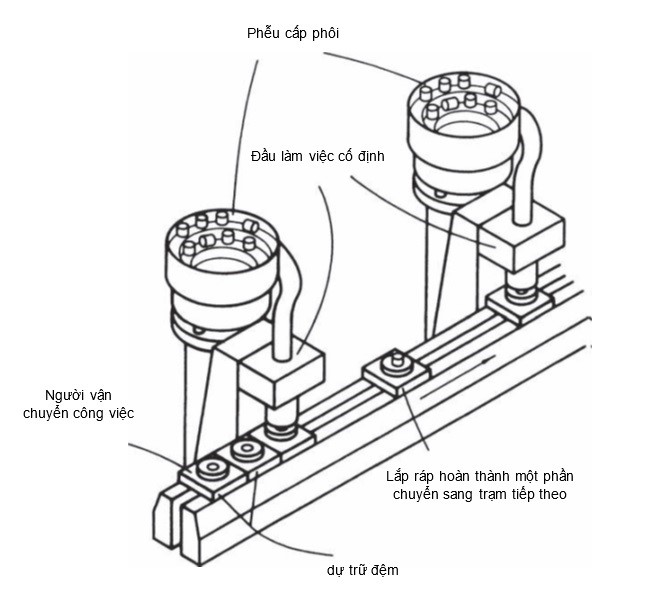
Unlike synchronized systems, fixtures do not necessarily have to move simultaneously according to the same cycle. Each workstation can operate at a different pace depending on the operation time and the readiness status of each position.
Operators can participate in certain operations, such as loading components, inspection, part assembly, or unloading finished products. The control system coordinates the status of the workstations to ensure that fixtures are transferred only when operating conditions allow.
4.2. Characteristics and benefits of asynchronous transfer systems
One notable characteristic of free transfer systems is their ability to minimize the impact of a malfunction at one workstation on the rest of the production line. If a station requires additional processing time or temporarily stops operating, other stations can continue working within the limits permitted by the system and the availability of intermediate storage positions.
This helps reduce situations in which the entire production line must stop immediately when an individual operation encounters a problem. At the same time, the system can better accommodate processes with different operation times or those requiring direct operator involvement.
However, to achieve effective operation, the machine must be equipped with buffer spaces between workstations, suitable control mechanisms, and a sensor system for monitoring fixture status. The design must also account for potential congestion at intermediate positions when a downstream station is not yet ready to receive the product.
5. Criteria for selecting a transfer system for automatic assembly machines
Each transfer configuration has its own structure, operating principle, and range of applications. Therefore, selecting a suitable system requires consideration of product characteristics, process requirements, and actual operating conditions.
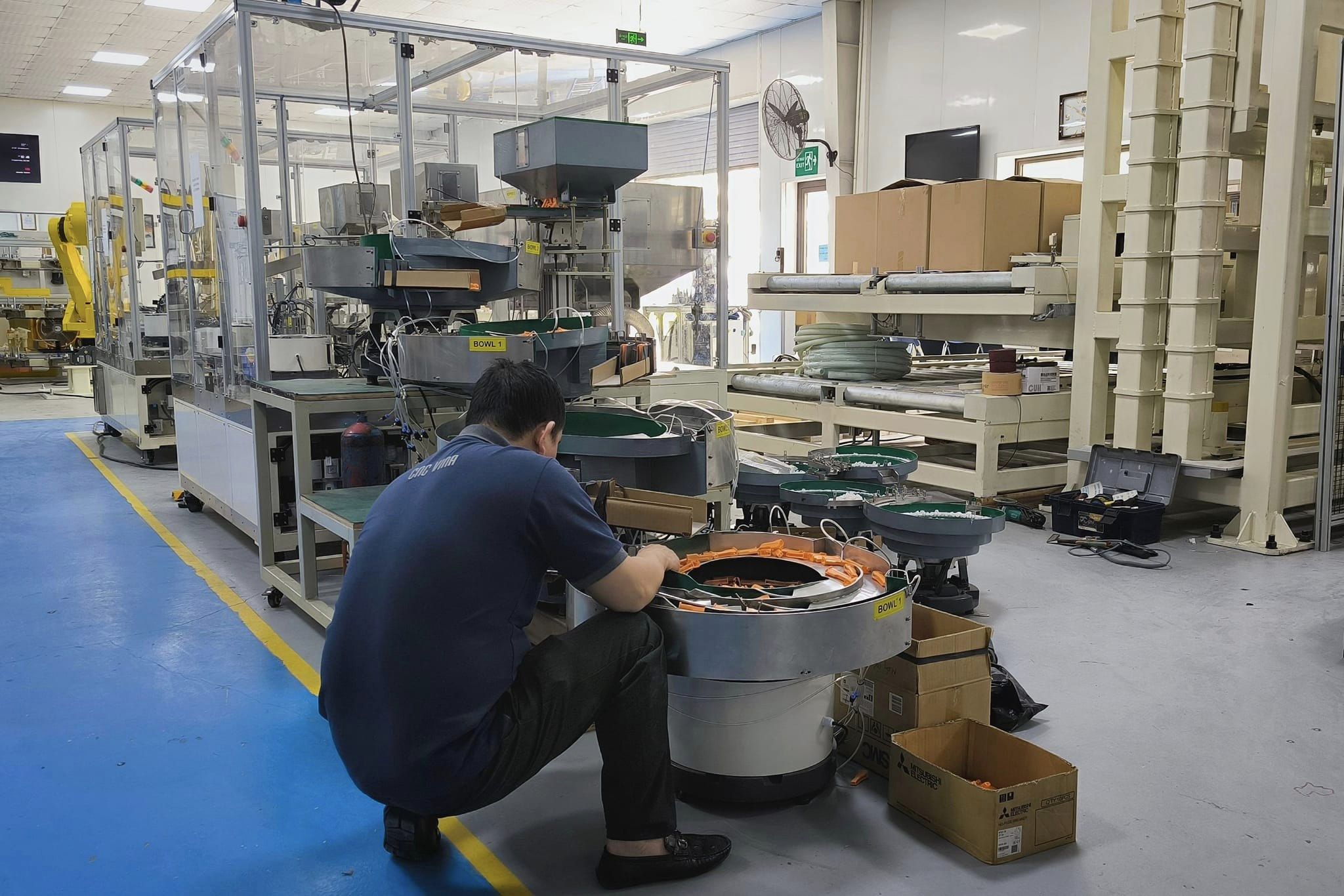
Some important factors to consider include:
-
Product characteristics: Product dimensions, weight, shape, and positioning requirements directly affect the design of fixtures and transfer mechanisms.
-
Production capacity requirements: Production lines with high output and short cycle times may benefit from continuous transfer systems or indexing rotary tables, depending on the characteristics of each operation.
-
Assembly accuracy: Press-fitting, component assembly, and positioning operations that require high precision need mechanisms to accurately locate and lock fixtures at each workstation.
-
Operation time at each station: If operation times vary significantly between workstations, an asynchronous transfer system may be a suitable option.
-
Installation space: Floor area, equipment height, and fixture return configurations should be considered when selecting an in-line or rotary table layout.
-
Expandability and maintenance: The machine structure should facilitate product changeovers, workstation repositioning, and maintenance of transfer mechanisms.
Evaluating these factors together helps businesses select an appropriate machine configuration, avoiding unnecessary design complexity or solutions that fail to meet production requirements.
Selecting a suitable transfer system for an automatic assembly machine is one of the key considerations in machine design. Depending on product characteristics, the number of assembly operations, and production capacity requirements, businesses can choose from indexing rotary table systems, linear transfer systems, pallet return mechanisms, or free transfer systems combined with operator involvement. CNC VINA provides custom design and manufacturing of automatic assembly machines based on the actual requirements of each business. The design approach is determined by considering product structure, assembly sequence, positioning methods, operation time, and equipment layout. During implementation, the transfer system is designed in coordination with fixtures, positioning mechanisms, working heads, and the control system. This ensures that products are transferred to the correct positions, remain stable throughout the process, and meet the requirements of each assembly operation. With a focus on developing solutions tailored to individual production processes, CNC VINA aims to deliver practical machine systems that offer stable operation and ease of use. Businesses can contact CNC VINA to discuss product characteristics, assembly requirements, and suitable automatic machine design solutions for their production needs.