 Tiếng
Việt
 Tiếng
Anh
 Tiếng
Nhật



 Tiếng Anh

What is an assist lifter? Applications in industrial manufacturing

Industrial assist lifters are widely used in factories to support the handling of heavy loads in assembly, material feeding, and product handling operations. When handling heavy materials, performing repetitive lifting tasks, or working in confined spaces, manual handling not only increases physical strain but also poses potential risks of workplace injuries. These systems combine a mechanical support structure with a control system to help operators lift, lower, rotate, and position loads more easily. Depending on the required load capacity and production conditions, businesses can choose pneumatic, hydraulic, or electric assist lifters with suitable installation configurations.
What types of industrial assist lifters are available, and what factors should be considered when selecting the right equipment? Let's explore the details with CNC VINA in this article.
1. What is an industrial assist lifter?
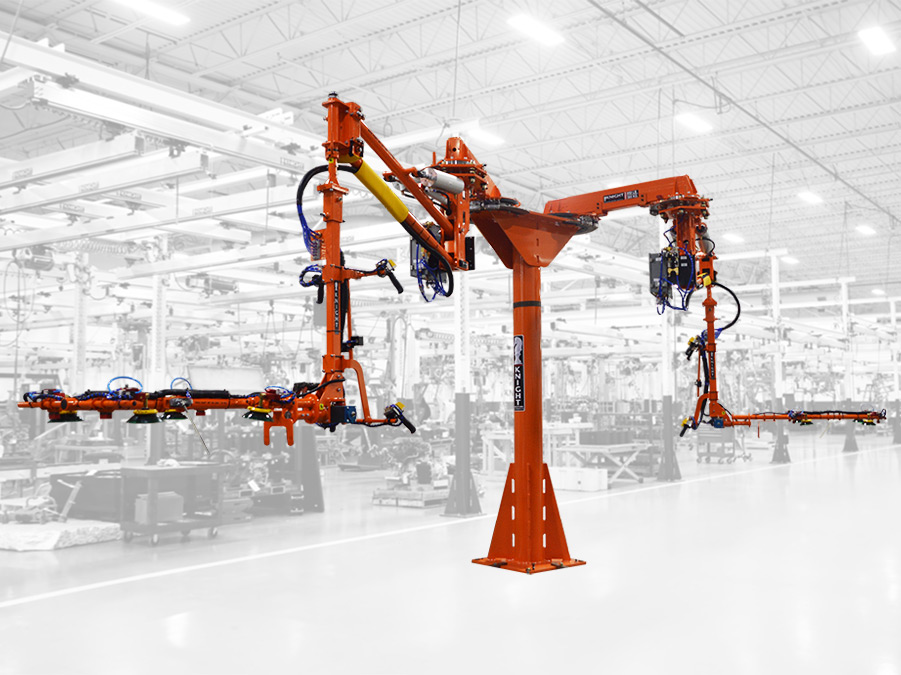
An industrial assist lifter is a material handling device designed to assist with lifting, lowering, moving, and positioning heavy loads in factories. It reduces manual effort and helps minimize the risk of operator injuries. The equipment typically consists of an articulated arm connected to a lifting mechanism and a control system. It uses pneumatic, hydraulic, or electric power to support lifting operations. Depending on its design, the assist lifter can perform lifting and lowering, rotation, tilting, and load positioning.
In industrial production, these systems are commonly used for material feeding, assembly, loading and unloading, and transferring products between workstations. Operators control the equipment directly through a handle or dedicated control unit, making it easier to handle heavy loads with greater convenience and precision.
1.1. Operating principle of an industrial assist lifter
An industrial assist lifter operates through the combination of an articulated arm mechanism, a lifting force system, and a load gripping or holding device. When the operator activates the controls, the system generates an assisting force to lift, lower, or move the workpiece along a predefined path. In pneumatic systems, compressed air pressure is converted into lifting force through a cylinder or load-balancing mechanism. In hydraulic systems, the lifting force is generated by oil pressure within the hydraulic circuit. Electric assist lifters, meanwhile, use motors and transmission mechanisms to control movement. Some assist lifters are designed with a load-balancing mechanism, allowing operators to adjust the position of a workpiece with minimal physical effort, without having to lift the entire weight of the product manually.
1.2. When should industrial assist lifters be used?
Industrial assist lifters are suitable for operations where manually lifting and moving materials requires significant physical effort, takes too much time, or poses potential safety risks. These systems are commonly used in the following situations:
- Heavy loads: Products exceed the safe lifting and handling capacity of a single operator.
- Difficult-to-reach positions: Products need to be placed on high shelves, loaded into machines, or positioned at assembly stations with limited working space.
- Repetitive operations: Operators must repeatedly lift, lower, and move multiple products throughout a work shift.
- Products with complex shapes: Loads need to be securely held, rotated, or repositioned at different angles during handling.
- Improved workplace safety: The equipment helps reduce the risk of musculoskeletal injuries caused by lifting heavy loads or maintaining improper working postures.
Industrial assist lifters are particularly beneficial in factories with high production volumes and multiple material feeding and assembly operations involving heavy loads.
2. Key criteria for selecting an industrial assist lifter
Selecting an industrial assist lifter requires careful consideration of the workpiece characteristics, load capacity, movement range, and actual installation conditions. Even if a piece of equipment has a suitable lifting capacity, an insufficient reach or an incompatible gripping mechanism can still make operation difficult and reduce handling efficiency.
2.1. Weight and lifting capacity
Lifting capacity is the first and most important specification to consider when selecting an industrial assist lifter. Businesses need to identify the maximum weight of the products to be handled and compare it with the equipment's rated working load. Industrial assist lifters are available in various load capacities, ranging from several tens of kilograms to hundreds of kilograms or more, depending on their structural design and configuration. In addition to the product weight, the weight of gripping devices, suction pads, and other attached accessories must also be taken into account. The selected lifting capacity must comply with the manufacturer's specifications and meet the applicable operational safety requirements.
2.2. Product dimensions and shape
The dimensions and shape of a workpiece directly affect the design of the gripping mechanism and the lifting method. Products with flat, cylindrical, block-shaped, or irregular surfaces require different load-handling solutions. For oversized products or workpieces with an off-center center of gravity, the lifting point and the ability to maintain load balance throughout the movement must be carefully considered.
2.3. Movement path and range of motion
Businesses need to determine the operations required from the equipment, such as vertical lifting and lowering, rotation around an axis, tilting, or turning over the workpiece. The transfer distance between the pickup and placement positions must also be defined. Parameters such as lifting height, reach, and working radius determine the arm structure and equipment installation position.
2.4. Working radius
The working radius refers to the area within which an assist lifter can reach to perform lifting and load handling operations. This parameter depends on the arm length, joint configuration, and equipment installation position. If the working range is too limited, the equipment may not be able to reach the required handling positions. Conversely, a longer reach generally requires an appropriate structural design to maintain stability and load-bearing capacity. Businesses should identify the pickup position, placement position, and available operating space in advance to select a suitable working radius.
2.5. Power source
The power source determines the lifting force, response speed, and control method of an assist lifter. Common options include pneumatic, hydraulic, electric, and manual operating mechanisms. The selection should be based on the required load capacity, operating frequency, positioning accuracy, and environmental conditions within the factory.
2.6. Gripping and workpiece handling mechanisms
The gripping mechanism must be compatible with the workpiece to ensure secure load retention throughout the lifting and handling process. Depending on the product characteristics, the following options may be considered:
- Vacuum suction cups: Suitable for products with relatively flat, non-porous surfaces that meet the requirements for vacuum gripping.
- Vacuum lifting systems: Use vacuum technology to handle products with suitable dimensions and shapes.
- Lifting hooks: Suitable for workpieces equipped with designated lifting points or suspension features.
- Mechanical clamps: Secure products through a mechanical clamping mechanism and can accommodate various shapes and structures.
- Magnetic lifters: Designed for handling materials with suitable magnetic properties.
- Dedicated fixtures or containers: Support the lifting and movement of products according to their specific dimensions and structural design.
The selection of a gripping mechanism must take into account the product weight, material, contact surface, and applicable safety requirements.
3. Which power source should you choose for an industrial assist lifter?
Each power source has its own operating characteristics and application range. Businesses should select the appropriate option based on actual production requirements rather than relying solely on lifting capacity.
3.1. Pneumatic assist lifters
Pneumatic assist lifters use compressed air pressure to generate lifting force and support load balancing. This solution is commonly used in factories equipped with existing compressed air systems, particularly in operations involving repetitive lifting, lowering, and material handling. The main advantages include a relatively compact structure, fast response, and the ability to accommodate various load capacities through different design configurations. In potentially explosive environments, pneumatic equipment may be a suitable option when specifically designed to meet the relevant safety requirements. However, operating performance depends on the air supply quality, supply pressure, and system configuration. Businesses should assess the available compressed air supply before implementation.
3.2. Hydraulic assist lifters
Hydraulic assist lifters use a hydraulic system to generate lifting force through oil pressure. This solution is suitable for applications requiring high lifting force and the handling of heavy loads. Hydraulic systems can generate substantial force. However, businesses need to consider the piping layout, hydraulic power unit, maintenance requirements, and potential oil leakage risks. The equipment's operating speed and positioning accuracy depend on the hydraulic circuit design and control system.
3.3. Electric assist lifters
Electric assist lifters typically integrate motors and transmission mechanisms to control lifting, lowering, and load positioning movements. Their main advantages include controlled movement, adjustable operating speed, and relatively precise positioning, depending on the design configuration. These systems are suitable for applications requiring stable operation and flexible control. In potentially explosive environments, electrical equipment must meet the applicable certification and protection requirements. Not all electric equipment is automatically suitable for use in ATEX environments.
3.4. Manual assist lifters
Manual assist lifters use mechanical mechanisms to support load lifting and movement without requiring an external power source. Their relatively simple structure makes them convenient for certain applications requiring flexible positioning and a moderate operating frequency. However, operating speed and load-handling capability depend more heavily on operator strength and the design of the mechanical assistance mechanism.
4. Classification of industrial assist lifters by installation structure
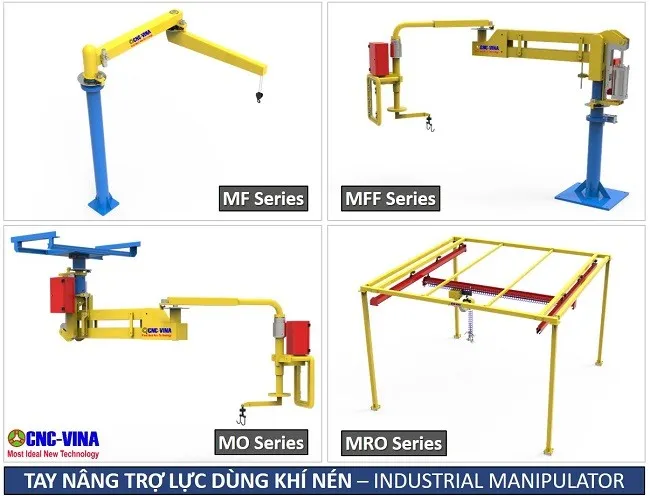
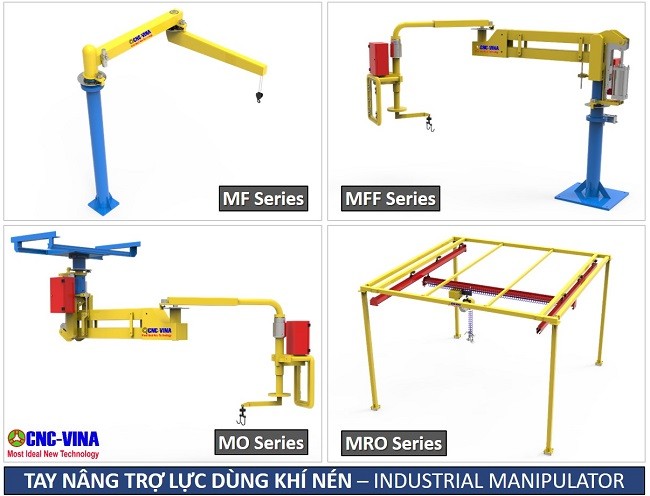
In addition to their power sources, industrial assist lifters can also be classified according to their structural design and installation method. The three common types are fixed-column assist lifters, fixed-suspended assist lifters, and overhead rail-mounted assist lifters.
4.1. Fixed-column assist lifters
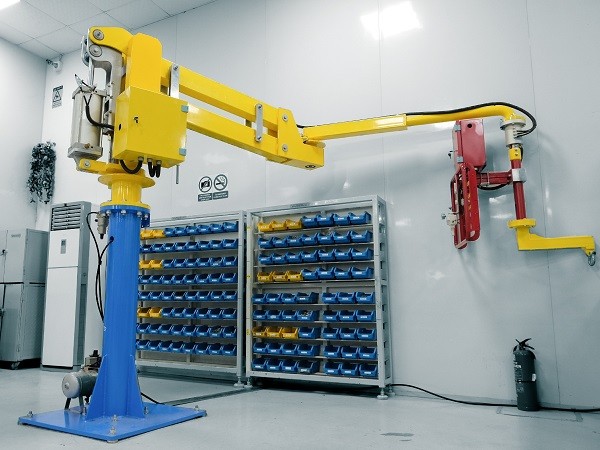
Fixed-column assist lifters are installed on a stationary support column, which is typically anchored to the factory floor using bolts or a suitable foundation structure. The operating range is determined by the arm length and structural design. This configuration is suitable for fixed workstations where products need to be lifted and moved within a designated area. Its main advantages include an independent structure, easy installation at individual production stations, and no dependence on the factory ceiling structure. However, it occupies floor space and cannot be relocated without modifying the installation.
4.2. Fixed-suspended assist lifters
Fixed-suspended assist lifters are installed on the ceiling structure or load-bearing beams above the working area. This configuration frees up floor space, making it suitable for factories with limited operating space or those requiring multiple lifting devices within the same area. However, the ceiling structure and mounting points must be capable of supporting the total system load, including the equipment, accessories, and lifted workpiece. The operating range is also limited by the installation position.
4.3. Overhead rail-mounted assist lifters
Overhead rail-mounted assist lifters are integrated with a trolley system that travels along an overhead track. This allows the equipment to reach multiple workstations within the track's operating range. This solution is suitable for production lines with multiple workstations or applications requiring products to be transferred between adjacent areas. Compared with fixed-column and fixed-suspended configurations, an overhead rail system provides a wider movement range but requires coordinated design of the supporting structure, track layout, and equipment integration.
5. Industrial assist lifter solutions designed and manufactured by CNC VINA
In industrial production, selecting an assist lifter must be based on the workpiece characteristics, load capacity, and actual operating process. A suitable system must not only meet lifting requirements but also provide sufficient reach, operational stability, and compatibility with the factory layout. CNC VINA specializes in machinery design and manufacturing, as well as the application of automation technologies in industrial production. With the capability to research and manufacture equipment according to specific requirements, CNC VINA focuses on developing solutions that support lifting, handling, and product transportation across different production operations.
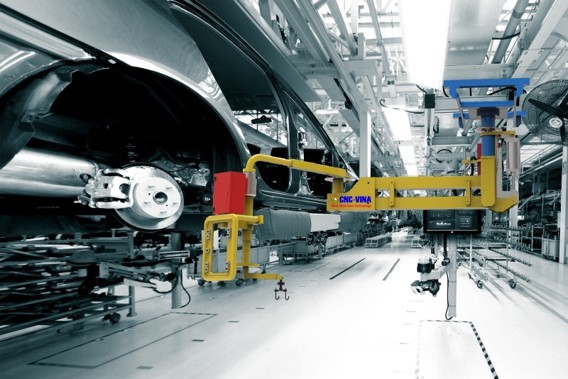
5.1. 100 kg fixed-column assist lifter
CNC VINA has designed and manufactured a fixed-column assist lifter with a lifting capacity of 100 kg. The equipment is installed on a stationary support column, helping operators lift and move products within its designed working range. This solution is suitable for operations involving frequent handling of heavy objects, helping reduce manual effort and support more controlled lifting and lowering operations.
5.2. Overhead rail-mounted assist lifter
In addition to the fixed-column configuration, CNC VINA also has product images of an assist lifter mounted on an overhead rail system. This configuration allows the equipment to travel along the track, expanding its reach across multiple operating positions within the factory. Depending on production requirements, the system can be designed with consideration for load capacity, track length, movement range, and workpiece gripping mechanisms.
5.3. Custom equipment design capabilities
When developing an industrial assist lifter solution, CNC VINA considers the actual application requirements, including product weight, dimensions, pickup and placement positions, reach, operating frequency, and available installation space. Based on these factors, the equipment is selected or designed with a suitable arm structure, power source, and gripping mechanism. Coordinated engineering calculations from the initial design stage help prevent situations where the equipment cannot reach the required operating positions or creates difficulties when integrated into an existing production line. Businesses can contact CNC VINA to discuss their technical requirements and receive consultation on suitable assist lifter design and manufacturing solutions for their production processes.
6. Should you choose an assist lifter or an industrial robot?
Both assist lifters and industrial robots are used to support the lifting, movement, and handling of products in factories. However, they differ in operating principles and levels of automation. An assist lifter is operated directly by a worker. It provides lifting assistance, allowing operators to lift, lower, rotate, and position workpieces more easily. This solution is suitable for businesses looking to reduce physical labor while maintaining direct worker involvement in handling operations. Industrial robots, on the other hand, can perform movements according to predefined control programs. They are suitable for operations with stable handling sequences, high automation requirements, and repetitive production cycles.
The two solutions can be compared based on the following criteria:
| Criteria | Assist lifter | Industrial robot |
|---|---|---|
| Operating method | Direct control by an operator | Program-controlled operation |
| Automation level | Assists manual operations | Can automate entire operating cycles |
| Programming | Generally does not require complex motion programming | Requires control program configuration |
| Handling flexibility | Flexible, based on operator input | Follows predefined paths and programs |
| Investment cost | Generally lower for simple lifting assistance applications | Depends on configuration, equipment, and integration level |
| Applications | Lifting, lowering, rotating, and moving heavy loads | Automated picking, placing, assembly, and material handling |
Assist lifters are suitable when the primary objective is to reduce physical effort, help workers handle heavy objects, and optimize investment costs. Industrial robots are more appropriate when businesses need to automate production cycles, reduce direct human intervention, and maintain programmed operating sequences. The selection should be based on automation objectives, production volume, product characteristics, and the factory's investment capacity.
7. Frequently asked questions about industrial assist lifters
How much weight can an industrial assist lifter handle?
The lifting capacity of an industrial assist lifter depends on its design and configuration. Available models can handle loads ranging from several tens of kilograms to hundreds of kilograms or more. Businesses should select equipment based on product weight, gripping accessory weight, and the rated load limits specified by the manufacturer.
What is the difference between pneumatic and hydraulic assist lifters?
Pneumatic assist lifters use compressed air pressure to generate assisting force. They generally feature a compact structure and fast response. Hydraulic assist lifters use oil pressure and are suitable for applications requiring greater lifting force. The selection depends on load capacity, operating requirements, and the factory's existing infrastructure.
Should you choose a fixed-column or suspended assist lifter?
Fixed-column assist lifters are suitable for stationary workstations with floors or foundations that meet installation requirements. Suspended assist lifters are suitable when floor space needs to be freed up and the overhead structure has sufficient load-bearing capacity. If equipment needs to move between multiple workstations, an overhead rail-mounted configuration can also be considered.
Can assist lifters completely replace industrial robots?
No. Assist lifters primarily help operators lift and move workpieces, whereas industrial robots can perform automated operating cycles according to predefined programs. These two types of equipment serve different levels of automation and can be selected according to production requirements.
Does CNC VINA provide custom-designed assist lifters?
CNC VINA specializes in machinery design and manufacturing, as well as industrial automation. Businesses can discuss their requirements with CNC VINA regarding load capacity, operating range, installation structure, and equipment design solutions tailored to their production processes.
Industrial assist lifters provide an effective solution for lifting and moving heavy loads, helping reduce manual effort and improve working conditions in factories. Equipment selection should be based on load capacity, product dimensions, working radius, power source, and gripping mechanism. In addition, column-mounted, suspended, or overhead rail-mounted configurations must be evaluated according to the factory layout and actual operating processes. Compared with industrial robots, assist lifters are more suitable for operations requiring direct collaboration between workers and equipment. With experience in machinery design, manufacturing, and the application of automation technologies, CNC VINA provides custom equipment design and manufacturing solutions tailored to production requirements. Contact CNC VINA for consultation on suitable assist lifter solutions to optimize lifting operations and improve factory efficiency.
CNC VIETNAM TECHNOLOGY APPLICATION AND CNC JOINT STOCK COMPANY
Factory: Song Cung Industrial Cluster, Dong Thap Commune, Dan Phuong District, Hanoi, Vietnam.
Office: Rox Tower (Rox Center Goldmark City), 136 Ho Tung Mau Street, Phu Dien Ward, Hanoi, Vietnam.
Phone: +84 916 639 355 / +84 915 744 664