 Tiếng
Việt
Tiếng
Việt
 Tiếng
Anh
Tiếng
Anh
 Tiếng
Nhật
Tiếng
Nhật




 Tiếng Anh

Structure and applications of automatic adhesive dispensing machines in electronics manufacturing

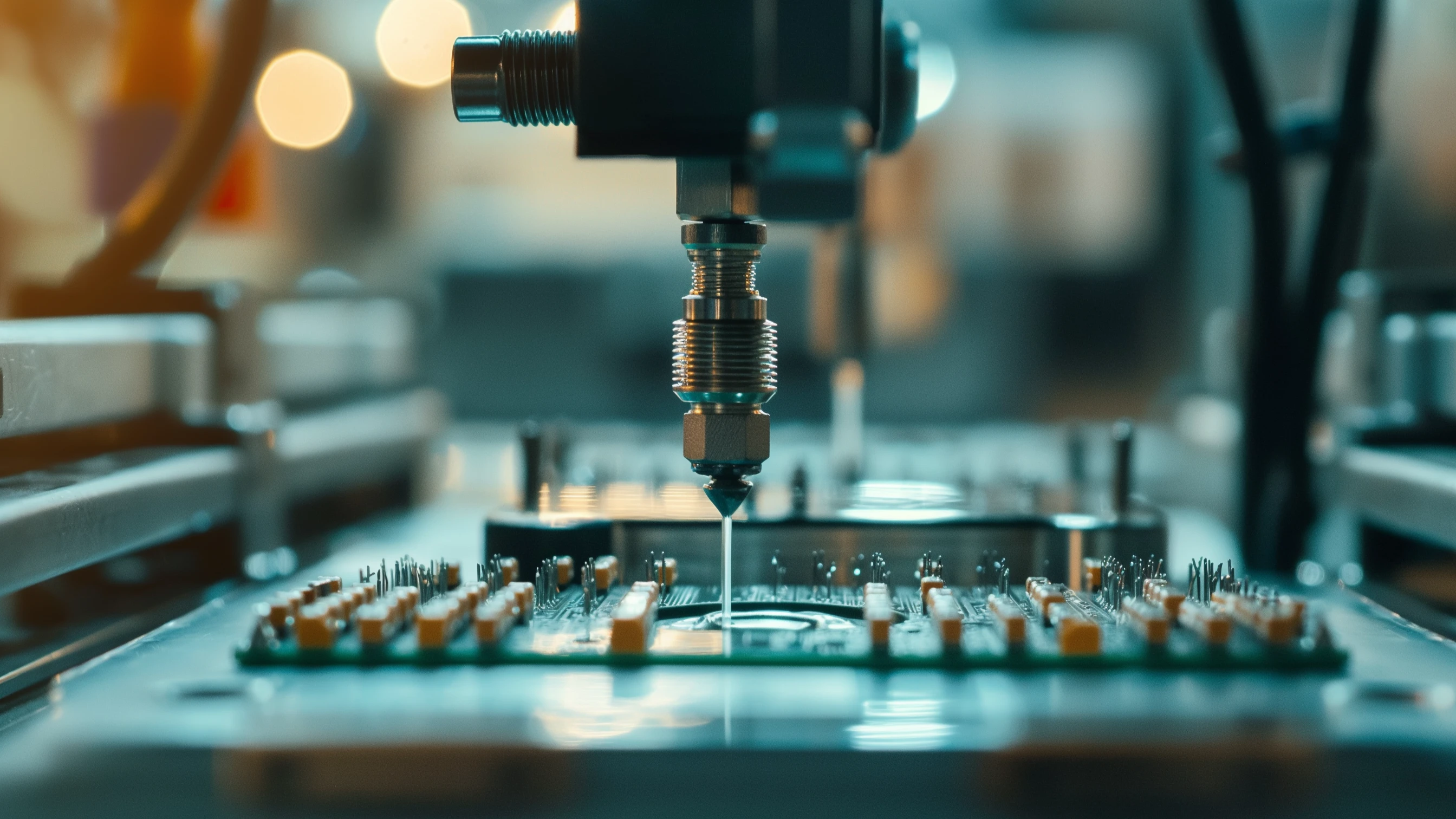
Automatic adhesive dispensing machine is a solution that helps manufacturers automate adhesive application in electronics production and component assembly. When products require adhesive at multiple locations or along precisely defined paths, manual application may struggle to maintain consistent positioning and dispensing volume. Selecting the right equipment requires consideration of the adhesive type, product geometry, technical requirements, and target production volume. In addition to the dispensing system, manufacturers should evaluate the motion mechanism, positioning method, and integration capabilities with the production line. Join CNC VINA to explore the structure, operating principles, and key selection criteria for an automatic adhesive dispensing machine that meets your production requirements.
What is an automatic adhesive dispensing machine?
An automatic adhesive dispensing machine is equipment that uses a control system and an adhesive delivery mechanism to dispense a specified amount of adhesive at designated positions on a product. In electronics manufacturing, it is used to apply, coat, or meter adhesive materials onto printed circuit boards (PCBs), electronic components, and assemblies that require bonding or fixation. Depending on its configuration, the machine can operate according to a pre-programmed sequence or integrate with workpiece feeding systems, fixtures, and other automated equipment. Using an automatic adhesive dispensing machine helps manufacturers improve control over adhesive volume, application position, and repeatability between products. It is particularly suitable for processes requiring high precision or involving numerous repetitive dispensing operations. However, actual performance depends on the adhesive properties, product geometry, technical requirements, and selected machine configuration.
1. Structure of an automatic adhesive dispensing machine
Automatic adhesive dispensing machines can be designed in various configurations. In systems using an XYZ-axis motion platform, the main components typically include a controller, a dispensing system, an adhesive dispensing valve, a motion assembly, and product fixtures.

1.1. Adhesive metering system
The metering system controls the amount of adhesive dispensed during each application cycle. Depending on the viscosity, material properties, and product requirements, the machine may use time-based or pressure-based metering, or dedicated volumetric dispensing mechanisms. For low-viscosity adhesives, pressure-and-time control may be suitable for certain simple applications. For high-viscosity materials or applications requiring more consistent dispensing volumes, businesses should consider a metering mechanism suited to the material and process requirements.
When selecting a metering system, it is important to check its ability to adjust the dispensing volume, maintain consistency between cycles, and ensure compatibility with the adhesive being used. Machine speed alone should not be used as the sole criterion for evaluating metering performance.
1.2. Adhesive dispensing valve and dispensing nozzle
The dispensing valve controls the opening and closing of the adhesive flow from the supply system to the dispensing nozzle. The nozzle delivers the material directly to the target application area. Therefore, its shape and shut-off mechanism affect the adhesive bead width, as well as the starting and ending points of the application path. Depending on the application, the machine may use needle tips, spray nozzles, or specialized dispensing tips. Selection should be based on adhesive viscosity, material properties, required bead dimensions, and the spacing between components. If the valve does not open and close consistently, the adhesive may drip, form strings, or continue flowing excessively after the cycle ends. The valve and dispensing tip should therefore be selected to work in conjunction with the metering system while allowing convenient cleaning and replacement.
1.3. XYZ-axis motion platform
The XYZ-axis motion platform enables the dispensing nozzle or workpiece to move according to programmed coordinates. Depending on the machine configuration, the three axes allow the system to dispense straight lines, follow contours, apply adhesive at designated points, or execute more complex paths. In PCB adhesive dispensing applications, an XYZ-axis platform can guide the nozzle to specified locations on the circuit board. For products with different shapes or dimensions, separate programs can be configured for each product model if the controller supports program storage and recall. Actual positioning accuracy depends on the drive mechanism, structural rigidity, workpiece positioning method, and calibration capability. Businesses should therefore evaluate the machine using actual product samples rather than relying solely on travel-range or movement-speed specifications.
1.4. Controller and positioning fixture
The controller manages motion programs, adhesive dispensing sequences, and operating parameters. Depending on the configuration, the machine may incorporate a human-machine interface (HMI) that allows operators to configure programs, select product models, and monitor operating status. The fixture holds the workpiece securely throughout the dispensing process. For small circuit boards or electronic components, accurate positioning helps minimize positional deviations and prevents adhesive from contacting areas where application is not permitted.
For more advanced automation, the system can be designed to integrate with workpiece feeding mechanisms, product-detection sensors, or post-dispensing inspection equipment. These integration requirements should be determined according to the actual needs of the production line.
2. Applications of automatic adhesive dispensing machines in electronics manufacturing
Automatic adhesive dispensing machines are used in various production processes where the application position and quantity of adhesive must be controlled. The dispensing head arrangement, adhesive type, and operating program should be selected according to the requirements of each product.
2.1. Adhesive dispensing on PCBs
In PCB manufacturing and electronics assembly, adhesives may be used to secure components, maintain component positioning, or provide bonding in accordance with product design requirements. An adhesive dispensing machine applies material to designated points or along programmed paths. For circuit boards with multiple dispensing locations, programmable equipment helps reduce manual operations and improve repeatability between products. However, the adhesive type, permitted application areas, and compatibility requirements for subsequent production processes must be clearly defined before selecting the machine configuration.
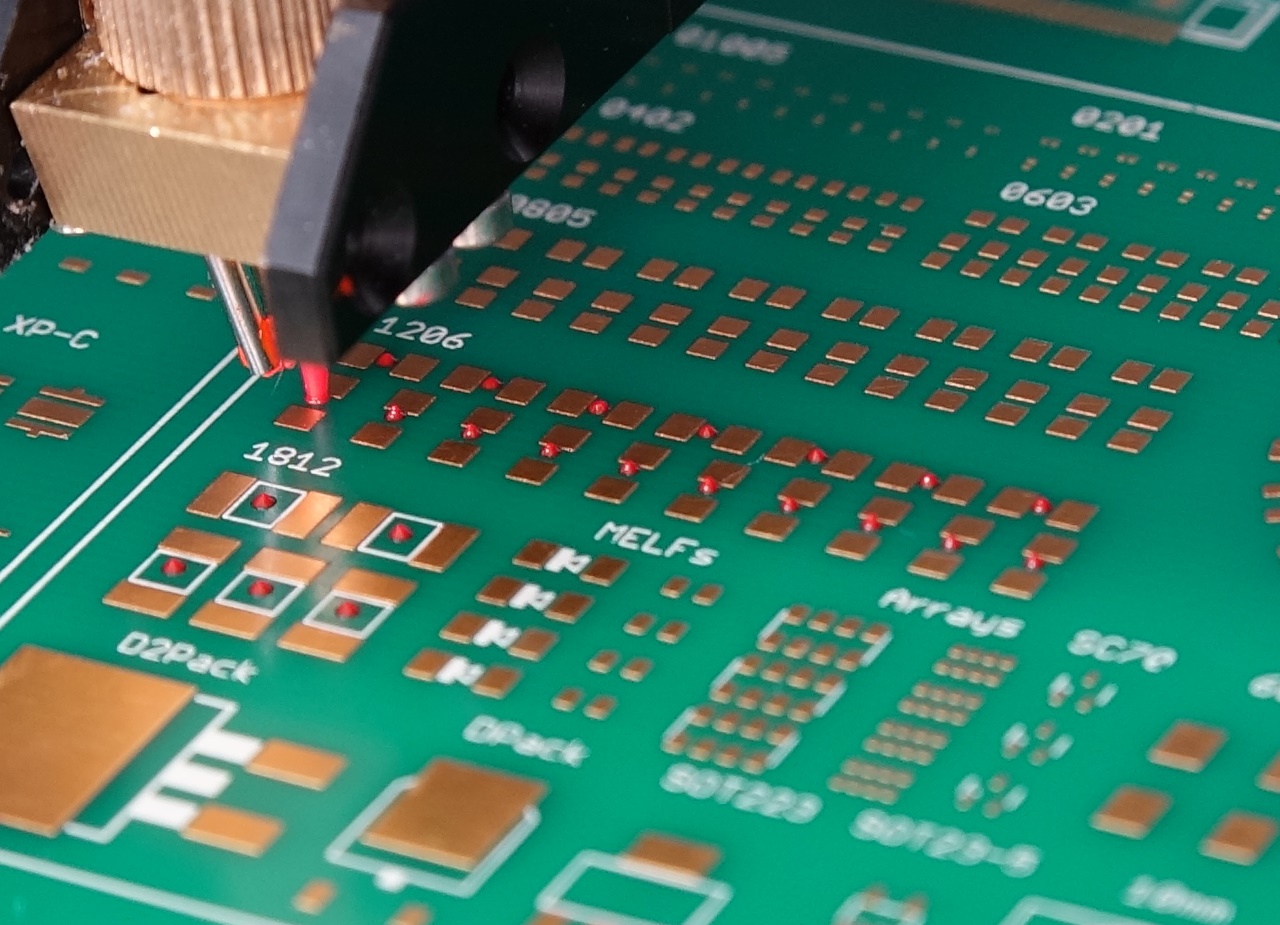
2.2. Adhesive application for securing components and assemblies
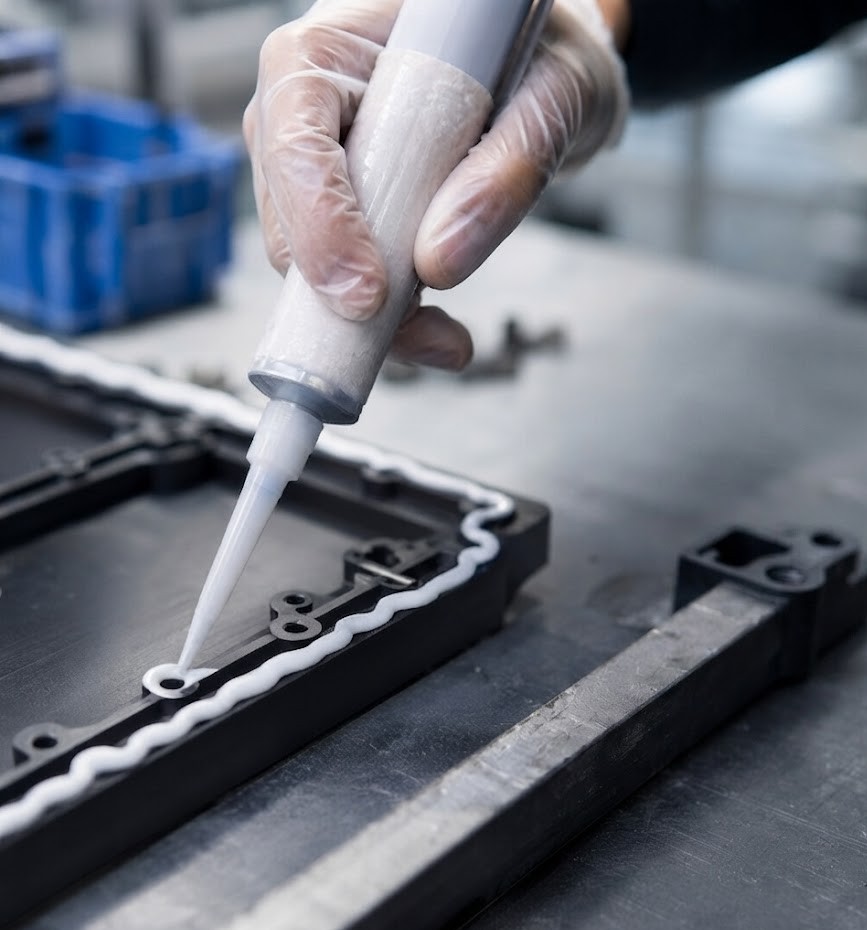
Some electronic component assemblies require adhesive bonding to prevent movement during assembly or use. The machine can dispense individual adhesive dots or apply beads along programmed contours. For these applications, businesses need to control the dispensing volume, application position, and cycle time. Too little adhesive may result in insufficient bonding strength, while excessive adhesive may overflow into adjacent areas or interfere with subsequent assembly operations.
2.3. Programmed adhesive dispensing for multiple product models
Manufacturers producing multiple component models can use programmable adhesive dispensing machines to manage different dispensing paths. When switching products, the operator selects the corresponding program and replaces the fixture or dispensing tip if necessary. Changeover speed depends on the control software, positioning method, and degree of variation between products. For product models with different technical requirements, the program must be verified and a first-piece inspection completed before mass production begins.
3. Benefits of using automatic adhesive dispensing machines
Compared with fully manual adhesive application, automatic adhesive dispensing machines can improve process control and reduce dependence on individual operator techniques.
- Adhesive volume control: The metering system and operating program help maintain the dispensing volume according to established parameters.
- Improved repeatability: Programmed dispensing positions and paths help minimize deviations caused by manual operations.
- Reduced operating time: The machine automatically performs repetitive dispensing paths, allowing operators to focus on workpiece loading and quality control.
- Fewer process defects: Proper control of adhesive volume and application position can reduce insufficient dispensing, excess adhesive, and incorrect application.
- Support for expanded automation: The equipment can be integrated with fixtures, workpiece feeding mechanisms, and inspection systems to create a coordinated production process.
These benefits are not guaranteed simply by investing in a machine. Businesses need to conduct trials using actual products, establish suitable operating parameters, and implement cleaning and maintenance procedures to maintain consistent quality.
4. Criteria for selecting an automatic adhesive dispensing machine
To select the right equipment, businesses should define the process requirements before deciding on the machine configuration. A high-speed machine that is unsuitable for the adhesive or product geometry may still cause defects and increase operating costs.
4.1. Adhesive properties and viscosity
These are important factors when selecting the metering system and dispensing valve. Businesses should identify the adhesive type, viscosity, curing characteristics, storage conditions, and dispensing-tip cleaning requirements. Not all adhesives can be used with the same dispensing mechanism. Compatibility between the adhesive and the pump, valve, delivery lines, and dispensing tip should therefore be verified before finalizing the equipment selection.
4.2. Dispensing accuracy and bead geometry
Technical requirements vary depending on whether the application involves individual dots, straight lines, or complex contours. Businesses should define the application positions, bead dimensions, and allowable deviations. For circuit boards with closely spaced components, particular attention should be paid to workpiece positioning and adhesive volume control to prevent overflow into unintended areas.
4.3. Throughput and product changeover capability
Throughput should be evaluated across the entire cycle, including product loading, positioning, adhesive dispensing, unloading, and cleaning when required. The dispensing head's travel speed alone does not accurately represent actual production output. For factories producing multiple product models, configurations that support program storage, convenient parameter changes, and model-specific fixtures should be prioritized.
4.4. Production line integration
In an automated production line, the adhesive dispensing machine may need to connect with workpiece feeding mechanisms, conveyors, sensors, or inspection systems. Control communication, operating sequences, and interlocking signals should be agreed upon during the design stage. For standalone equipment, businesses may prioritize flexibility and ease of program changes. For integrated production lines, they should also evaluate cycle time, installation space, and coordination with upstream and downstream equipment.
4.5. Operating and maintenance costs
In addition to the initial investment, businesses should consider adhesive consumption, replacement parts, cleaning time, maintenance, and downtime costs. A design that provides easy access to the valve, dispensing tip, and adhesive delivery lines can simplify routine operation and maintenance. Before final acceptance, the machine should be tested using the actual adhesive and products. Its consistency should be checked over multiple cycles, and the criteria for evaluating output quality should be agreed upon.
5. Common problems when using automatic adhesive dispensing machines
Dispensing quality depends on several factors, including the material, adhesive supply system, machine movement, and operating conditions. When a defect occurs, the cause should be investigated systematically across these areas rather than adjusting machine speed alone.
| Common problem | Possible cause | Recommended checks |
|---|---|---|
| Inconsistent adhesive volume | Unstable supply pressure, unsuitable metering settings, or changes in adhesive viscosity | Check the adhesive supply system, metering parameters, and material conditions |
| Adhesive dripping after shut-off | The valve does not seal properly, shut-off settings are unsuitable, or residual pressure remains | Inspect the valve and dispensing tip, and check the shut-off sequence |
| Adhesive bead misalignment | Misaligned fixture, unstable workpiece positioning, or an inaccurate program | Check the reference points, fixture, and programmed coordinates |
| Interrupted adhesive bead | Clogged dispensing tip, interrupted material supply, or unsuitable operating parameters | Inspect the dispensing tip and delivery lines, and check the adhesive supply conditions |
| Adhesive overflow into adjacent areas | Excessive adhesive volume, an unsuitable dispensing path, or incorrect application positioning | Adjust the dispensing volume and path, then verify the workpiece position |
Troubleshooting should be based on the material properties and the actual equipment configuration. After each adjustment, inspect the output sample and confirm its quality before returning the machine to mass production.
Frequently asked questions about automatic adhesive dispensing machines
1. What types of adhesives can automatic adhesive dispensing machines handle?
Compatibility depends on the viscosity, chemical properties, and storage requirements of each adhesive. Before selecting a machine, verify that the material is compatible with the pump, valve, delivery lines, and dispensing tip.
2. What are the advantages of an XYZ automatic adhesive dispensing machine?
An XYZ-axis motion platform allows the dispensing head to move according to programmed coordinates, making it suitable for dot dispensing, straight-line application, and contour-based dispensing. Actual performance depends on the mechanical configuration, control system, and product requirements.
3. Why does an automatic adhesive dispensing machine drip or dispense intermittently?
Possible causes include the dispensing valve, supply pressure, a clogged dispensing tip, material properties, or operating parameters. Each component should be checked, followed by testing after adjustments, to identify the actual cause.
4. What information should be prepared when ordering a custom automatic adhesive dispensing machine?
Businesses should provide product samples or drawings, adhesive specifications, required application positions and volumes, target production output, and installation conditions. This information helps determine the appropriate equipment configuration and acceptance criteria.
An automatic adhesive dispensing machine helps standardize adhesive application in electronics manufacturing, from securing components to dispensing adhesive along programmed paths. To meet actual production requirements, businesses need to select a suitable metering system, dispensing valve, motion mechanism, and workpiece positioning method. Trial runs using the actual adhesive and products are essential for verifying quality before mass production. With experience in industrial automation, CNC VINA provides consultation, design, and custom machine manufacturing to meet production requirements. A suitable automatic adhesive dispensing machine helps improve process control and supports greater production consistency.
VIETNAM TECHNOLOGY APPLICATION & CNC JOINT STOCK COMPANY
Factory: Song Cung Industrial Cluster, Dong Thap Commune, Dan Phuong District, Hanoi, Vietnam.
Office: Rox Tower Goldmark City, 136 Ho Tung Mau Street, Phu Dien Ward, Hanoi, Vietnam.
Telephone: +84 916 639 355 / +84 915 744 664.
Website: www.cncvina.com.vn | www.cncvina.net