 Tiếng
Việt
Tiếng
Việt
 Tiếng
Anh
Tiếng
Anh
 Tiếng
Nhật
Tiếng
Nhật




 Tiếng Anh

What types of soldering flux are available? How to choose for dip and wave soldering

Soldering flux is a material used to support the soldering process by removing oxide layers from metal surfaces and improving solder wettability. In printed circuit board (PCB) manufacturing, selecting the appropriate flux directly affects solder joint quality, residual deposits, and post-soldering cleaning requirements. Depending on the soldering process, whether dip soldering, wave soldering, or manual soldering, manufacturers need to select a suitable flux and application method. In addition to material properties, flux volume, coating uniformity, and heating conditions must also be carefully controlled. Join CNC VINA to explore the different types of soldering flux, selection criteria, and flux application solutions for electronics manufacturing lines.
1. What is soldering flux?
Soldering flux is a chemical agent used during the soldering of electronic components. The term is often associated with rosin-based soldering materials. Technically, however, rosin is only one type of base material used in flux formulations and does not represent all available soldering fluxes. During soldering, oxide layers can form on component leads and copper pads, preventing molten solder from properly wetting and bonding to the metal surfaces. Flux contains active ingredients that help remove these oxides and promote solder wetting. The three primary functions of flux are to remove surface oxides, reduce reoxidation during heating, and improve the spreading and wetting behavior of molten solder. However, flux cannot replace proper cleaning of heavily contaminated surfaces or compensate for incorrect soldering temperatures, unsuitable pad designs, or improper solder contact times. Solder joint quality ultimately depends on the combined effects of flux properties, solder alloy composition, and process parameters.

2. Common types of soldering flux
Soldering fluxes used in electronics manufacturing are available in various formulations, with different compositions, activity levels, and cleaning requirements. When selecting a flux, manufacturers should distinguish between its base composition and the characteristics of the residues left after soldering.
2.1. Rosin-based flux
Rosin-based flux uses rosin as its base material, combined with solvents and activators depending on the formulation. This type of flux is widely used in electronics soldering because it helps remove surface oxides and improves solder wettability. Depending on its activity level, rosin-based flux may leave different amounts of residue after soldering. Some formulations produce relatively stable residues under suitable operating conditions, while more highly activated formulations may require cleaning to minimize risks to electrical reliability. Flux selection should therefore not be based solely on the rosin designation. Manufacturers should also consider the flux activity classification, the supplier's application instructions, and post-soldering cleaning requirements.
2.2. No-clean flux
No-clean flux is formulated so that the residues remaining after soldering can be acceptable under specified operating conditions. This allows manufacturers to reduce or eliminate PCB cleaning operations after soldering, provided the finished product meets the required technical specifications. However, no-clean does not mean residue-free. Excessive flux application, unsuitable heating profiles, or operating conditions that do not follow the manufacturer's recommendations can still produce residues that interfere with inspection, conformal coating, or product reliability. For circuit boards with stringent cleanliness requirements, high component density, or conformal coating applications, manufacturers must evaluate material compatibility before deciding to eliminate the cleaning process.
2.3. Water-soluble flux
Water-soluble flux typically uses organic activator systems that effectively assist in removing surface oxides. Certain formulations are selected for applications requiring strong solder wetting performance or involving surfaces that are difficult to solder. Unlike many no-clean formulations, water-soluble flux generally requires post-soldering cleaning according to the manufacturer's instructions. Residual active substances may absorb moisture, increasing the risk of corrosion or compromising electrical insulation performance if they are not thoroughly removed. When using this type of flux, manufacturers should also consider the cleaning system, water quality, drying capability, and methods for verifying PCB cleanliness.
2.4. Comparison of PCB soldering flux types
| Flux type | Advantages | Limitations | Post-soldering cleaning requirements |
|---|---|---|---|
| Rosin-based flux | Good solder wetting performance; available in various activity levels | May leave rosin residues | Depends on the formulation and product requirements |
| No-clean flux | Can reduce cleaning operations; suitable for mass production | Requires control of application volume and residual deposits | Generally not required if specified conditions are met |
| Water-soluble flux | Can support applications requiring high flux activity | Requires controlled cleaning and drying processes | Generally required according to the material manufacturer's instructions |
These categories are not entirely mutually exclusive. Rosin refers to the flux base composition, whereas no-clean and water-soluble primarily describe application and cleaning characteristics. For accurate selection, manufacturers should consult technical datasheets and flux classifications under the IPC J-STD-004 standard.
3. How to select flux for dip soldering, wave soldering, and hand soldering
Each soldering method involves different solder contact conditions, heating processes, and flux application requirements. Therefore, a single flux formulation may not be suitable for every soldering operation.
3.1. Flux for dip soldering
In dip soldering, component leads or designated soldering areas are immersed in molten solder at a specified depth and for a controlled duration. Flux must be applied to the required soldering areas before the workpiece comes into contact with the molten solder. When selecting a flux, manufacturers should evaluate solder wettability, flux activity level, application volume, and compatibility with the dipping temperature and immersion time. Insufficient flux application may increase the risk of poor wetting or incomplete solder joints. Conversely, excessive flux may increase residual deposits and create additional cleaning requirements. For production lines equipped with dip soldering machines, the flux application system should be arranged to suit the fixtures, workpiece movement direction, and heating sequence.

3.2. Flux for wave soldering
In wave soldering, PCBs typically undergo flux application, preheating, and contact with a wave of molten solder. Flux must be properly distributed across the areas to be soldered, particularly around through-hole component leads. Manufacturers should consider flux coverage, solids content, activation characteristics during preheating, and post-soldering cleaning requirements. Inappropriate flux volume or insufficient or excessive heat input can affect solder wettability and solder joint formation.
In wave soldering lines, controlled flux spraying is commonly used to apply flux to specific areas or across the entire required surface. However, spraying parameters must be adjusted according to the flux formulation, PCB configuration, and conveyor speed.
3.3. Flux for hand soldering
Hand soldering typically uses flux-cored solder wire or additional flux applied directly to the areas being soldered. This method is suitable for small-batch assembly, repair work, and soldering individual locations. When selecting flux for hand soldering, manufacturers should consider its activity level, residue characteristics, cleaning requirements, and compatibility with soldering iron tip temperatures. Excessive flux should not be used to compensate for contaminated surfaces, unsuitable soldering iron tips, or improper heating techniques.
4. Methods of applying soldering flux
Flux can be applied to product surfaces using various methods. The appropriate method depends on PCB geometry, production volume, soldering locations, and the required level of control over flux application.
4.1. Manual flux brushing
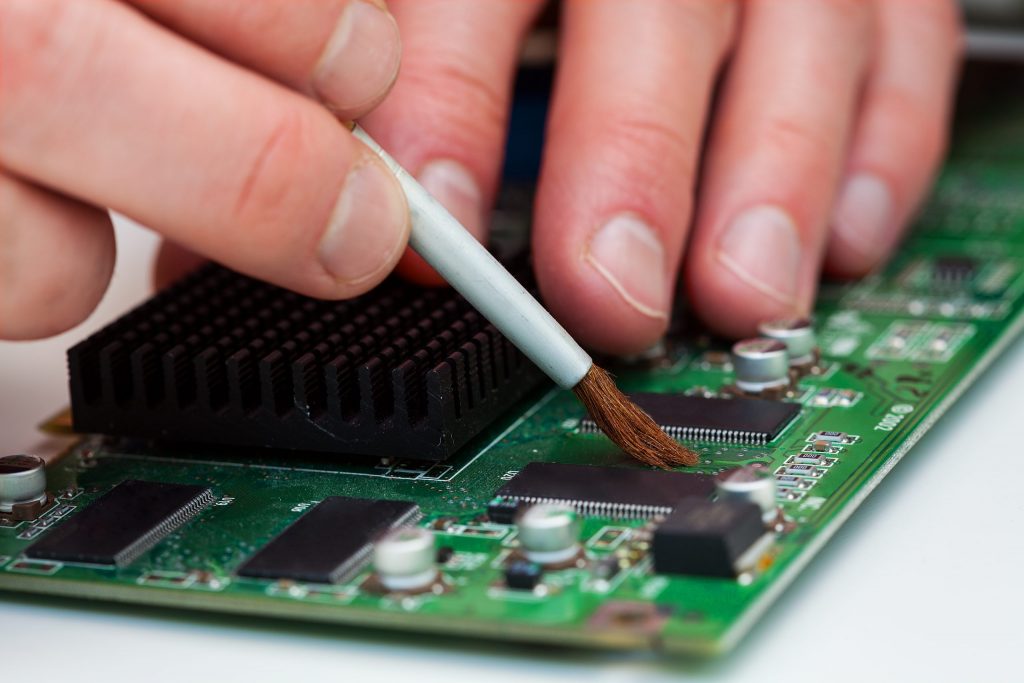
Manual brushing involves using a brush or specialized applicator to apply flux to the areas requiring soldering. Its advantages include simple operation, low equipment costs, and suitability for repair work or small-scale production. However, the amount of flux applied and the uniformity of coverage depend heavily on the operator, making it difficult to maintain consistent results when processing large numbers of products continuously.
4.2. Flux dipping
The dipping method involves immersing the area to be treated in a flux solution contained in a tray or tank. This method may be suitable for certain components, component leads, or fixtures with defined geometries. However, manufacturers need to control the immersion depth, contact time, and amount of flux retained on the product. Improper dipping conditions may cause flux to spread into areas where it is not required.
4.3. Automatic flux spraying
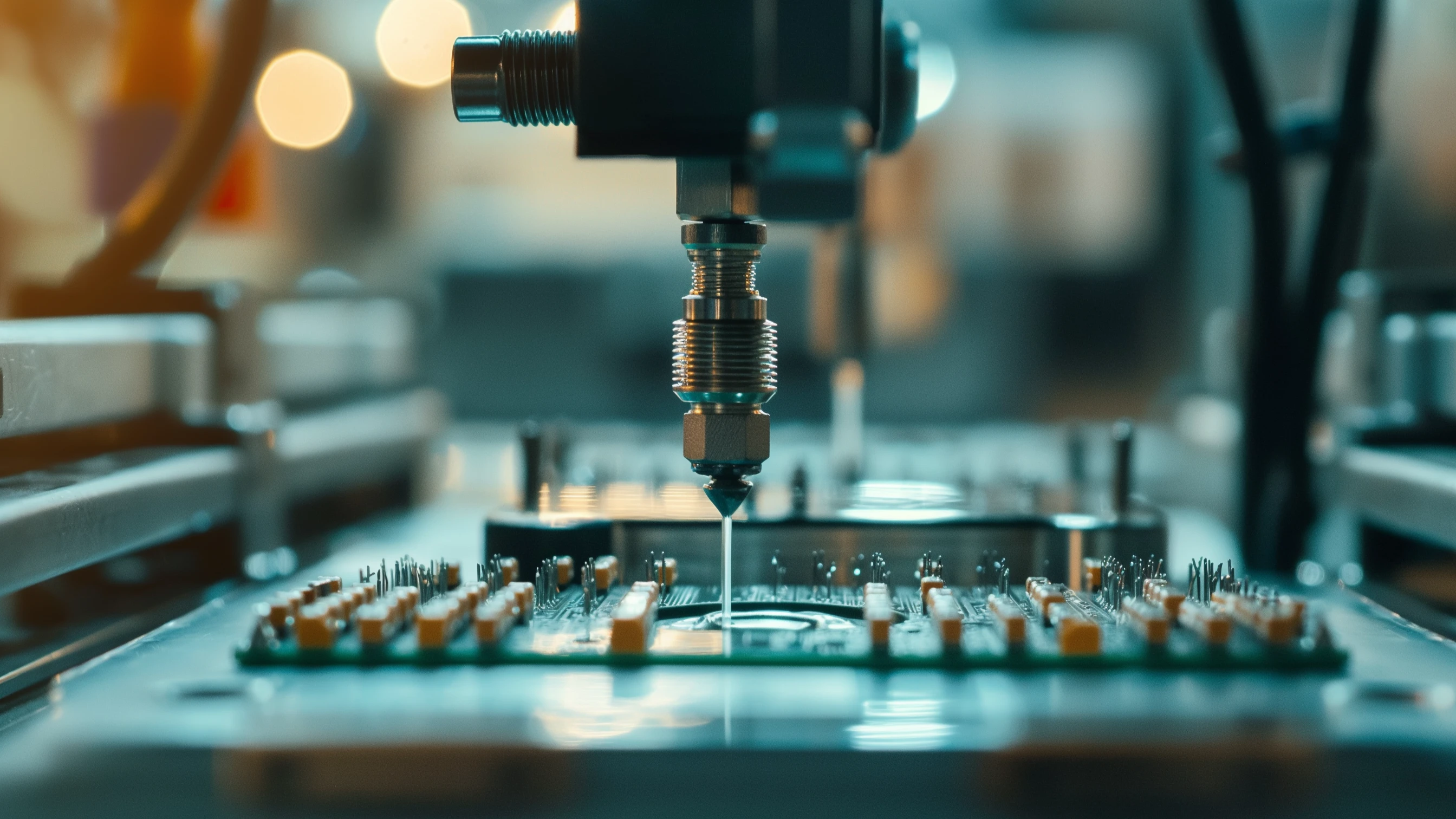
An automatic flux spraying machine uses a supply mechanism and spray nozzle to distribute flux over the required areas. Depending on its design, the equipment may allow adjustments to the flow rate, spray coverage, and nozzle movement. In mass PCB production, automatic flux spraying reduces reliance on manual operations and improves repeatability between production cycles. With a programmable spraying system, manufacturers can configure spray positions and paths to suit individual products. Controlling the spray area can also minimize unnecessary flux application, potentially reducing material consumption when the equipment configuration and operating parameters are optimized. Actual performance should be verified through tests evaluating spray coverage, flux consumption, and solder joint quality.
5. Common soldering defects related to flux
Selecting or using an unsuitable flux can affect PCB cleanliness and solder joint quality. However, when defects occur, manufacturers should evaluate the material properties, heating process, and product design together.
| Defect | Possible causes | Recommended checks |
|---|---|---|
| White residues after soldering | Unsuitable flux formulation, heating conditions, or cleaning process | Check the flux type, heating conditions, and cleaning procedures |
| Corrosion or reduced insulation resistance | Residual activators, moisture, or inadequate cleaning | Check the flux classification, residue levels, and environmental conditions |
| Poor solder wetting | Insufficient flux, oxidized surfaces, or unsuitable soldering temperatures | Check flux coverage, metal surface conditions, and thermal parameters |
| Solder bridging | Unsuitable pad design, solder drainage direction, flux volume, or soldering parameters | Check component lead arrangement, flux coverage, and solder contact conditions |
| Uneven residue distribution | Unstable flux spraying or improper material distribution | Check the spray nozzle, flow rate, spray path, and coverage |
In particular, solder bridging cannot be attributed solely to insufficient flux. This defect may also be associated with component lead spacing, pad geometry, PCB travel direction, and solder drainage conditions. After adjusting materials or process parameters, manufacturers should inspect sample products before implementing the changes across the entire production line.
6. CNC VINA's inline PCB flux spraying machine
In PCB soldering lines, the flux application process must be controlled in terms of application position, coverage, and coordination with upstream and downstream equipment. For continuous production, an inline flux spraying system automates PCB transportation and programmable flux application. CNC VINA's inline PCB flux spraying machine is designed to apply flux to printed circuit boards using a conveyor mechanism and an automatically controlled spray nozzle system. The equipment features a programmable nozzle motion mechanism, allowing spray coordinates and paths to be configured according to product requirements.

The control system and HMI (Human-Machine Interface) allow operators to configure, adjust, and save operating programs. By combining a conveyor system with an automated spraying mechanism, the equipment supports the integration of flux application into electronics manufacturing lines.
Reference technical specifications
| Item | Specification |
|---|---|
| Machine dimensions | L1800 × W850 × H1200 mm |
| Power supply | Single-phase, 220V – 50Hz |
| Compressed air pressure | 0.4–0.6 MPa |
| Conveyor speed | 200 mm/s |
| Spray nozzle travel speed | 250 mm/s |
| Flux tank capacity | 10 L |
| Cleaning solution tank capacity | 1 L |
| PCB transfer height | 110 ± 20 mm |
| Adjustable conveyor width | 50–450 mm |
These specifications are provided for reference based on the previously introduced inline flux spraying machine configuration. They should be verified against the technical drawings and project requirements before publication or quotation.
For manufacturers planning to automate their flux application processes, CNC VINA can recommend suitable equipment solutions based on PCB dimensions, flux type, required spray coverage, target production capacity, and production line integration requirements.
Frequently asked questions about soldering flux
1. Are rosin and soldering flux the same?
Rosin is one type of base material used in soldering flux formulations. Flux is a broader term that includes both rosin-based formulations and other types of soldering agents. Although the terms are often used interchangeably in practice, they are not technically identical.
2. Is no-clean flux always safe to leave on a PCB?
No. No-clean flux is formulated so that its residues may be acceptable under specified conditions. For products with stringent cleanliness requirements or those requiring protective coatings, manufacturers must still evaluate residual contamination levels and material compatibility.
3. Is flux necessary for dip soldering?
Flux is generally used to help remove surface oxides and improve solder wettability. The appropriate flux type and application volume should be selected according to the component lead material, the surfaces to be soldered, and the process conditions.
4. Can an automatic flux spraying machine reduce flux consumption?
A controlled spraying system can minimize unnecessary flux application outside the required areas and improve coating repeatability. Actual savings depend on the flux formulation, spray nozzle configuration, operating program, and previously used application method.
5. How do you select the right flux for a wave soldering line?
Manufacturers should consider the solder alloy, PCB surface characteristics, flux activity, preheating conditions, cleaning requirements, and flux application method. Testing with actual products is recommended to evaluate solder joint quality and post-soldering residues.
Soldering flux plays an important role in promoting solder wetting and solder joint formation on printed circuit boards. Different flux formulations have varying activity levels, residue characteristics, and cleaning requirements. Therefore, the appropriate flux should be selected according to the soldering method and product quality standards. In addition to material selection, the flux application method also affects coverage uniformity, process repeatability, and material consumption. For high-volume production lines, programmable spraying equipment provides a practical solution for standardizing the flux application process. With extensive experience in industrial automation, CNC VINA provides consultation, design, and custom manufacturing of inline PCB flux spraying machines, helping manufacturers improve control over PCB soldering processes.
VIETNAM TECHNOLOGY APPLICATION & CNC JOINT STOCK COMPANY
Factory: Song Cung Industrial Cluster, Dong Thap Commune, Dan Phuong District, Hanoi, Vietnam.
Office: Rox Tower Goldmark City, 136 Ho Tung Mau Street, Phu Dien Ward, Hanoi, Vietnam.
Telephone: +84 916 639 355 / +84 915 744 664.
Website: www.cncvina.com.vn | www.cncvina.net