 Tiếng
Việt
Tiếng
Việt
 Tiếng
Anh
Tiếng
Anh
 Tiếng
Nhật
Tiếng
Nhật




 Tiếng Anh

What is a solder dipping machine? Operating principle and how to choose one for a PCB factory

A solder dipping machine is a soldering solution used in PCB manufacturing to process multiple soldering points in a short period while improving consistency across products. Instead of soldering each joint individually with a soldering iron, the process is organized into a controlled cycle, allowing manufacturers to better manage production capacity and operating conditions. In PCB assembly lines using through-hole technology (THT) components, the number of component leads requiring soldering can be substantial, particularly for products manufactured repeatedly in high volumes. When the soldering process relies entirely on manual operations, productivity and process consistency can be affected by operator skill, handling time, and variations between production shifts. This is why manufacturers with stable production volumes often consider semi-automatic or fully automatic solder dipping systems to standardize this process. Depending on product requirements, the equipment can be configured with different levels of automation, ranging from a temperature-controlled solder bath to a fully automatic solder dipping machine equipped with a lifting mechanism, positioning jig, PLC, HMI, temperature control system, and fume extraction system. The appropriate configuration should be determined based on PCB dimensions, soldering areas, solder alloy, production volume, and cycle time rather than equipment capacity alone.
So, how is a solder dipping machine constructed, how does it work, and what should manufacturers consider when selecting one? Join CNC VINA as we explore these aspects in detail in the following article.
What is a solder dipping machine?
In essence, a solder dipping machine is an equipment system designed to create and maintain a controlled molten solder bath for PCB soldering applications. A typical system consists of a solder bath, heating unit, temperature sensors, control system, and product fixture. For automated configurations, the machine can be equipped with additional components such as a lifting mechanism, dedicated jig, PLC, HMI, solder dross removal mechanism, and fume extraction system. During operation, the PCB is securely mounted on a jig to ensure that its position and designated soldering areas are accurately controlled. The motion mechanism moves the product into the working position according to a predefined cycle and then removes the PCB from the solder bath once the process is complete. Depending on the process requirements, the system can control parameters such as solder bath temperature, contact time, dipping depth, and lifting speed.
By combining precise temperature control with controlled motion, a solder dipping machine can be applied to highly repetitive soldering processes, particularly for PCBs with a large number of THT leads or products that require processing under consistent process conditions. When properly designed for the specific product, the equipment can also meet requirements related to PCB dimensions, soldering areas, production volume, and the desired level of automation.

Operating principle of a solder dipping machine
In general, the operating principle of a solder dipping machine involves heating the solder bath, stabilizing the solder temperature, preparing the bath surface, securely positioning the PCB, and bringing the product into contact with molten solder according to a predefined cycle.
Heating and maintaining solder temperature
The solder is contained in a solder bath and heated by an electric heating unit. Temperature sensors continuously monitor the actual temperature and transmit feedback to the control system to maintain it within the preset range. Temperature is one of the most critical parameters of the system. If the temperature is too low, the solder may not reach the appropriate molten state, which can affect solder joint formation. Conversely, excessive temperature or prolonged heating can accelerate oxidation and increase the amount of dross formed on the bath surface. Therefore, machine design must take into account the heating capacity, solder bath volume, sensor position, and temperature control method simultaneously. For production lines handling multiple product types, the ability to set and store temperature parameters for each product model should also be considered.
Removing dross from the solder bath surface
During the heating process, oxides and dross may form on the surface of the molten solder. Excessive dross accumulation can interfere with the contact area between the solder and the PCB. The machine can be equipped with a dross removal mechanism to remove oxides and impurities from the bath surface. Depending on the machine design, this operation can be performed manually or automatically at predefined intervals. For high-volume production environments, an automatic dross removal mechanism can reduce operator intervention and help maintain more stable operating conditions over extended periods.
PCB fixturing and positioning
Before dipping, the PCB is securely mounted on a jig to prevent positional movement during the dipping process. The jig should be designed according to the PCB dimensions, component locations, soldering areas, and dipping orientation. For production involving multiple product models, quick-change jigs or adjustable fixturing mechanisms can be used to improve flexibility. This is an aspect that is often overlooked when evaluating a solder dipping system. In practice, even a solder bath with stable temperature control can produce positioning errors or inadequate soldering coverage if the jig is not properly designed. Therefore, when ordering a machine, manufacturers should provide PCB drawings or actual PCB samples so that the machine builder can design the jig accurately according to the product.
Dipping and lifting the PCB
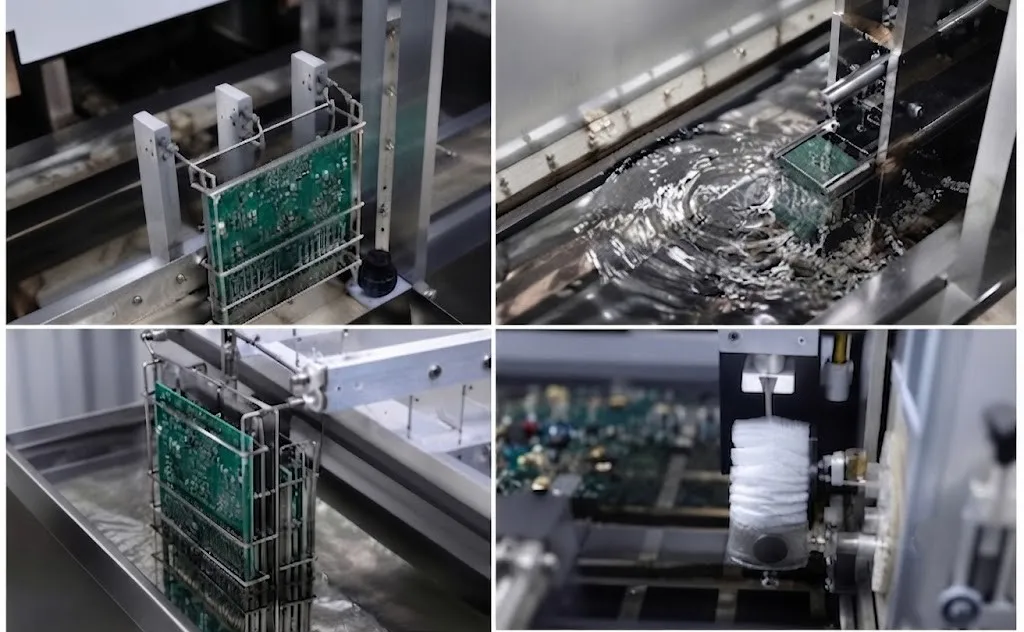
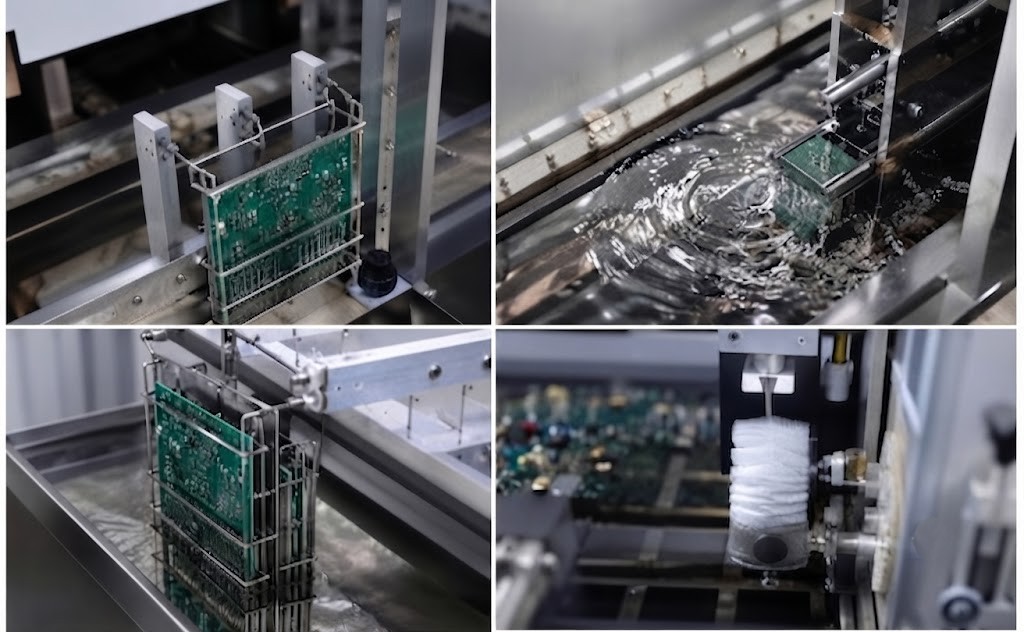
Once the PCB is securely mounted and the solder bath reaches the preset temperature, the lifting mechanism lowers the product into the molten solder. During this stage, three key parameters need to be controlled: dipping depth, contact time, and PCB lifting speed. Dipping depth determines which portion of the PCB comes into contact with the molten solder. Dipping time affects heat transfer and solder joint formation. The PCB lifting speed must then be controlled to ensure stable solder drainage as the product is removed from the solder bath. With manual equipment, these parameters depend heavily on operator technique. In contrast, an automatic solder dipping machine can be programmed with a defined motion sequence, helping reduce variations between production cycles and improve process consistency.
Common types of solder dipping machines
Not every PCB production facility requires the same type of equipment. The appropriate solution depends on factors such as production volume, number of product models, required level of automation, and quality control requirements.
Manual solder dipping bath
A manual solder dipping bath has a relatively simple configuration, typically consisting of a solder bath, heating unit, temperature sensor, and control system. The operator manually loads the PCB onto the jig, performs the dipping operation, and removes the product after the process is completed. The main advantages of this solution are its low initial investment cost, simple operation, and suitability for trial production or small-volume manufacturing. However, its main limitation is the high level of dependence on operator performance. If dipping time, dipping depth, or lifting speed is not properly controlled, variations in soldering quality may occur between products.
Automatic solder dipping machine
An automatic solder dipping machine uses a motion mechanism combined with a control system to execute the dipping cycle according to predefined parameters. Depending on production requirements, the system can integrate a PLC/HMI, heating unit, temperature sensors, lifting mechanism, positioning jig, dross removal mechanism, and fume extraction system. For production lines with higher safety and process control requirements, the machine can also be equipped with interlock sensors, over-temperature protection, emergency stop buttons, and protective guarding around heated areas. The key advantage of an automatic system is its ability to repeat the same process cycle consistently. Once the process parameters have been established, operators no longer need to manually estimate the dipping time or depth for each product. This reduces manual intervention, improves process consistency, and makes automatic solder dipping machines more suitable for production facilities with stable and continuous output.
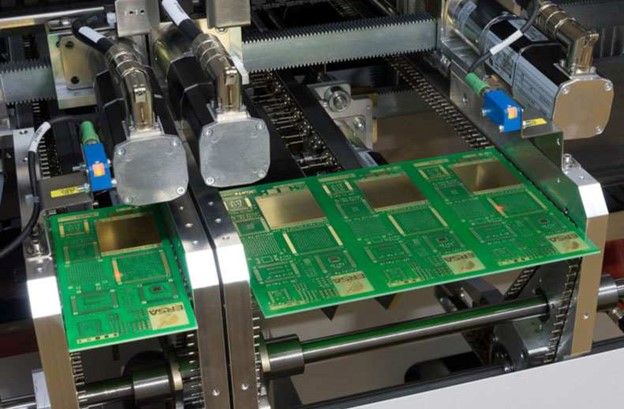
Wave soldering machine
A wave soldering machine also uses molten solder to solder through-hole components, but its solder delivery principle differs from the dipping method. The PCB passes through processes such as flux application, preheating, and the solder wave zone, where the solder wave contacts the underside of the PCB to create multiple solder joints in succession. This solution is suitable for high-volume production lines that require continuous PCB processing and a high level of automation across multiple stages. However, a wave soldering machine has a more complex configuration, requires more floor space, and involves a higher investment than a dedicated solder dipping system. If a manufacturer only needs to automate a specific soldering operation rather than build an entire wave soldering line, a solder dipping machine can be designed around the existing product and process, providing a more optimized equipment configuration.
5 criteria for selecting a solder dipping machine for a PCB factory
Equipment should not be selected based on price alone. A suitable solder dipping machine should be determined based on the characteristics of the PCB, production volume, solder material, and automation requirements of the production line.
1. PCB dimensions and characteristics
PCB dimensions directly affect the working area, solder bath size, motion range, and jig design. However, overall dimensions are not the only factors that need to be considered. The machine builder also needs to know the actual dipping area, component locations, component height, product weight, and characteristics of the PCB underside. A large board that only requires a small area to be dipped has completely different design requirements from a product that needs the entire underside to contact the solder. If the factory produces multiple PCB models, jig changeover and product changeover time should also be considered from the beginning.
2. Production volume and cycle time
Production volume determines the required level of automation as well as the configuration of the motion mechanism. A facility with low production volume may only require a semi-automatic system, while a high-volume production line needs strict cycle time control to prevent the solder dipping process from becoming a bottleneck. When specifying the machine, manufacturers should define the required output per day or per shift, operating hours, and target cycle time. Based on these parameters, the machine builder can calculate the time required for product loading, dipping, PCB lifting, and transition to the next cycle. It is important to distinguish heating capacity from processing capacity. Heating capacity determines how quickly the solder bath reaches the operating temperature and how effectively it recovers heat, while processing capacity depends on the complete operating cycle of the machine.
3. Solder alloy and thermal requirements
The solder alloy directly affects the design requirements of the solder bath and heating system. Manufacturers should clearly identify the solder type being used, particularly when switching between leaded and lead-free alloys.
Solder material information provides the basis for selecting the appropriate heating unit, sensors, and temperature control method. A fixed temperature setting from another machine should not simply be applied to every product, as soldering conditions also depend on the alloy, PCB, components, and overall process requirements.
4. Control system and program storage capability
For factories producing multiple product models, the ability to store and recall parameters for each PCB model can reduce setup time and minimize errors during product changeovers. A PLC combined with an HMI can be used to manage parameters such as solder bath temperature, dipping time, dipping depth, lifting speed, and operating sequence. Operators can monitor the machine status directly through the control interface and receive alerts when abnormalities occur. If the machine is integrated into an automated production line, the control system can also be designed to exchange signals with upstream and downstream equipment, helping synchronize the overall production process.
5. Thermal safety and fume extraction system
A solder dipping machine operates with molten metal at high temperatures, so safety must be considered from the machine design stage. The solder bath area should be equipped with appropriate guarding, while the system should include over-temperature protection and emergency stop functions. In addition, the soldering process may generate fumes from flux and related materials. Depending on factory conditions, a fume extraction system can either be integrated directly into the machine or connected to the facility's general ventilation system. A well-designed machine should not only meet production requirements but also be suitable for the actual operating conditions and production environment of the manufacturer.
Which manufacturers are suitable for an automatic solder dipping machine?
Higher automation is not necessarily the right choice for every manufacturer. The return on investment depends on production volume and the specific problems that the equipment is expected to solve.
An automatic solder dipping machine is generally suitable when a manufacturer has one or more of the following requirements:
- Stable PCB production volume and a need to increase productivity.
- A soldering process that relies heavily on manual labor.
- A need to control dipping time consistently between products.
- Multiple PCB models requiring repetitive processing.
- A need to reduce operator variations between production shifts.
- A need to connect the dipping process with an automated production line.
- A need to store and manage operating parameters for each product model.
Conversely, if production volume is low or products change frequently, a semi-automatic system or dedicated solder dipping bath may provide a more suitable solution.
Therefore, the machine configuration should be developed based on the actual production process rather than simply selecting a machine with the largest number of features.
Information to prepare when ordering a solder dipping machine
To enable the machine builder to recommend the appropriate configuration from the beginning, manufacturers should prepare basic information about the product and production line.
| Information | Purpose |
|---|---|
| PCB dimensions | Determine the working area and jig |
| PCB thickness/weight | Calculate the fixturing and lifting mechanism |
| Dipping area | Determine the solder contact area |
| Solder alloy | Determine thermal requirements |
| Daily production volume | Calculate equipment capacity |
| Target cycle time | Determine cycle speed |
| Number of PCB models | Determine jig changeover method |
| PCB images/drawings | Support mechanical and jig design |
| Automation level | Determine the control configuration |
| Factory conditions | Calculate electrical, pneumatic, and fume extraction requirements |
If 2D/3D drawings or actual PCB samples are available, the jig and machine mechanism design process can be carried out more efficiently and accurately.
CNC VINA designs and manufactures solder dipping machines according to the actual product, process, and installation conditions of each manufacturer. Instead of using a fixed configuration, each system is engineered based on PCB dimensions, dipping area, solder alloy, production volume, cycle time, and required automation level.
Depending on the application, the equipment can integrate a solder bath, heating unit, temperature sensors, lifting mechanism, positioning jig, PLC, HMI, dross removal mechanism, and fume extraction system. The machine can also be optimized to suit the actual factory layout and operating process. For production lines handling multiple PCB models, CNC VINA can develop quick-change jig solutions or suitable adjustable fixturing mechanisms to make product changeovers more convenient. Parameters such as temperature, dipping time, dipping depth, and lifting speed can also be configured for each operating cycle to improve process stability and repeatability. From product assessment, mechanical design, fabrication, and assembly to commissioning and final optimization, CNC VINA develops custom automation machinery and equipment with a focus on achieving the right balance between technology, productivity, and actual operating conditions.
If your company is looking for an automatic solder dipping machine or needs a solder dipping system designed for a specific PCB, please provide the product drawings, images of the soldering area, solder type, production volume, and expected cycle time. CNC VINA will use these actual requirements to recommend the appropriate configuration, technical approach, and automation solution.
Contact CNC VINA for consultation and a quotation for a customized solder dipping machine.
CNC VIETNAM TECHNOLOGY APPLICATION AND CNC JOINT STOCK COMPANY
Factory: Song Cung Industrial Cluster, Dong Thap commune, Dan Phuong district, Hanoi, Vietnam.
Office: Rox Tower Goldmark City, 136 Ho Tung Mau, Phu Dien ward, Hanoi, Vietnam.
Phone: +84 916 639 355 / +84 915 744 664.
Website: www.cncvina.com.vn ; www.cncvina.net