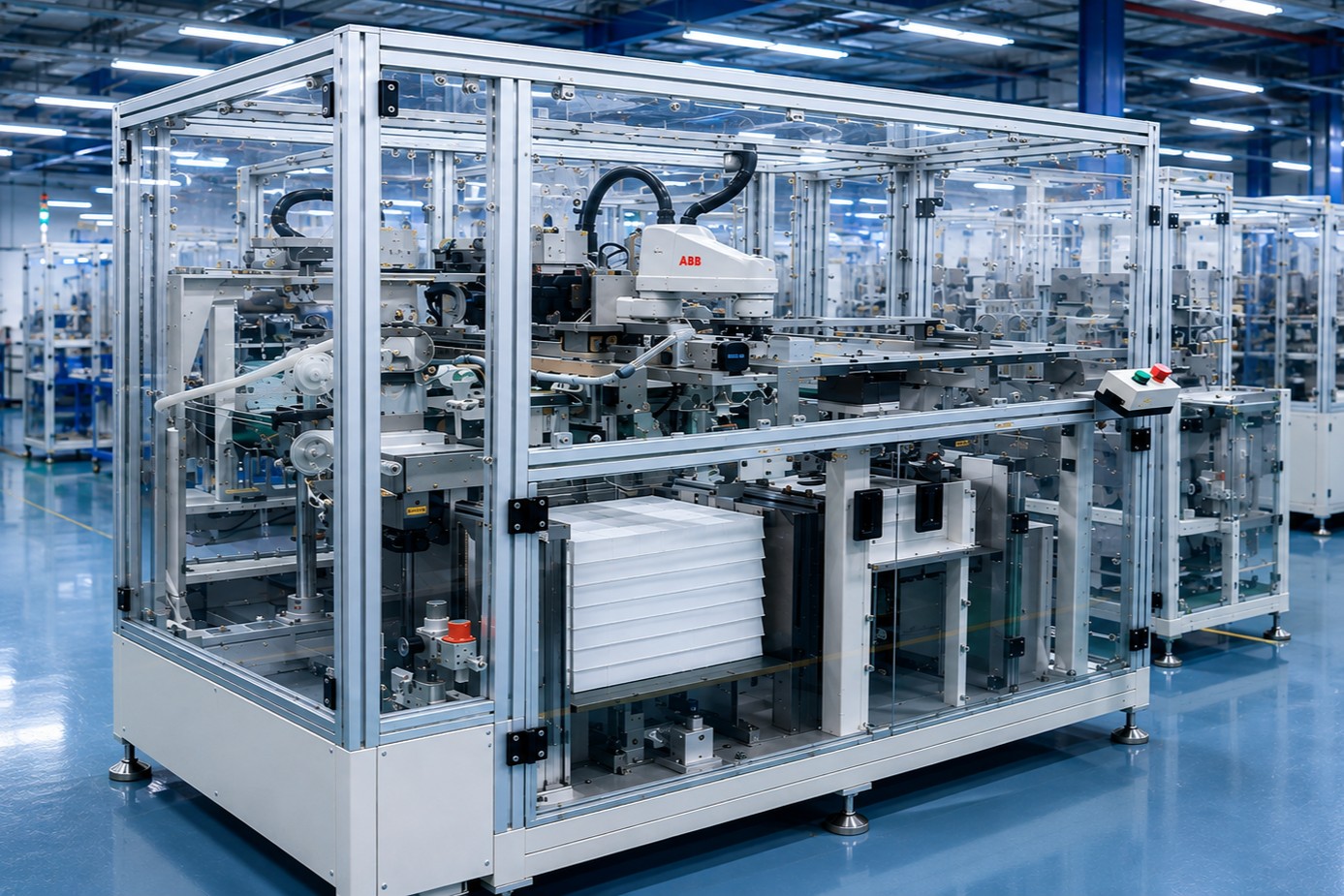
Overview of Automatic Assembly Line with Robot Integration
Automated assembly lines have become an effective solution for increasing productivity and reducing costs in industry. This technology not only saves time and labor but also brings stability and high accuracy in the production process.
CNC VINA, a leading company in the field of providing production automation solutions, has developed a reliable and efficient automated assembly line integrating robots. This article will introduce the technical specifications, outstanding features and characteristics of CNC VINA's automatic assembly line integrating robots.
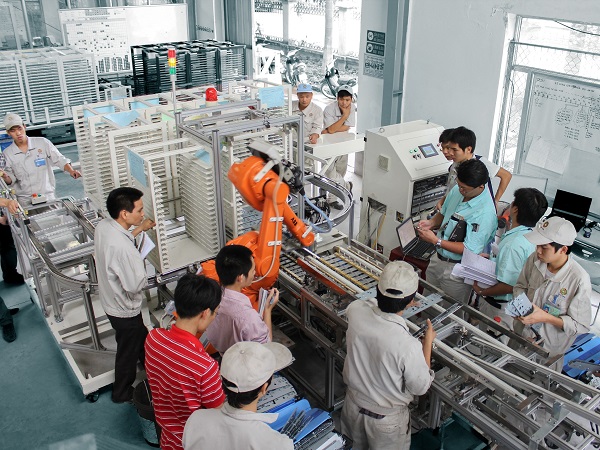
The automatic assembly line integrates a robot to arrange printer parts
CNC VINA's automatic lines are designed and adjusted flexibly to meet each customer's requirements. This is a robot system that integrates with different devices to ensure increased productivity and stable operation 24/7. Below are some important technical parameters of VINA CNC automatic assembly line:
Components of the assembly line
- Stamping machine: This is the first step in the assembly process. Stamping machines are used to stamp out printer frames with large output. The product output speed of the stamping machine is 1.2 seconds/2 products/1 stamping time.
- Conveyor system: After the printer bone plate is stamped out, it will be pushed onto the conveyor belt to prepare for the next step.
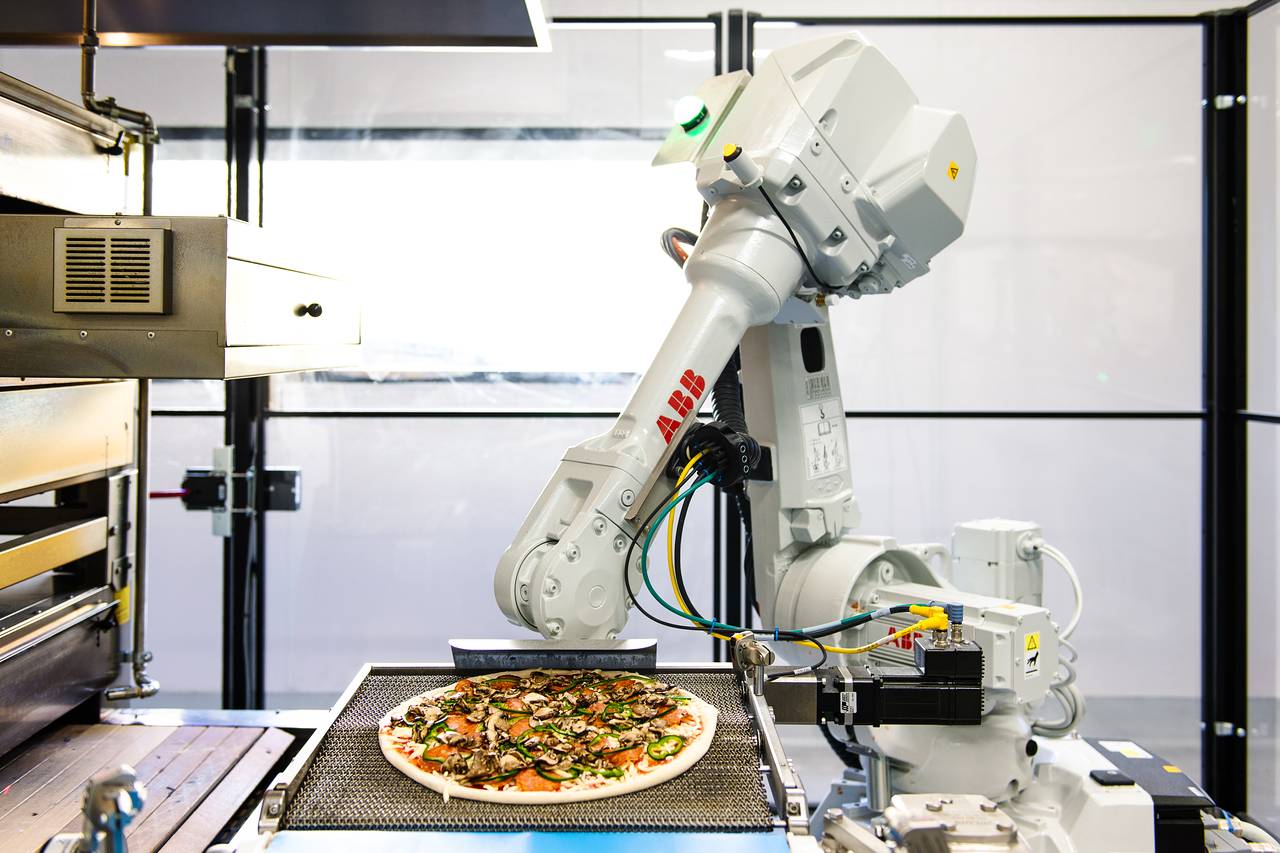
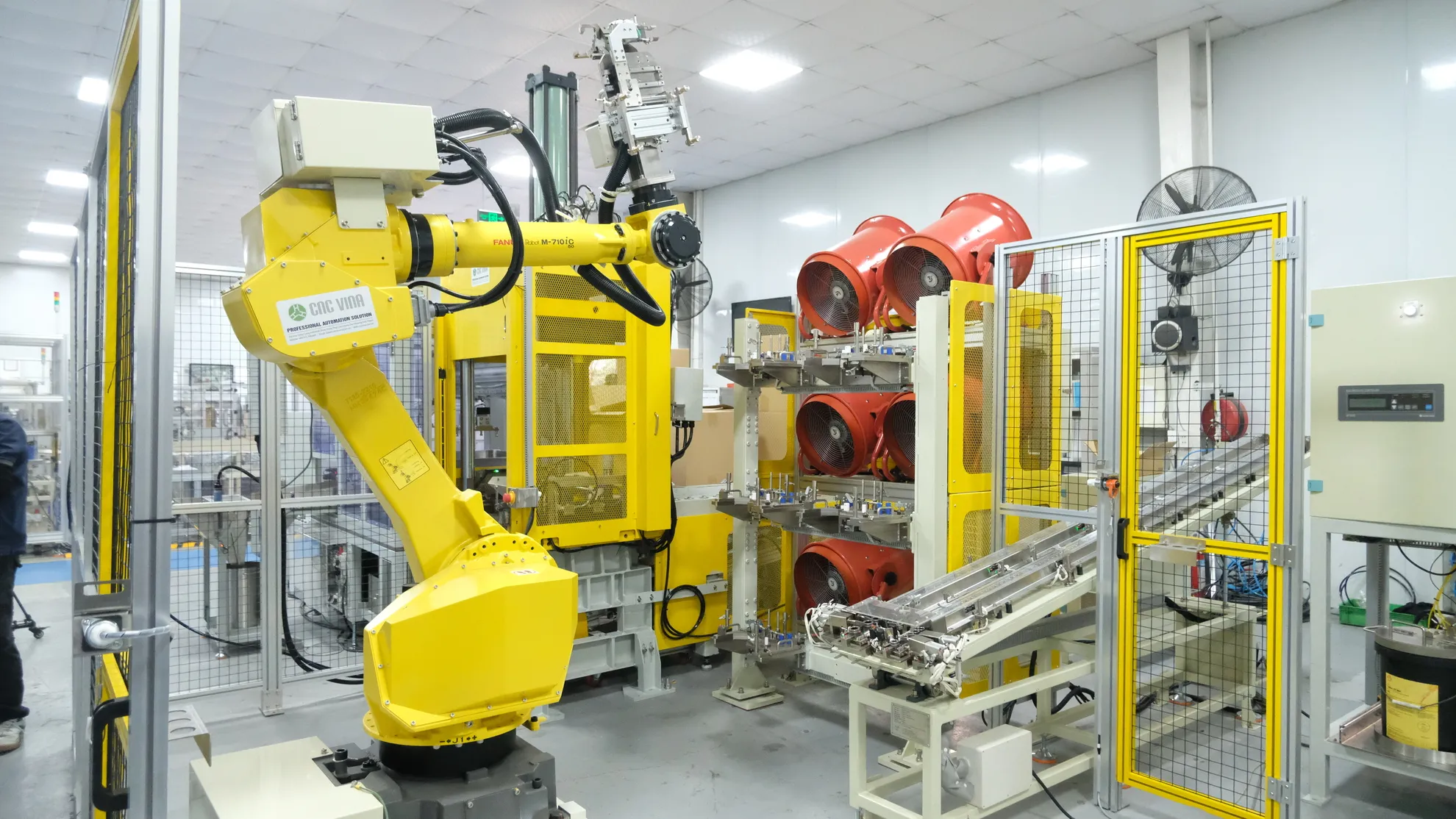
- ABB robot picks up products: The system uses high-speed ABB robots to pick up and place printer plates into the product rack (Rack) to move to the next stage.
- Sensor, control and control system: This is the control and monitoring system for the entire assembly process, ensuring stable and accurate operation.
Flexible application for different types of products
CNC VINA's automatic line is capable of being used for many different product models. This is done through quickly changing the gripper mechanism on the robot. By changing the product picking and clamping mechanism on the robot arm, we can apply the robot to different products easily.
ABB robots are capable of picking up from 5 to 9 products at a time on 2 conveyors below and above, depending on different models. This brings great flexibility to the automated line and helps save time.
Flexible gripping structure
To meet the needs of each product, CNC VINA's automatic assembly line uses a product-picking mechanism with a vacuum head or flexible hydraulic clamp. This allows the system to be applied to a wide variety of products, from light to heavy.
Outstanding features of CNC VINA's automatic robot-integrated line
CNC VINA's robot-integrated automatic assembly line has the following outstanding features:
Increase productivity and reduce costs
With the combination of high-speed ABB robots and automatic equipment, CNC VINA's automatic assembly line helps increase productivity and reduce labor costs. Instead of needing 4 workers to ensure the line's speed, only 2 people are needed to control and monitor the assembly process.
Works stably and accurately
The sensor, control and control system of the VINA CNC automatic line ensures stable and accurate operation. ABB robots are precisely controlled to pick up and place products in the required position, and at the same time the system Control helps ensure the assembly steps take place according to the correct procedure.
Flexible and easy to use
CNC VINA's automatic line is designed to be flexible and easy to use. Changing the picking mechanism to apply to different types of products only takes a little time. Furthermore, ABB robots can work in harsh industrial environments without problems.
Considerations when implementing an automated assembly line with integrated robots
Initial investment and overall cost analysis
Industrial robots are a type of modern machinery and are generally relatively expensive. The most expensive part of a robot is not the mechanical or electronic part. Although modern materials may be very expensive and so are the costs of advanced processing methods, the basic electro-mechanical part of the robot only includes simple steps. chain, motor, gear box, sensor system (possibly) electronic boards that control the motor and boards that perform robot functions.
The most expensive thing is the control system, software, and operating system that connects the mechanical and electronic parts together. Usually the robot operating and control system is an industrial secret of robot developers, it provides a platform for buyers to program on it. These operating systems can be used for all of the company's robots.
When a robot has a broken operating system or software, there may be a situation where you have to buy a completely new robot because the company may not have reinstallation support services and the business may not have enough funds to buy it back. their operating system.
In short, the initial investment cost for industrial robots is relatively high. It not only includes the purchase cost but also includes many other initial setup costs such as transportation, assembly, operator training, programming, auxiliary systems, and costs of building integration plans into the line. existing, etc
Space and facility requirements
There are many sizes of industrial robots, the larger the robot's motor, the larger the robot's working load limit, the more area and volume it takes up.
There are many types of industrial robots that can perform the same task. For example, picking up products is a basic task and it can be said that any industrial robot can do it.
Choosing a robot depends on many factors, but if the business already has existing production lines and facilities, it is often better to choose them so that they are suitable for this existing platform instead of changing the system to match. with robots. The important issue to consider is whether the workshop space is enough to integrate the type of industrial robot you choose.
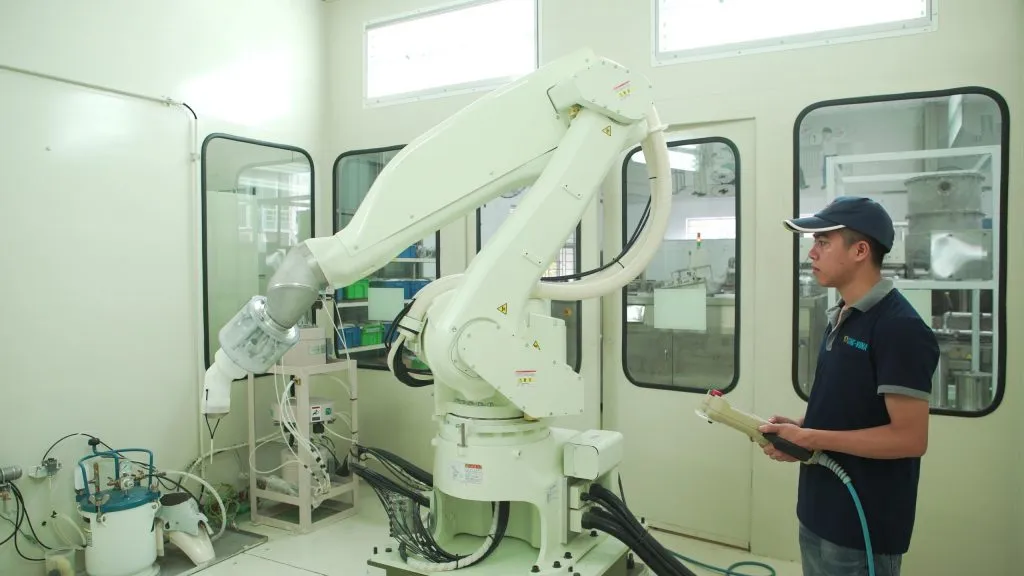
To determine whether space and physical requirements are sufficient, it is necessary to base on the space occupied when the robot is not operating (kinematic parameters are zero) and the robot's working space.
If it is not suitable, then you can consider solutions such as expanding the workshop, changing the line or choosing another type of robot that can still perform that task but remove elements that are not really necessary at the present time. .
Training and skills needed for the workforce
Industrial robots are a type of high-tech, expensive machinery, jobs related to them often require proper training to avoid accidents and serious failures, which not only cause huge economic losses but also can cause serious economic losses. immediately endangering labor safety for people. Of course this is also a significant cost:
Necessary skills that need to be trained for the workforce:
Maintenance and support considerations
Maintenance, inspection, and replacement of electronic components, circuit boards, algorithms, and specialized software can be extremely difficult, and only manufacturers hold technological records and public secrets. Only technology about the type of industrial robot that businesses are using can be implemented.
Before buying or ordering a robot, pay attention to the manufacturer's after-sale services, predict situations when the robot has problems, how these services will help or whether you can solve the problem without These services are not available. All to avoid or limit economic losses to a minimum when incidents occur.
Adjust and optimize
Another issue is whether the industrial robot can be upgraded. When expanding production or with the need to increase productivity, robots will be required to operate more efficiently, faster, with more capacity or to perform other tasks. The algorithms and software that come with the robot can be updated to have more features or stability, optimize programming, and optimize the robot's operation. Whether the mechanisms, engine capacity, gear box can be replaced, adjusted, etc
For all information contact the manufacturer and make sure you have enough information before making a decision.
Other applications of automatic assembly lines with integrated robots
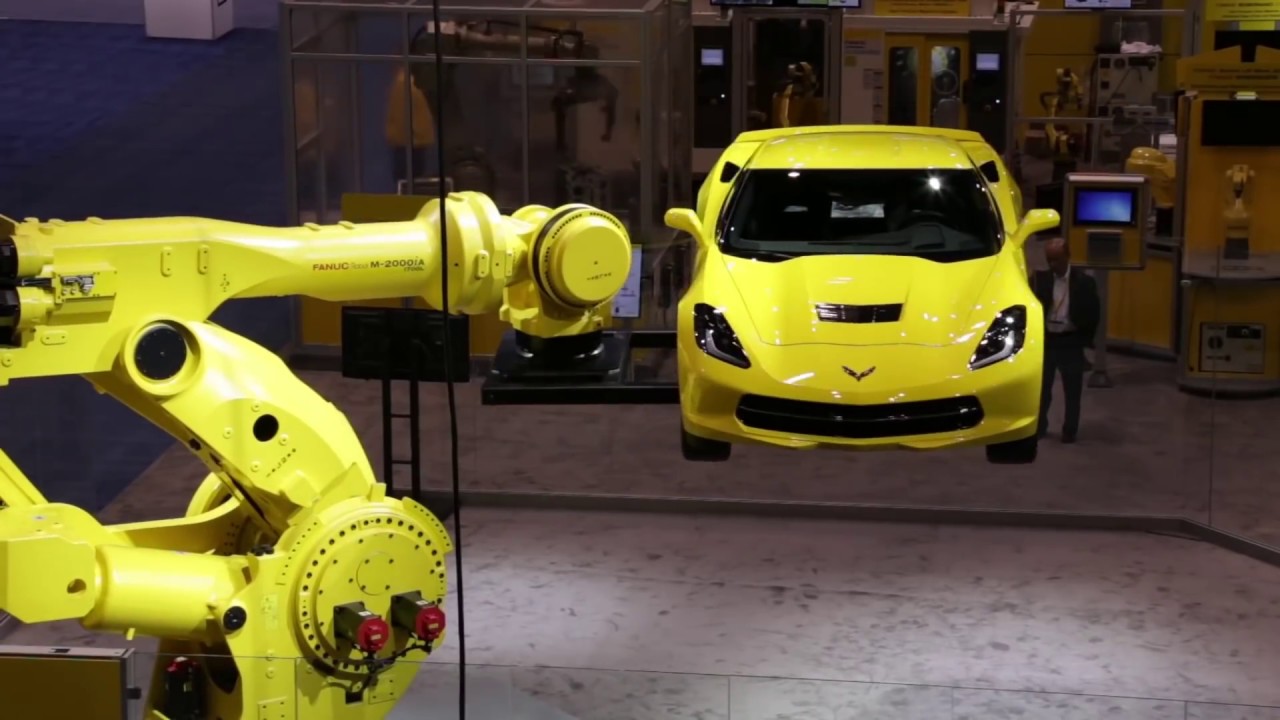
Automotive industry
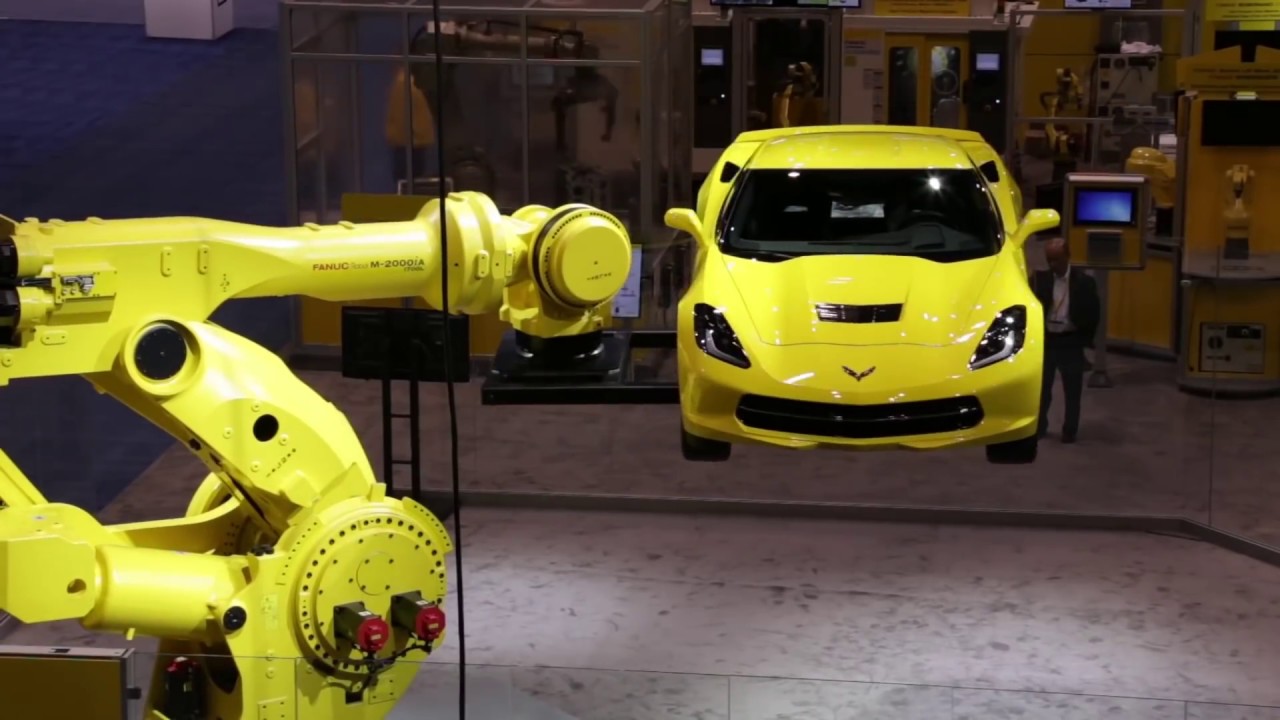
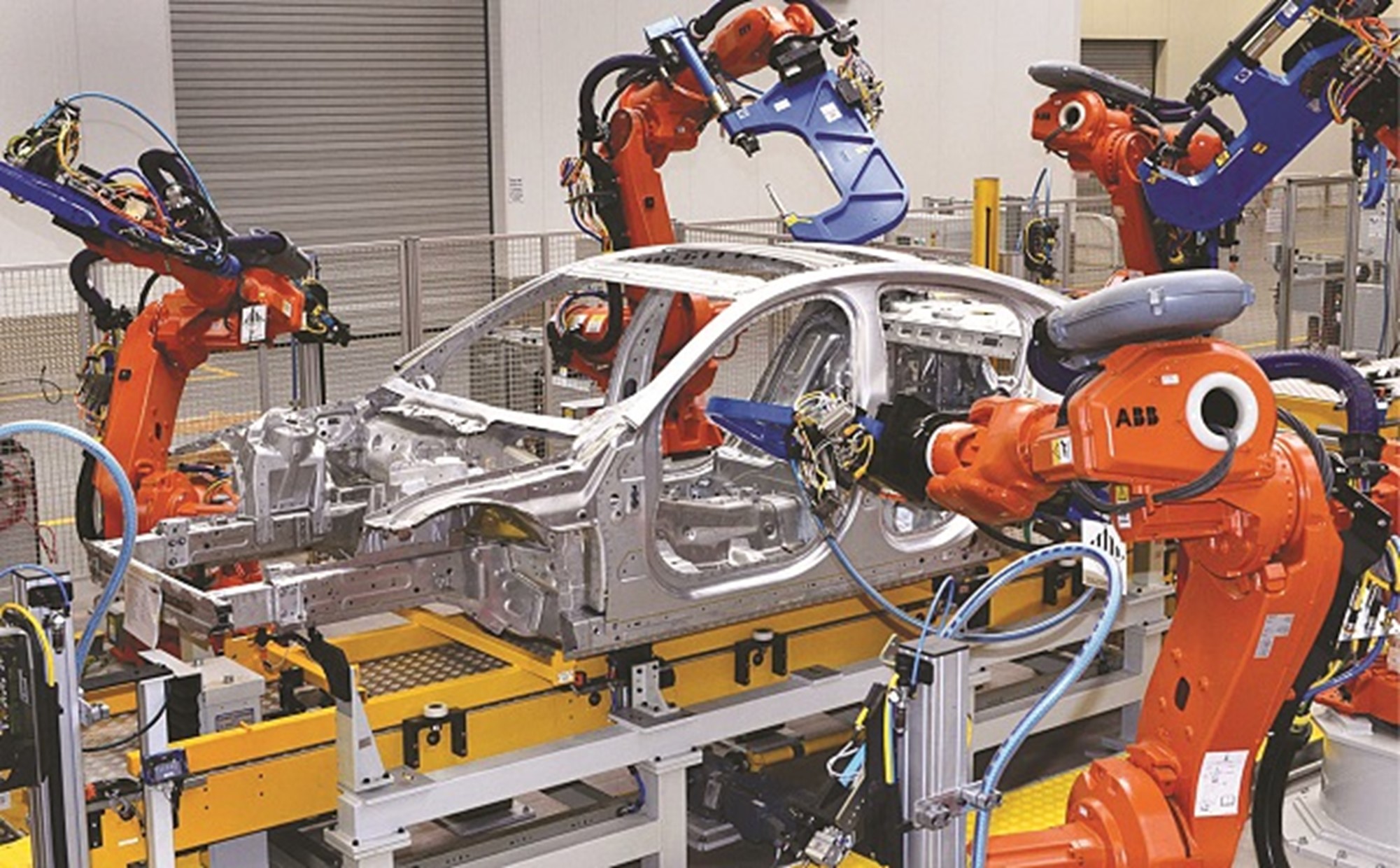
Robotic manipulators assemble and weld frames in the automobile assembly line
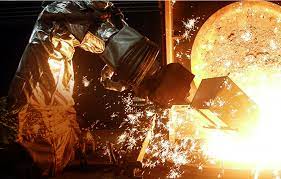
After being manufactured by many processing methods such as casting, stamping, grinding, etc., the car's shell and frame parts need to be assembled together to form a complete car mechanical frame. This process requires high precision and speed to ensure production productivity. The environment is toxic due to heat and burning fumes from the welding process, making it very ineffective for human use.
Applying industrial robots to assembly in the automobile production line helps the finished product be both accurate and saves production time, making the price cheaper while ensuring human safety and cutting labor costs.
Industrial robots transport large loads
Cars or their components are so heavy that it is difficult for people to transport them effectively. If you use rigid transportation systems such as conveyor belts, the capacity is very large but it is difficult to customize when you need to change the endpoint of the transportation process.
Industrial manipulators are applied to help the transportation process become extremely flexible, the endpoint can be easily changed thanks to programming. In addition, they can be fitted with additional wheels, making them even more flexible.
Electronic industry
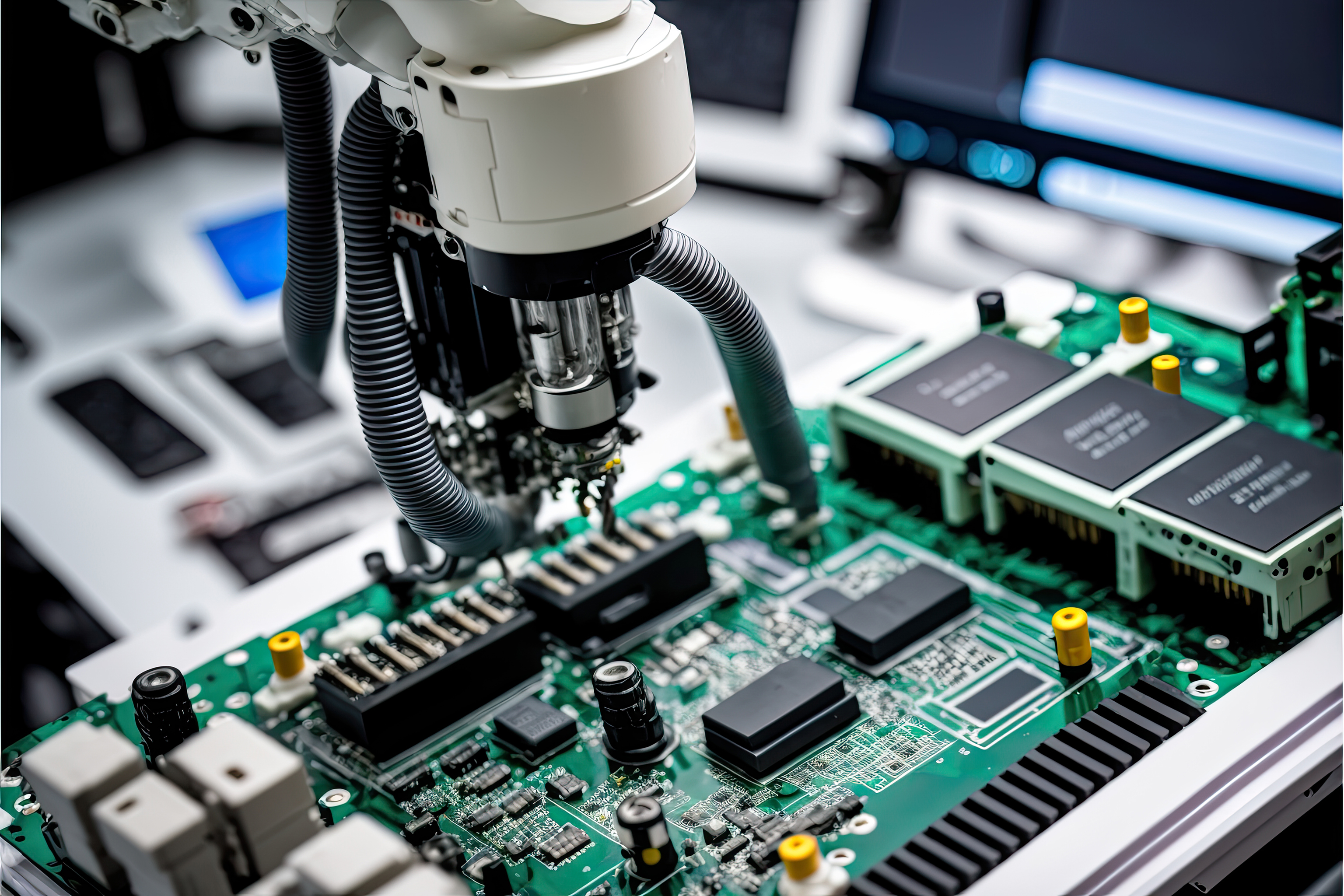
Robot plugs and welds electronic components
Soldering electronic components is a fairly simple job, but achieving high quality and productivity is not an easy thing. A large electronic circuit board can have thousands or millions of components. If one component does not have good solder contact, the entire board will become a waste product. Reviewing and re-inspecting is also extremely difficult.
Using labor brings low machine investment costs but high risks for expensive circuit boards.
Industrial robots with the application of plugging and welding components are the necessary solution to optimize this process. They operate stably, long-term, and at high speed, ensuring productivity and repeatability are also very high, and can be continuously adjusted and optimized.
Furthermore, with programmability, the robot easily changes its operations to suit different types of circuit boards, creating a flexible production system. Unlike humans, it takes a while to adapt and determine the location of components.
Pharmaceutical industry
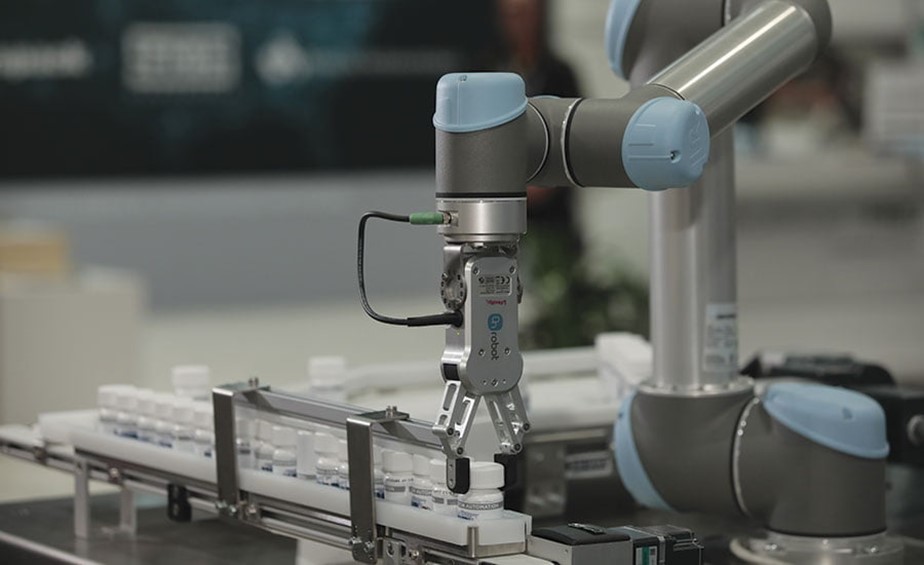
Pick and place robot
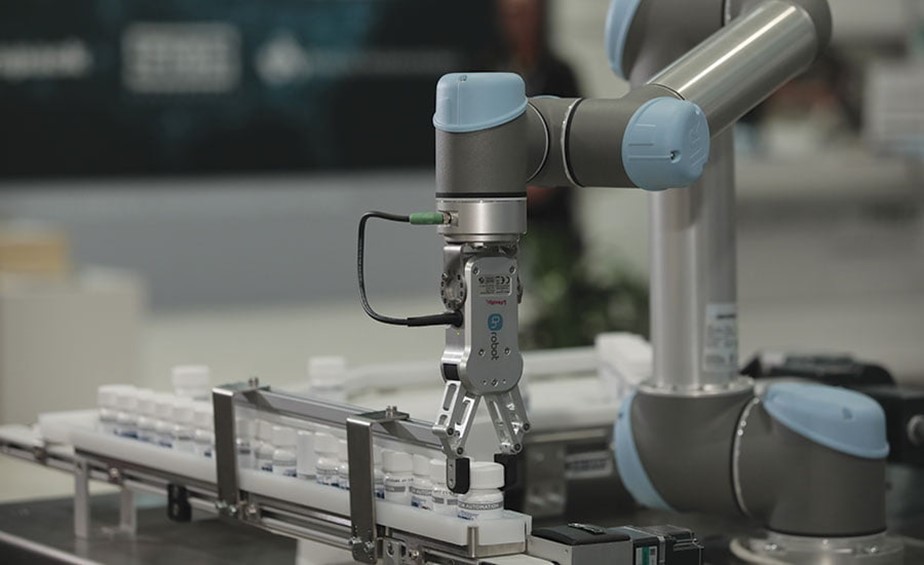
It's simply picking up and moving objects. These may be products that need to be taken off the conveyor belt and into a work area or sorting items for further processing. For the pharmaceutical industry, you can think about sorting medicine bottles or organizing syringes.
Robot checks drug packaging quality
Inspection is hard work for workers because they must have high concentration throughout the work process. An error in testing can cause serious consequences for the patient. Robots can be an optimal solution here as they can operate extremely consistently. For example, robots can check whether blister packs are completely filled or detect defects.
Robot closes the lid
Used for automatic capping applications of medicine bottles.
Filling and packaging robots
Dosage in the pharmaceutical industry is paramount. Packaging the wrong dosage can have serious consequences. Using humans can easily cause errors, while machines can adjust accuracy and repeatability to keep errors within allowable levels.
Food and beverage industry
Basically, applications such as pick and place, quality control, filling, packaging, and capping of the pharmaceutical industry can all be applied to the food and beverage industry. However, the level of quantitative and qualitative precision required may not be as stringent as that of pharmaceuticals.
Some other applications:
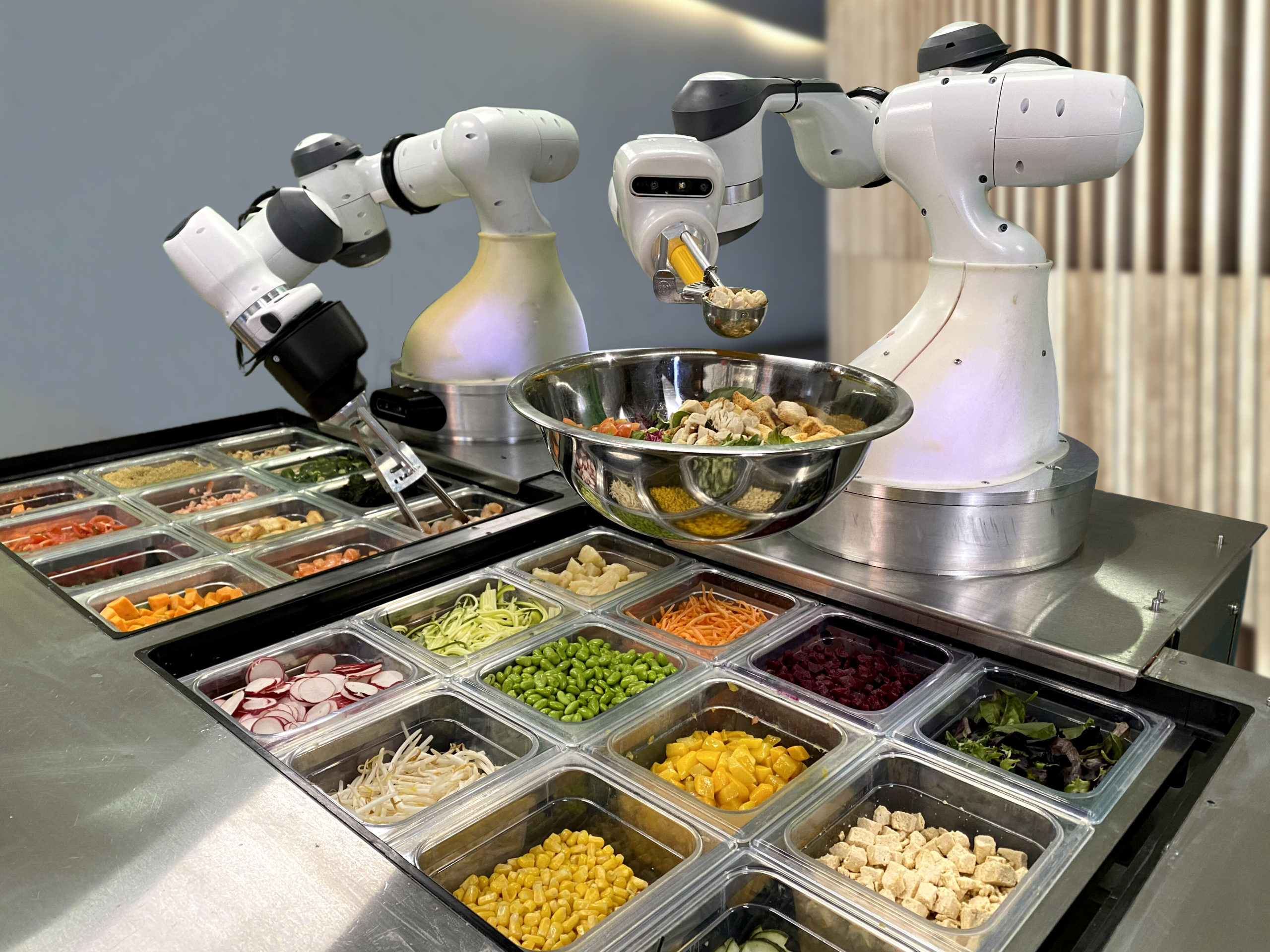
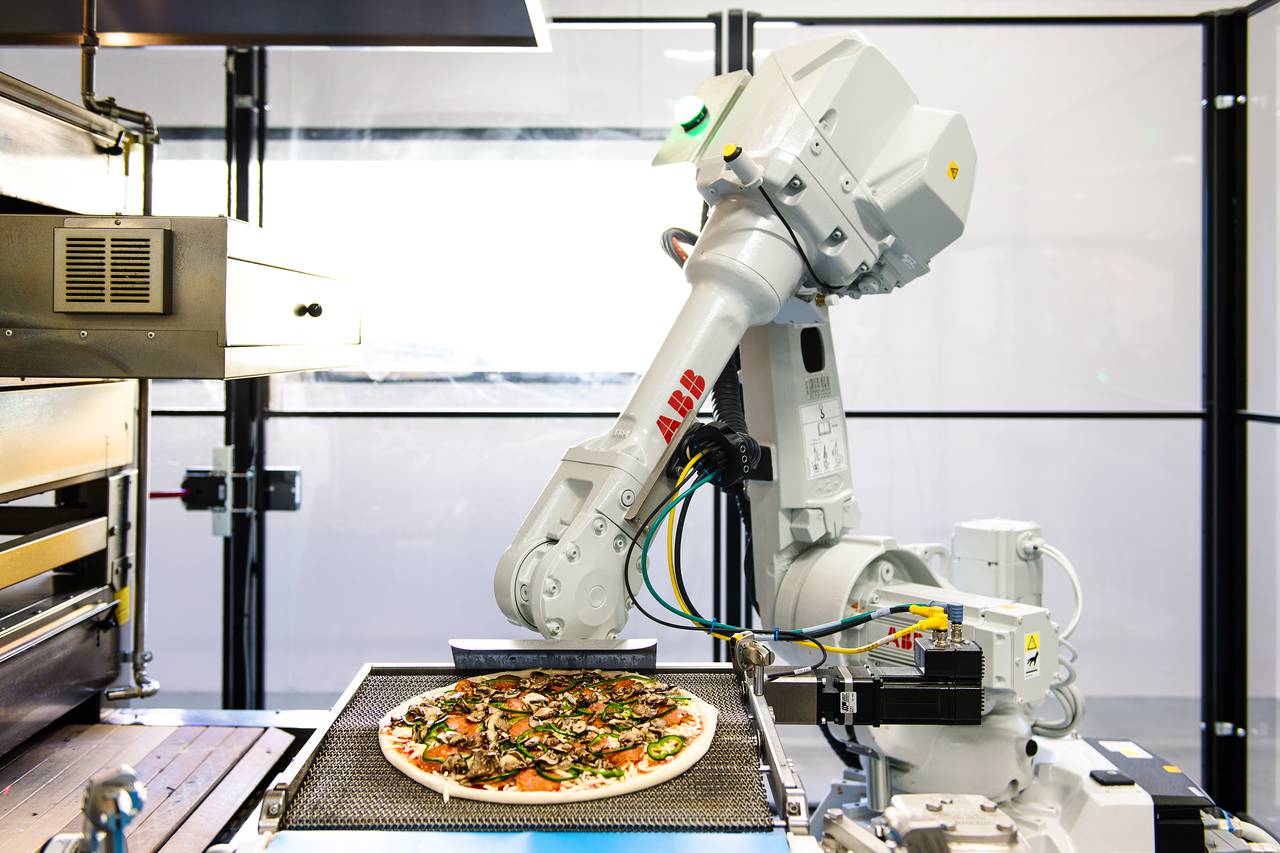
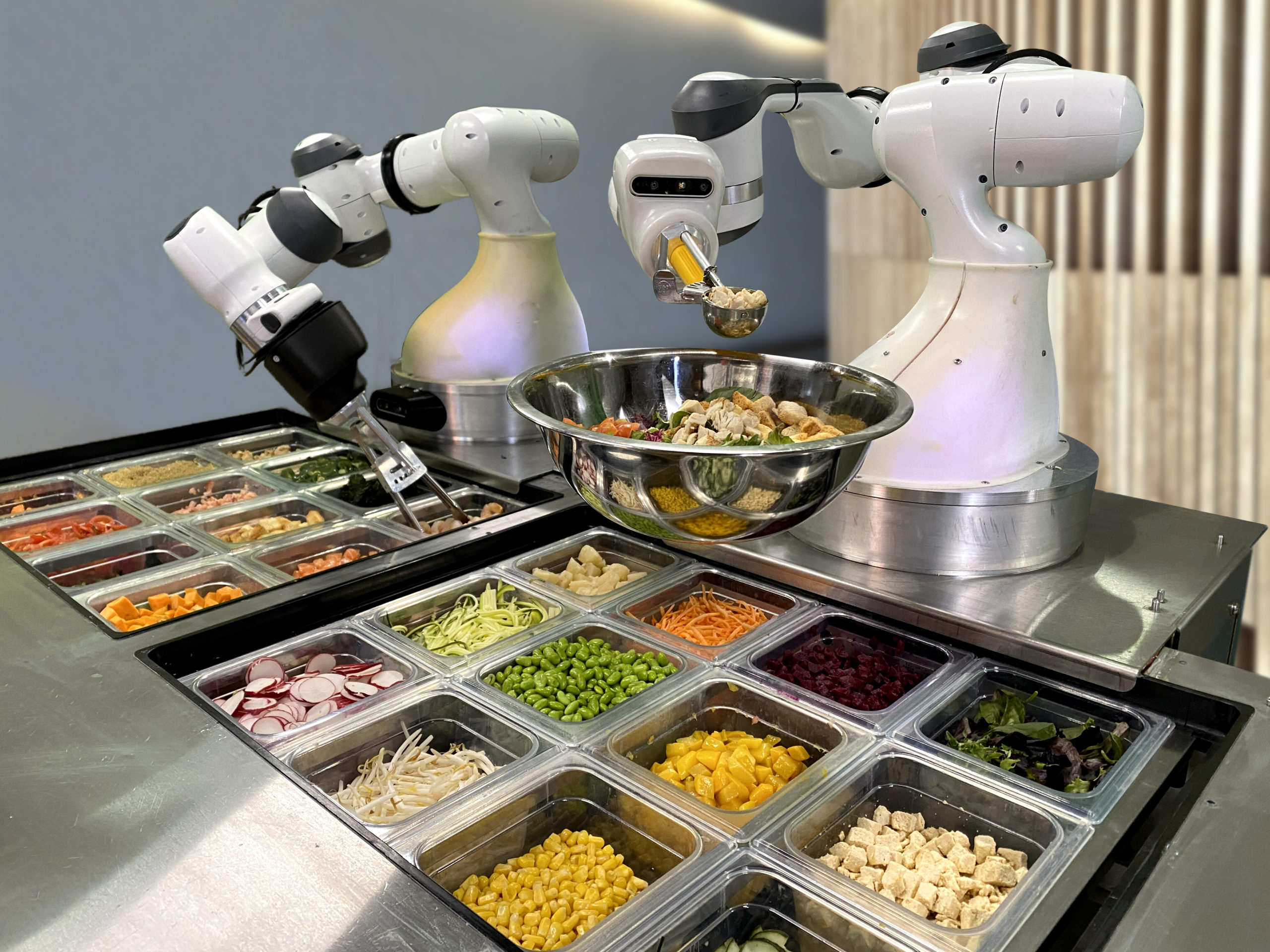
Robot sprinkles spices and ingredients
The job of sprinkling ingredients and spices is a very special job, often found in the food processing industry. The use of robots helps speed up speed, increase productivity and help finished products have more uniform and even distribution of materials.
Robot kneading ingredients
The process of kneading ingredients is not only found in the processing of foods but also in beverages.
There are many different ways to knead ingredients, using a normal kneader it is difficult to change the kneading method, usually you can only change the speed and kneading tools and need to pour the ingredients into the machine. then take it out. The use of industrial robots makes this task more flexible and diverse.
In addition, if aesthetics are required and materials are not crushed, recreating human hand movements with a robot can give better results.
Other industries
There are many other industries that can apply industrial robots such as mechanical manufacturing industry, aerospace industry, shipbuilding industry, etc. In general, basic applications such as picking, sorting, and using The tools and tools used in the above mentioned industries can also be applied to other industries.
Of course, some specific jobs of different industries will bring different applications of industrial robots. For example, in the aerospace industry, industrial robots are used to replace workers working in harsh laboratory environments or for bar feeding applications in mechanical manufacturing.
The automated line integrating a robot for printer part handling and stacking provides an efficient automation solution for picking, transporting, and arranging products after the stamping process. By combining a high-speed ABB robot, conveyor system, and automatic control system, the production line operates faster, more accurately, and more consistently than manual handling methods. The interchangeable gripper mechanism also allows the system to flexibly adapt to different product models and production requirements. In addition to improving productivity, this solution helps reduce the number of workers directly involved in production and optimize operating costs. CNC VINA provides comprehensive robot system solutions, including design, manufacturing, and integration, based on each customer's product specifications, factory layout, and technological requirements. The system can be applied not only to printer parts but also to various picking, stacking, and material-handling applications across other industrial sectors. It is an ideal automation solution for manufacturers looking to gradually build automated production lines while improving productivity and enhancing overall competitiveness.
Some automatic lines integrate robots that CNC manufactures
Electronic component assembly lines and robot integration applications in our production lines, assembly, manufacturing and smart warehouse operations:
Collaborative robots
Industrial robots for assembly
Robot stacks goods on pallets
Universal 6-axis robot
AGV self-propelled vehicle
Customers who need consulting, design, manufacturing and installation of automated lines integrating robots and automation solutions with industrial robots please refer to our typical projects below and contact us. contact for support.
VIETNAM CNC & TECHNOLOGY APPLICATION JOINT STOCK COMPANY
Factory: Song Cung Industrial Site, Dong Thap Commune, Dan Phuong District, Hanoi City, Vietnam.
Hotline: +84.916 63 9355 / +84.915 74 4664
Website: www.cncvina.com.vn
Email: Sales01@cncvina.com.vn | Sales03@cncvina.com.vn

 Tiếng
Việt
Tiếng
Việt
 Tiếng
Anh
Tiếng
Anh
 Tiếng
Nhật
Tiếng
Nhật



 Tiếng Anh