 Tiếng
Việt
 Tiếng
Anh
 Tiếng
Nhật




 Tiếng Anh

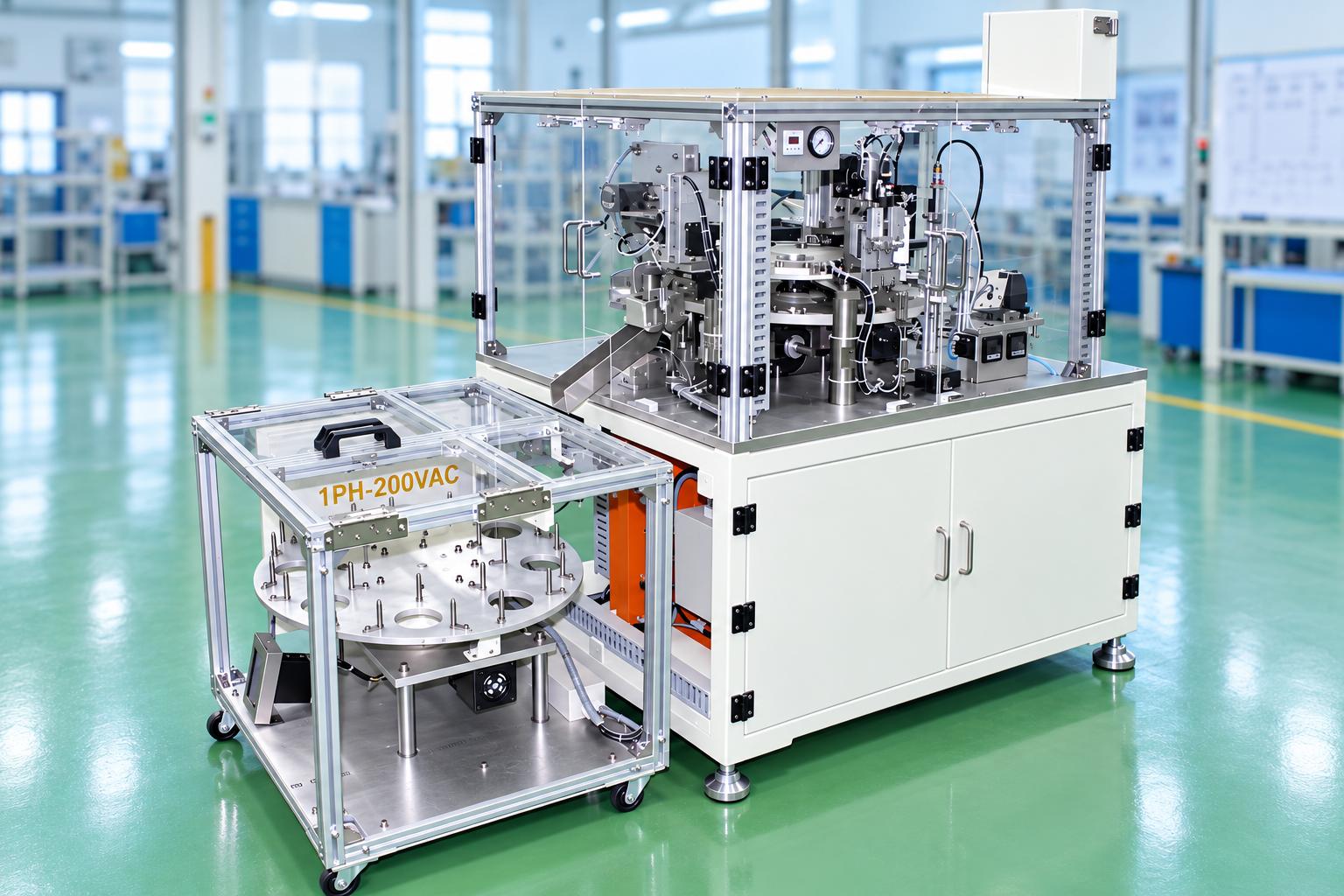
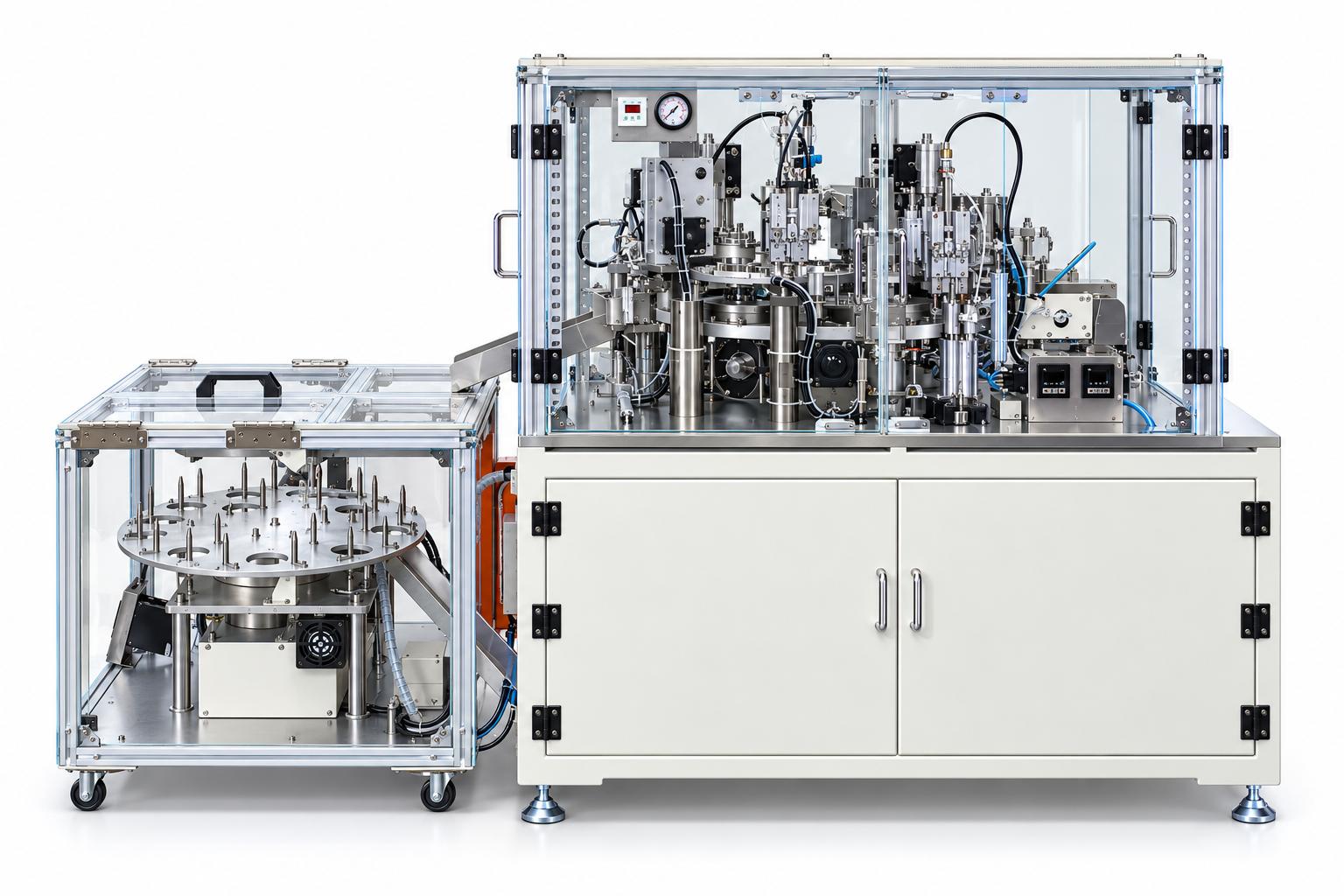
Automatic assembly and packaging machine
Automatic assembly and packaging machine integrates component feeding, assembly, inspection, sorting, and quantity-based product collection into a single system. The machine utilizes an indexing rotary table, pick-and-place mechanisms, press-fitting units, and sensors to perform each operation according to a programmed sequence. After assembly, products are inspected for color and assembly condition before being transferred to the collection unit or the reject outlet. The PLC control system and HMI enable program configuration, operation monitoring, and product quantity tracking. CNC VINA customizes machine configurations based on component characteristics, inspection requirements, and the product collection methods of each manufacturing facility.
VIETNAM CNC & TECHNOLOGY APPLICATION JOINT STOCK COMPANY
Hotline: +84.916 63 9355 / +84.915 74 4664
Email: Sales01@cncvina.com.vn / Sales03@cncvina.com.vn
Product description

Automatic assembly and packaging machine integrates component feeding, assembly, inspection, sorting, and quantity-based product collection into a single system. The machine utilizes an indexing rotary table, pick-and-place mechanisms, press-fitting units, and sensors to perform each operation according to a programmed sequence. After assembly, products are inspected for color and assembly condition before being transferred to the collection unit or the reject outlet. The PLC control system and HMI enable program configuration, operation monitoring, and product quantity tracking. CNC VINA customizes machine configurations based on component characteristics, inspection requirements, and the product collection methods of each manufacturing facility.
What is an automatic assembly and packaging machine?
An automatic assembly and packaging machine is an integrated system that combines component feeding, assembly, inspection, sorting, and product collection through a programmed control sequence. The machine can incorporate an indexing rotary table, pick-and-place mechanisms, sensors, and collection units to perform consecutive operations within a production line.
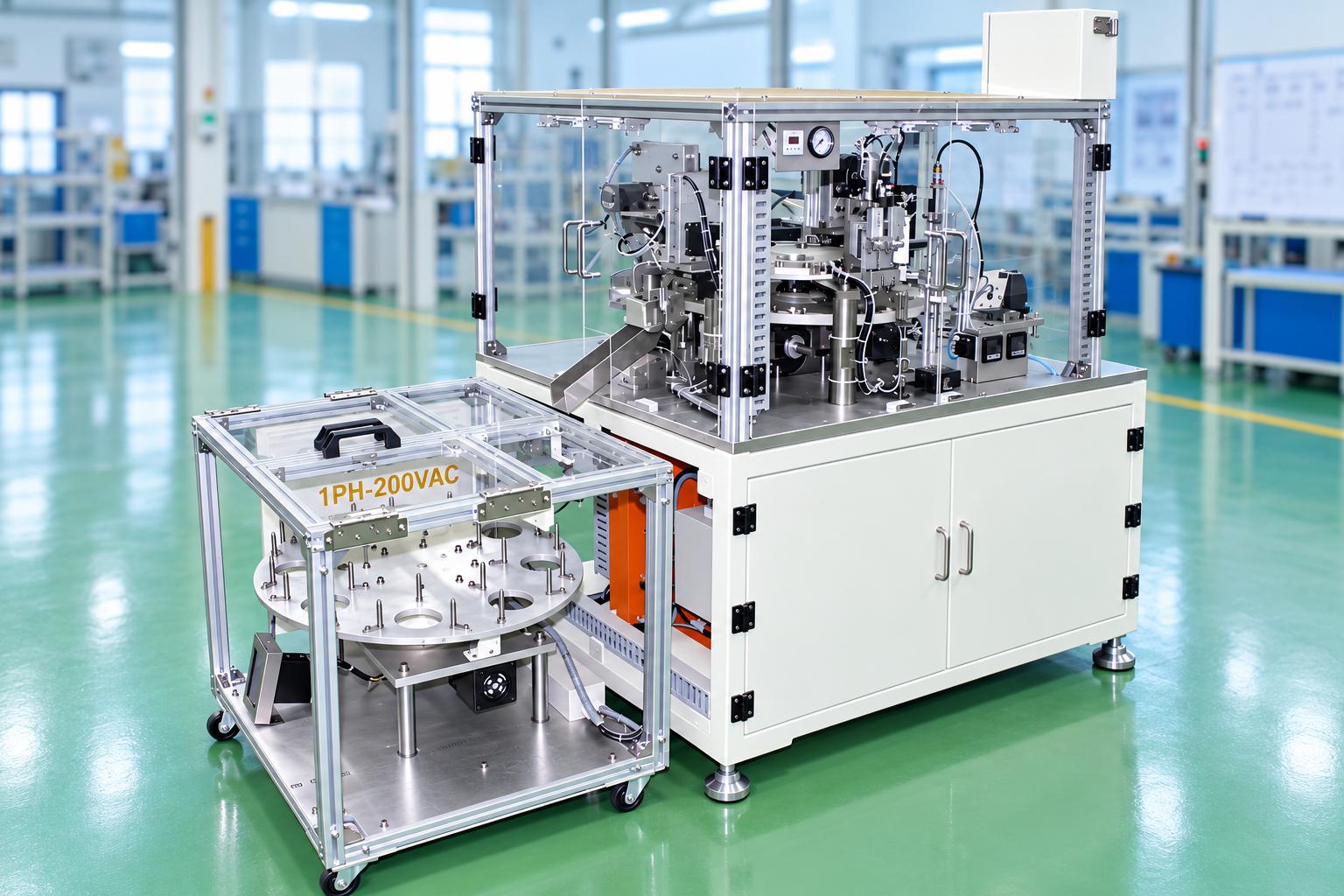
Role of the automatic assembly and packaging machine in manufacturing
In component manufacturing, arranging feeding, assembly, inspection, and collection as separate processes requires frequent product transfers between workstations. For products with multiple variants or post-assembly inspection requirements, manufacturers must also ensure that the correct components are supplied and distinguish conforming products from defective ones. The CNC VINA automatic assembly and packaging machine integrates these processes into a unified operating sequence. The housing is placed onto a fixture on the indexing rotary table and moves through the assembly, pressing, and inspection stations. Products that pass inspection are transferred to the collection unit, while rejected products are directed to a separate outlet. This integrated configuration reduces manual product handling, supports assembly process control, and enables product quantity tracking directly at the machine. Actual production capacity is determined based on product characteristics, feeding conditions, and trial operation results.
Key features of the CNC VINA automatic assembly and packaging machine
-
Integrated processing operations: Combines component feeding, assembly, inspection, sorting, and product collection within a single system.
-
Indexing rotary table: Transfers products between workstations using dedicated positioning fixtures.
-
Automatic feeding and assembly: Utilizes vibratory feeders, pick-and-place mechanisms, heating units, and press-fitting mechanisms.
-
Inspection and sorting: A color sensor and two contact probes help detect conditions that do not meet the configured inspection criteria.
-
Quantity-based product collection: An eight-tube rotary collection table automatically indexes to the next receiving position when the preset quantity is reached.
-
PLC and HMI control: Supports machine operation, program selection, production quantity monitoring, and fault history tracking.
These features represent a reference machine configuration. When changing products, the fixtures, feeding mechanisms, inspection methods, and output requirements must be reassessed.
Structure and technology of the automatic assembly and packaging machine
Component feeding units with vibratory feeders and pick-and-place mechanisms
The machine uses separate feeding units for housings and retaining components. Vibratory feeders deliver components to their pickup positions, where pick-and-place mechanisms transfer the housings onto the fixtures and position the retaining components at the assembly station. The system combines stepper motors, pneumatic actuators, and gripping or vacuum pickup mechanisms according to the requirements of each operation.
The design of the feeders, grippers, and fixtures depends on the product geometry, dimensions, and required feeding orientation. At the retaining component feeding station, the machine incorporates a hot-air heating unit, a temperature sensor, and a temperature control mechanism. Heating conditions are established according to material properties and assembly requirements and must be validated through sample testing.
Indexing rotary table and dedicated assembly unit
The indexing rotary table transfers products through the feeding, assembly, pressing, and inspection stations according to the programmed sequence. The housing is secured in a positioning fixture, while the pick-and-place mechanism places the retaining component into its designated assembly position. At the pressing station, a pneumatic cylinder works together with the press head and supporting mechanism to complete the assembly operation.
The PLC coordinates the movements of the rotary table and associated mechanisms based on feedback signals, ensuring that the programmed conditions are satisfied before proceeding to the next step. The fixtures, press head, and supporting mechanism are designed according to the product's positioning references. When component dimensions or structures change, the contact positions, required assembly force, and allowable deformation limits must be reassessed.
Color and assembly condition inspection unit
A color sensor located near the housing feeding area compares the product color with the selected production program, helping detect incorrect color variants. After assembly, the product is inspected using two contact probes positioned on opposite sides of the retaining component. Inspection signals are transmitted to the control system to determine whether the product meets the configured criteria. The HMI displays fault information, helping operators identify the areas requiring inspection.
The inspection scope depends on product characteristics and the measurement method. Additional requirements, such as retention force testing, other dimensional measurements, or post-assembly functional testing, must be specified separately during the design stage.
Product marking and sorting mechanism
Products that meet the inspection criteria are transferred to the marking station. A pick-and-place mechanism then transfers them to the guide chute leading to the collection unit. Rejected products are pneumatically ejected into a separate collection chute according to the programmed sequence. This arrangement separates accepted and rejected products directly within the production process. During acceptance testing, both defect detection capability and sorting accuracy must be verified to ensure that products are directed to the correct collection locations.
Quantity-based collection unit with an eight-tube rotary table
The collection unit is connected to the assembly machine through a product guide chute. Its rotary table holds eight collection tubes, positioning each tube at the receiving station in sequence. When the number of products collected in a tube reaches the preset quantity, the rotary table indexes to the next receiving position.
Sensors monitor the product receiving status, and the system generates an alert when product removal is required. This mechanism supports quantity-based batch collection, facilitating handling in subsequent processes. This is a quantity-based collection function and does not include bagging, boxing, or finished packaging. If complete packaging is required, the manufacturer must additionally specify the packaging materials and corresponding mechanisms.
PLC control system and HMI
The PLC coordinates the operation of the rotary table, feeding mechanisms, assembly stations, inspection units, and collection system. Sensor signals are used to verify the conditions required to proceed between operating steps and to handle abnormal conditions. The HMI supports manual and automatic operation, product color selection, program configuration, and production data monitoring.
Displayed information includes accepted and rejected product counts, collection unit status, operating time, and fault history. The reference configuration includes a start-of-shift sampling program and inspection using samples with known results, helping verify the sorting function before production begins. Requirements for long-term data storage or integration with a Manufacturing Execution System (MES) must be specified separately.
Operating principle of the automatic assembly and packaging machine

The operating process is controlled by the PLC, using sensor feedback and the operating conditions of each mechanism.
-
Production preparation: Check the fixtures, power supply, compressed air system, feeding units, collection containers, and product program.
-
Component feeding: Housings and retaining components are loaded into their respective feeders. Vibratory feeders deliver the components to the pickup positions.
-
Product positioning: The pick-and-place mechanism positions the housing on the indexing rotary table fixture, while the color sensor checks its color against the selected production program.
-
Assembly and pressing: The rotary table transfers the product to the retaining component assembly station, followed by the pressing station to complete the assembly.
-
Inspection and sorting: The inspection unit checks the assembly condition. Accepted products are marked and transferred to the collection unit, while rejected products are directed to a separate outlet.
-
Quantity-based collection: Accepted products are transferred into collection tubes. The collection table indexes to the next position when the preset quantity is reached.
-
Monitoring and product removal: The operator monitors the HMI, responds to alarms, and removes collected products according to the operating procedure.
Before continuous operation, the machine should be tested using representative samples to verify feeding performance, assembly quality, and sorting results. Following a product changeover or an abnormal event, the relevant operating conditions must be rechecked before production resumes.
Applications of the automatic assembly and packaging machine
Electrical and electronic component assembly
The automatic assembly machine can be considered for products consisting of housings and retaining components that require multiple consecutive assembly operations. The indexing rotary table and dedicated fixtures help maintain accurate product positioning during feeding, pressing, and inspection.
Suitability must be verified according to the structure, materials, and technical requirements of each component type.
Industrial and automotive component assembly
For components requiring positioning, press-fitting, and post-assembly inspection, CNC VINA can develop a machine configuration tailored to the application. The proposed system can integrate component feeding, handling mechanisms, inspection, and sorting within a single machine. Products with different geometries may require modifications to the feeding units, grippers, and positioning fixtures.
Multi-variant production and batch collection
For products available in multiple color variants, the color sensor helps verify that incoming components match the selected production program. After assembly, accepted products are collected according to preset quantities for subsequent inspection, further assembly, or transfer to a final packaging process.
Technical specifications of the automatic assembly and packaging machine
|
Item |
Reference specifications |
|---|---|
|
Main functions |
Component feeding, assembly, inspection, sorting, and collection |
|
Assembly components |
Housings and retaining components |
|
Main power supply |
AC 220 V, single-phase, 50 Hz |
|
Control power supply |
DC 24 V |
|
Compressed air pressure |
0.4–0.6 MPa |
|
Feeding mechanism |
Component feeders and vibratory units |
|
Handling mechanisms |
Stepper motors, pneumatic actuators, gripping or vacuum pickup mechanisms |
|
Product transfer mechanism |
Indexing rotary table |
|
Inspection system |
Color sensor and two contact probes |
|
Sorting mechanism |
Marking of accepted products and separation of rejected products |
|
Collection unit |
Eight-tube rotary collection table |
|
Control system |
PLC and HMI |
|
Reference design cycle time |
2 seconds/product |
The above specifications represent a reference configuration developed by CNC VINA. The cycle time of 2 seconds per product is a design value indicated in the engineering drawings and does not constitute a guaranteed production rate under all operating conditions. Actual production output must be evaluated through trial operation, considering feeding performance, product acceptance rate, product removal time, and machine downtime. The installation area must also provide sufficient space for operation, product collection, and maintenance.
Criteria for selecting an automatic assembly and packaging machine
Product characteristics and assembly requirements
Manufacturers should provide drawings or samples of the housing, retaining component, and completed assembly.
Important information includes dimensions, materials, positioning references, assembly orientation, required pressing force, and the expected condition after assembly. These details form the basis for selecting suitable fixtures, grippers, and pressing mechanisms.
Feeding conditions and product changeover capability
Component geometry, dimensions, burrs, surface conditions, and feeding orientation should be evaluated when designing the vibratory feeders and pick-and-place mechanisms. For production involving multiple product models, the mechanical components requiring replacement or adjustment must be identified. Selecting a different program on the HMI does not automatically enable the machine to handle every product type.
Inspection and sorting requirements
Manufacturers must clearly define the defects to be detected, such as incorrect color, missing retaining components, or improper assembly positions. Each inspection criterion should have corresponding accepted samples, defective samples, and an appropriate inspection method. Additional requirements, such as retention force testing or dimensional measurement, must be included in the machine's design scope.
Production capacity and collection method
When selecting the machine, manufacturers should establish the target production output, quantity per batch, product removal time, and output handling requirements. For the eight-tube collection configuration, tube capacity, product transfer paths, and indexing conditions must be verified. If bagging, boxing, or labeling is required, additional packaging processes must be incorporated.
Sample testing and machine acceptance
Sample testing helps evaluate whether the automatic assembly and packaging machine meets the specified production requirements. Testing should use components representative of actual operating conditions, including predefined accepted and defective samples.
Key evaluation criteria include:
-
Stable component feeding and pickup performance.
-
Assembly position, condition, and finished-product quality.
-
Detection of incorrect colors and assembly defects within the designed inspection scope.
-
Accurate sorting of accepted and rejected products.
-
Collection of the correct quantities and reliable switching between collection positions.
-
Machine behavior during stopping, cycle completion, and restarting.
Acceptance testing should evaluate the entire process, from component feeding to product output.
Actual production capacity should be verified based on the number of accepted products produced during an agreed trial period, while recording feeding time, product removal time, and machine stoppages.
Operation and maintenance
Before operation, the feeding units, grippers, fixtures, inspection components, compressed air supply, and collection unit status must be checked. The selected product program and machine readiness conditions should be verified according to the operating instructions. During production, operators should monitor feeding performance, assembly quality, sorting results, and collection status. If an alarm occurs or an abnormal product is detected, the machine should be stopped according to the established procedure to identify the cause. Maintenance focuses on vibratory feeders, pick-and-place mechanisms, fixtures, press heads, sensors, pneumatic systems, and moving components. When clearing jams, replacing fixtures, or accessing the machine interior, the machine must be stopped and the relevant energy sources isolated in accordance with established safety procedures.
Frequently asked questions about the automatic assembly and packaging machine
What processes does the automatic assembly and packaging machine perform?
The machine integrates component feeding, assembly, inspection, sorting, and product collection according to a programmed sequence. Operators are still responsible for supplying components, selecting programs, removing products, and monitoring machine operation. The degree of automation depends on the machine configuration.
Can the machine inspect and reject defective products?
Yes, within the scope of its installed inspection functions. The reference configuration uses a color sensor and two contact probes. Products that fail the inspection criteria are directed to a separate outlet. Additional inspection requirements must be incorporated into the machine design.
Does the eight-tube collection unit provide complete packaging?
No. The eight-tube collection unit collects products according to preset quantities. It does not include bagging, boxing, or labeling. Final packaging operations must be designed separately if required.
Can the machine assemble different product types?
A multi-product configuration can be considered if the technical requirements are met. Product changeovers may require adjustments or replacement of feeding units, grippers, fixtures, pressing mechanisms, and inspection methods. Compatibility must be verified using actual product samples.
CNC VINA – Custom automatic assembly and packaging machine design and manufacturing
The CNC VINA automatic assembly and packaging machine integrates component feeding, assembly, inspection, sorting, and product collection into a single system. Machine configurations can be customized according to component characteristics, assembly methods, inspection requirements, and factory output handling processes. With extensive experience in industrial machinery design, manufacturing, and automation systems, CNC VINA provides solutions tailored to specific production requirements. Before project implementation, manufacturers are encouraged to provide product drawings, component samples, and target production capacity so that technical solutions, sample testing, and acceptance criteria can be evaluated and agreed upon. Contact CNC VINA to discuss your requirements for a customized automatic assembly and packaging machine.
VIETNAM CNC & TECHNOLOGY APPLICATION JOINT STOCK COMPANY (CNC VINA)
Factory: Song Cung Industrial Cluster, Dong Thap Commune, Dan Phuong District, Hanoi, Vietnam.
Office: Rox Tower Goldmark City, 136 Ho Tung Mau Street, Phu Dien Ward, Hanoi, Vietnam.
Phone: +84 916 639 355 / +84 915 744 664
Website: www.cncvina.com.vn | www.cncvina.net
Email: sale01@cncvina.com.vn | sales03@cncvina.com.vn