 Tiếng
Việt
Tiếng
Việt
 Tiếng
Anh
Tiếng
Anh
 Tiếng
Nhật
Tiếng
Nhật




 Tiếng Anh


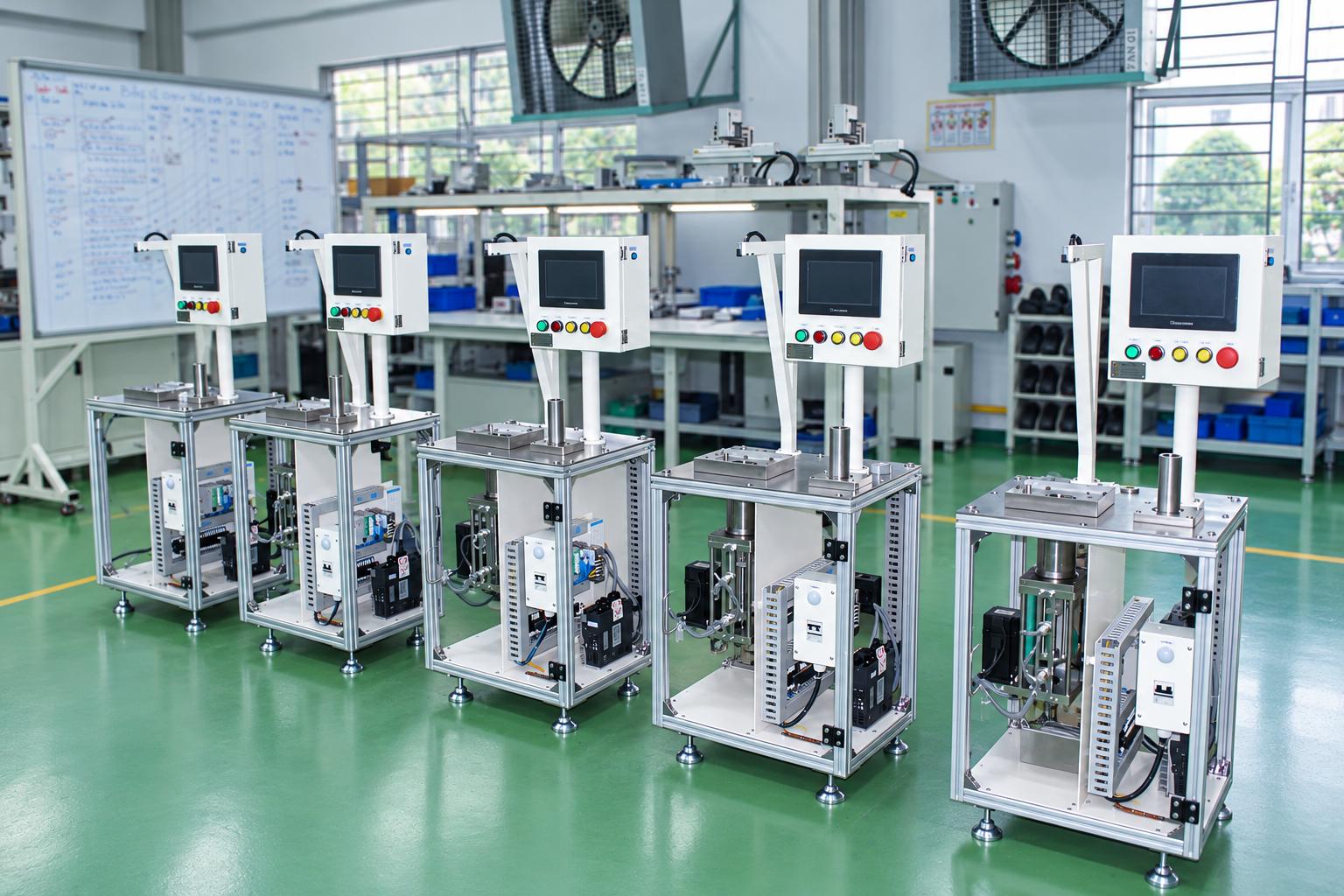
Ultrasonic welding machine for car plastic bumpers
Ultrasonic welding machine for plastic bumpers for cars and household products, electronic components, cars and motorbikes, medical equipment on automatic machines. The machine is designed with multiple ultrasonic welding heads, according to product requirements.
Automatic and semi-automatic operation with PLC control system, user safety sensors. Optimal fixture and jig system, easy to replace, suitable for many different product models requiring ultrasonic welding.
If you have any needs, please contact us for advice and support:
VIETNAM CNC & TECHNOLOGY APPLICATION JOINT STOCK COMPANY
Hotline: +84.916 63 9355 / +84.915 74 4664
Email: Sales01@cncvina.com.vn / Sales03@cncvina.com.vn
Product description

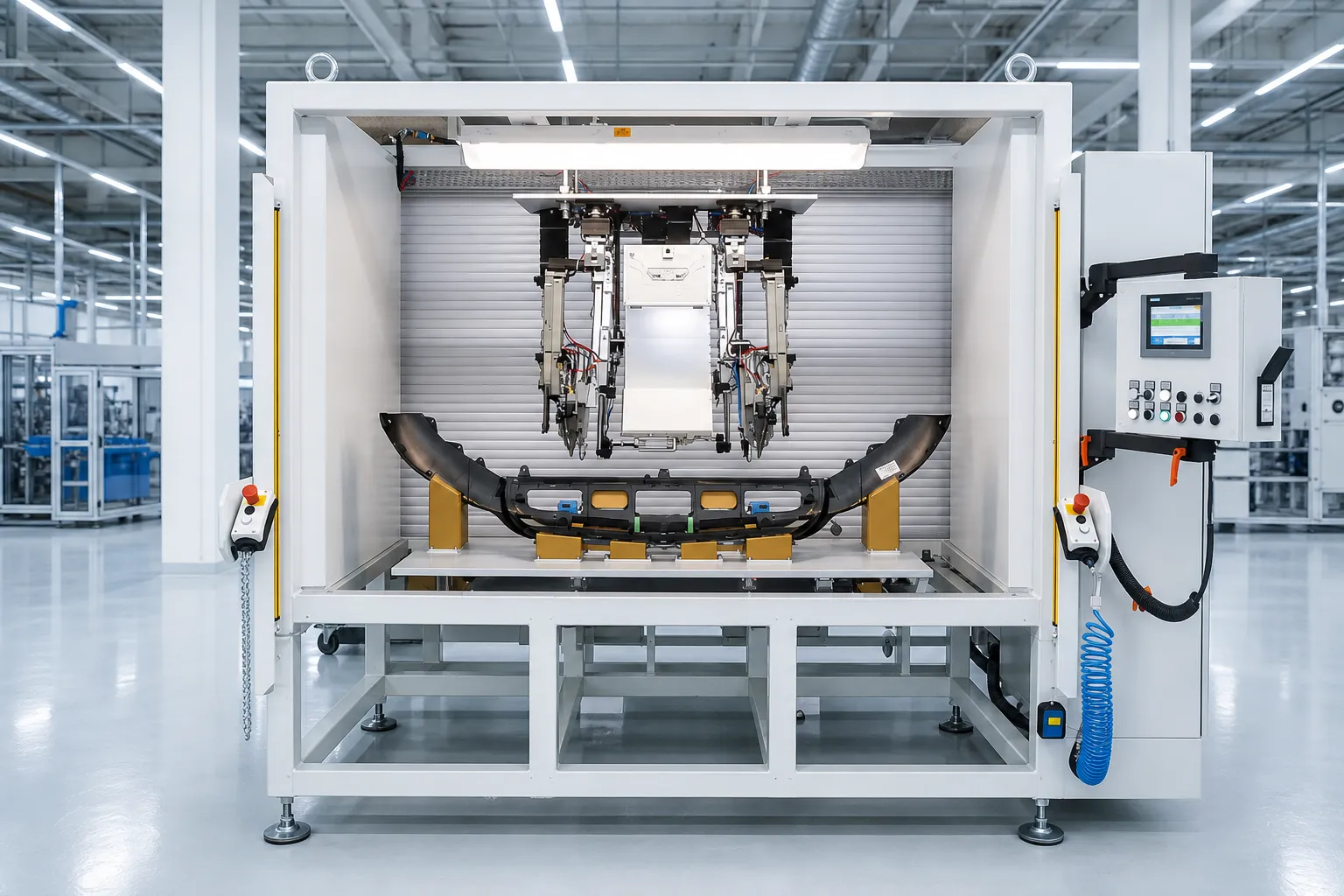
The ultrasonic welding machine for automotive plastic bumpers is equipment used in the processing and finishing of plastic components for front and rear automotive bumpers. During the manufacturing process, bumpers require not only dimensional accuracy but also precise processing at various positions for installing auxiliary components, sensors, and connecting parts before assembly. Ultrasonic welding enables plastic components to be joined quickly through high-frequency vibrations, making it suitable for manufacturing products with large dimensions and complex structures. Depending on the type of bumper, the machine can be designed with different configurations and operating methods to meet specific production requirements. The equipment can also integrate multiple processes within a single system, helping reduce manual operations and maintain consistency throughout production cycles. With a high level of automation, ultrasonic welding machines for automotive plastic bumpers are increasingly used in production lines for automotive components and parts. The ultrasonic welding machine for automotive plastic bumpers, designed and manufactured by CNC VINA, is one of the solutions that helps manufacturers improve productivity and maintain quality control during the processing of plastic products.
Technical specifications of the ultrasonic welding machine for automotive plastic bumpers
| Operating frequency | 15 kHz or 20 kHz |
| Power | 2000 W |
| Operating voltage | 220 VAC, 50–60 Hz |
| Air pressure | 0.5 - 0.7 MPa |
| Operating temperature | 0 - 300 °C |
| Welding time | Adjustable, from 0.1 to 10 seconds |
| Working dimensions | Customizable to suit the bumper size |
| Welding materials | ABS, PP, PE, PVC and other types of plastic |
| Welding performance | Strong and consistent joints |
What Is the structure of the ultrasonic welding machine for automotive plastic bumpers?
The ultrasonic welding machine for plastic bumpers is designed with multiple integrated mechanisms to perform the positioning, clamping, and welding of plastic components on automotive bumpers in a stable and consistent manner. Depending on the shape, size, and welding positions of each product, the machine configuration can be customized in terms of the number of welding heads, welding power, stroke, horn shape, and motion mechanism. A complete system typically consists of the following main components:
1. Ultrasonic welding head system
The welding head is the component that directly performs the welding process on plastic components mounted on the bumper. The welding head assembly is selected based on the type of plastic material, product dimensions, welding position, and required joint strength. Depending on the product, the machine can be equipped with one or multiple welding heads arranged at different positions. The welding power, operating frequency, pressing stroke, and horn shape are calculated and configured according to the specific bumper design.
The horn (ultrasonic welding tool) is machined according to the actual shape of the product and its contact position. For bumpers with multiple welding points or complex welding geometries, individual horns can be designed for each area to ensure accurate contact and stable transmission of ultrasonic energy to the plastic component. The welding head assembly can be designed as a fixed unit or arranged as a multi-head system depending on the number and positions of welding points required on the product.
2. Welding head motion mechanism
The welding head assembly is integrated with a motion mechanism that moves the horn to the required welding position. In an automated system, the welding head can move vertically according to a preset stroke. The motion mechanism typically includes:
- Motor or transmission mechanism.
- Pneumatic cylinder for pressing movement.
- Linear rails or slide guides.
- Stroke limit mechanism.
- Position sensors.
- Welding head mounting assembly.
The use of slide guides and linear guidance mechanisms helps ensure stable movement of the welding head and minimize vibration during the pressing process. The welding head stroke can be adjusted according to the height and shape of the bumper.
For products with multiple welding positions or complex curved surfaces, the machine can use a robotic arm instead of a fixed welding head mechanism. The robot can move the welding head to multiple positions according to a programmed sequence, providing greater flexibility when processing products with complex geometries.
3. PLC/CNC control system
The control system manages the entire operating cycle of the machine. The machine can be programmed using a PLC or CNC system, depending on the motion requirements and level of automation.
The control system coordinates the operation of the welding head mechanism, pneumatic system, sensors, fixture, and safety devices.
A typical welding cycle can be programmed in the following sequence:
Product positioning → safety condition check → product clamping → welding head movement → pressing and welding → holding for the preset time → welding head returns to the initial position → cycle completion.
The parameters of each operation can be configured through the control system according to the product requirements. If an abnormal condition is detected, the system can stop the cycle and issue an alarm, allowing the operator to inspect and address the problem.
4. Bumper fixing fixture
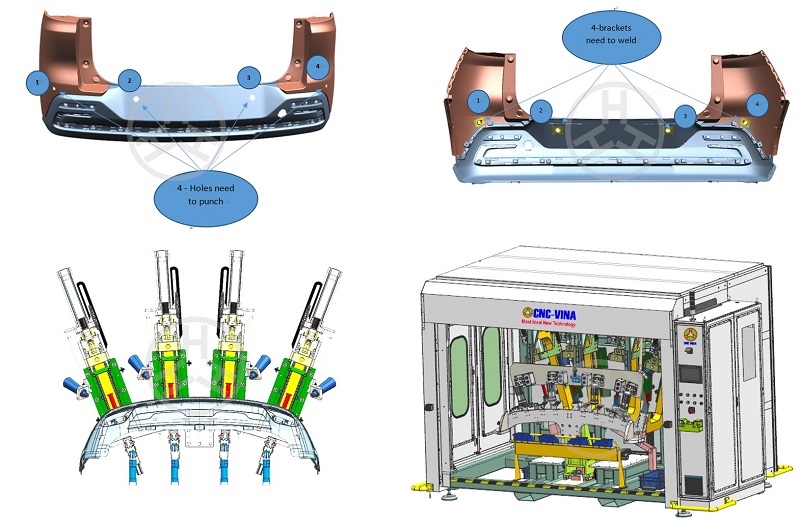
The fixture is an important component used to securely hold the bumper throughout the welding process. Since automotive bumpers are large, curved, and feature multiple assembly positions, the fixture is custom-designed for each specific product.
The fixture body and positioning components can be CNC machined to ensure high accuracy during product installation and positioning. Support points, locating pins, and clamping mechanisms are arranged according to the actual shape and structure of the bumper.
The fixture is designed to:
- Position the bumper accurately before welding.
- Keep the product stable while the welding head is operating.
- Minimize product movement or deformation.
- Ensure that welding points are processed at the correct positions.
- Facilitate fixture removal, installation, and product changeover.
For production lines handling multiple bumper models, the fixture can be designed in a modular configuration to facilitate easy removal, replacement, and relocation when switching to a different product model.
5. Safety sensor system
The ultrasonic welding machine for automotive plastic bumpers is equipped with sensors to monitor the status of the product, fixture, safety doors, and moving mechanisms. Depending on the machine configuration, the sensors can be used to confirm:
- The bumper has been correctly positioned.
- The fixture is in the working position.
- The clamping mechanism has completed its operation.
- The safety door is closed.
- The welding head has returned to the correct position.
- The punching mechanism has completed its stroke.
- All necessary conditions have been met before starting the welding cycle.
This helps prevent the machine from operating when the product has not been properly positioned or when the required safety conditions have not been met.
6. Electrical cabinet and operating control system
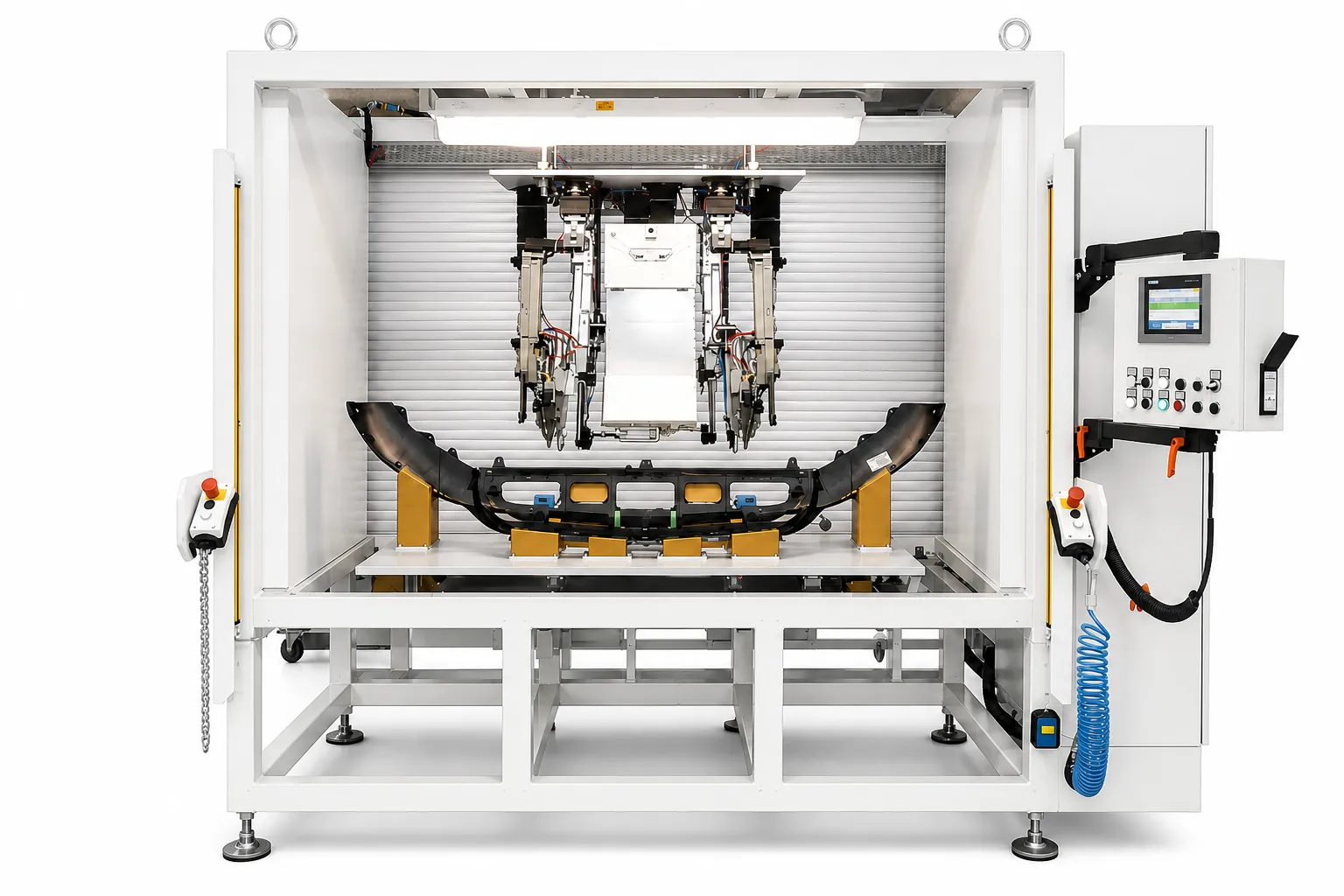
The electrical cabinet houses the machine's control and protection components, including the PLC, switching devices, controllers, power supply units, welding head control equipment, and other related electrical components.
A control panel or HMI screen can be installed on the outside of the machine, allowing operators to select operating modes, monitor equipment status, and adjust parameters within the configured range.
The control interface can also display error codes and alarm statuses, helping operators quickly identify the area that requires inspection when a fault occurs.
7. Error alarm system
The alarm system is connected to the PLC and sensors throughout the machine to detect abnormal conditions during operation. When an error occurs, the machine can provide warnings through indicator lights, audible alarms, or notifications displayed on the control screen.
At the same time, the operating cycle can be stopped at a safe position, allowing the operator to identify and inspect the cause before resuming production. Integrating an alarm system makes machine operation easier to monitor and helps reduce the risk of operating errors during the production process.
Common applications of multi-head ultrasonic welding machines
- Automotive industry: Front and rear bumper components, automotive lighting, dashboards, control panels, automotive doors, and other plastic components.
- Toy industry: Toy guns, toy phones, model cars, model airplanes, and other products made from synthetic plastics.
- Electronics industry: Wristwatches, computers, televisions, speaker enclosures, and other electronic components.
- Light manufacturing: Lighting fixtures and other plastic products.
- Packaging industry: PVC plastic boxes and other plastic packaging products.
- Plastic ultrasonic welding: Suitable for materials such as ABS, PE, PC, PS, PVC, PP, and other compatible plastics.
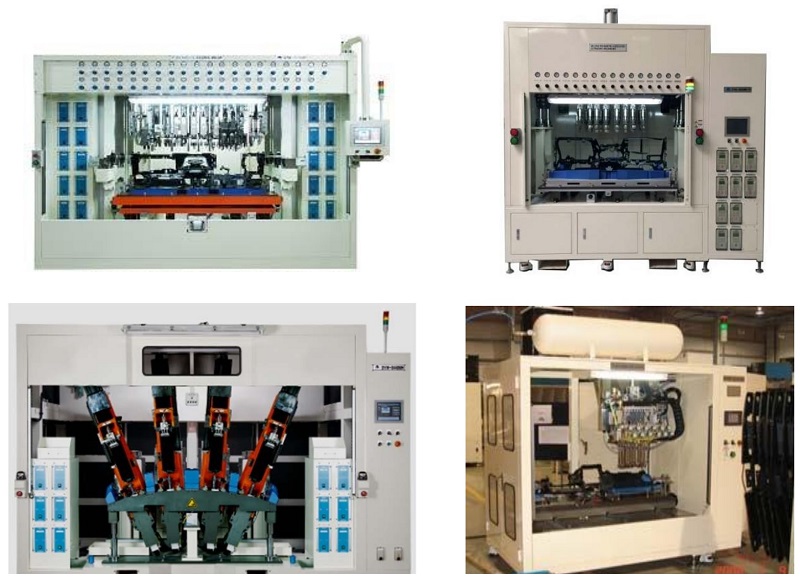
The ultrasonic welding machine for automotive plastic bumpers meets the demand for processing and joining plastic components during the production of bumpers and automotive parts. Compared with manual processing methods, the application of an automated ultrasonic welding system helps streamline production processes while maintaining greater consistency between products within each production cycle. The machine can be designed to accommodate various bumper shapes, product dimensions, and processing requirements, ranging from single-head welding systems to multi-head configurations and integrated automation solutions. In addition to welding, the equipment can also incorporate other necessary processing operations to suit the specific production process of each manufacturer. Integrating the machine into a production line helps reduce repetitive manual operations, shorten processing time, and improve overall production efficiency. If you are interested in this product, please contact CNC VINA for a suitable solution tailored to your company's specific product and production requirements.
Customers interested in automatic ultrasonic welding machines, plastic ultrasonic welding machines, metal welding, and ultrasonic welding and cutting solutions for their products please contact:
VIETNAM CNC & TECHNOLOGY APPLICATION JOINT STOCK COMPANY
Factory: Song Cung Industrial Site, Dong Thap Commune, Dan Phuong District, City. Hanoi Vietnam
Phone: +84.916 63 9355 / +84.915 74 4664
Website: https://cncvina.com.vn; https://cncvina.net; https://cncviname.com.vn
Email: Sales01@cncvina.com.vn | Sales03@cncvina.com.vn