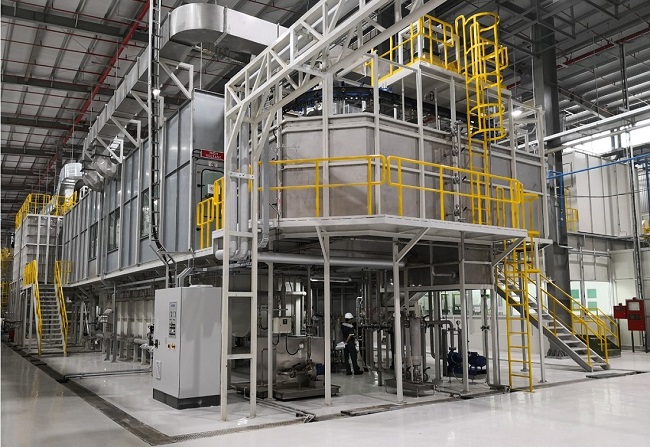
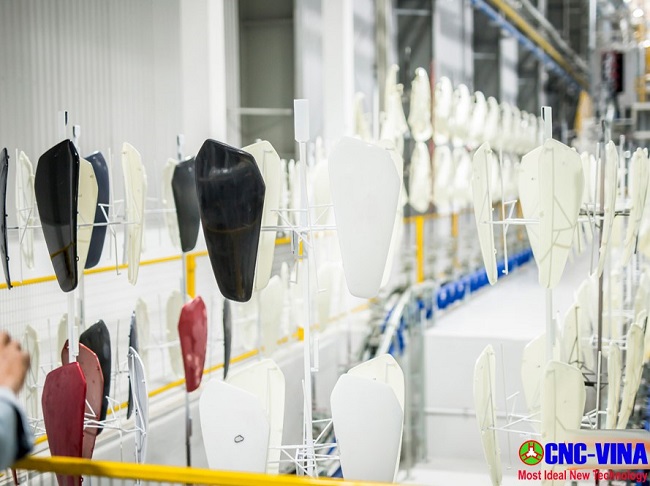
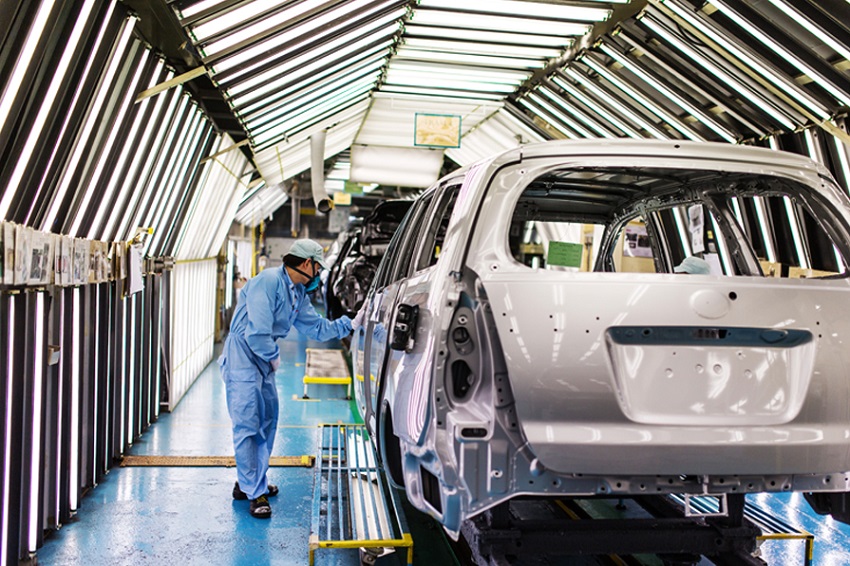
Overview of powder coating lines
What is powder coating?
Before learning about a powder coating line, it is important to understand the characteristics of powder coating technology. Powder coating is a coating technology that uses dry powder as the coating material and is widely applied to metal products. Among the available application methods, electrostatic powder spraying is commonly used. The powder particles are electrically charged and sprayed onto the product surface. The coated product is then transferred to a curing oven, where heat causes the powder to melt and cure, forming a continuous coating film on the surface.
The quality of a powder coating depends on various factors, including the condition of the substrate surface, pretreatment method, type of powder coating, spraying conditions, coating thickness, and curing temperature and time. Therefore, to achieve the required coating uniformity and performance, the coating process must be properly designed and controlled according to the substrate material, product geometry, and intended application. Depending on the product and production scale, powder coating can be carried out as a batch process or integrated into a continuous coating line. In batch coating, certain operations such as product loading, handling, or powder spraying may still require operator involvement. As production volume increases or greater process consistency is required, manufacturers may consider a powder coating line with an appropriate level of automation to achieve better control over product flow and process parameters.
What is a powder coating line?
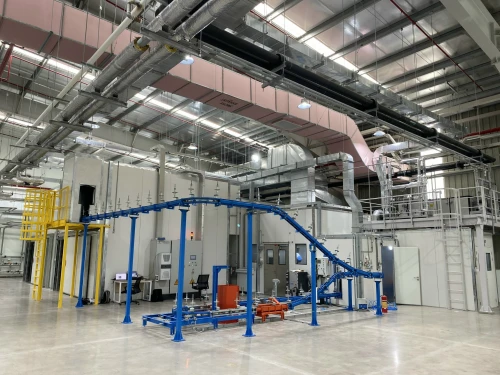
A powder coating line is a system of equipment arranged according to the required process sequence to perform surface preparation, drying, powder spraying, curing, and other post-coating operations as required. Products are transferred between process stages using suitable conveying systems, such as overhead chain conveyors or other handling mechanisms, depending on the product characteristics and line configuration. A powder coating line can be designed with different levels of automation. Depending on production requirements, product dimensions, material type, coating system, available factory space, and applicable standards, the line configuration may include pretreatment equipment, a powder coating booth, a powder recovery system, a curing oven, a conveying system, and a control system. The selection and layout of each component should be engineered as an integrated system to meet the technical requirements and actual operating conditions of each project.
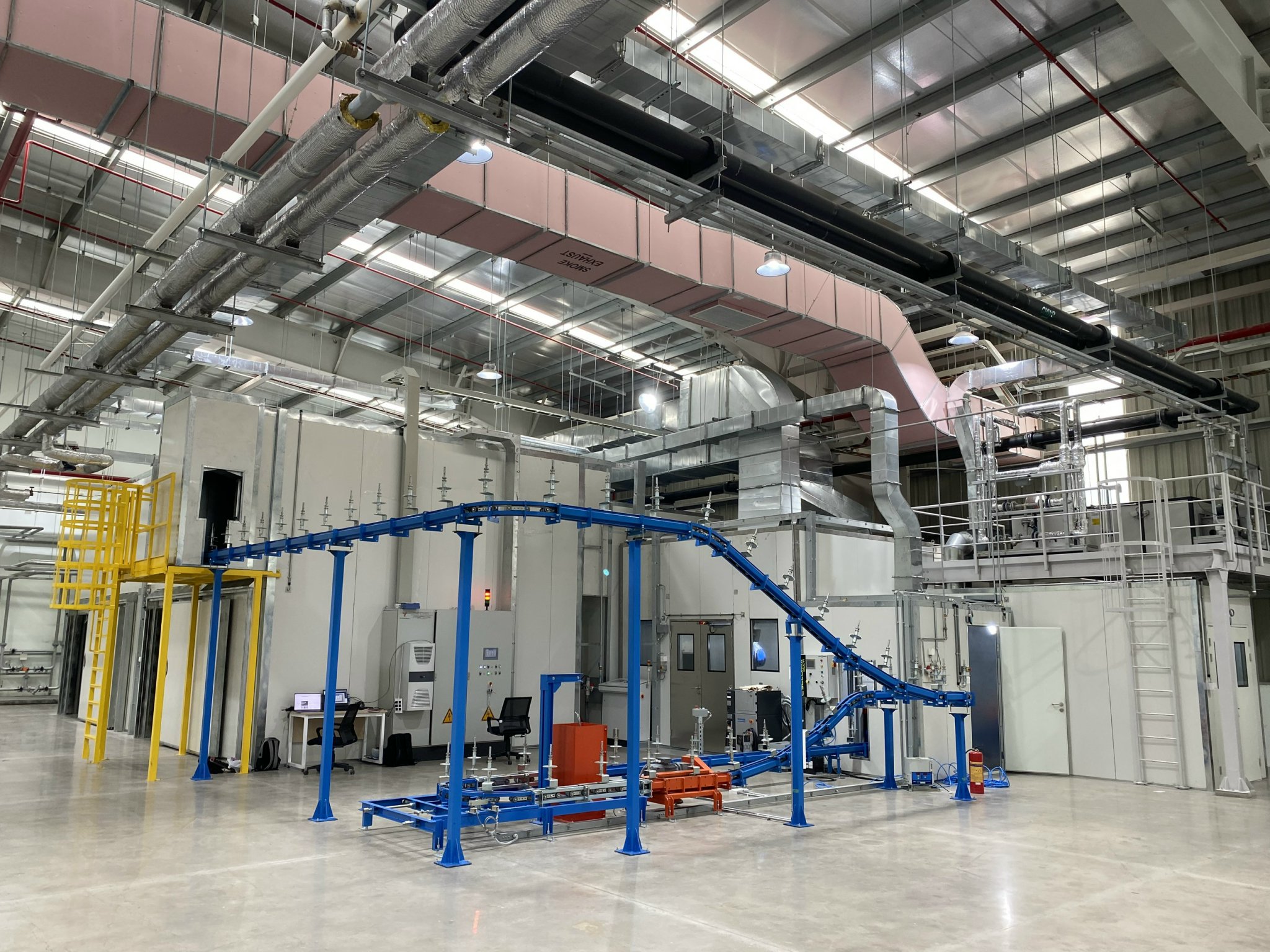
Automatic powder coating line
Powder Coating Line and Wet Painting Line
Both powder coating lines and wet painting lines are used to create protective coatings and provide the required surface finish for products. However, they differ in coating materials, application methods, coating film formation mechanisms, and post-application treatment requirements. Depending on the product type, substrate material, appearance requirements, production volume, and service conditions, manufacturers can select a suitable coating system. Despite their technological differences, the two types of coating lines share several similarities in surface preparation, product handling, and control of post-coating processes.
Similarities
Both powder coating lines and wet painting lines require control of the product surface condition before coating. Depending on the substrate material and coating system requirements, the surface may need to be cleaned of dust, oil and grease, chips, welding slag, rust, or existing coatings. Burrs, sharp edges, and other surface defects that may affect coating quality may also need to be addressed. The extent and method of surface preparation should be selected according to the substrate material, required adhesion, and coating system.
In continuous production lines, products can be transferred between process stages by overhead chain conveyors, roller conveyors, or other conveying mechanisms suitable for the product characteristics. Depending on the type of coating and process requirements, the line may also include drying or curing stages after coating. Therefore, the conveying system and process sequence should be designed as an integrated system based on production volume, product dimensions, and the required processing time at each stage.
Differences
The most significant differences between the two technologies lie in the coating material and the mechanism by which the coating film is formed. Powder coating uses a dry powder coating material, which is commonly applied using electrostatic powder spraying equipment. After the powder is deposited on the product surface, the coated product is transferred through a curing oven, where heat causes the powder to melt, form a continuous film, and develop the required coating properties. In some configurations, overspray powder can be collected through a powder recovery system and reused when the material, color, cleanliness, and other relevant conditions meet the requirements.
Wet painting, on the other hand, uses liquid paint and can be applied using various methods, such as pneumatic spraying, pressure spraying, airless spraying, or electrostatic spraying, depending on the paint system and product requirements. For coating systems containing solvents, spraying and drying processes may generate VOCs and other volatile components. Therefore, ventilation, collection, and exhaust treatment systems should be designed according to the type of paint, line capacity, and applicable environmental requirements.
The two technologies also differ in their drying and curing conditions. Powder coating generally requires heating to melt and cure the powder according to the conditions specified by the powder coating manufacturer. Wet paint, meanwhile, may dry or cure through solvent evaporation, chemical reactions, heating, or a combination of several mechanisms, depending on the coating system. Therefore, temperature, processing time, and treatment methods should be determined based on the characteristics of the coating material and the product.
Powder coating process
The powder coating process consists of multiple sequential stages designed to prepare the surface, apply powder coating to the product, and form the required coating film. In an industrial coating line, the typical process may include surface treatment, cleaning and product drying, powder spraying, curing, cooling, and quality inspection. Depending on the product type and level of automation, the actual configuration can be adjusted to suit production volume, product dimensions, substrate material, and appearance requirements.
During the spraying stage, powder coating is applied to the product surface using suitable spraying equipment. In electrostatic spraying, powder particles are electrically charged and deposited on the product surface under the influence of an electric field. The product is then transferred to a curing oven. Under the effect of heat, the powder melts and forms a continuous film before curing under the conditions specified for the coating system. Once the curing process is complete, the product is cooled before being transferred to subsequent stages.
Removal of contaminants
This is one of the important stages before coating. The product surface needs to be cleaned of substances that may affect film formation and coating adhesion, such as dust, oil and grease, chips, welding slag, rust, existing paint, or other contaminants depending on the surface condition. For metal products, surface treatment methods may include degreasing, water rinsing, chemical treatment, shot blasting, sandblasting, or other mechanical and chemical methods depending on the substrate material and coating system. After treatment, the surface should reach a condition that meets the applicable technical requirements before proceeding to the next stage. Surface condition has a direct impact on coating adhesion, uniformity, and appearance after curing. Therefore, when designing a powder coating line, the pretreatment process should be selected and integrated according to the product material, coating system, and actual operating conditions.
Surface conversion treatment
After cleaning, metal surfaces may undergo chemical conversion treatment depending on the substrate material, coating system, and corrosion protection requirements of the product. This process is intended to prepare the surface for the subsequent coating and support improved coating adhesion and surface protection performance. Common surface treatment methods used in powder coating lines include:
Chemical surface treatment: Uses a suitable treatment solution to clean, activate, or condition the metal surface before coating.
Phosphating: Forms a conversion coating on the metal surface to support corrosion resistance and provide a suitable surface for the subsequent coating.
Zinc phosphating: A type of phosphating treatment that uses zinc phosphate compounds to form a conversion coating on the surface. It is commonly selected when the coating system requires appropriate control of adhesion and corrosion protection performance.
The specific treatment method should be selected based on the metal type, surface condition, coating system, appearance requirements, and operating environment of the product. Not every product requires the same pretreatment process.
Rinsing
After the surface treatment stages, the product is rinsed to remove contaminants and residual treatment chemicals from the surface. Depending on the line configuration, this stage may use standard process water, treated water, or water of different quality levels according to the process requirements. Control of the rinsing process is important for limiting residual chemicals and contaminants before the product enters the drying stage. Water quality, number of rinsing stages, rinsing method, and treatment time can be designed according to the substrate material and pretreatment system.
Drying process
After rinsing, the product enters the drying stage to remove water and reduce residual moisture on the surface before powder spraying. Controlling the surface condition before coating helps minimize the effects of water or moisture on powder deposition and coating quality. Depending on the product type, material, and line configuration, the drying system can be designed with appropriate temperature, residence time, and air circulation conditions. For products with complex geometries, particular attention should be paid to drainage and drying at corners, gaps, holes, and other difficult-to-reach areas.
Powder spraying
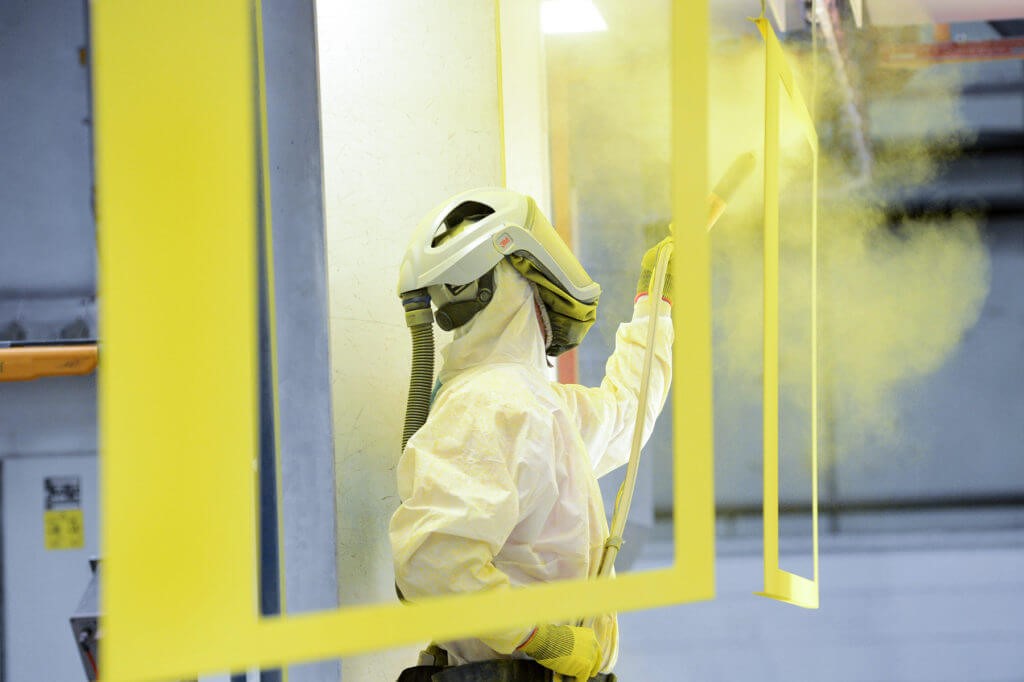
Powder spraying is the stage in which powder coating material is applied to the product surface. In an electrostatic powder spraying system, the powder is stored in a powder hopper and delivered to the spray gun through a feed system combined with compressed air. The spray gun electrically charges the powder particles, allowing them to be attracted to and deposited on the product surface under the influence of an electric field. During spraying, parameters such as powder feed rate, voltage, current, air pressure, gun-to-product distance, conveying speed, and gun position need to be adjusted according to the powder type, product geometry, and requirements for coating thickness and uniformity.
For automated coating lines, spray guns can be integrated with motion systems or robots to control the spray path according to the product geometry. Overspray powder can be collected by a dedicated powder recovery system. The feasibility of reuse depends on factors such as powder type, color, contamination level, and system configuration.
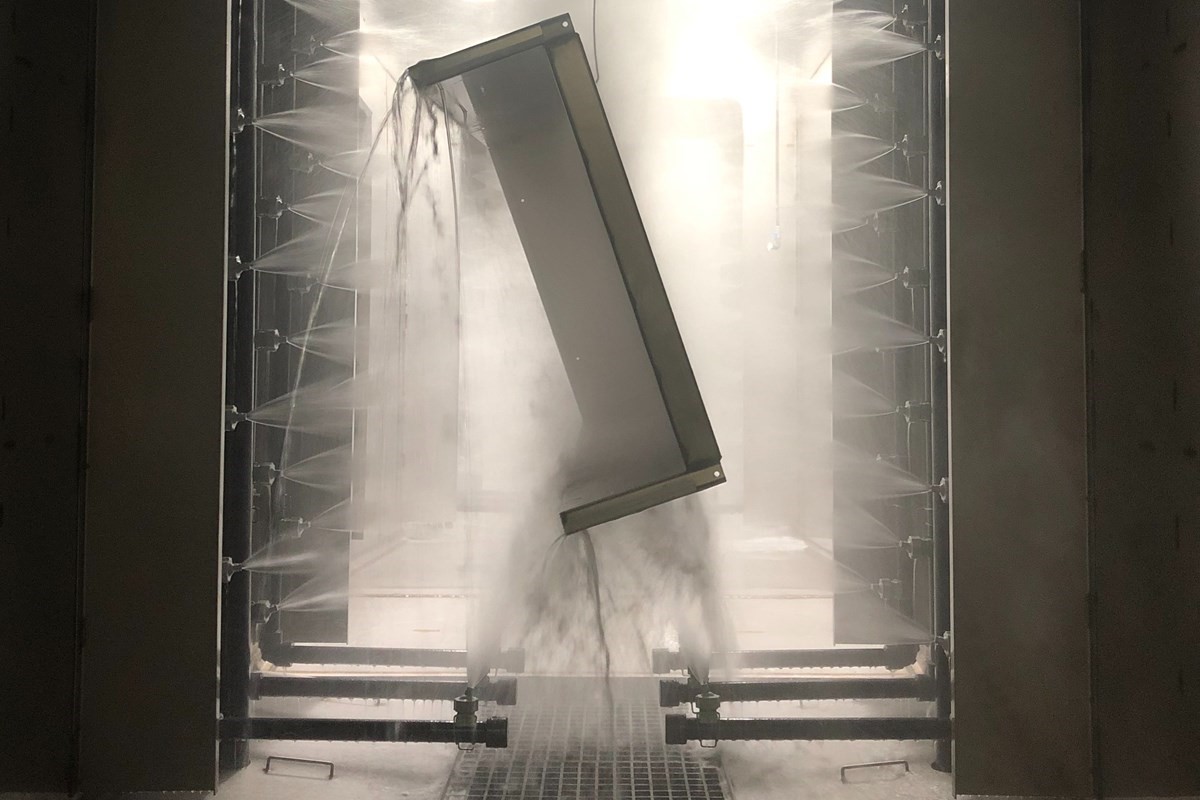
Cleaning step before powder coating process
Thermal treatment process
After powder spraying, the product is transferred by the conveying system into the curing oven. At this stage, the product is heated under conditions appropriate for the powder coating type, substrate material, product dimensions, and coating performance requirements. The oven temperature, residence time, and curing conditions need to be properly controlled so that the powder coating melts, forms a continuous coating film, and develops the required properties after curing.
Once the curing process is complete, the product is discharged from the oven and cooled to a suitable condition before being transferred to the next stage. For continuous coating lines, the residence time in the oven is calculated based on the conveying speed, product dimensions, and coating system requirements rather than being determined solely by the oven set temperature.
Powder coating line structure
Surface pretreatment equipment
Abrasive blasting booth
An abrasive blasting booth is used to treat metal surfaces by propelling abrasive media at high velocity onto the product surface. Depending on the substrate material, surface condition, and treatment requirements, the blasting media may include steel shot, metallic abrasive media, or other abrasive materials suitable for the equipment and process.
This process can be used to remove rust, oxides, mill scale, surface residues, or existing coatings where applicable, while also creating a suitable surface profile for subsequent coating. For products requiring high coating adhesion performance, the required level of surface cleanliness and the surface characteristics after blasting should be determined according to the substrate material, coating system, and applicable technical requirements.
The blasting booth is typically designed as an enclosed or semi-enclosed structure, depending on the configuration, to limit the release of dust and abrasive media into the surrounding area. The dust collection and filtration system removes dust generated during blasting while helping maintain stable operating conditions and minimizing the risk of dust redepositing on the product surface.
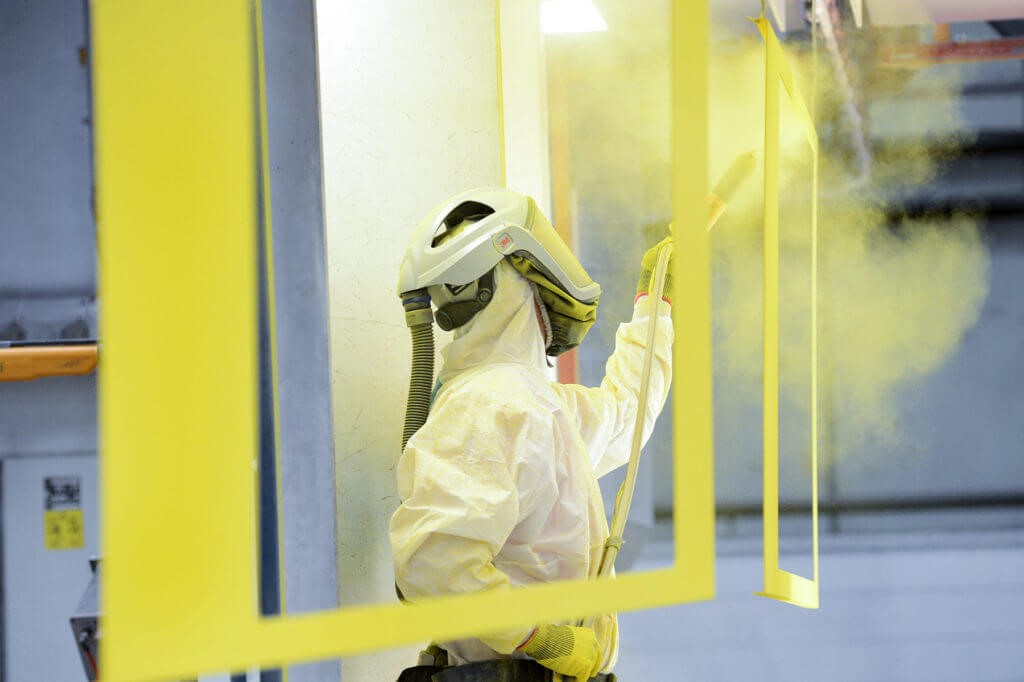
Powder coating process
Surface Treatment and Cleaning Station
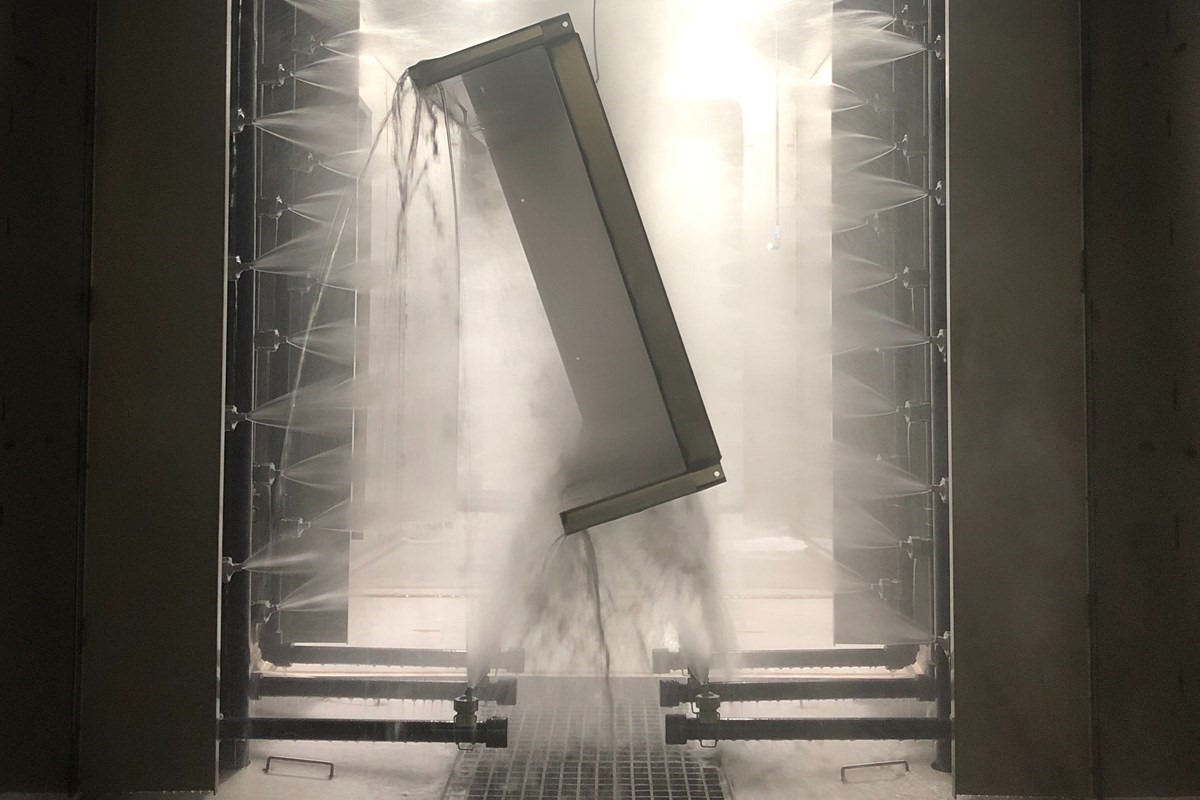
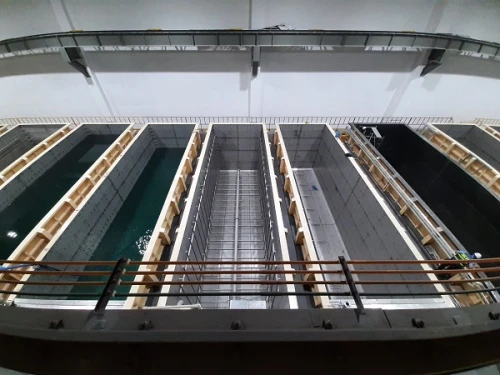
The surface treatment and cleaning station may consist of multiple consecutive stages designed to remove oil and grease, dust, oxides, and other contaminants, while also carrying out the chemical treatment steps required before coating. Depending on the product material, coating system, and technical requirements, the station can be configured with immersion tanks or spray systems for applying treatment solutions to the product surface.
The structure of the treatment area may be made from stainless steel or other chemically resistant materials suitable for the treatment solutions being used. Material selection should be determined based on the chemical properties of the treatment solutions, operating temperature, and actual working conditions of each stage.
During product transfer, the conveying system may be combined with drip recovery mechanisms to minimize the carryover of treatment solutions from one stage to the next. Controlling chemical carryover helps reduce cross-contamination between treatment tanks and supports consistent surface treatment quality.
After the chemical treatment stages, the products are rinsed with water according to the line configuration to remove residual treatment solutions and contaminants from the surface. Water quality, temperature, spray pressure, and the number of rinsing stages are selected according to the pretreatment process and product requirements. The products are then transferred to the pre-drying stage before powder spraying.
Drying and Curing Ovens
The drying and curing ovens perform different functions in a powder coating line. The pre-drying oven is used to remove water and residual moisture from the product surface after rinsing, preparing the product for the subsequent powder spraying stage.
The curing oven, meanwhile, is installed after the powder spraying stage. In this oven, the product is heated under conditions appropriate for the coating system, allowing the powder particles to melt, form a continuous coating film, and undergo the curing process. The temperature and residence time should be determined based on the requirements of the powder coating type, substrate material, product dimensions, and operating conditions of the coating line.
Therefore, the two types of ovens should not be distinguished solely by which one operates at a higher temperature. The key difference lies in the technological purpose and treatment conditions of each process stage.
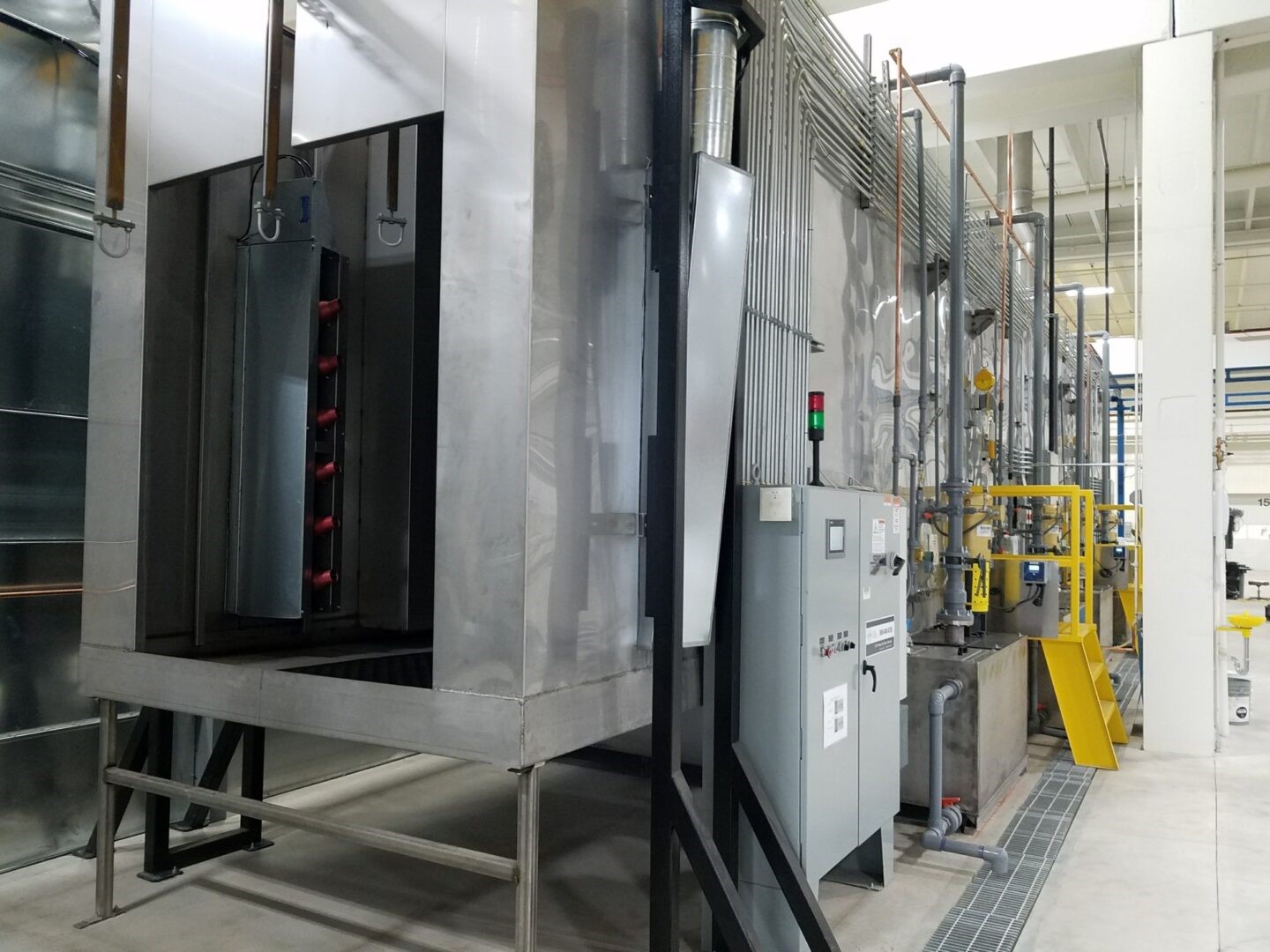
Surface treatment and cleaning station
The surface treatment and cleaning station may consist of multiple consecutive stages designed to remove oil and grease, dust, oxides, and other contaminants, while also carrying out the chemical treatment steps required before coating. Depending on the product material, coating system, and technical requirements, the station can be configured with immersion systems or spray systems for applying treatment solutions to the product surface. The treatment area may be constructed using stainless steel or other chemically resistant materials suitable for the treatment solutions being used. Material selection should be determined based on the chemical properties of the treatment solution, operating temperature, and actual working conditions of each stage.
During product transfer, the conveying system can be combined with drip recovery mechanisms to minimize the carryover of treatment solution from one stage to the next. Controlling chemical carryover helps reduce cross-contamination between treatment tanks and supports consistent surface treatment quality. After the chemical treatment stages, the products are rinsed with water according to the line configuration to remove residual treatment solution and contaminants from the surface. Water quality, temperature, spray pressure, and the number of rinsing stages are selected according to the pretreatment process and product requirements. The products are then transferred to the drying stage before powder spraying.
Drying and curing ovens
The drying and curing ovens perform different functions in a powder coating line. The pre-drying oven is used to remove water and residual moisture from the product surface after rinsing, preparing the product for the subsequent powder spraying stage. The curing oven, meanwhile, is installed after the powder spraying stage. The product is heated under conditions appropriate for the coating system, allowing the powder particles to melt, form a continuous coating film, and undergo the curing process. The temperature and residence time should be determined based on the requirements of the powder coating type, substrate material, product dimensions, and operating conditions of the coating line. Therefore, the two types of ovens should not be distinguished solely by which one operates at a higher temperature. The key difference lies in the technological purpose and treatment conditions of each process stage.
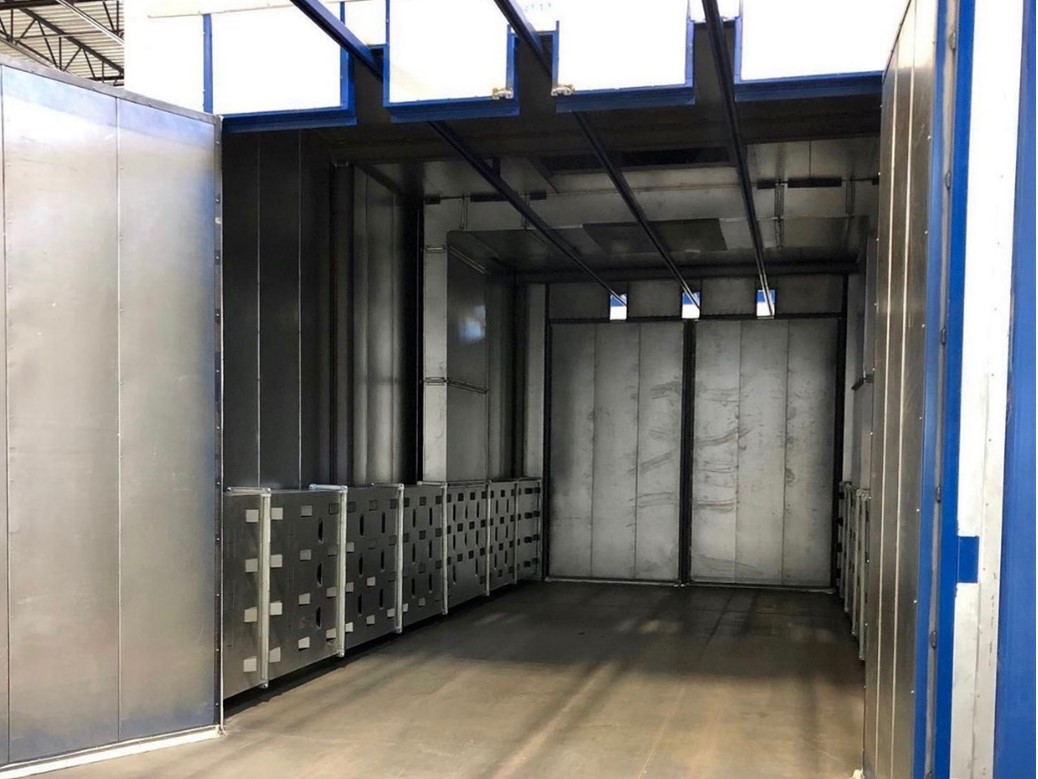
Powder paint drying oven
Powder coating oven
Both pre-drying ovens and curing ovens need to be designed with appropriate insulation to minimize heat loss and maintain stable processing conditions throughout the time the products remain inside the oven. The heat source may be a gas burner or an electric heating system, depending on the design and requirements of each project. The temperature control system monitors and adjusts the heating conditions according to the setpoint and may control different temperature zones within the oven when required.
For powder coating curing ovens, temperature control and temperature uniformity are particularly important because the heating conditions directly affect the melting and curing of the coating. The construction materials, insulation structure, air circulation method, and heating capacity should be selected according to the operating temperature and product dimensions. Depending on the coating type, heat source, and equipment configuration, the oven may be equipped with exhaust, collection, or air treatment systems as required by applicable technical and environmental requirements.
Powder coating booth
A powder coating booth is designed to control the spraying area, limit the dispersion of powder coating into the surrounding area, and reduce the risk of dust or contaminants from the external environment affecting the coating process. The booth structure, ventilation system, and airflow rate are designed according to the spraying method, powder type, product dimensions, and automation level of the coating line. During spraying, a portion of the powder that does not adhere to the product becomes overspray. The booth can be integrated with a powder recovery system to separate and collect excess powder. Depending on the equipment configuration and coating material, recovered powder may be reused when it meets the requirements for color, cleanliness, powder type, and material control procedures.
The dimensions and structure of the spray booth are designed according to product dimensions, the method used to transfer products into the booth, and operating requirements. For automated spraying systems, the booth can be integrated with automatic spray guns, robots, or motion mechanisms together with a powder recovery system. For semi-automatic or manual systems, the booth can provide an appropriate working area for operators while still requiring effective control of powder dispersion and ventilation conditions.
Powder recovery system
The powder recovery system collects overspray generated during the powder spraying process. Depending on the line configuration, the system may use cartridge filters, cyclones, or other recovery methods suitable for the powder type and operating requirements. The selection of a recovery method should take into consideration the powder coating type, color, production volume, color change frequency, and requirements for powder reuse. For coating lines with frequent color changes, the powder recovery system and spray booth cleaning procedures should be designed to minimize cross-contamination between different colors.
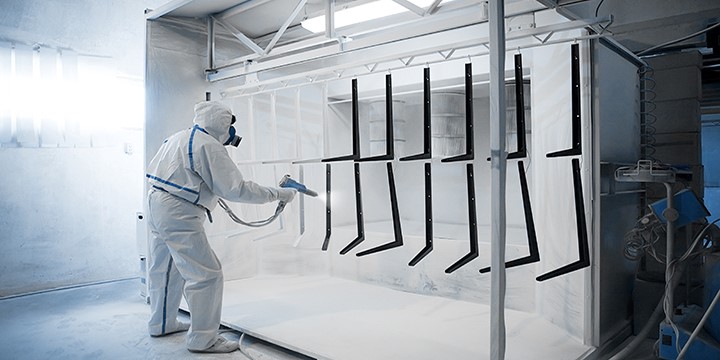
Powder coating booth
For small- to medium-sized products where installation space needs to be optimized, a powder coating spray wall or a compact spray booth can be used. The spray area can be integrated with spray guns, ventilation, and powder recovery systems according to the line configuration. Depending on the operating method, the system can be designed for manual spraying, semi-automatic operation, or integration with automatic spraying equipment.
For products requiring a high level of appearance consistency or strict control of environmental conditions in the spraying area, the line can incorporate an environmentally controlled spray area or a cleanroom, depending on project requirements. The system can monitor and control parameters such as temperature, humidity, air cleanliness, and other environmental conditions that may affect the spraying process and coating quality. The required level of environmental control should be determined based on the product type, coating system, appearance requirements, and applicable standards. Not every powder coating line requires a cleanroom. In many cases, controlling ventilation, air filtration, and dust levels within the spraying area may already be sufficient to meet the process requirements.
Conveyor System
In continuous powder coating lines, the conveying system typically uses an overhead chain conveyor or other suitable conveying solutions to transport products through pretreatment, drying, powder spraying, curing, and cooling stages. The conveyor type should be selected based on the product load, dimensions, line speed, residence time at each stage, and the temperature and chemical conditions under which the equipment will operate. For high-temperature areas such as drying and curing ovens, the chain, sprockets, hangers, bearings, and other related components should be selected with materials and structural designs suitable for the operating conditions. Similarly, in the pretreatment area, components that may come into contact with chemical solutions should be selected according to the chemical compatibility of each treatment solution.
The conveyor and hanging mechanism should be designed to match the product load and geometry while minimizing vibration and product movement during transportation. Hangers, support fixtures, and painting jigs can be modified for different product groups to maintain stable hanging positions and facilitate surface treatment, powder spraying, and curing. For lines handling multiple product models, the design of hangers and jigs should take into account product dimensions, weight, surfaces to be coated, and areas requiring masking. This arrangement helps maximize the usability of the coating line while minimizing surface obstruction during the spraying process.
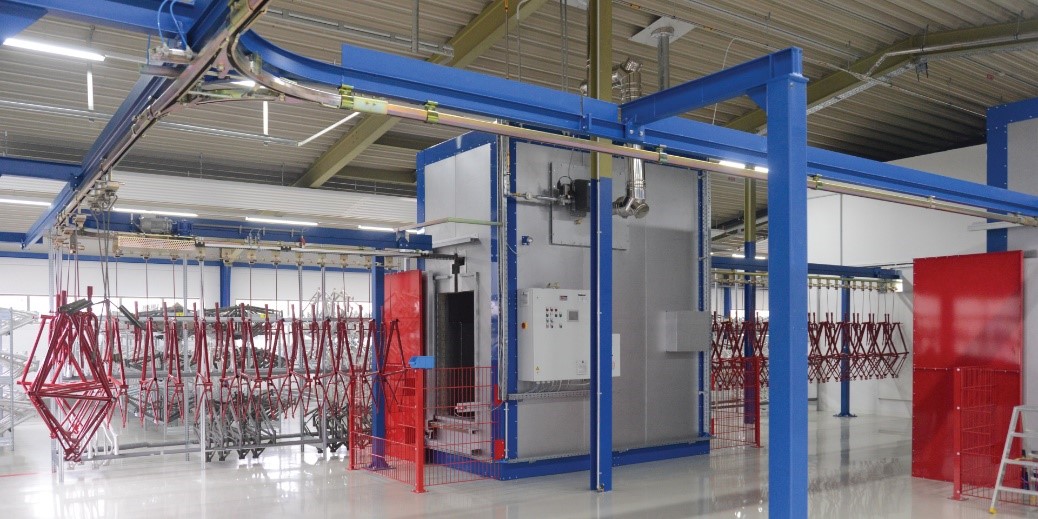
Powder coating line conveyor
Types of powder coating materials used in powder coating lines
The selection of powder coating materials should be based on the substrate material, operating conditions, appearance requirements, corrosion resistance, chemical resistance, weather resistance, and curing conditions. Common powder coating resin systems used in industrial applications include epoxy, polyester, epoxy-polyester hybrid, fluoropolymer, and polyurethane.
Epoxy
Epoxy powder coatings offer good adhesion and chemical resistance and are commonly selected for indoor applications or locations where high UV resistance is not required. Epoxy systems can also be used in combination with metal surface treatment processes such as phosphating to establish a suitable surface protection system. However, the color and gloss retention of epoxy coatings under prolonged UV exposure is generally less suitable for outdoor applications requiring high color durability. Therefore, epoxy is commonly used for indoor components and equipment, or as a primer layer in certain multi-coat systems where the product's technical requirements are compatible.
Polyester
Polyester powder coatings generally provide better weather and UV resistance than epoxy and are therefore widely used for products intended for outdoor environments. Depending on the formulation, polyester coatings can meet different requirements for gloss, color retention, corrosion resistance, and curing conditions. Some polyester systems are formulated for low-temperature curing or specific appearance requirements. The powder coating material should be selected based on the manufacturer's technical specifications and the actual operating conditions of the coating line.
Super durable polyester
Super durable polyester is developed to provide enhanced UV resistance and color retention compared with standard polyester systems. This type of coating is suitable for outdoor applications with higher requirements for color durability, gloss retention, and long-term appearance. Depending on the formulation, super durable polyester can provide different levels of moisture resistance, corrosion resistance, hardness, and environmental durability. Actual performance specifications should be verified against the technical documentation of each powder coating product.
Epoxy-polyester hybrid
Epoxy-polyester hybrid powder coating is a system that combines epoxy and polyester resins in controlled proportions within the formulation. This system can combine certain advantages of epoxy, such as adhesion and chemical resistance, with the appearance characteristics and processing properties of polyester. However, its UV resistance and weather durability are generally not selected for harsh outdoor applications to the same extent as specialized polyester or super durable polyester systems. Therefore, epoxy-polyester hybrid coatings are commonly used for metal furniture, indoor equipment, electrical cabinets, and other products requiring suitable appearance and surface protection under appropriate operating conditions.
Fluoropolymer
Fluoropolymer powder coatings are used in certain architectural and outdoor applications requiring high weather resistance, color durability, and long-term appearance retention. Depending on the material system, fluoropolymer coatings can be selected for products such as profiles, door and window frames, doors, curtain walls, and architectural metal components. This coating group generally involves higher technical requirements and material costs than commonly used powder coating systems. Therefore, its selection should be based on the designed service life, environmental conditions, and appearance requirements of the project.
Polyurethane
Polyurethane powder coatings can provide a smooth surface finish and meet certain requirements for durability, chemical resistance, and corrosion protection. Depending on the formulation, these systems are used for various industrial products, including certain agricultural equipment, hvac equipment, door handles, and metal components. When designing the drying and curing process, coating thickness and heating conditions should be controlled according to the powder manufacturer's requirements. For certain coating systems or thicker films, outgassing from the substrate or coating layers may affect surface appearance. This should therefore be considered during pretreatment and process parameter selection.
Materials that can be coated using powder coating technology
Powder coating is most commonly applied to metal substrates such as steel, coated or plated steel, aluminum, and certain metal alloys. Because powder coating curing generally requires heating, applications on non-metallic materials require additional consideration of heat resistance, surface characteristics, and adhesion mechanisms. For metal substrates, electrostatic powder spraying is a widely used application method because the substrate is electrically conductive and can be grounded to support the charging and deposition of powder particles. The pretreatment, spraying, and curing processes still need to be designed according to the specific metal substrate and coating system.
For plastics and composite materials, certain specialized powder coating technologies can be applied when the substrate can withstand the processing conditions and the coating system is suitable. These solutions may involve low-temperature-curing powder coatings, suitable heating methods, or surface treatment processes to improve adhesion. The process parameters of a metal powder coating line should not be directly applied to different types of plastic materials.
For non-conductive materials such as certain types of wood, mdf, or composite materials, powder coating requires dedicated technologies and process conditions. The considerations involve not only electrostatic deposition capability but also the material's heat resistance, moisture content, surface condition, and the curing mechanism of the coating system. Therefore, before designing the coating line, the substrate material, product dimensions and geometry, intended coating system, appearance requirements, coating thickness, and operating conditions should be clearly defined. These factors provide the basis for selecting the appropriate pretreatment method, spraying equipment, drying and curing oven, and conveying system.
Features of CNC VINA automatic powder coating lines
For each product and coating system, the process may differ in terms of pretreatment, spraying method, drying conditions, and curing requirements. Therefore, an automatic powder coating line should be designed based on the product characteristics, substrate material, production volume, quality requirements, and available installation space of each project.
CNC VINA provides integrated powder coating line solutions, from process consulting and line layout design to equipment selection, fabrication, and system integration according to project requirements. Depending on the project, the configuration may include a pretreatment system, conveyor, powder coating booth, powder recovery system, drying and curing oven, control system, and auxiliary equipment.
With experience in implementing coating line solutions for various product groups such as automobiles, motorcycles, electronics, and household appliances, CNC VINA can provide process recommendations based on actual product requirements, production volume, and required level of automation.
Customers can also refer to the following types of coating lines supplied by CNC VINA:
Customers planning to invest in a powder coating line can contact CNC VINA to discuss their products, production volume, quality requirements, and suitable process solutions.
VIETNAM TECHNOLOGY APPLICATION & CNC VIETNAM JOINT STOCK COMPANY
Factory: Song Cung industrial cluster, Dong Thap commune, Dan Phuong district, Hanoi, Vietnam.
Office: Rox Tower (Rox Tower Goldmark City), 136 Ho Tung Mau street, Phu Dien ward, Hanoi, Vietnam.
Phone: +84 916 639 355 / +84 915 744 664
Website: www.cncvina.com.vn | www.cncviname.com.vn
Email: Sales01@cncvina.com.vn | Sales03@cncvina.com.vn

 Tiếng
Việt
Tiếng
Việt
 Tiếng
Anh
Tiếng
Anh
 Tiếng
Nhật
Tiếng
Nhật




 Tiếng Anh