 Tiếng
Việt
Tiếng
Việt
 Tiếng
Anh
Tiếng
Anh
 Tiếng
Nhật
Tiếng
Nhật




 Tiếng Anh

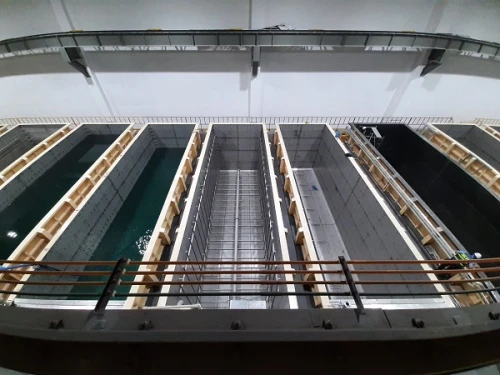
Processing and manufacturing industrial tanks
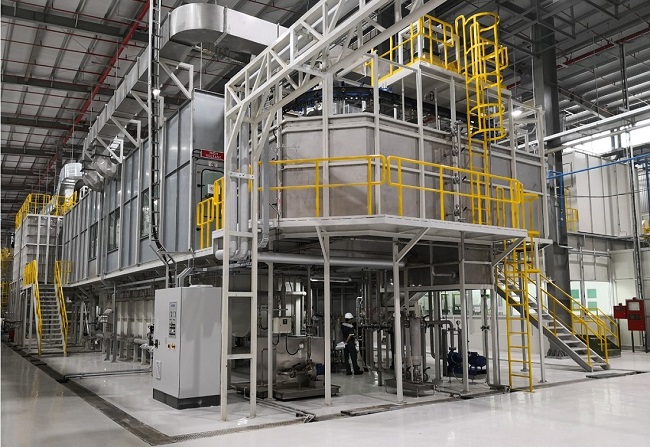
CNC VINA specializes in manufacturing and installing storage tanks to serve ED paint lines, tanks, chemical tanks and serve the production of raw materials, processing and processing of semi-finished products.
With experience from projects of foreign partners and customers, our large tank products always meet strict technical requirements in manufacturing and safety in installation and operation. onion.
Customers who want to order processing and manufacturing of large industrial tanks, please contact:
VIETNAM CNC & TECHNOLOGY APPLICATION JOINT STOCK COMPANY
Hotline: +84.916 63 9355 / +84.915 74 4664
Email: Sales01@cncvina.com.vn / Sales03@cncvina.com.vn
Product description

Industrial tanks – Custom design, fabrication and installation
Industrial tanks are essential components in many manufacturing plants, particularly in production lines that require the storage of raw materials, chemicals, solvents, oils and fuels, as well as surface treatment processes. Depending on the type of medium, capacity, operating temperature and service conditions, tanks can be fabricated from carbon steel, stainless steel 304, stainless steel 316L, or a combination of suitable surface protection solutions. In PT/ED painting lines, tank systems are also integrated with circulation pumps, piping, heating systems, insulation and other auxiliary equipment. Therefore, the design and fabrication process must address structural integrity, leak tightness, corrosion resistance and actual operating conditions. Together with CNC-VINA, explore custom industrial tank design, fabrication and installation solutions for manufacturing plants and industrial production lines.
Industrial tanks supplied by CNC-VINA
CNC-VINA provides design, fabrication and installation services for a wide range of tanks used in industrial production systems. Each tank configuration is determined based on the process medium, capacity, material, installation location and connection requirements of the production line.
Our scope of supply includes:
- Storage tanks for raw materials, solvents and industrial chemicals.
- Storage tanks for oil, gasoline, fuels and other liquids as required.
- Washing and surface treatment tanks for production lines.
- Dip tanks and spray tanks.
- Phosphating tanks and electrophoretic coating (ED) tanks.
- Tank systems for PT/ED painting lines for automotive and motorcycle manufacturing.
- Silos and other industrial storage systems designed to meet specific requirements.
- LPG tanks for burner systems, as well as other auxiliary tank and vessel systems depending on project requirements.
For large-scale tanks, CNC-VINA can carry out the entire process from structural fabrication at our workshop to on-site installation and system integration, depending on the scope of each project.
Tanks for PT/ED painting lines
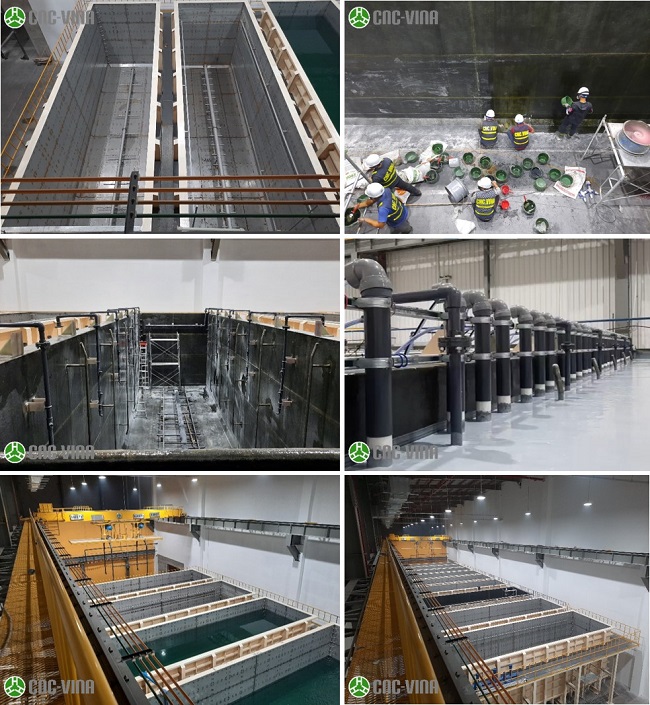
Tank systems are one of the key components of surface treatment and painting lines. Depending on the process configuration, a production line may include dip tanks, spray tanks, water rinsing tanks, chemical treatment tanks, phosphating tanks, electrophoretic coating tanks and DI water rinsing stages. CNC-VINA designs and fabricates tank systems for PT/ED painting lines with capacities of up to 300 m³, integrated with circulation pumps, thermal insulation, piping systems and electrodes for the ED coating process according to specific technical requirements.
Dip tanks
Dip tanks are used in processes where products are immersed directly into a treatment solution. Tank design needs to take into account product dimensions, solution capacity, construction materials, circulation requirements and process temperature or surface treatment requirements. For large-capacity tanks, the structure must be designed to accommodate the load of both the tank and the process solution during operation, while ensuring proper integration with the equipment and piping systems of the production line.
Spray tanks
Spray tanks are used for surface treatment processes in which treatment solutions are applied by spraying. The system may include the tank, circulation pump, piping and spray lines arranged according to the requirements of the production process. The piping and spray system layout must be designed to suit product dimensions, solution flow rate and the requirements of each treatment stage.
Washing and chemical treatment tanks
Depending on the process, the system may include hot-water washing tanks, chemical washing tanks, phosphating tanks or DI water rinsing tanks. The construction material and surface protection solution should be selected according to the properties of the treatment solution in contact with the tank. For corrosive environments, the tank material, lining or protective coating should be determined based on the chemical properties, concentration, operating temperature and actual service conditions.
Electrophoretic coating (ED) Tanks
Electrophoretic coating tanks have specific technical requirements because they must maintain suitable process conditions and interface with the electrode system. Depending on the production line configuration, the tank can be integrated with circulation systems, temperature control, piping and other auxiliary equipment. For areas where electrostatic control is required, the material and surface coating solution can be selected according to the technical requirements of each system.
Materials for industrial tank fabrication
The choice of material directly affects the tank's service performance, service life and maintenance requirements. CNC-VINA uses materials such as carbon steel, stainless steel 304 and stainless steel 316L depending on the application and specific project requirements.
Carbon steel
Carbon steel can be used for structures and tanks suitable for the specified process medium and operating environment. It is also commonly used for large tank structures where the contact surface does not require a high level of corrosion resistance, or where an appropriate protective solution is provided.
Stainless steel 304
Stainless steel 304 is used for applications requiring corrosion resistance and a surface that is easy to clean. The selection of stainless steel 304 should be based on the properties of the process medium and actual operating conditions.
Stainless steel 316L
Stainless steel 316L offers higher corrosion resistance than stainless steel 304 in certain environments and may be considered for applications with more demanding material requirements. The final material selection should still be based on the actual process medium and the technical requirements of the system.
Surface coatings and protection
In addition to selecting the base material, certain tanks may require protective coatings or other surface protection solutions. For applications requiring electrostatic control, anti-static FRP lining or coating can be applied in accordance with the design and specifications of the production line.
Tank design, fabrication and installation process
For large-scale tank systems, implementation requires close coordination between engineering, structural fabrication, tank manufacturing and on-site installation. Depending on project requirements, the process may include the following main stages:
1. Requirement survey and technical assessment
Key parameters are identified, including the process medium, capacity, dimensions, operating temperature, material, installation location, connection requirements and operating conditions.
2. Tank and auxiliary system design
Based on the technical requirements, the tank structure, manholes, inlet and outlet connections, piping, circulation pumps, heating systems, insulation and other auxiliary equipment are designed as required.
3. Structural fabrication
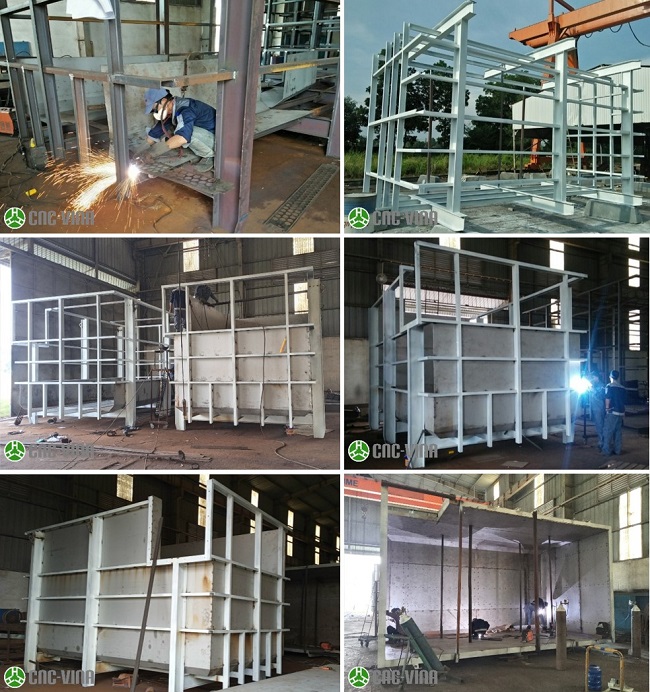
At the workshop, materials are cut, prepared and assembled according to the approved drawings. Structural components are welded and finished before proceeding to the subsequent fabrication stages.
4. Tank interior fabrication and surface treatment
The tank interior can be fabricated from steel plate or stainless steel depending on the specified configuration. Surface treatment, protective coating, insulation or FRP lining can then be applied according to the technical requirements.
5. On-site installation
The tanks are transported and installed at the designated location. Pumps, circulation piping, spray lines, supply and discharge lines, and other auxiliary equipment are connected to the system.
6. Inspection and handover
Upon completion, the system is inspected in accordance with the applicable technical requirements and project acceptance criteria before being put into operation. CNC-VINA has directly participated in projects involving the fabrication and installation of tank systems for automotive and motorcycle painting lines. These projects require capabilities in large-scale structural fabrication, quality control throughout the manufacturing process and effective on-site installation.
For tank systems used in PT/ED painting lines, technical requirements extend beyond the tank structure itself and include leak prevention, corrosion resistance, thermal insulation, solution circulation and integration with other production-line equipment.
With in-house fabrication capabilities and on-site installation experience, CNC-VINA can execute tank-related work within the defined scope of each project. Large-scale tanks are fabricated based on specific requirements for capacity, materials, structural configuration and installation conditions.
Key factors to consider when designing industrial tanks
There is no single tank configuration suitable for every manufacturing plant. When selecting or commissioning a custom tank, several key parameters should be defined:
- Process medium: Chemicals, water, solvents, raw materials, oil or other liquids.
- Capacity and dimensions: Determine the overall tank size and layout.
- Material: Selected based on the properties of the process medium and operating conditions.
- Operating temperature: Particularly important for tanks equipped with heating or thermal insulation systems.
- Corrosion resistance requirements: Determine the contact material and surface protection solution.
- Circulation system: Should be designed to match the required flow rate and production-line configuration.
- Installation location: Affects tank dimensions, transportation and installation methods.
- Connection requirements: Including piping, pumps, instrumentation and other auxiliary systems.
Defining these parameters at the early design stage helps ensure that the proposed solution matches actual operating conditions and minimizes modifications during fabrication and installation.
Industrial tanks should be designed and selected according to the process medium, capacity, material and actual operating conditions of each manufacturing plant. For PT/ED painting lines, the tank system also needs to be properly integrated with circulation pumps, piping, heating, insulation and other auxiliary equipment. CNC-VINA has experience in designing, fabricating and installing tank systems for automotive and motorcycle production and assembly lines. With capabilities ranging from structural fabrication at our workshop to on-site installation, CNC-VINA can execute tank projects according to specific technical requirements. Contact CNC-VINA for consultation on industrial tank design, fabrication and installation solutions tailored to your manufacturing requirements.
CNC VIETNAM TECHNOLOGY APPLICATION JOINT STOCK COMPANY (CNC-VINA)
Factory: Song Cung Industrial Cluster, Dong Thap Commune, Dan Phuong District, Hanoi, Vietnam
Office: Rox Tower Building (Rox Tower Goldmark City), 136 Ho Tung Mau Street, Bac Tu Liem District, Hanoi, Vietnam
Tel: +84.916 63 9355 / +84.915 74 4664
Website: www.cncvina.com.vn / www.cncviname.com.vn