 Tiếng
Việt
 Tiếng
Anh
 Tiếng
Nhật



 Tiếng Anh

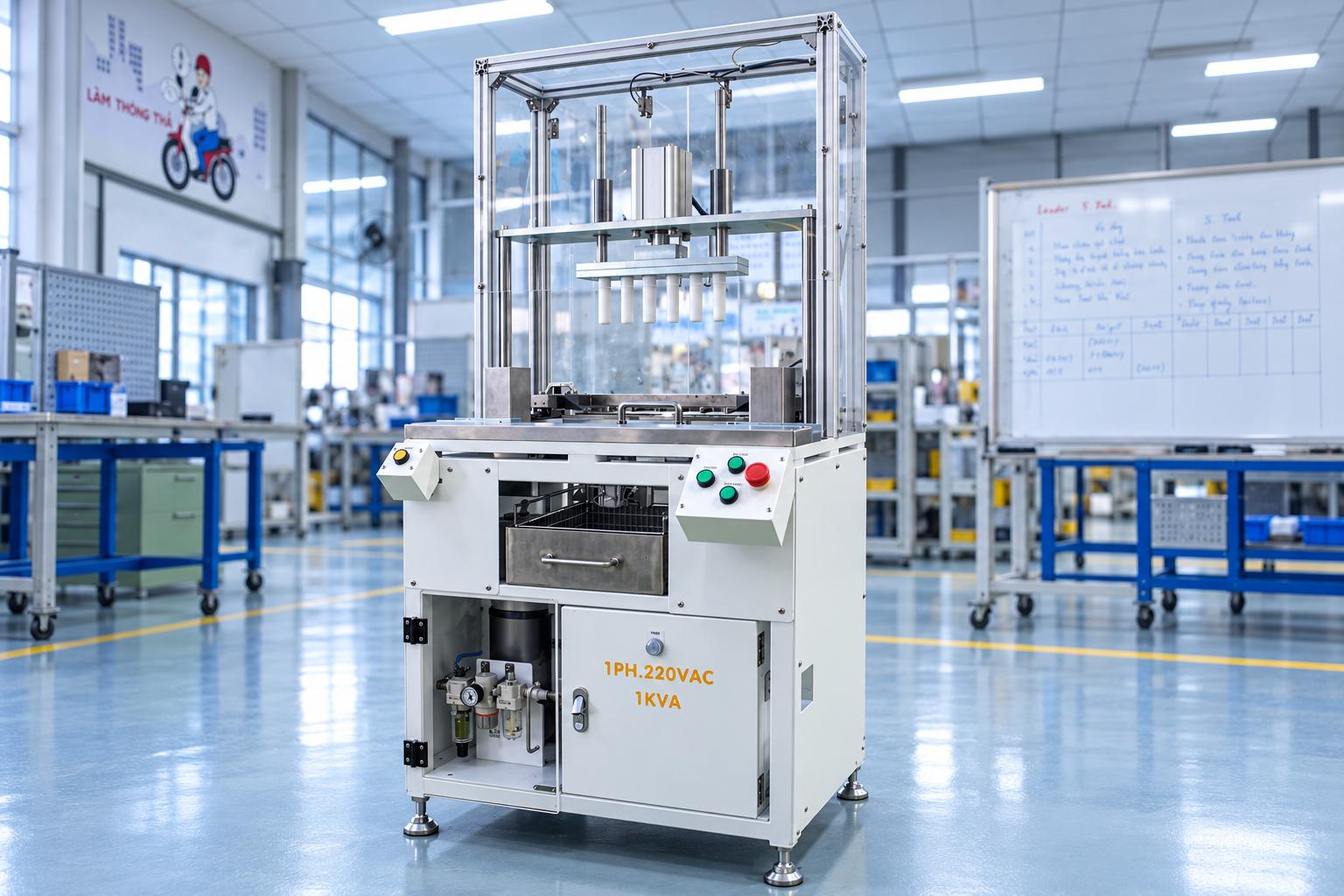
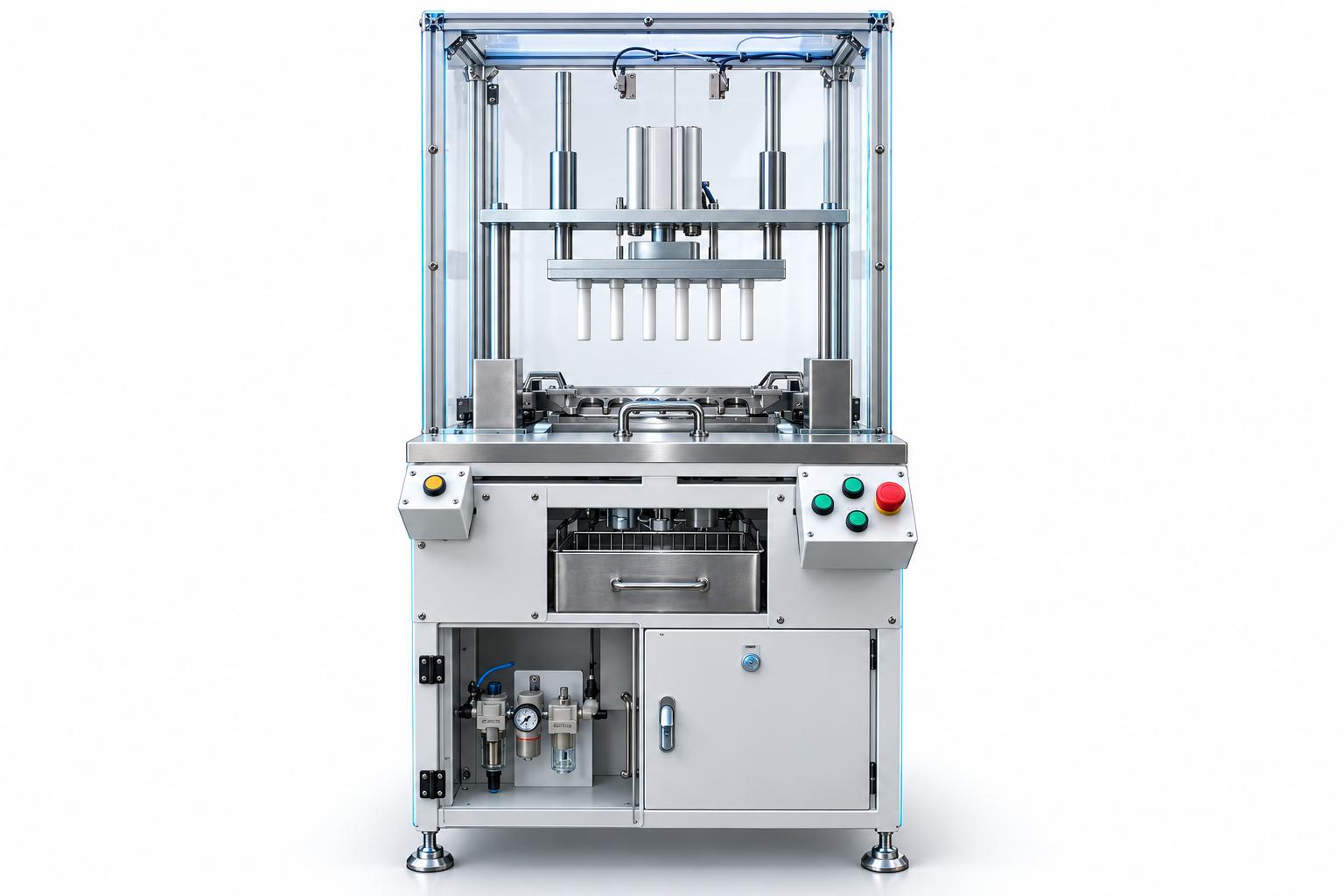
Molded product ejection machine
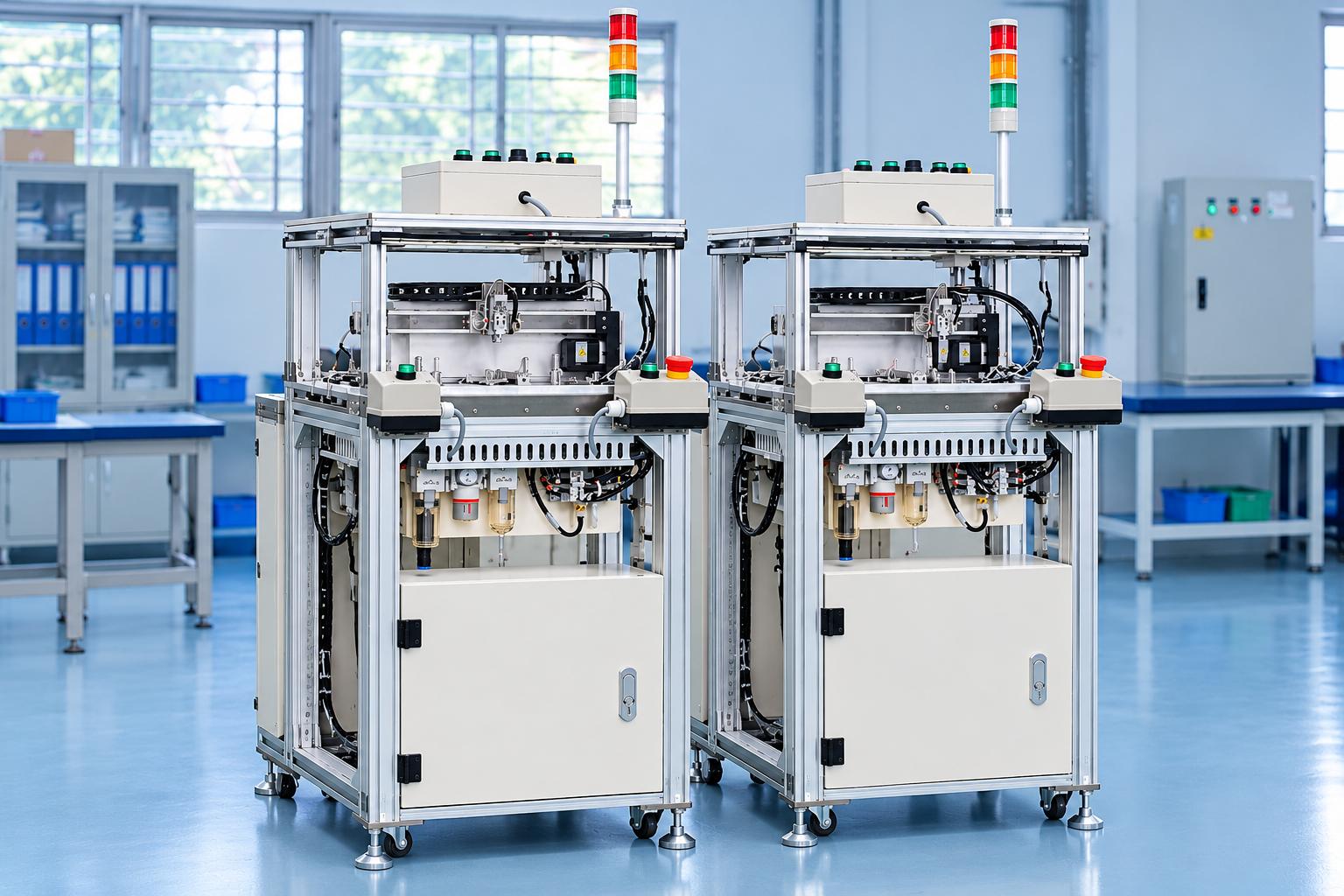
The CNC VINA molded product ejection machine supports the process of removing products from molds using pneumatic lifting and ejection mechanisms. The operator places the mold in the fixture, moves the fixture, and controls each step using a foot pedal and push buttons. The mechanisms operate according to positional conditions monitored by sensors and a PLC controller.
The machine is suitable for processes requiring product ejection in a defined direction and can be designed with fixtures tailored to the mold. CNC VINA provides custom machine design based on product shape, mold structure, contact requirements, and production process organization. Ejection performance should be verified using actual samples to determine the appropriate mechanisms and ejector heads.
VIETNAM CNC & TECHNOLOGY APPLICATION JOINT STOCK COMPANY
Hotline: +84.916 63 9355 / +84.915 74 4664
Email: Sales01@cncvina.com.vn / Sales03@cncvina.com.vn
Product description

The molded product ejection machine is a specialized piece of equipment designed to assist in removing products from molds after the forming process is complete. It is designed to reduce manual labor while making mold ejection more convenient and stable during production. By combining mechanical structures, drive systems, and an automatic control system, the machine controls movements according to a predefined operating sequence. The machine configuration can be adjusted to suit the structure, dimensions, and product ejection requirements of different molds. During operation, the operator works in coordination with the machine's functional mechanisms to ensure that the mold is correctly positioned before the ejection process begins. In addition to supporting production, the equipment emphasizes ease of operation, motion control, and operational safety. As a result, the molded product ejection machine helps improve work efficiency and meets the specialized requirements of industrial production lines. So, which industries use this equipment, and how is it constructed? In the following article, let's explore these topics with CNC VINA.
Technical specifications of the molded product ejection machine
| Item | Specification |
| Machine dimensions | L770 x W580 x H1620 mm |
| Control voltage | 24V DC |
| Air supply pressure | 0.4 - 0.5 MPa |
| Controller | PLC |
| Main mechanisms | Mold receiving, lifting and lowering, product ejection |
| Operating method | Step-by-step control using push buttons and a foot pedal |
| Mold loading and fixture movement | Performed by the operator |
| Interchangeable fixtures | Compatible with 4, 5, or 6-point mold configurations |
| Safety features | Protective door with sensor and emergency stop button |
When reviewing the machine layout, sufficient space must be allocated for fixture movement, mold loading, product removal, and maintenance. The machine's overall dimensions should be considered alongside the entire operating area.
The role of mold ejection machines in manufacturing
Product removal is an important step that must be considered alongside the forming process. Even when a part meets the required specifications inside the mold, it may still be damaged if the contact points, direction of applied force, or mold-holding method are unsuitable during removal. Specialized equipment helps organize the process using dedicated fixtures and predefined movements, reducing the amount of physical effort required from operators.
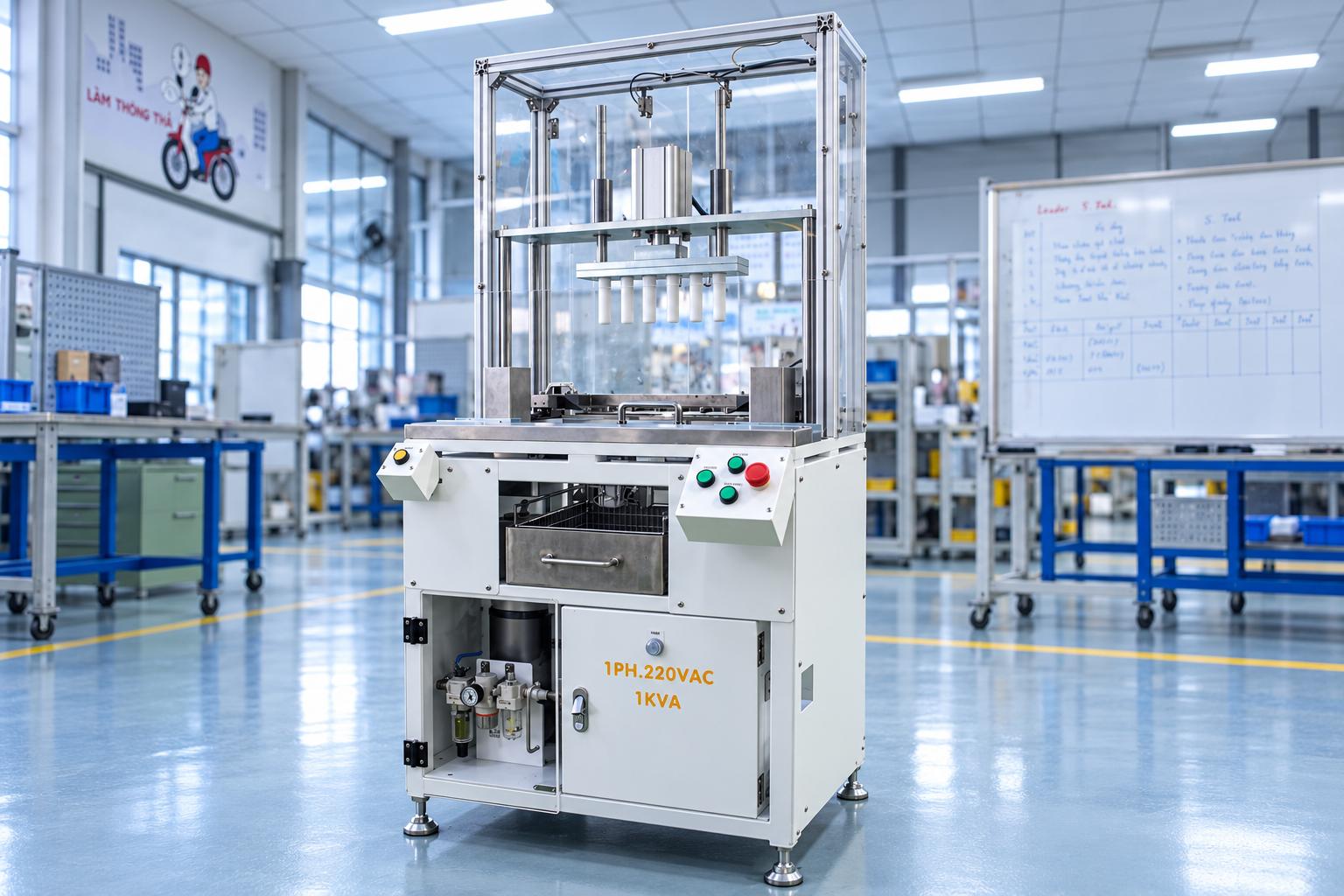
In this configuration, the mold loading mechanism, lifting and lowering unit, and product ejection unit each perform a specific function. The operator manually proceeds to the next step after checking the operating status. This approach mechanizes the mold ejection process through individual operations, making it suitable for businesses that still require operators to monitor and handle molds at the workstation.
Operational effectiveness should be evaluated based on product quality after ejection, mold condition, ease of operation, and actual working cycle time. The movement time of a single cylinder accounts for only part of the overall process.
Key features of the pneumatic mold ejection machine
-
Functional separation of mechanisms: Includes mold loading support, fixture lifting and lowering, and product ejection mechanisms.
-
Step-by-step control: The foot pedal and push buttons work in coordination with the positional conditions of each mechanism.
-
Interchangeable mold-specific fixtures: The mold ejection fixture and ejector head assembly must be installed as a matching set.
-
Position monitoring by sensors: Monitors the in-and-out positions, lifting and lowering movements, and cylinder strokes.
-
Protective door and emergency stop button: Integrated into the machine's operating permission conditions.
Structure of the specialized mold ejection machine
The molded product ejection machine is designed with coordinated mechanical assemblies, a pneumatic system, and a PLC controller to assist in removing products from molds. Each assembly performs a specific function, from receiving and positioning the mold to lifting, lowering, ejecting the product, and controlling the operating sequence. This arrangement makes operation more convenient and accommodates the requirements of different mold types.
Mold receiving assembly and sliding fixture
The mold receiving assembly uses a lifting cylinder controlled by a foot pedal to assist in positioning the mold. The operator manually pushes or pulls the mold-holding fixture between working positions. The horizontal movement of the fixture must be distinguished from the vertical lifting and lowering movement performed by the cylinder.
Slide rails, shafts, and guide bushings provide paths for the mechanical assemblies to move along. When designing the machine for a new mold, factors such as mold weight, positioning references, operating clearance, and the force required to move the fixture must be considered. The handle design and mold placement position also directly affect ease of use during shift operations.
Lifting and lowering assembly and mold ejection fixture
The lifting and lowering assembly uses a cylinder combined with guiding components to move the fixture into the working position. The specialized fixture establishes the support points and relative positioning of the mold, allowing the mechanism to apply force in the intended direction.
The machine supports fixtures for four-, five-, or six-point mold configurations. Each configuration requires a corresponding mold ejection fixture and ejector head assembly. The number of positions on the fixture does not necessarily equal the number of products successfully ejected in one cycle; productivity also depends on mold arrangement and the operating sequence.
Product ejection assembly
The upper cylinder carries the ejector head assembly downward to apply force to the product. After the ejection operation and the preset dwell time, the cylinder automatically retracts. The ejector heads are arranged according to the fixture used for each mold configuration.
For a new part, the permitted contact points, ejection direction, and required stroke must be determined to ensure that the product can be released from the mold. The working head must suit the part's geometry and surface requirements. Sample testing provides a basis for evaluating the risk of contact marks, deformation, or the product remaining stuck after ejection.
Pneumatic circuit and air-oil intensifier unit
The pneumatic circuit includes an air filter, pressure regulator, control valves, and flow control components for each mechanism. The lifting and lowering assembly also incorporates an air-oil intensifier unit in its operating circuit. The selection and adjustment of these components must take into account the movement requirements of the mold and fixture.
The specified air supply pressure for this configuration is 0.4–0.5 MPa. This value represents the air supply condition, not the product ejection force. When commissioning a custom machine, the required force and movement must be determined based on the adhesion between the product and mold, the contact area, and the part's ability to withstand the applied force.
PLC and motion enable conditions
The PLC receives signals from push buttons, the foot pedal, limit switches, and cylinder sensors to control the valves. The door sensor is part of the machine's operating enable conditions. Movements are interlocked according to the status of the fixture and related mechanisms.
For example, the mold receiving assembly can only be raised when the mechanisms meet the initial position conditions. The lifting and lowering assembly requires the fixture to be in the inner position. The ejector can only be activated when the lifting and lowering assembly is raised and the mold-holding fixture is in the outer position. These conditions help ensure that operations follow the designed sequence.
Operating principles and maintenance of the specialized mold ejection machine
The mold ejection machine operates through coordinated actions by the operator, movements of the mechanical assemblies, and the PLC control system. To ensure stable operation, it is important to understand the working procedure, motion conditions, and periodic maintenance requirements.
Operating procedure of the product ejection machine
The machine requires the operator to control each stage individually. The main operating sequence is as follows:
-
Fixture preparation: Install the mold ejection fixture and ejector head assembly according to the correct configuration, then check the supply sources and the status of the mechanisms.
-
Mold loading: The operator uses the foot pedal to control the auxiliary lifting mechanism and places the mold into the fixture according to the operating procedure.
-
Moving the fixture to the lifting position: Push the mold-holding fixture inward and operate the lifting mechanism by coordinating the two designated function buttons.
-
Moving to the ejection position: After the lifting step, move the mold-holding fixture outward to meet the operating conditions of the ejector.
-
Product ejection: Activate the ejection mechanism using the specified button combination. The ejector moves downward and automatically retracts after the programmed dwell time.
-
Completion and preparation for the next cycle: Inspect the ejected product and return the fixture and mechanisms to the mold receiving state according to the operating instructions.
Position conditions are monitored throughout the coordinated movements. The specialized mold ejection machine does not automatically load molds or execute the entire cycle with a single start button. The working cycle time must account for mold loading, pushing and pulling the fixture, operating the mechanisms, and removing the ejected products.
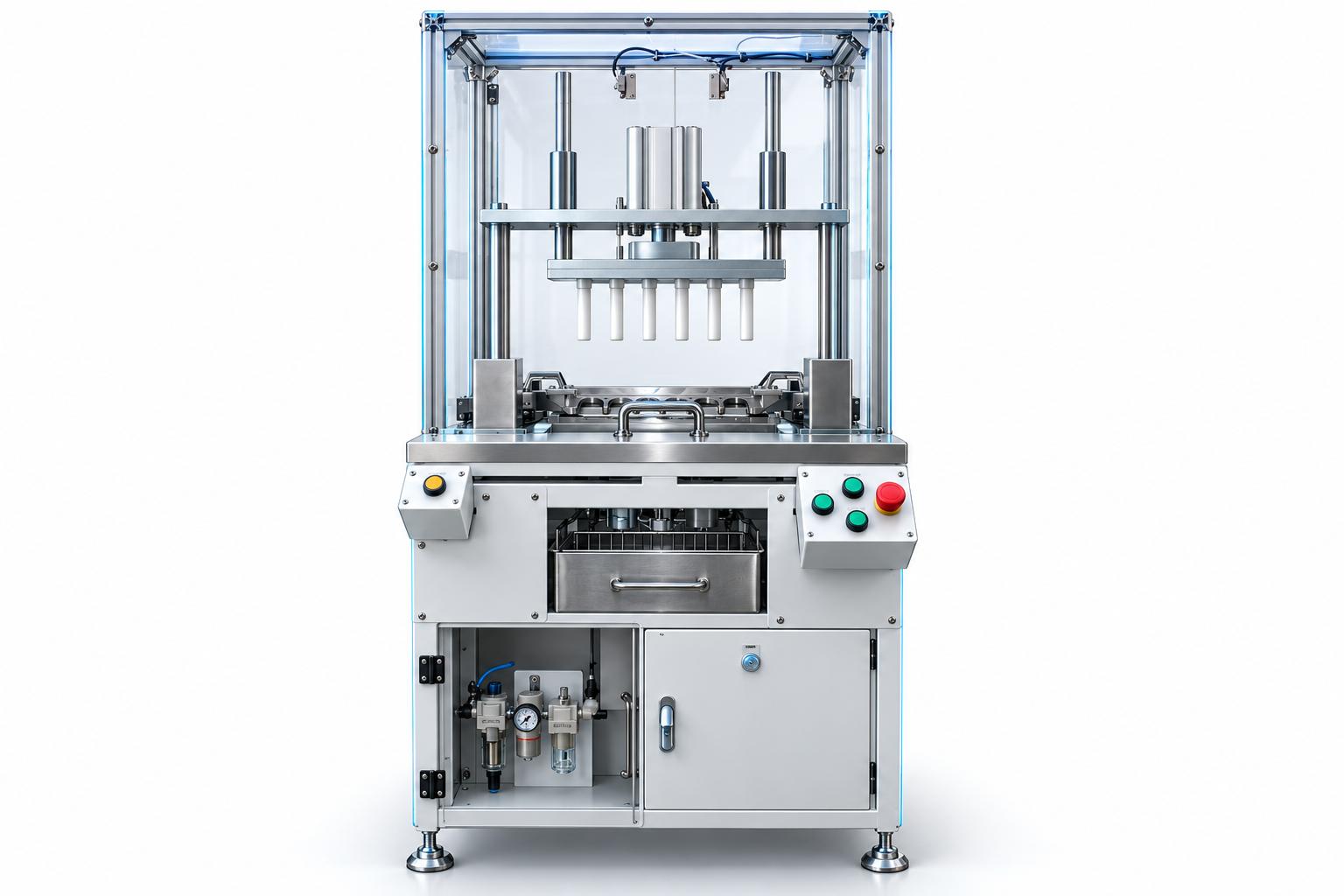
Operation and maintenance
Before each shift, check that the correct fixture configuration is installed, all connections are secure, the guide surfaces are clean, and the air supply pressure is within the specified range. Operators must understand the operating sequence for the foot pedal, button combinations, and waiting conditions of each mechanism.
Regularly inspect the slide rails, shafts, guide bushings, ejector heads, cylinders, and pneumatic lines. Any wear, scratches, or movement obstruction must be addressed before the machine is used again. Position sensors and door sensors must be kept correctly positioned, and their signals must be checked according to the maintenance schedule.
Before cleaning, changing fixtures, or carrying out repairs, isolate the electrical and pneumatic supplies and control stored energy and potentially moving assemblies according to the applicable procedure. After completing the work, test and verify each function before returning the machine to production. The response of each mechanism during an emergency stop must be clearly explained in operator training.
Applications of mold ejection machines in industrial manufacturing
-
Removing products from casting molds: A molded product ejection machine can perform the lifting and ejection operations when the product and mold are positioned using suitable fixtures. Application requires a feasible ejection direction, appropriate contact points for the ejector head, and sufficient clearance for product removal. Testing with the actual mold and product is necessary before confirming the machine configuration.
-
Batch production involving different mold sets: Interchangeable fixture designs allow the workstation to be configured for different mold setups. Changes must be coordinated between the mold ejection fixture and ejector head assembly, followed by checks of positioning and stroke. This arrangement is suitable for sharing one workstation among a group of evaluated molds, with fixture changeover time included in the production plan.
-
Improving manual mold ejection operations: The machine can be considered as a solution for transferring lifting and ejection tasks from manual handling to mechanical mechanisms. Its benefits should be evaluated in terms of ease of operation, ejection results, and compatibility with upstream and downstream processes. Any reduction in labor requirements or increase in output must be verified through production trials under actual factory conditions.
-
Products and molds with different structural designs: CNC VINA can assess the ejection principle, redesign the fixtures, and select suitable mechanisms for different applications. Product material, temperature at the time of ejection, mold adhesion, and appearance requirements are important factors to evaluate. This is a customized design approach that requires testing before implementation for each part type.
Factors buyers should determine
Mold structure and ejection conditions
Prepare mold drawings or samples, product samples, and a description of the current removal method. Key information includes the ejection direction, areas where the product is retained or adheres to the mold, permitted pushing and contact areas, mold weight, and the product's condition when transferred to the workstation.
If the product is still hot or has a surface that is sensitive to impact, these conditions must be included in the testing process. Areas that must not be subjected to force should be clearly identified to help determine the appropriate support points and ejector heads. The ejection solution must be suitable for both the product and the mold.
Fixtures and mold changeover capability
The ability to accommodate multiple mold sets depends on the positioning references, spacing between positions, mold assembly height, and required stroke. The number of ejector heads is only one factor in the design. When changing configurations, the two fixture components must match and be inspected before operation.
Manufacturers should determine the frequency of mold changes, the expected number of fixture sets, and the requirements for storing each set. For new products, it is necessary to assess whether the existing mechanisms can be reused or whether changes to the stroke, working heads, and control logic are required.
Operating cycle time and post-ejection quality
Production output should be evaluated using the total process time, from mold receipt until the machine is ready for the next cycle. This includes manual fixture handling, product removal, and inspection time. The ejector's automatic retraction delay does not represent the complete machine cycle.
Quality criteria should include complete product release from the mold, acceptable surface condition, no deformation beyond permitted limits, and preservation of the mold's serviceable condition. If force measurement, equipment-assisted visual inspection, or automatic result verification is required, these items should be included in the specific design requirements.
Sample testing and equipment acceptance
Testing should cover all mold sets and product variations intended for production. Trials should be conducted under actual process conditions rather than limited to checking unloaded movements.
-
Positioning capability: Check mold placement, support points, and compatibility between the two fixture components.
-
Ejection results: Verify that the product is released from the mold and inspect contact marks, deformation, and mold condition after ejection.
-
Motion coordination: Check the inward and outward positions, lifting and lowering movements, ejector stroke, and conditions required to proceed to the next step.
-
Production cycle time: Record the total process time based on the intended mold-loading and product-removal arrangements.
-
Operating conditions: Check the protective door, control buttons, foot pedal, emergency stop, and the correct recovery procedure.
Test results provide the basis for finalizing the fixtures, mechanisms, and operating instructions. Additional requirements, such as post-ejection product inspection or automated mold loading, must be evaluated and accepted separately according to the defined project scope.
Frequently asked questions
Can the machine automatically complete the entire mold ejection cycle?
This configuration uses step-by-step control. The operator loads the mold, pushes or pulls the fixture, and operates the mechanisms using the foot pedal and designated button combinations. The ejector automatically retracts after operation, but the overall process still requires operator coordination.
Can the machine be used with any molds that have the same number of positions?
The spacing, positioning references, height, ejection direction, and pushing contact points must also be checked. Two molds with the same number of positions may still require different fixtures. Compatibility must be confirmed through dimensional checks and sample testing.
Does the air supply pressure indicate the product ejection force?
The force at the working head also depends on the mechanism, cylinder dimensions, friction, and contact conditions with the part. Therefore, the required force and actual ejection results must be evaluated using real products before selecting the appropriate configuration.
Can automated mold loading or automatic inspection be added?
CNC VINA can assess these options based on the mold transfer method and inspection requirements of the process. The design scope, coordination conditions, and acceptance criteria must be established separately for each project.
The molded product ejection machine is an effective solution for supporting product removal from molds, making operations more convenient and controllable. The coordination of lifting and lowering mechanisms, sliding fixtures, ejector head assemblies, and the PLC control system establishes an operating sequence suited to the requirements of different molds. Selecting the correct fixtures and ejector heads is essential for achieving effective product removal while minimizing unwanted effects on part surfaces. In addition, interlocking conditions help monitor and control the status of each mechanism during operation. For production line improvement or expansion projects, CNC VINA can assess the required level of automation, mold loading methods, product removal, and post-ejection inspection. If you are interested in a product ejection machine, contact CNC VINA for consultation and a quotation.
VIETNAM CNC TECHNOLOGY APPLICATION JOINT STOCK COMPANY
Factory: Song Cung Industrial Cluster, Dong Thap Commune, Dan Phuong District, Hanoi, Vietnam
Phone: +84.916 63 9355 / +84.915 74 4664
Website: https://cncvina.com.vn; https://cncvina.net; https://cncviname.com.vn
Email: Sales01@cncvina.com.vn | Sales03@cncvina.com.vn