 Tiếng
Việt
Tiếng
Việt
 Tiếng
Anh
Tiếng
Anh
 Tiếng
Nhật
Tiếng
Nhật




 Tiếng Anh

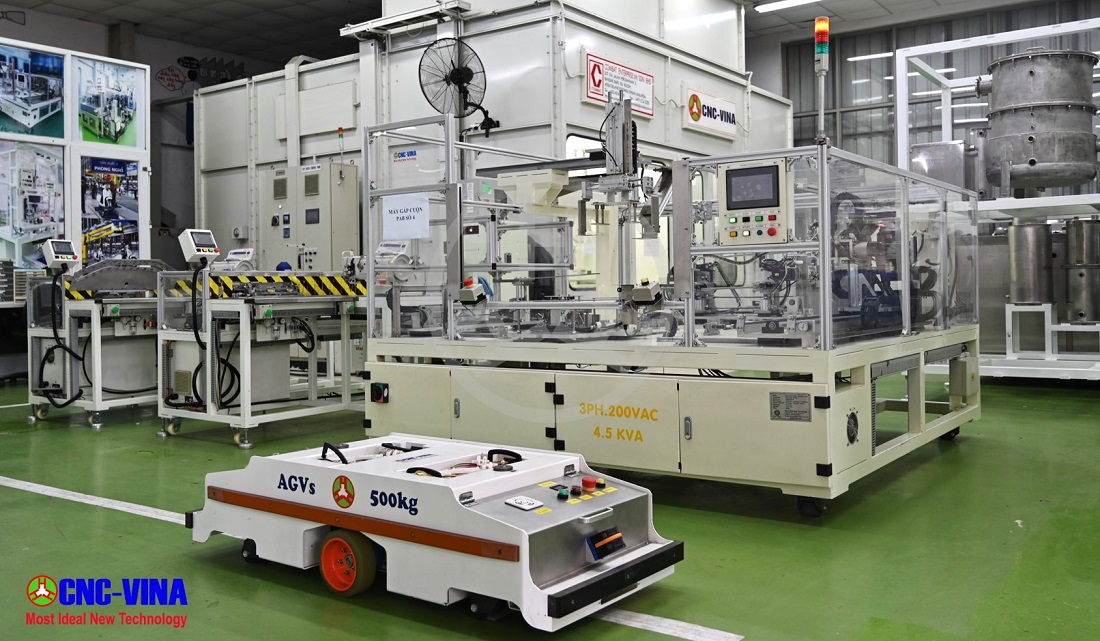
Automated guided vehicle
AGV (automated guided vehicle) is an internal transportation solution widely used in factories, warehouses, and production lines to automate the movement of materials, semi-finished products, and finished goods. Instead of relying entirely on manual transportation methods, AGVs can follow predefined routes to connect production areas with warehouses, material supply stations, or other processes within the factory. Depending on requirements for payload capacity, facility layout, and the desired level of automation, AGVs can utilize different guidance and positioning methods, such as magnetic tape, QR codes, laser navigation, or natural feature-based navigation technologies. When integrated with conveyors, robots, automated storage systems, and management software, AGVs can become an integral part of an automated material handling system within the factory. Together with CNC VINA, let’s explore the structure, guidance technologies, applications, and key factors to consider when implementing AGV automated guided vehicles for manufacturing and internal logistics.
VIETNAM CNC & TECHNOLOGY APPLICATION JOINT STOCK COMPANY
Hotline: +84.916 63 9355 / +84.915 74 4664
Email: Sales01@cncvina.com.vn / Sales03@cncvina.com.vn
Product description

AGV (automated guided vehicle) is an internal transportation solution widely used in factories, warehouses, and production lines to automate the movement of materials, semi-finished products, and finished goods. Instead of relying entirely on manual transportation methods, AGVs can follow predefined routes to connect production areas with warehouses, material supply stations, or other processes within the factory. Depending on requirements for payload capacity, facility layout, and the desired level of automation, AGVs can utilize different guidance and positioning methods, such as magnetic tape, QR codes, laser navigation, or natural feature-based navigation technologies. When integrated with conveyors, robots, automated storage systems, and management software, AGVs can become an integral part of an automated material handling system within the factory. Together with CNC VINA, let’s explore the structure, guidance technologies, applications, and key factors to consider when implementing AGV automated guided vehicles for manufacturing and internal logistics.
What is an AGV automated guided vehicle?
AGV (automated guided vehicle) is an automated transportation vehicle designed to move materials and goods between different locations within factories, warehouses, and logistics areas. Depending on its configuration, an AGV can tow carts, transport pallets, boxes, or racks, or be integrated with lifting mechanisms, conveyors, and auxiliary equipment to perform automated material handling tasks.
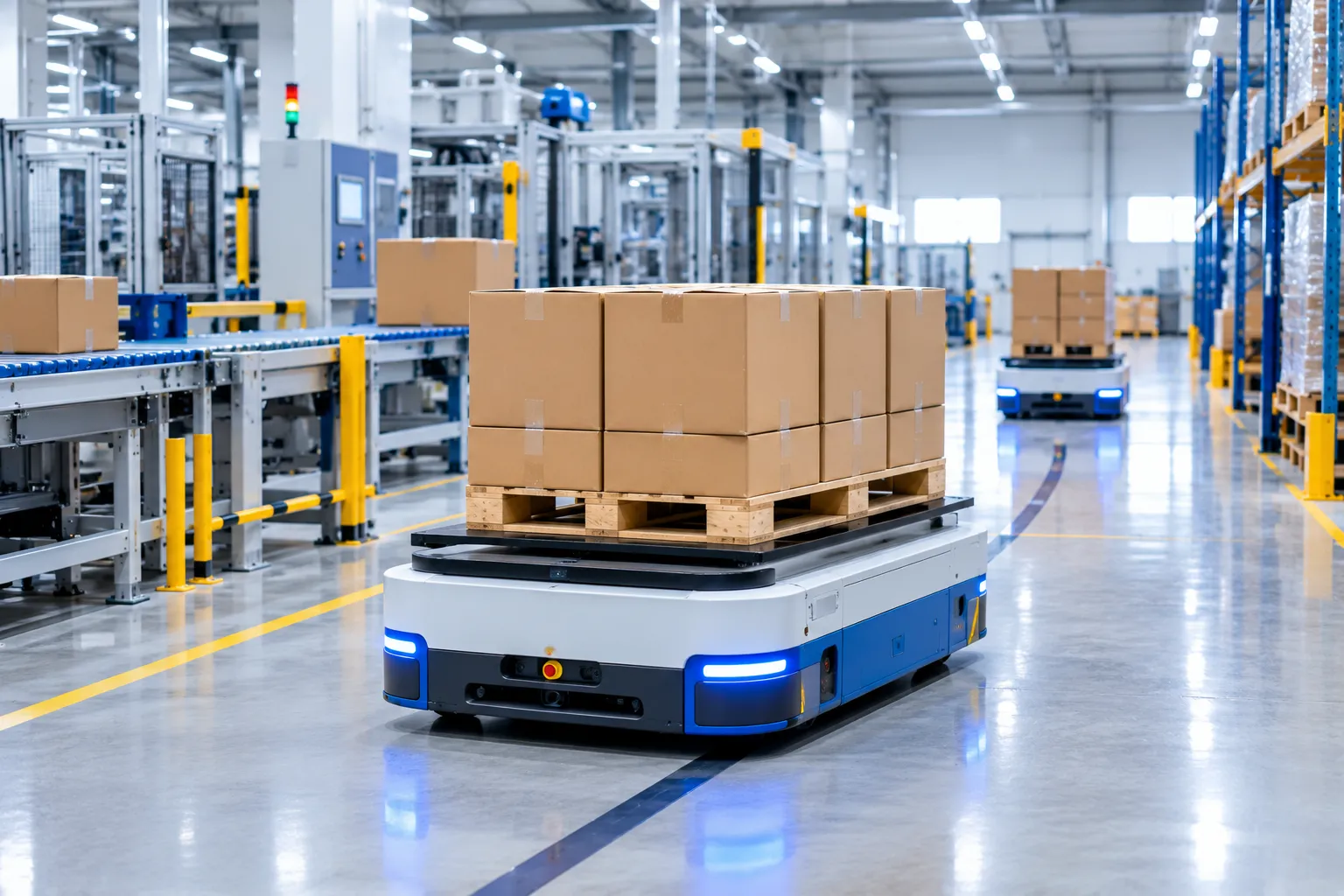
Unlike manually operated material handling equipment, AGVs are equipped with control systems, sensors, and navigation technologies that enable them to follow predefined routes and perform assigned transportation tasks automatically. Once a task is received, the vehicle can travel to the designated pickup point, collect or tow the load, and transport it to the required destination according to the programmed workflow.
In manufacturing plants, AGVs are commonly used for repetitive material handling tasks, such as supplying materials to production lines, transporting semi-finished products between processes, moving finished goods to storage areas, and connecting production areas with shipping zones. Unlike autonomous vehicles designed for road transportation, industrial AGV systems are developed specifically for controlled factory environments. Their configuration is determined by factors such as payload capacity, load dimensions, aisle width, turning radius, pickup and drop-off points, and integration requirements with other automated equipment.
Applications of automated guided vehicles in production lines
A significant part of internal logistics in manufacturing involves supplying materials, moving semi-finished products, and transferring finished goods to storage areas. These tasks are often repetitive, follow predefined routes, and may need to be performed continuously in line with production schedules. Automated guided vehicles (AGVs) help automate these material handling processes, creating a consistent flow of goods between designated areas within the factory. Depending on the production process, AGVs can transport pallets, racks, boxes, or tow carts between predefined pickup and drop-off points. When integrated with production equipment and other automation systems, AGVs can also help establish a more coordinated material flow throughout the manufacturing facility.
Guidance technologies for automated guided vehicles
The guidance and positioning system is a key component that determines how an automated guided vehicle (AGV) navigates, identifies its location, and carries out assigned tasks within a factory. By combining sensors, positioning devices, and control systems, an AGV can determine its position, identify the required route, and travel between designated pickup and drop-off points according to predefined instructions. The appropriate guidance technology depends on several factors, including the factory layout, operating environment, transportation requirements, and the level of flexibility required for the AGV system. Common approaches include magnetic tape guidance, QR code or marker-based positioning, laser guidance, inertial navigation, vision guidance, and natural feature-based navigation.
Magnetic tape guidance
Magnetic tape guidance is commonly used for AGV systems operating along relatively fixed transportation routes. Magnetic tape or other guidance materials are installed on the factory floor to define the route, which the AGV detects and follows during operation.
This approach has a relatively simple configuration and is suitable for factories with stable material flows between predefined locations. However, if the factory layout changes or new transportation routes need to be added, the guidance path may also need to be modified. For this reason, pickup and drop-off points, intersections, operating areas, and traffic flows should be considered during the initial system design to establish an efficient and practical AGV route.
QR code and laser guidance
In addition to magnetic tape, AGVs can use QR codes, markers, or sensor-based positioning methods to determine their location during operation. Markers can be installed at designated points along the route, allowing the AGV to identify its position and perform the corresponding operation according to the programmed sequence.
Laser guidance uses laser sensors to detect reference points or features in the surrounding environment. Based on the collected data, the AGV can determine its position and adjust its direction accordingly. This approach can provide greater flexibility than fixed-route guidance in applications where positioning requirements are more complex. The choice between magnetic tape, QR or marker-based positioning, laser guidance, and other technologies depends not only on the AGV itself but also on the factory layout, vehicle traffic, obstacles, route flexibility, and the required level of integration with the existing automation system.
Inertial guidance
Inertial guidance uses sensors such as gyroscopes and motion sensors to monitor the AGV's movement and orientation. Data collected from these sensors can be combined with other positioning information to help the vehicle maintain its heading and determine its position during operation. Inertial navigation can also be combined with other guidance technologies to improve positioning stability and overall system performance. For each project, the sensor configuration and navigation method should be selected based on the required positioning accuracy, route characteristics, and actual operating conditions within the factory.
Camera-based guidance and vision guidance
At a higher level of automation, AGVs can use cameras and image recognition technologies to identify features within their surrounding environment. The camera system captures visual information along the route and processes it together with positioning data to determine the vehicle's direction of travel.
With vision guidance, AGVs can navigate based on visual information from their surroundings rather than relying solely on a physical guidance path installed on the factory floor. This approach can provide greater flexibility for factories where layouts may change or where different transportation routes are required. Depending on the system configuration, cameras can also work together with other sensors to detect obstacles, identify pickup and drop-off points, and monitor the surrounding operating environment. The actual capabilities of a vision-guided AGV depend on the sensor configuration, control software, and specific requirements of each application.
Natural feature-based navigation
Some modern AGV systems can use fixed features within the operating environment, such as walls, columns, corners, or other reference points, to determine their position without relying entirely on physical guidance paths installed on the floor. Sensor data is used to identify and interpret these environmental features, allowing the AGV to determine its position and select an appropriate route. This approach can be suitable for applications requiring greater route flexibility or multiple pickup and drop-off locations within the same operating area. With a properly designed factory layout and appropriately configured positioning system, AGVs can travel between multiple locations without requiring a separate fixed route for every transportation task.
Selecting the right guidance technology for AGVs
There is no single guidance technology that is suitable for every manufacturing environment. For stable processes with fixed transportation routes, magnetic tape guidance can provide a practical and straightforward solution. For applications requiring greater flexibility, QR or marker-based positioning, laser guidance, camera-based navigation, or natural feature-based navigation may be considered.
Beyond the guidance technology itself, businesses should also evaluate payload capacity, AGV dimensions, aisle width, turning radius, pickup and drop-off locations, internal traffic density, obstacles, and integration requirements with other equipment. These factors should be assessed during the factory layout and automation planning stages to ensure that the AGV system can operate reliably and support the actual requirements of the production process.
In larger automation systems, automated guided vehicles (AGVs) can operate as part of an integrated material handling solution rather than as standalone equipment. AGVs can be connected with robots, conveyors, automated storage systems, and central control systems to coordinate transportation tasks across different areas of the factory. By exchanging information such as vehicle status, location, and transportation tasks, the system can coordinate material flows, assign transportation jobs, and manage AGV routes more efficiently.
Why are automated guided vehicles becoming increasingly important in modern manufacturing?
Before looking at the benefits of AGVs in manufacturing, it is important to understand their role in an industrial environment. Automated guided vehicles (AGVs) are robotic vehicles designed to transport materials and goods between different processes, production areas, and storage locations within a factory. They are different from autonomous vehicles developed for road transportation and are specifically designed to operate within controlled industrial environments.
Automated guided vehicles improve material handling efficiency
Unlike traditional manual transportation, AGVs can perform repetitive material handling tasks for extended operating periods according to predefined production schedules. AGV towing vehicles can transport a wide range of products, with payload capacities ranging from several tens to hundreds of kilograms, between different areas of a production line. They can also transport goods from the end of a production line to a storage area via an industrial conveyor, or move materials from storage areas to designated loading and shipping points.
By handling repetitive transportation tasks along predefined routes, AGVs can help maintain a consistent material flow and improve the efficiency of internal logistics operations. The introduction of AGVs to support or automate material transportation does not necessarily mean replacing the entire manual workforce. Instead, AGVs can take over repetitive, physically demanding, and time-consuming transportation tasks, allowing employees to focus on production operations, process monitoring, quality control, and other activities that require human involvement. As manufacturing capacity expands and automation requirements increase, AGVs can therefore serve as a practical solution for improving material handling efficiency while supporting the broader development of automated manufacturing systems.
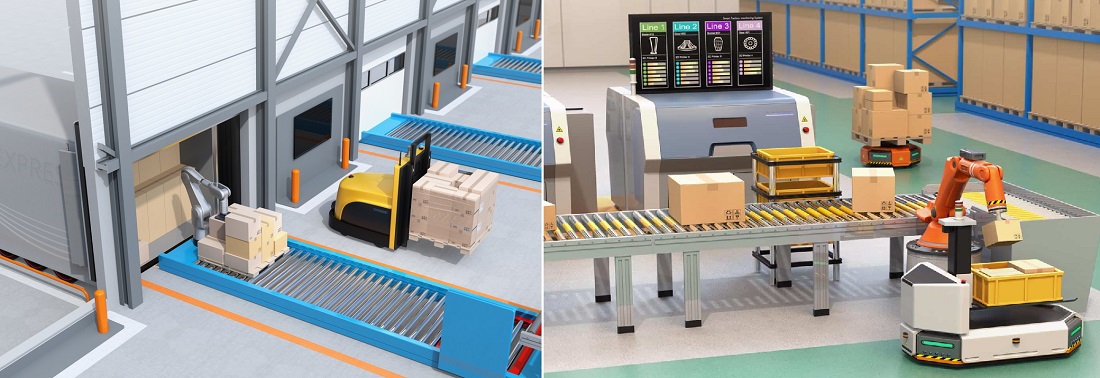
AGV Automated guided vehicle: Fully automated, intelligent, and safe operation
Material handling in manufacturing plants is often repetitive, physically demanding, and associated with various operational risks, including collisions with equipment or personnel, incorrect material handling, and product damage during transportation. Today, these tasks can be automated with AGV automated guided vehicles, which follow pre-programmed routes and predefined operating scenarios. Input data can be integrated into the AGV system to determine and execute suitable transportation routes using technologies such as barcodes, QR codes, magnetic guide strips, laser guidance signals, and infrared sensors.
AGVs can automatically detect obstacles, stop when necessary, adjust their routes, and identify products based on codes, colors, and dimensions. These intelligent capabilities have become an integral part of modern automated manufacturing environments.
AGVs can easily tow pallets, containers, racks, and other heavy loads weighing several hundred kilograms throughout the factory. They can also be configured to operate in challenging environments, including high or sub-zero temperatures, dusty or smoky areas, noisy production zones, chemical environments, and areas with limited lighting. By automating transportation tasks in such conditions, AGVs help reduce workers' exposure to hazardous or physically demanding operations. Automation therefore contributes to reducing manual labor while allowing employees to move away from difficult and potentially dangerous tasks.
Smart factories with AGVs, smart warehouses, and modern production management systems
With palletizing robots, collaborative robots, and AGV automated guided vehicles, your smart warehouse solution can be more comprehensive, helping maximize productivity and strengthen manufacturing competitiveness. In modern production environments, automated equipment supports and replaces human labor in repetitive tasks, physically demanding operations, and processes performed under unsuitable working conditions.
AGVs are designed to address these transportation and material handling requirements while maintaining operational productivity, improving workplace safety, and supporting integration with modern production management systems. As manufacturing continues to move toward higher levels of automation, AGVs are becoming an increasingly important solution for optimizing internal material transportation and factory operations.
Technical specifications and key features of CNC VINA AGV automated guided vehicles
CNC VINA develops automated guided vehicles (AGVs) and tugger AGVs for internal material transportation in manufacturing plants. The vehicles can be customized according to load capacity, transportation routes, factory layout, and integration requirements with existing production systems. Key specifications and features include:
| Specification / Feature | Details |
|---|---|
| Load capacity | 200 kg, 500 kg, 1,000 kg, or 1,500 kg depending on configuration |
| Travel speed | 10–50 m/min |
| Navigation method | Configured according to the transportation route and application requirements |
| Communication | Wireless RF signal transmission and reception system |
| Safety system | Sensors for obstacle detection and collision prevention |
| Structure | Bent sheet metal, welded structural components, and protective coating |
| Customization | Customized according to load capacity, cargo characteristics, factory layout, and transportation requirements |
The video introduces the solution for transporting goods in the factory's production and assembly line with towing robots and AGV self-propelled vehicles designed and manufactured by CNC-VINA.
CNC-VINA has developed AGV self-propelled vehicles since 2010 and is a supplier of AGV self-propelled vehicle products to many foreign companies in Vietnam such as: Canon, Pionner, GE, Bridgestone, Nidec, Sumitomo... CNC Vina produces produces two main lines of AGV: Pulling AGV/Robot (Pulling AGV Robocar) and AGV/undercarriage robot (Tunnel AGV Robocar).
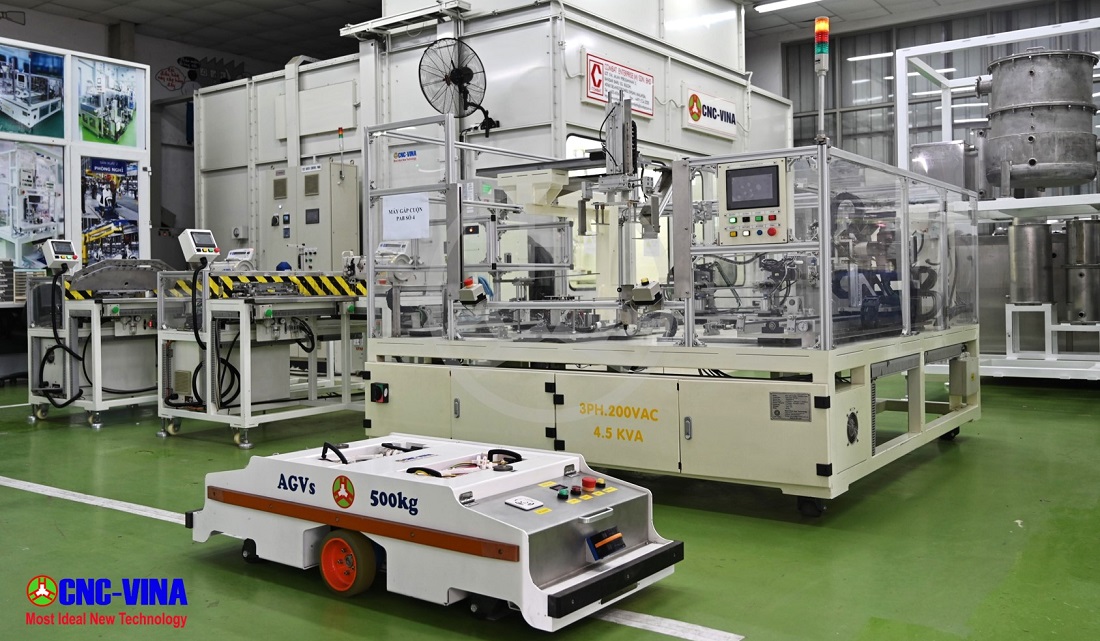
AGV automated guided vehicles help businesses automate internal material transportation, from supplying materials to production lines to transporting work-in-process goods, finished products, and connecting with warehouse systems. The effectiveness of an AGV depends not only on the vehicle itself but also on the navigation technology, factory layout, load capacity, transportation routes, and its ability to integrate with other automated equipment. Therefore, a suitable AGV solution should be designed based on each company's actual production processes and material handling requirements.
With experience in AGV development since 2010, CNC VINA provides design and manufacturing solutions for tugger AGVs, under-riding AGVs, and integrated material transportation systems tailored to specific requirements. Businesses can choose a standalone AGV solution or develop an automated transportation system integrated with production lines, robots, and warehouse systems. Contact CNC VINA for consultation on an AGV automated guided vehicle solution tailored to your factory's load capacity, layout, and transportation processes.
Contact us for consultation on smart warehouse solutions for smart factories using AGV automated guided vehicles.
VIETNAM TECHNOLOGY APPLICATION & CNC JOINT STOCK COMPANY
Factory: Song Cung Industrial Cluster, Dong Thap Commune, Dan Phuong District, Hanoi, Vietnam
Office: Rox Tower (Rox Center Goldmark City), No. 136 Ho Tung Mau Street, Bac Tu Liem District, Hanoi, Vietnam
Tel: +84.916 63 9355 / +84.915 74 4664
Email: Sales01@cncvina.com.vn | Sales03@cncvina.com.vn
Website: www.cncvina.com.vn | www.cncvina.net