Automatic soldering robots are used to automate soldering operations on electronic circuit boards, either at specific points or along defined paths. Instead of manually soldering each position, the robot uses a control system and multi-axis motion mechanisms to move the soldering tip to programmed locations, helping standardize the soldering process in electronic manufacturing and assembly. Automating this operation can reduce processing time, minimize reliance on manual labor, and maintain consistent performance across soldering cycles.
Automatic soldering robots are designed and programmed according to the specific characteristics of each product, from soldering positions and movement paths to the operating sequence. The system can be configured to meet different motion and soldering requirements, making it suitable for high-volume production lines as well as repetitive processes involving precisely defined soldering positions. With product-specific programming capabilities, automatic soldering robots can be applied in manufacturing and assembly facilities for printed circuit boards (PCBs) and electronic components.
Structure and systems of automatic soldering robots
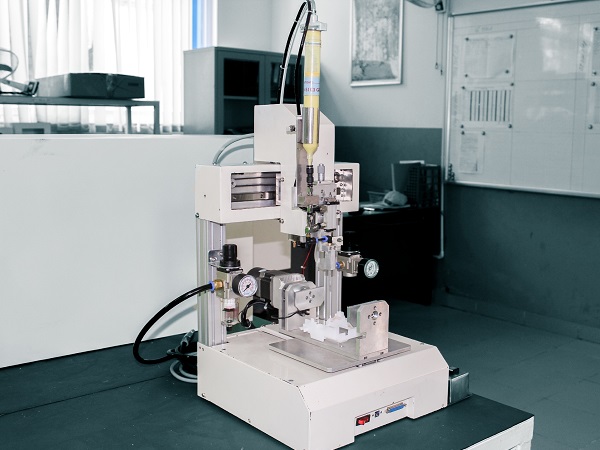
An automatic soldering robot consists of a machine frame, motion system, PCB fixture, soldering tip, and control system. These components work together to perform positioning, movement, and soldering operations according to the programmed sequence.
Machine frame: The machine features a rigid structural frame designed to meet the layout and integration requirements of the production line. The frame supports the motion mechanisms, PCB fixture, and soldering system, helping maintain structural stability during operation.
Three-axis motion system: The soldering tip moves along the X and Z axes, while the PCB fixture moves along the Y axis. The system uses linear guide rails combined with stepper motors or servo motors, enabling the soldering tip to follow programmed paths such as coordinate-based points, straight lines, circles, zigzag patterns, and three-dimensional interpolation trajectories.
Control and solder wire feeding system: The PLC-based control system manages the movement of the machine mechanisms and the sequence of soldering operations. The automatic solder wire feeding mechanism supplies solder wire to the soldering tip according to the programmed settings, supporting soldering at predefined coordinates and following the specified operating sequence.
Key features
Multi-path programming capability: The robot can be programmed for different motion and soldering paths, including point soldering, straight lines, circular paths, zigzag patterns, and interpolated trajectories.
Convenient operation and adjustment: The control system allows operators to set up and modify programs for individual products, making it easier to adjust soldering positions and operating sequences when required.
Compact design: The machine structure is designed for efficient placement within the production area, facilitating operation and integration into production lines according to specific layout and automation requirements.
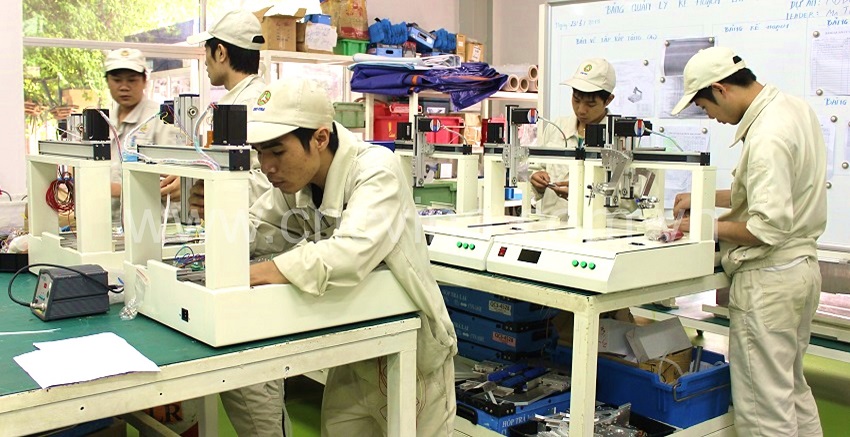
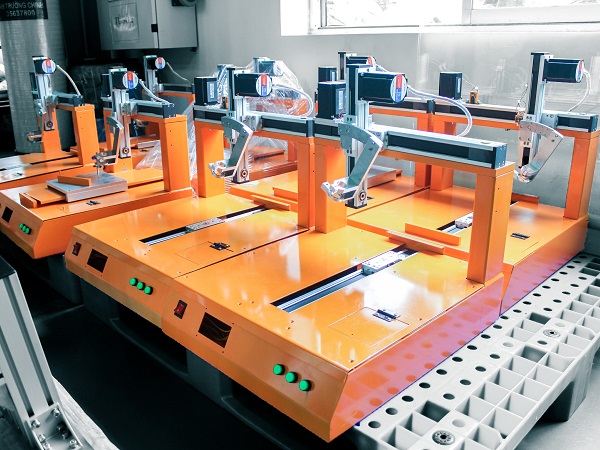
Image of a batch of welding robots manufactured by CNCVina being assembled in the factory's assembly room
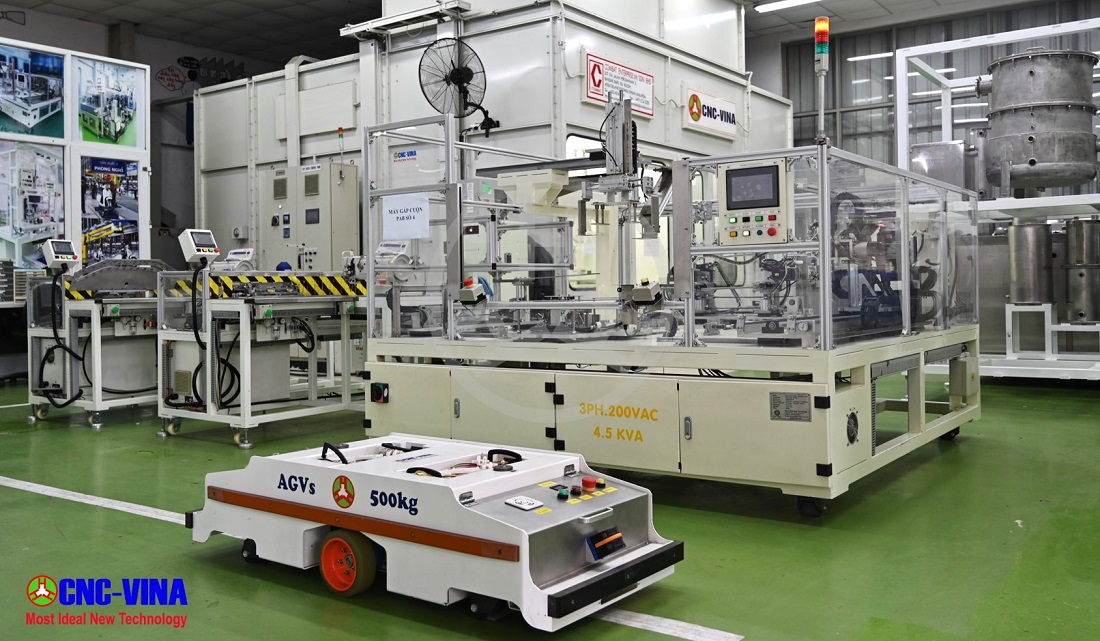
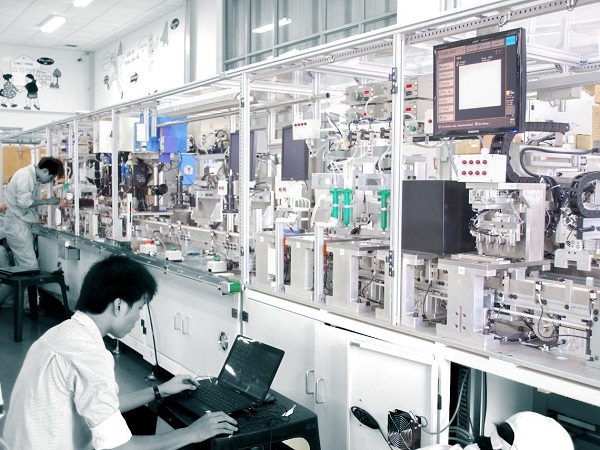
With CNC VINA's automatic soldering robots, soldering operations on PCBs and electronic components are carried out according to a predefined program, covering soldering position alignment, motion path control, solder wire feeding, and the soldering process itself. Integrating a robot into this operation helps standardize repetitive tasks, reduce reliance on manual operator skills, and maintain consistent performance across production cycles. When integrated into an electronic component manufacturing and assembly line, the robot can also work in coordination with feeding, fixturing, and inspection processes to create a more automated production workflow.
Features and components of automatic soldering robots
An automatic soldering robot is an integrated system combining mechanical structures, motion mechanisms, and control systems to perform soldering operations according to product-specific programs. Rather than simply controlling the movement of the soldering tip, the system must coordinate the soldering position, movement path, operating sequence, and solder wire feed throughout each working cycle. The interaction between these components determines the system's ability to meet different soldering requirements for various types of PCBs and electronic components.
Robot arm
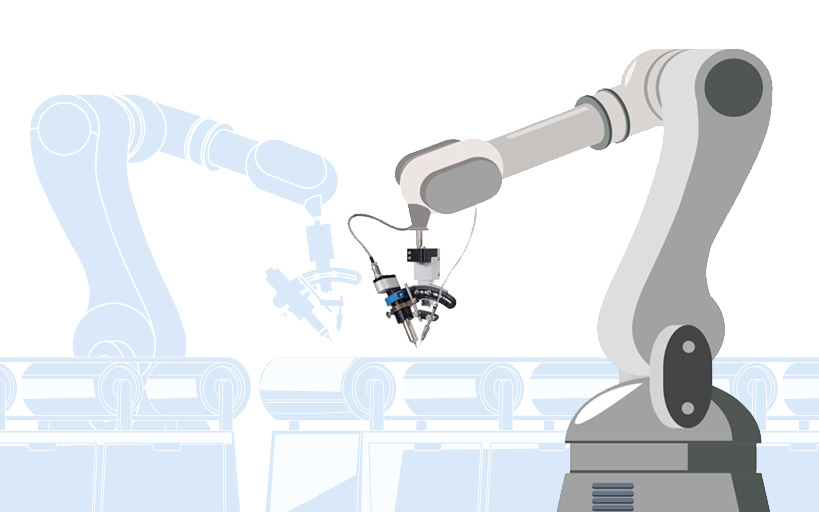
The robot arm is the mechanism that directly carries and controls the movement of the soldering tip to the required soldering positions. Through its drive system and programmed control sequence, the robot arm can move along predefined coordinates or paths, adapting to the shape and location of solder joints on each product.
For automatic soldering robots, precise path control is particularly important when a product contains multiple soldering points or requires continuous soldering along a defined path. The robot arm must operate in coordination with the PCB fixture, soldering tip, and solder wire feeding mechanism to position the soldering tip accurately, maintain the programmed motion, and complete each soldering cycle before moving to the next position.
Soldering tip / Soldering tool
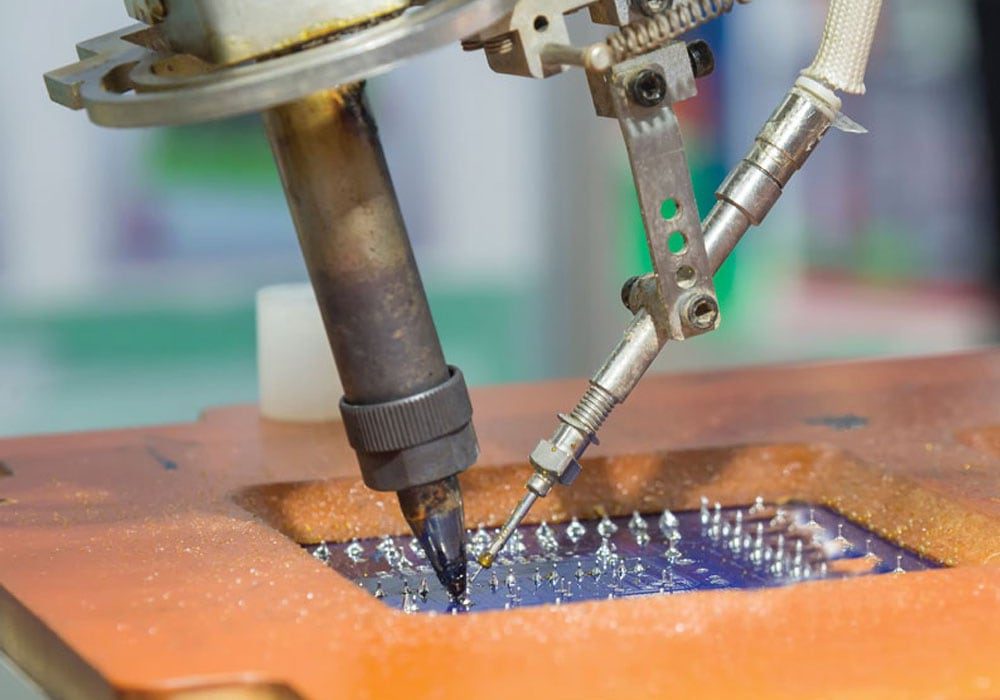
The soldering tip is the component that directly performs the heating process and applies solder to the required positions on the PCB or electronic components. Depending on the requirements of each product, the soldering tip can be selected and configured according to the size of the soldering point, joint geometry, and operating conditions of the production line. The temperature control system helps maintain the preset temperature during operation, supporting consistent soldering conditions across production cycles. The combination of temperature, heating time, and solder feed rate directly affects the quality of the resulting solder joint.
Vision system
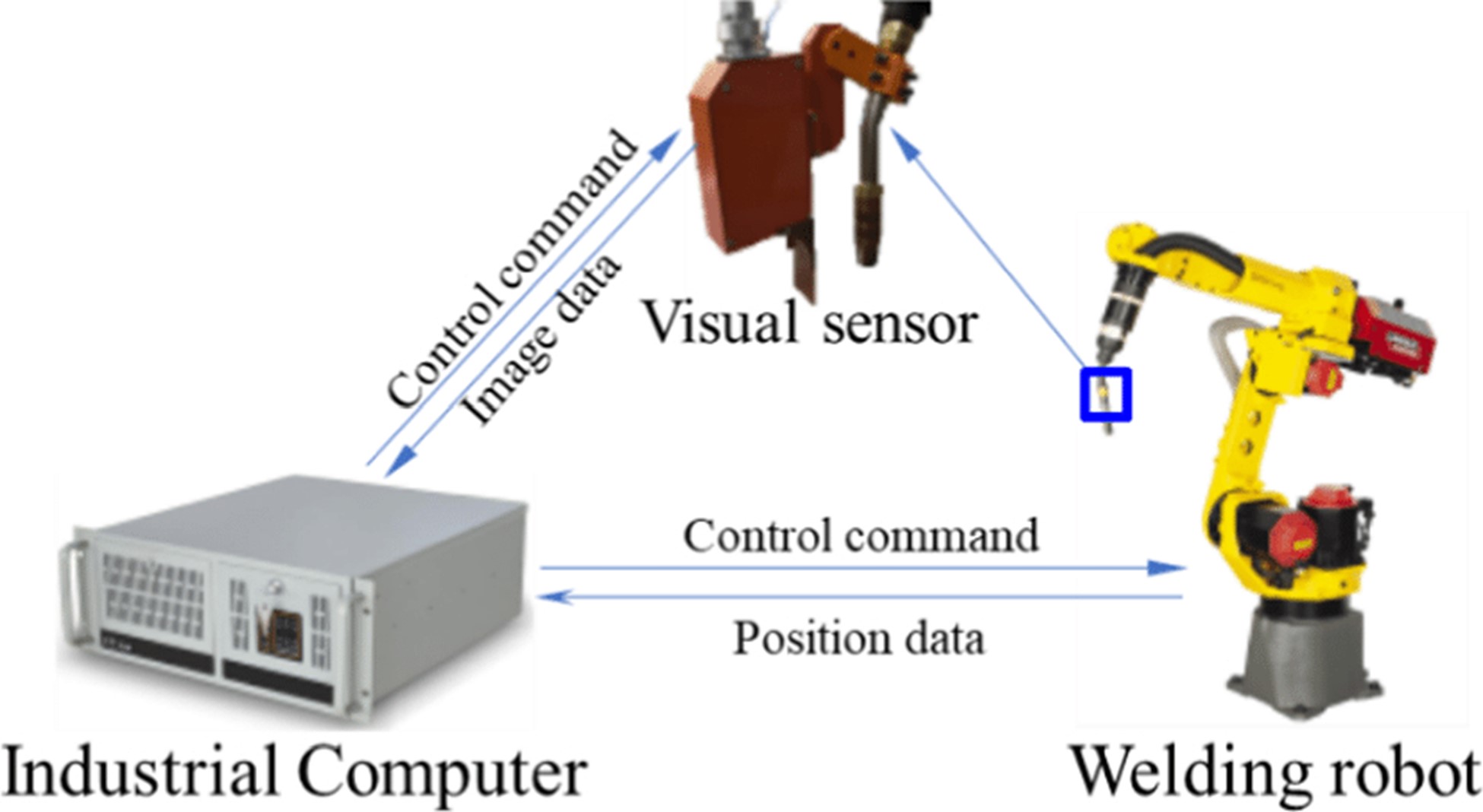
For systems that require product recognition and positioning, an automatic soldering robot can be integrated with a machine vision system to identify the required soldering positions. The camera captures images of the PCB or component, while image-processing software analyzes the visual data to determine the position and adjust the operating coordinates according to the programmed parameters. This solution is particularly useful when product positioning may vary between production cycles or when multiple product models need to be processed on the same system. Integrating cameras with image-processing software also reduces reliance on purely mechanical positioning methods.
Flux dispensing system
In some soldering processes, flux is used to clean the surfaces, improve solder wettability, and facilitate the formation of reliable solder joints. An automatic soldering robot can be integrated with a flux dispensing mechanism depending on the specific process requirements of the product. The system delivers flux to the required positions and controls the dispensing volume according to the preset parameters, helping minimize inconsistencies during repeated production cycles. The use of a flux dispensing mechanism should be determined based on the materials, soldering method, and technical requirements of each application.
Programming and control system
The programming and control system manages the overall operating sequence of the automatic soldering robot. Through this system, operators can set coordinates, motion paths, soldering sequences, and parameters related to solder feeding and heating. With the ability to store and recall programs, the machine can switch between different products without requiring the entire process to be programmed from scratch. The control system also coordinates the operation of the motion mechanisms, soldering tip, and peripheral equipment to ensure that each step is performed according to the programmed sequence.
Safety system
The safety system is designed to reduce operational risks and protect personnel working with the equipment. Depending on the machine configuration and production line requirements, the system may include emergency stop buttons, safety doors or guards, safety switches, and equipment status monitoring mechanisms. When an abnormal condition or stop signal is detected, the system can bring the equipment to a safe state according to the configured control logic. Safety devices should be designed and integrated in accordance with the machine structure and the actual operating conditions of each production line.
Benefits of automatic soldering machines
Reduced errors and less rework
During manual soldering, results can be affected by operator skill, working technique, and working conditions. With an automatic soldering machine, soldering positions, movement paths, operating sequences, and relevant parameters can be programmed in advance, allowing the process to follow a consistent procedure across production cycles.
Program-controlled operation helps minimize unnecessary variations during soldering, thereby reducing the risk of defective solder joints and the need for repair or rework. For production lines with a large number of soldering points or highly repetitive operations, maintaining a consistent process makes it easier for manufacturers to control output quality.
Improved operational efficiency
Automatic soldering machines can perform programmed soldering operations without requiring operators to manually solder each individual point. Once the equipment has been installed and the appropriate program has been configured, operators primarily handle tasks such as loading products, monitoring machine status, and making adjustments when necessary.
Reducing manual operations at the soldering stage allows personnel to focus on other processes within the production line while supporting a more automated and continuous workflow. For products with a large number of repetitive soldering points, this can also improve the overall utilization of the equipment.
Flexibility for product changes
One of the advantages of an automatic soldering system is its ability to create product-specific programs based on different process requirements. Coordinates, movement paths, soldering sequences, and related parameters can be adjusted to suit the structure of each PCB or electronic component.
Instead of relying entirely on manual operations when changing products, manufacturers can store corresponding programs and recall them when required. This programming capability is particularly useful for production lines handling multiple product models or frequent model changes, allowing the system to adapt more effectively to actual manufacturing requirements.
Increased productivity and automation
Automatic soldering machines perform operations according to programmed cycles, reducing the time required for repetitive soldering tasks and minimizing dependence on individual operator working speed. When properly integrated with feeding systems, fixtures, or upstream and downstream processes, the equipment can become part of a continuous automated production workflow.
For high-volume production lines, standardizing the operating time and sequence across production cycles makes production activities easier to organize and control. Actual productivity, however, depends on factors such as the number of soldering points, required heating temperature and time, movement speed, and the way the machine is integrated into the overall production line.
Consistent solder joint quality
Solder joint quality depends not only on the amount of solder applied but also on factors such as temperature, heating time, soldering tip position, and movement path. An automatic soldering machine allows these parameters to be programmed and controlled during operation, helping maintain consistent soldering conditions across products.
The automatic solder wire feeding mechanism also helps control the delivery of solder wire to the soldering position according to the preset parameters. When combined with appropriate temperature and motion control, the system can minimize variations that may occur during repeated manual operations.
For PCBs with high component density or a large number of soldering points, precise control of coordinates and movement paths allows the soldering tip to reach the programmed positions accurately. This provides a stronger basis for standardizing solder joint quality and reducing variations between production cycles.
Optimized material and labor costs
Automating the soldering process can help optimize operating costs by reducing the amount of manual work required and providing better control over material consumption during each production cycle. The programmed solder wire feeding mechanism delivers solder according to the configured parameters, helping minimize excessive solder consumption caused by inconsistent manual operations.
In addition, as the amount of manual work required at the soldering stage is reduced, personnel can be allocated to inspection, monitoring, or other tasks requiring greater technical involvement. Actual cost savings will depend on factors such as production volume, number of soldering points, operating method, and the overall level of automation across the production line.
Applications of automatic soldering robots
Automatic soldering robots are used in various manufacturing processes that require repetitive soldering operations, controlled positioning, and consistent performance across production cycles. Depending on product structure, soldering requirements, and the automation level of the production line, the equipment can be used as a standalone system or integrated with feeding, fixturing, and inspection systems. Key application areas for automatic soldering robots include:
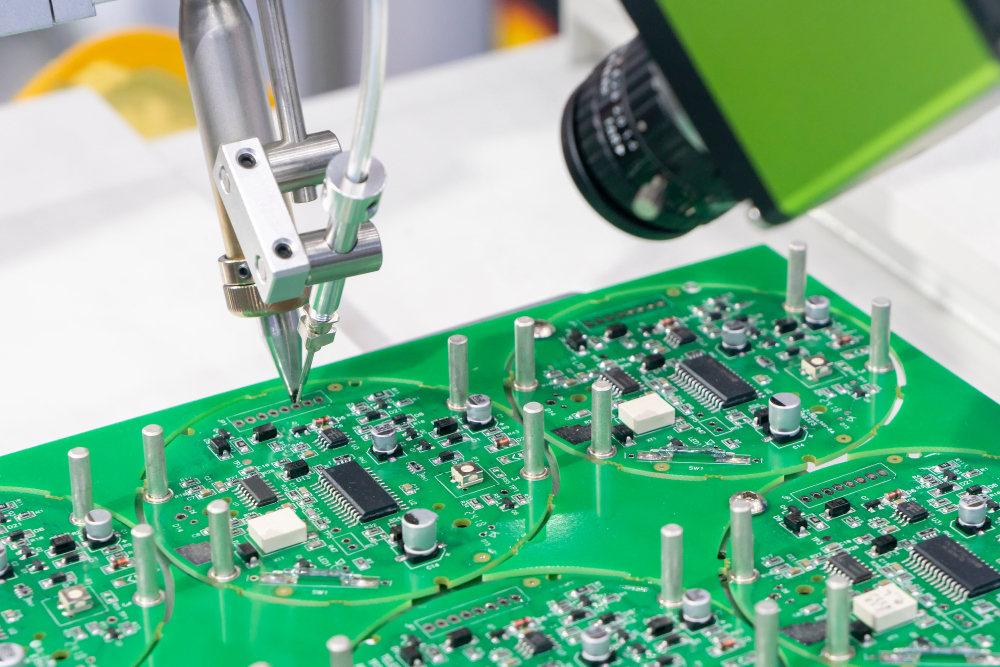
Electronic manufacturing and assembly
Automatic soldering robots are used in electronic circuit board manufacturing and assembly processes, particularly for products with a large number of soldering points or highly repetitive soldering operations. The equipment can perform soldering points or continuous soldering paths at programmed coordinates on the PCB, while working in coordination with the solder wire feeding mechanism and PCB fixture to carry out each soldering cycle according to a predefined sequence. For assemblies incorporating SMD components, through-hole components, wires, or connectors, the system can be designed according to the specific characteristics of each product to meet its soldering position and path requirements.
Automotive electrical and electronic component manufacturing
In the automotive industry, an increasing number of functional assemblies incorporate PCBs, sensors, connectors, and other electrical and electronic components. Automatic soldering robots can be applied to processes such as soldering wires to printed circuit boards (PCBs), soldering connectors, or performing soldering operations on component assemblies where working space is limited.
Programmable coordinates and motion paths allow the equipment to access predefined soldering positions while maintaining a consistent operating sequence across products. This capability is particularly useful for component assemblies with multiple soldering points or applications requiring precise positioning within compact spaces.
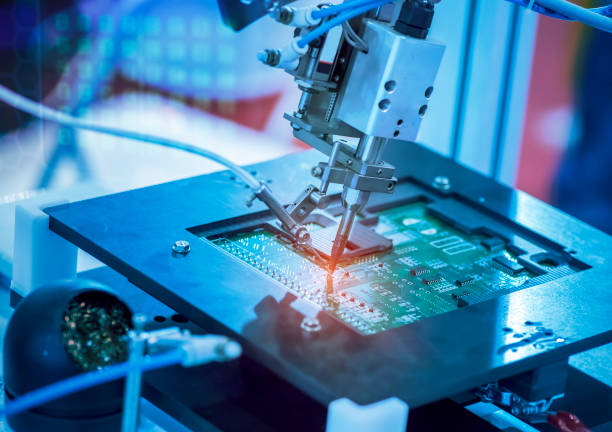
Consumer electronics manufacturing
Smartphones, smart devices, computers, electronic home appliances, and other consumer electronics rely on PCBs and electronic assemblies with increasingly high component density. In high-volume production lines, automatic soldering robots can perform repetitive soldering operations on PCBs, wires, connectors, and component positions according to programmed parameters.
Automation helps manufacturers standardize soldering operations, control production sequences, and reduce reliance on manual work for highly repetitive processes. When integrated with feeding systems and other automated equipment, automatic soldering robots can become part of a more highly automated electronic assembly line.
CNC VINA – Customized automation solutions for production requirements
With experience in the design and integration of automation equipment, CNC VINA provides automatic soldering robot solutions designed around the specific characteristics of each product, soldering position, and actual operating requirements of the production line. From motion mechanisms, PCB fixtures, and soldering tips to solder wire feeding and control systems, each component can be configured to suit the specific manufacturing process. If your business is looking for an automatic soldering robot for PCBs, electronic components, or repetitive soldering operations, CNC VINA can provide consultation on a suitable design and integration solution based on the product requirements and available production line layout.
CNC VIETNAM TECHNOLOGY & APPLICATION JOINT STOCK COMPANY
Office: ROX Tower – ROX Center Goldmark City, 136 Ho Tung Mau Street, Hanoi, Vietnam
Factory: Song Cung Industrial Cluster, Dong Thap Commune, Dan Phuong District, Hanoi, Vietnam
Phone: +84 916 63 9355 / +84 915 74 4664
Websites: cncvina.com.vn | cncvina.net | cncviname.com.vn
Email: Sales01@cncvina.com.vn | Sales03@cncvina.com.vn

 Tiếng
Việt
Tiếng
Việt
 Tiếng
Anh
Tiếng
Anh
 Tiếng
Nhật
Tiếng
Nhật




 Tiếng Anh