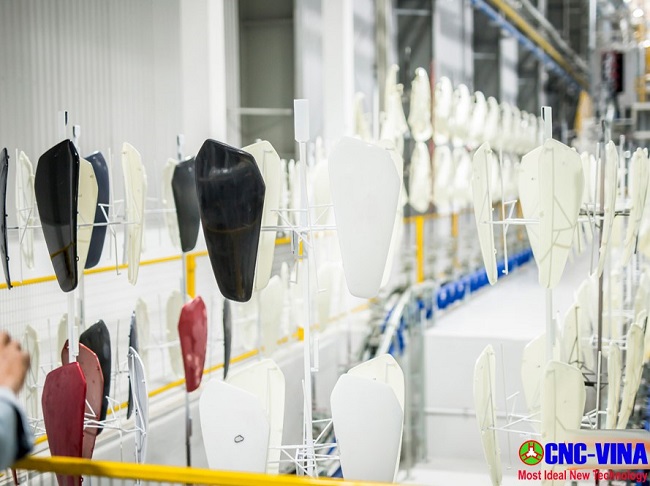
Pretreatment system for painting lines
A pretreatment system for painting lines consists of a series of cleaning, surface treatment, and conversion coating processes performed before products enter the painting stage. This is an important step that directly affects paint adhesion, surface stability, and corrosion resistance during service. Depending on the substrate material, quality requirements, paint system, and production capacity, the system can be configured using different technologies, such as phosphate pretreatment, zirconium conversion coating, or mechanical surface treatment.
In an industrial painting line, the effectiveness of the pretreatment process depends not only on the chemicals used but also on the number of process stages, rinse water quality, temperature, treatment time, spraying or immersion method, and the ability to control operating parameters. Therefore, the system should be designed in coordination with the product material, production volume, and downstream painting technology. CNC VINA provides an in-depth overview of pretreatment processes, common surface treatment technologies, equipment systems, and key considerations when investing in a pretreatment line for industrial products.
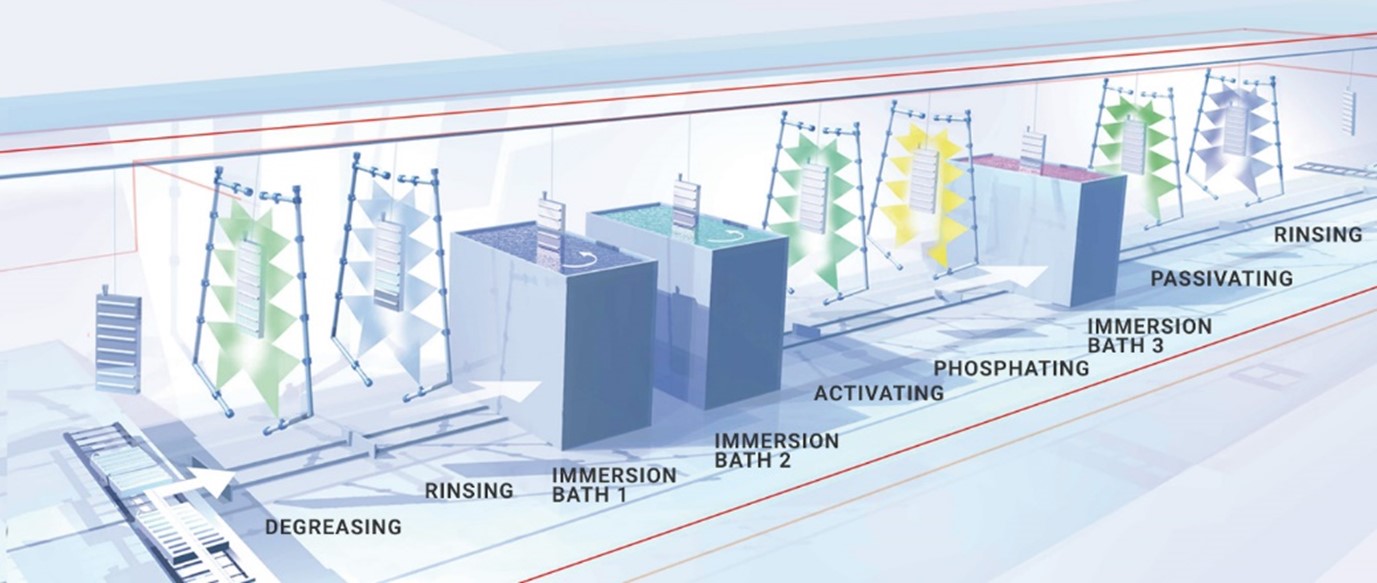
Processes in the pretreatment system
Role of the pretreatment system in a painting line
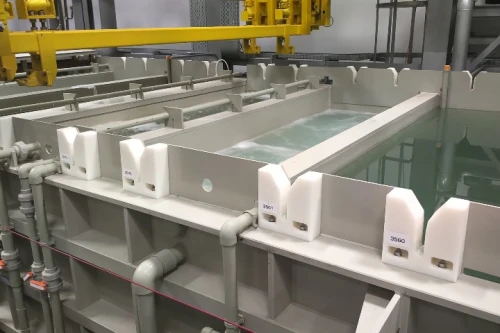
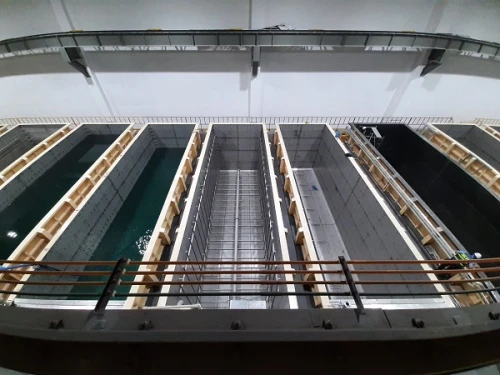
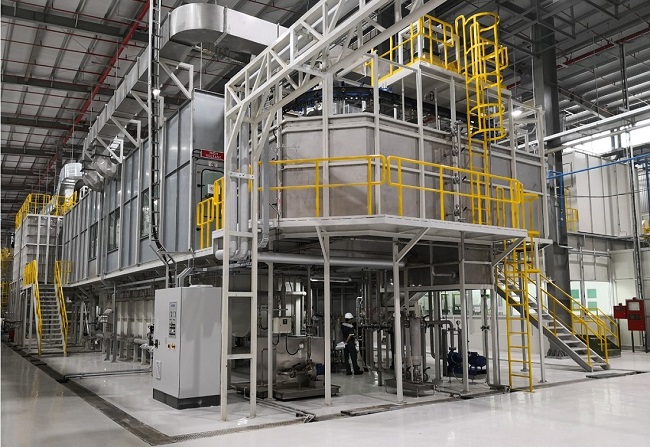
After machining and fabrication, product surfaces often contain oil, grease, dust, oxides, processing residues, and other contaminants that can affect the painting process. If these contaminants are not properly removed, they may reduce paint adhesion, cause coating non-uniformity, and increase the risk of defects during service. Therefore, pretreatment is positioned before the painting stage to bring the product surface into a condition suitable for the subsequent coating process. Depending on the material and product requirements, the pretreatment process may include cleaning, degreasing, water rinsing, surface conditioning, conversion coating, and final rinsing. These stages can be arranged as a continuous process or divided into individual treatment zones, together with tanks, spray nozzles, circulation pumps, heating systems, water supply systems, and conveyors.
A properly designed pretreatment system helps maintain consistent surface quality before painting while supporting paint adhesion and corrosion resistance. For high-volume production lines, automation and control of parameters such as temperature, solution concentration, spray pressure, flow rate, and treatment time can further improve process stability.
Cleaning and contaminant removal
Cleaning is the first stage in many pretreatment systems and is intended to remove oil, grease, dust, machining residues, and other contaminants from the product surface. The required level of cleanliness depends on the downstream coating system, as residual contaminants may interfere with the formation of the conversion coating and reduce paint adhesion. In industrial production lines, the cleaning method is generally selected according to the product material, type of contamination, component dimensions, and required production capacity. Common options include alkaline cleaning solutions, degreasing, high-pressure spraying, or a combination of several treatment stages. In continuous lines, the cleaning solution can be supplied and circulated through pumps, spray nozzles, or treatment tanks according to the system configuration. After cleaning, products need to be rinsed with water to remove residual chemicals and contaminants before entering the next treatment stage. Rinse water quality, flow rate, contact time, and carryover between process stages should be controlled to maintain overall pretreatment stability.
Improving paint adhesion
After cleaning, the metal surface may undergo a conversion coating treatment to provide suitable conditions for bonding between the substrate and the subsequent paint layer. The conversion coating modifies the surface characteristics and forms an intermediate layer between the metal substrate and the organic coating above it. The effectiveness of this process depends on various factors, including substrate material, treatment chemicals, temperature, treatment time, rinsing conditions, and other operating parameters. Therefore, the pretreatment technology should be selected in coordination with the paint system and product requirements rather than based solely on the number of process stages.
For products continuously painted at high production volumes, stable control of the pretreatment process is particularly important for maintaining consistent coating quality between production batches.
Enhancing corrosion resistance
Pretreatment not only prepares the surface for painting but can also contribute to protecting the metal from environmental exposure. Depending on the selected technology, a conversion coating can form an intermediate layer that helps limit corrosion and support the protective performance of the final coating system. The resulting corrosion resistance depends on the entire pretreatment and painting system, including substrate material, cleaning method, conversion coating technology, rinse water quality, drying conditions, and final coating system. Therefore, corrosion resistance requirements should be established during the line design stage so that an appropriate treatment configuration can be selected. For products operating in high-humidity environments or requiring long coating service life, the pretreatment process should be carefully controlled together with the downstream painting and drying stages.
Product Pretreatment Process
The pretreatment process is designed to clean and prepare product surfaces before they enter the painting stage. Depending on the substrate material, paint system, corrosion resistance requirements, and production capacity, the number and method of treatment stages can be adjusted accordingly. In industrial lines, products are typically transported continuously through treatment zones by conveyors and jigs, while treatment solutions are supplied, sprayed, or circulated according to the system design.
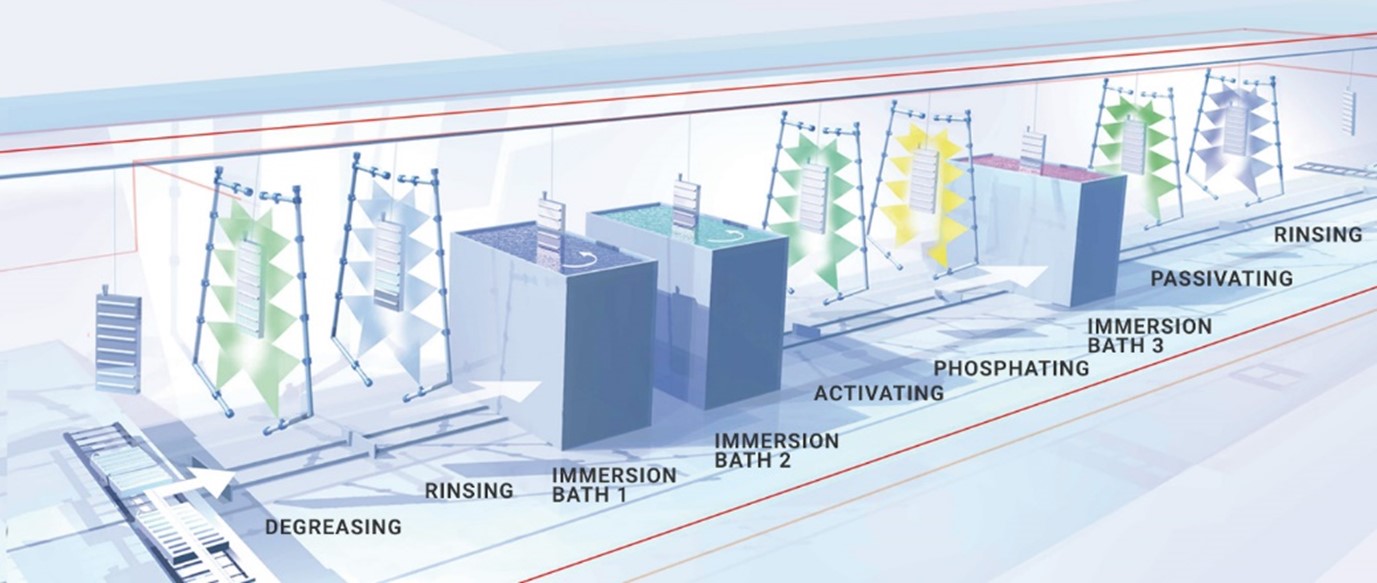
A typical pretreatment process may include:
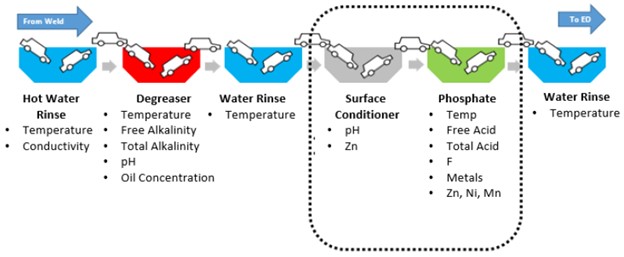
Cleaning → Water Rinsing → Surface Conditioning → Conversion Coating → Post-Treatment Rinsing → DI/RO Water Rinsing → Drying → Transfer to Painting Stage
Not every painting line uses all of these stages. The number of tanks, spraying or immersion methods, chemical types, operating temperatures, and water quality should be determined based on the product material, coating requirements, and actual operating conditions.
Process of product pretreatment
Clean

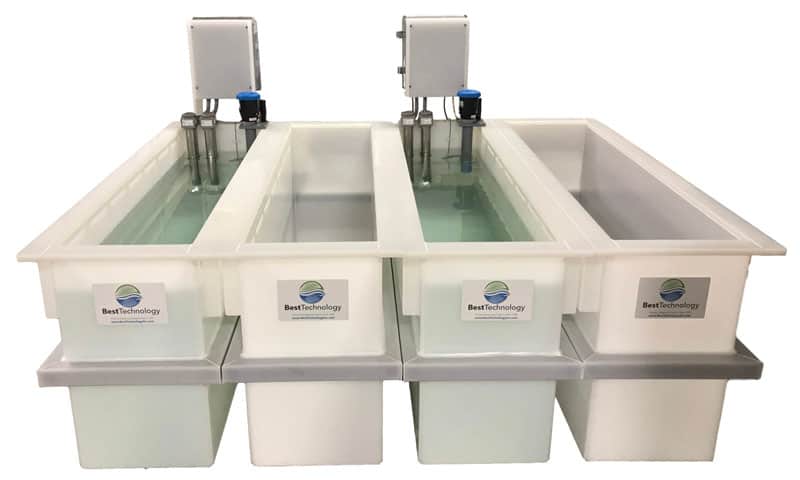
Cleaning is the first stage for removing oil, grease, dust, machining residues, and other contaminants remaining on the product surface. This provides an important condition for subsequent treatment stages to contact the metal substrate uniformly and form a stable conversion coating. Depending on the material, type of contamination, and product requirements, the system may use alkaline cleaning solutions or other suitable treatment methods. In automated lines, the cleaning solution can be sprayed directly onto products through spray nozzles or applied through immersion tanks, combined with circulation pumps and equipment for monitoring process parameters.
Cleaning effectiveness needs to be monitored throughout operation. If oil, grease, or other contaminants remain on the surface, the conversion coating formed in the subsequent stage may become non-uniform, which can affect the adhesion and corrosion resistance of the overall coating system.
Water rinsing
After cleaning, products enter the water rinsing stage to remove residual chemicals and contaminants before proceeding to the next treatment stage. Rinsing helps minimize solution carryover from one process stage to another, thereby maintaining stable treatment conditions in each section of the line. Rinsing systems can use spraying or immersion depending on the line configuration. Water quality, flow rate, spray pressure, and circulation conditions should be controlled according to process requirements. For applications requiring a high level of cleanliness, multiple rinsing stages using different water qualities may be installed. Maintaining appropriate rinse water conditions also helps reduce the amount of chemicals and contaminants carried between tanks, contributing to stable conversion coating quality in the subsequent stage.
Surface conditioning
Surface conditioning is used in certain pretreatment processes, particularly zinc phosphate systems. This stage prepares the metal surface before conversion coating, helping control coating formation and the characteristics of the resulting conversion layer. Surface conditioning provides favorable conditions for more uniform formation of the conversion coating. Its effectiveness depends on the chemical formulation, substrate material, and operating parameters of the line. In automated systems, the conditioning solution can be supplied and controlled using metering pumps or circulation systems. The actual configuration should be selected based on the phosphate technology and the required quality of the finished product.
Treatment process selection
Traditionally, iron phosphate and zinc phosphate have been widely used as pretreatment options to achieve the required level of performance. More recently, alternative technologies have been developed to address growing concerns related to energy and water consumption, environmental impact, and overall process efficiency.
Conversion coating
Conversion coating is a chemical treatment process in which an inorganic layer is formed on the metal surface through a reaction between the substrate and the treatment solution. This layer acts as an intermediate interface between the metal substrate and the paint, helping improve coating adhesion and corrosion resistance. Common conversion coating technologies used in industrial painting lines include iron phosphate, zinc phosphate, and newer technologies such as zirconium conversion coating. Each technology has different characteristics in terms of substrate compatibility, number of process stages, operating conditions, and quality requirements. The treatment can be performed by spraying or immersion. In automated lines, parameters such as solution temperature, contact time, chemical concentration, spray pressure, and flow rate need to be controlled to maintain stable treatment conditions.
Iron phosphate pretreatment system
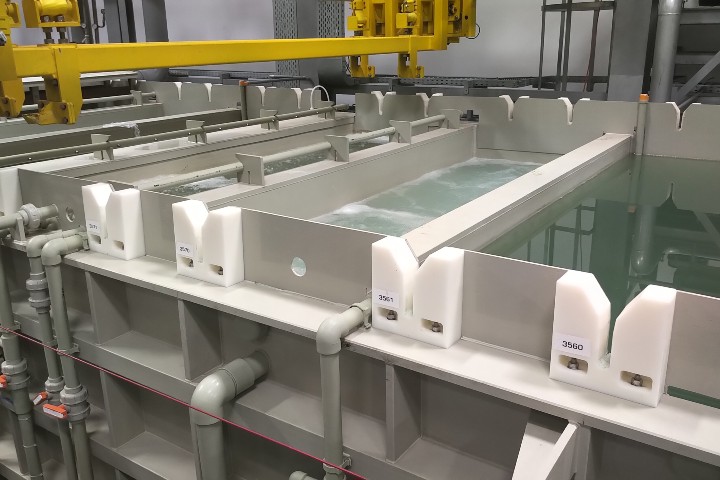
Iron phosphate systems, also referred to as alkali metal phosphate systems, are used for components requiring a durable finish but not necessarily exposed to highly corrosive environments. These systems may consist of two to six stages, with the simplest configuration involving a combined cleaning and coating stage followed by a tap-water rinse. Short-stage systems can be used where lower performance requirements apply. Components that are more difficult to clean or require higher surface quality may require a separate cleaning stage, dedicated rinsing, iron phosphate treatment, post-treatment rinsing, and DI water rinsing.
A post-treatment rinse, with or without chromium depending on the selected process, may improve corrosion performance compared with iron phosphate treatment alone.
Iron phosphate forms an amorphous conversion coating on steel, with surface appearance ranging from iridescent blue to gray depending on operating conditions and chemical formulation. Mixed-metal products may be treated using modified formulations that can contain fluoride compounds. Iron phosphate is generally easier to operate and requires fewer treatment stages than zinc phosphate. However, its corrosion protection performance may not be equivalent to that of zinc phosphate in applications with higher corrosion resistance requirements.
Zinc phosphate pretreatment system
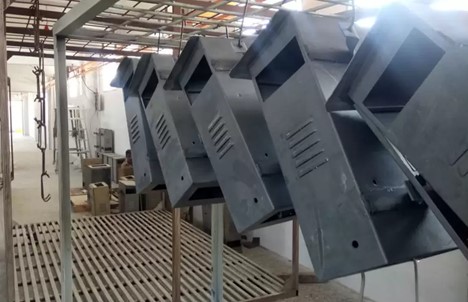
Zinc phosphate systems differ from iron phosphate systems in two important areas. First, they generally require a surface-conditioning stage. Second, the zinc phosphate bath contains additional metal ions that become incorporated into the conversion coating together with metal ions originating from the substrate being treated.
Surface conditioning
Surface-conditioning rinses are used in zinc phosphate processes to refine crystal morphology and control coating weight. Modern conditioning products are available in liquid formulations that can be consistently applied using metering pumps. Surface conditioning takes place immediately before the zinc phosphate stage and is the only stage in this sequence followed by another chemical treatment stage, namely the zinc phosphate bath. Traditional surface-conditioning chemicals were often colloidal suspensions of titanium salts. As these conventional baths age, their effectiveness may decrease, requiring water replacement or overflow to maintain process performance. More recent conditioning technologies have been developed to improve the fineness and consistency of zinc phosphate coatings while providing greater process stability.
Zinc phosphate
Zinc phosphate is a widely used surface treatment technology in industrial painting lines, particularly where high requirements are placed on paint adhesion and corrosion resistance. The process forms a conversion coating on the metal surface, improving the interface between the substrate and the subsequent paint layer.
Depending on the substrate material, paint system, and product requirements, the system can be designed with different chemical parameters, operating temperatures, treatment times, and spraying or immersion methods. Compared with iron phosphate, zinc phosphate is often considered for projects requiring higher corrosion resistance and coating performance. The technology can be applied to various metal substrates in industrial manufacturing; however, compatibility with each material should be evaluated according to the specific chemical system and process. For products made from multiple metals, such as steel, galvanized steel, or aluminum, the chemical formulation and pretreatment configuration should be carefully considered to achieve consistent surface treatment. Modern zinc phosphate systems tend to operate at lower temperatures, generate less sludge, and provide improved chemical control compared with some conventional systems. Some formulations have also been developed to reduce or eliminate certain chemical components, depending on environmental requirements, project regulations, and finished-product specifications. Therefore, when investing in a pretreatment line, technology selection should not be based solely on the chemical name. Quality requirements, substrate materials, production capacity, chemical consumption, water consumption, sludge generation, wastewater treatment requirements, and automation capabilities should all be considered together.
In a pretreatment system, zinc phosphate performance depends on factors such as the cleanliness of the surface before treatment, solution temperature, contact time, chemical concentration, rinse water quality, and operating conditions of the treatment tank. For continuous spray lines, the design of circulation pumps, piping, spray nozzles, and flow control also directly affects treatment uniformity. For products with mixed-metal substrates, the chemical system may incorporate additional components to control coating formation on different materials. However, the specific configuration should be determined based on the metal types, paint requirements, and chemical supplier specifications. This is also why the pretreatment system should be designed as an integrated process rather than selecting individual chemical tanks independently. From an investment perspective, zinc phosphate can be considered for projects seeking a balance between corrosion resistance, paint adhesion, and production stability. When selecting the technology, manufacturers should simultaneously evaluate chemical costs, thermal energy consumption, water usage, sludge generation, wastewater treatment requirements, and the automation level of the entire system.
Next-generation conversion coatings
Newer conversion coating technologies have been developed to provide several potential process benefits. Compared with some conventional zinc or iron phosphate processes, these technologies can use fewer treatment stages, simpler process configurations, and lower operating temperatures, depending on the selected chemical system. They can be designed for standard substrates such as steel, galvanized steel, and aluminum. They may also reduce water consumption and environmental impact while providing corrosion performance suitable for certain painted-metal applications.
These characteristics can potentially reduce operating and investment costs for manufacturers that transition from conventional pretreatment processes, although the actual benefits depend on the product, chemical system, line configuration, and operating conditions. Next-generation conversion coating processes are commonly based on zirconium compounds and other supporting chemicals. When applied to a metal surface, these chemicals react to form a thin, amorphous zirconium oxide-based conversion layer. Depending on the formulation and process conditions, the resulting layer can be significantly thinner than conventional iron or zinc phosphate coatings. These processes can be formulated without zinc, nickel, manganese, or phosphate, depending on the selected chemistry. Their environmental and regulatory characteristics should be evaluated according to the specific chemical formulation and the applicable requirements in the target market.
The newer conversion coating process can require fewer treatment stages than a conventional zinc phosphate process and fewer chemical stages than some conventional zinc and iron phosphate systems. In a simplified configuration, the process may consist of two chemical stages and three water-rinsing stages. Reducing the number of process stages can also reduce the footprint required for the pretreatment section. Water consumption may likewise be reduced because fewer treatment and rinsing stages are required. The actual reduction depends on the line design, production capacity, water management system, and selected chemistry.
Post-treatment and final rinsing
After the conversion coating stage, products need to pass through appropriate rinsing stages to remove residual treatment solution from the surface and stabilize the surface condition before entering the next process. The number of rinsing stages and water quality requirements depend on the pretreatment technology, chemical system, and coating requirements.
For painting lines using electrophoretic coating (ED), final rinse water quality is particularly important. RO or DI water may be used depending on system requirements to control the level of ions and contaminants remaining on the product surface before coating. Water quality control should be coordinated with the technical requirements of the ED coating system and pretreatment chemicals. In some processes, an additional post-treatment chemical may be applied after conversion coating to support corrosion resistance or stabilize the surface before painting. Whether this stage is required depends on the chemical technology, substrate material, and product quality standards.
Types of pretreatment systems available
There are several types of pretreatment systems available for paint application. These systems are designed to clean and prepare surfaces prior to painting or coatings. Below are some common types of preprocessing systems
Chemical pretreatment system
Phosphate pretreatment system
Phosphate is a widely used pretreatment method that involves applying a Phosphate coating onto the surface. This coating enhances the adhesion and corrosion resistance of the paint or coating.
Chromate conversion coating system
Chromate conversion coating is another type of chemical pretreatment. They provide excellent corrosion resistance and adhesion to paints or coatings.
Mechanical pretreatment system
Abrasive blasting system
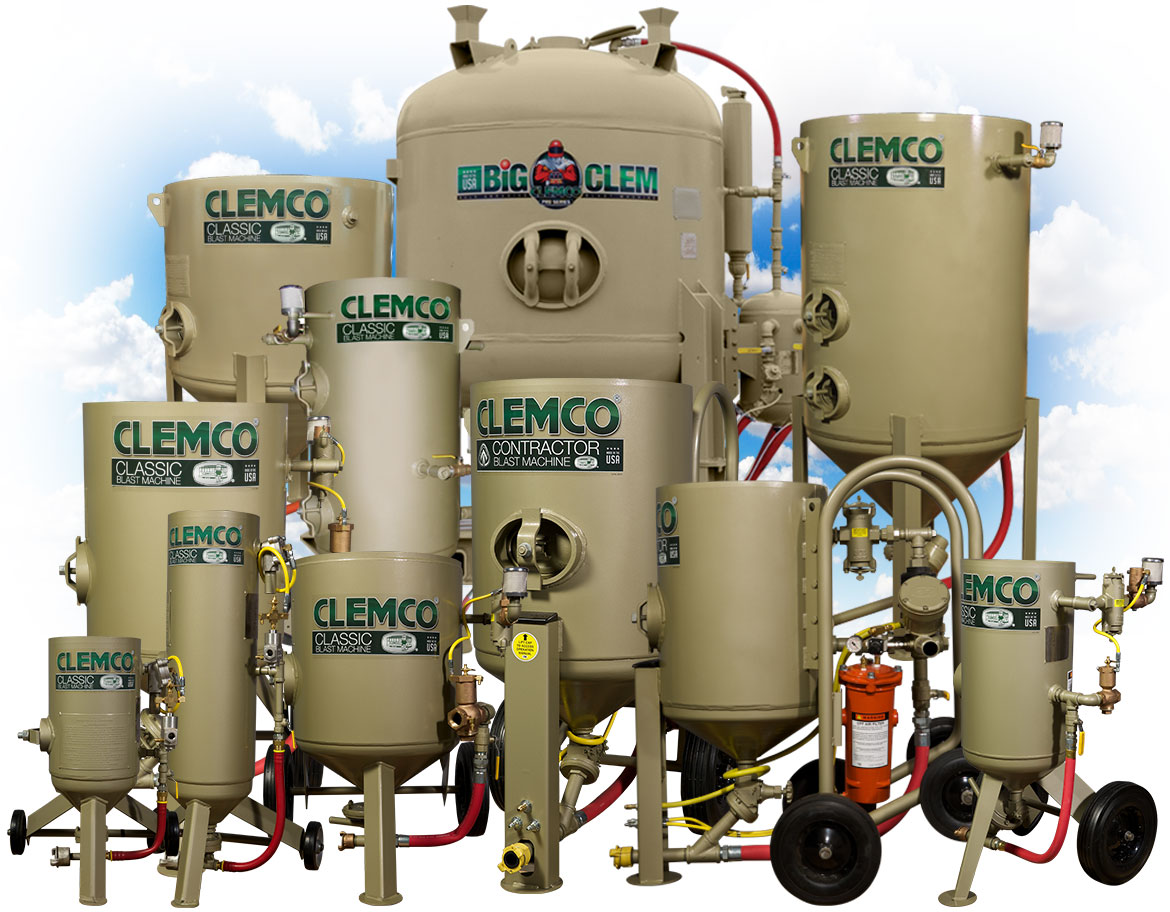
Abrasive blasting involves using an abrasive material, such as sand or walnut shells, to remove contaminants and create a clean surface. This method is often used for steel surfaces.
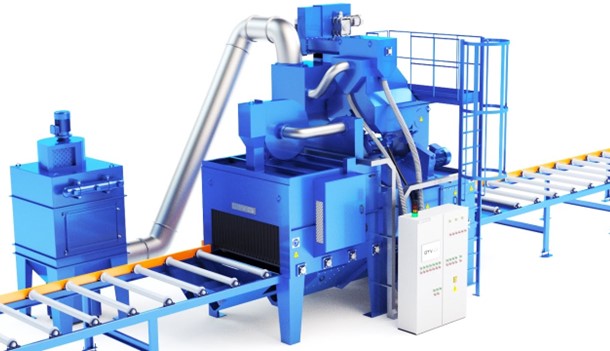
Shot blasting system
Comparison of pretreatment technologies
Pretreatment technology should be selected according to product characteristics and coating-system requirements rather than applying a fixed configuration to every painting line. The following table provides an overview of the main characteristics and control factors for each option:
| Technology |
Treatment Principle |
Common Substrates Considered |
Main Purpose |
Key Control Factors |
| Iron Phosphate |
Forms a phosphate conversion coating on the metal surface |
Mainly steel and substrates compatible with the chemical system |
Supports paint adhesion and surface protection before painting |
Chemical concentration, pH, temperature, treatment time, rinse water quality |
| Zinc Phosphate |
Forms a zinc phosphate conversion coating on the surface |
Steel, galvanized steel, and other compatible substrates |
Supports paint adhesion and corrosion resistance of the coating system |
Chemical composition, temperature, treatment time, surface condition, rinse water |
| Zirconium Conversion Coating |
Forms a thin conversion coating on the metal surface |
Steel, galvanized steel, aluminum, and other compatible substrates |
Surface preparation before painting; may optimize the number of process stages in suitable configurations |
Chemistry, pH, temperature, treatment time, water quality, coating-system compatibility |
| Abrasive Blasting |
Uses abrasive media to mechanically treat the surface |
Various metal products depending on the process |
Removes rust, oxides, old coatings, and creates surface profile |
Abrasive type, blasting pressure, cleanliness, dust, residual abrasive |
| Shot Blasting |
Uses high-velocity shot media to clean the surface |
Various metal products, particularly those requiring rust or oxide removal |
Cleans and prepares the surface before painting |
Shot type, blasting speed, media recovery, dust filtration, throughput |
A pretreatment system for painting lines plays an important role in cleaning and stabilizing product surfaces and preparing them for subsequent painting processes. Depending on the product material, corrosion resistance requirements, paint system, production volume, and conveying method, manufacturers can select iron phosphate, zinc phosphate, zirconium conversion coating, or combine chemical pretreatment with mechanical methods such as abrasive blasting and shot blasting. The selected technology should be integrated with treatment tanks, spray booths, circulation pumps, heating systems, process water supply, conveyors, control systems, and wastewater treatment equipment to ensure stable line operation.
With experience in designing, manufacturing, and integrating industrial automation systems and production lines, CNC-VINA can provide consultation on pretreatment systems for painting lines according to product characteristics, production capacity, and actual plant layout. The system can be configured from semi-automatic to fully automated solutions, with pretreatment stages integrated with painting, drying, and product conveying systems within the same production line.
VIETNAM CNC AND TECHNOLOGY APPLICATION JOINT STOCK COMPANY
Factory: Song Cung Industrial Cluster, Dong Thap Commune, Dan Phuong District, Hanoi, Vietnam.
Office: Rox Tower Goldmark City, 136 Ho Tung Mau Street, Phu Dien Ward, Hanoi, Vietnam.
Hotline: +84 916 639 355 / +84 915 744 664
Website: https://cncvina.com.vn/
Email: Sales01@cncvina.com.vn / Sales04@cncvina.com.vn

 Tiếng
Việt
Tiếng
Việt
 Tiếng
Anh
Tiếng
Anh
 Tiếng
Nhật
Tiếng
Nhật




 Tiếng Anh