 Tiếng
Việt
 Tiếng
Anh
 Tiếng
Nhật



 Tiếng Anh


Motorcycle shock absorber tube washer (Model: PBWM-01)
The motorcycle fork pipe washing machine is a specialized piece of equipment used in component manufacturing lines to clean the inner and outer surfaces of fork pipes while also supporting air leak testing before the parts proceed to the next production stage. The machine combines a brushing mechanism, a high-pressure washing system, a circulating filtration system, and an air-blowing drying unit to improve cleaning efficiency and meet industrial quality requirements. By automating part feeding, washing, and drying processes, the equipment helps reduce manual operations, maintain process consistency, and optimize production time. CNC VINA designs and manufactures machines tailored to the characteristics of each product and the actual operating requirements of individual businesses.
VIETNAM CNC & TECHNOLOGY APPLICATION JOINT STOCK COMPANY
Hotline: +84.916 63 9355 / +84.915 74 4664
Email: Sales01@cncvina.com.vn / Sales03@cncvina.com.vn
Product description

The motorcycle fork pipe washing machine is specialized equipment used in the manufacturing and processing of motorcycle components, helping improve part cleaning efficiency. The machine is designed to meet industrial cleaning requirements and support product quality control before parts proceed to subsequent production stages. With its automation capabilities, the machine helps ensure consistent part processing and meets actual production needs. Its application not only reduces manual operations but also helps businesses organize their production workflows more efficiently. The machine configuration can be adjusted to suit the characteristics of the parts, cleaning requirements, and production line layout of each factory. In addition to operational efficiency, the equipment is designed with a focus on durability, safety, and ease of maintenance throughout its service life. So, what components make up a motorcycle fork pipe cleaning machine? In the following article, let’s explore the details with CNC VINA.
Technical specifications of motorcycle shock absorber tube washing machine
| Item | Specifications |
| Power supply | 3-phase, 380 V |
| Compressed air pressure | 0.4 - 0.5 MPa |
| Compressed air flow rate | 30 m³/min |
| Machine construction material | SUS201 stainless steel |
| Control system | PLC |
| Cleaning method | Brush cleaning combined with high-pressure spraying |
| Drying system | Air-blowing rack |
| Filtration system | Circulating filtration pump, filter bags, and oil skimmer |
| Part feeding method | Automatic conveyor |
The role of the motorcycle suspension system
The suspension system is an important component of a motorcycle's structure. Its primary function is to absorb and dampen vibrations and impacts generated when the motorcycle travels over rough roads, potholes, or uneven surfaces. This system helps maintain vehicle stability, improves tire contact with the road surface, and enhances riding comfort.
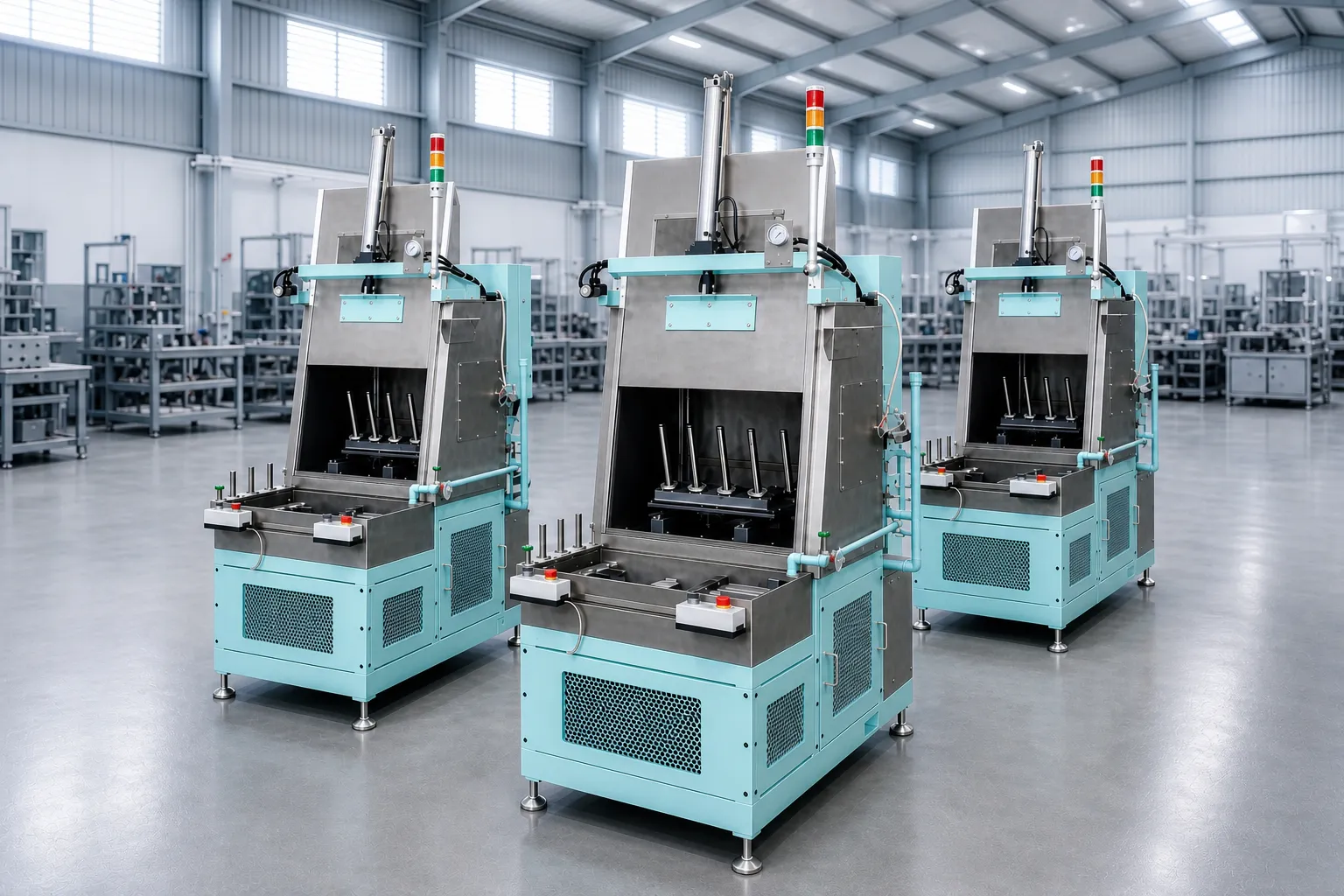
Within the suspension assembly, the fork pipe is an important component that contributes to the structure and operation of the damping mechanism. Its surface must meet the cleanliness, surface condition, and dimensional accuracy requirements specified in the technical drawings. Contaminants such as metal dust, machining oil, and residual debris may affect the assembly process or finished product quality if they are not properly removed.
Therefore, the fork pipe cleaning process must be carefully controlled during manufacturing. The motorcycle fork pipe washing machine helps clean components before they proceed to the next production stage and can also integrate an air leak testing function according to process requirements. Using specialized equipment helps businesses standardize the cleaning process, reduce reliance on manual operations, and improve consistency among products.
Key features of the motorcycle fork pipe washing machine
The fork pipe washing machine is designed with automatic cleaning, inspection, and part-handling mechanisms to meet component manufacturing cleanliness requirements. The combination of brushing, high-pressure spray nozzles, an air testing system, and an air-blowing drying rack helps improve part processing efficiency. In addition, the circulating filtration system and PLC control contribute to stable operation, reduced washing solution consumption, and easier operation and maintenance. The following are the key features of the motorcycle fork pipe cleaning machine:
-
Internal and external cleaning: The machine combines rotational and reciprocating brush movements with high-pressure spray nozzles to remove grease and contaminants from the inside and outside of fork pipes. Cleaning performance depends on the characteristics of the parts and the operating parameters.
-
Automated part loading and unloading: The automatic conveyor transports parts into the washing chamber, with separate loading and unloading positions. This design reduces manual handling and helps prevent processing steps from being overlooked.
-
Automatic drying after washing: After cleaning, the parts are dried using an air-blowing rack to remove residual water and washing solution from their surfaces, reducing waiting time before the next production stage.
-
Circulating filtration and filter-clogging alerts: The filtration pump, filter bags, and oil skimmer help remove contaminants and floating oil while recirculating the washing solution. The filter-clogging alert helps detect problems, maintain cleaning efficiency, and reduce operating costs.
-
PLC control: The PLC coordinates the mechanisms according to the programmed sequence, monitors sensor signals, and controls processing times. This helps ensure stable operation and facilitates parameter adjustment and maintenance.
The role of the motorcycle suspension system
Within the suspension assembly, the fork pipe is an important component that contributes to the structure and operation of the damping mechanism. Its surface must meet the cleanliness, surface condition, and dimensional accuracy requirements specified in the technical drawings. Contaminants such as metal dust, machining oil, and residual debris may affect the assembly process or finished product quality if they are not properly removed.
Therefore, the fork pipe cleaning process must be carefully controlled during manufacturing. The motorcycle fork pipe washing machine helps clean components before they proceed to the next production stage and can also integrate an air leak testing function according to process requirements. Using specialized equipment helps businesses standardize the cleaning process, reduce reliance on manual operations, and improve consistency among products.
Key features of the motorcycle fork pipe washing machine
The fork pipe washing machine is designed with automatic cleaning, inspection, and part-handling mechanisms to meet component manufacturing cleanliness requirements. The combination of brushing, high-pressure spray nozzles, an air testing system, and an air-blowing drying rack helps improve part processing efficiency. In addition, the circulating filtration system and PLC control contribute to stable operation, reduced washing solution consumption, and easier operation and maintenance. The following are the key features of the motorcycle fork pipe cleaning machine:
-
Internal and external cleaning: The machine combines rotational and reciprocating brush movements with high-pressure spray nozzles to remove grease and contaminants from the inside and outside of fork pipes. Cleaning performance depends on the characteristics of the parts and the operating parameters.
-
Automated part loading and unloading: The automatic conveyor transports parts into the washing chamber, with separate loading and unloading positions. This design reduces manual handling and helps prevent processing steps from being overlooked.
-
Automatic drying after washing: After cleaning, the parts are dried using an air-blowing rack to remove residual water and washing solution from their surfaces, reducing waiting time before the next production stage.
-
Circulating filtration and filter-clogging alerts: The filtration pump, filter bags, and oil skimmer help remove contaminants and floating oil while recirculating the washing solution. The filter-clogging alert helps detect problems, maintain cleaning efficiency, and reduce operating costs.
-
PLC control: The PLC coordinates the mechanisms according to the programmed sequence, monitors sensor signals, and controls processing times. This helps ensure stable operation and facilitates parameter adjustment and maintenance.
Structure and operating principle of the fork pipe washing machine
The motorcycle fork pipe washing machine is designed with coordinated functional assemblies to meet the requirements for cleaning and processing parts in an industrial manufacturing environment. Each system performs a specific task while working with the mechanical mechanisms, pneumatic components, and control system to maintain the appropriate operating sequence. Understanding the machine's structure and how its systems work together helps businesses better evaluate its capabilities and select a configuration suited to their actual production requirements.
Structure and functional assemblies
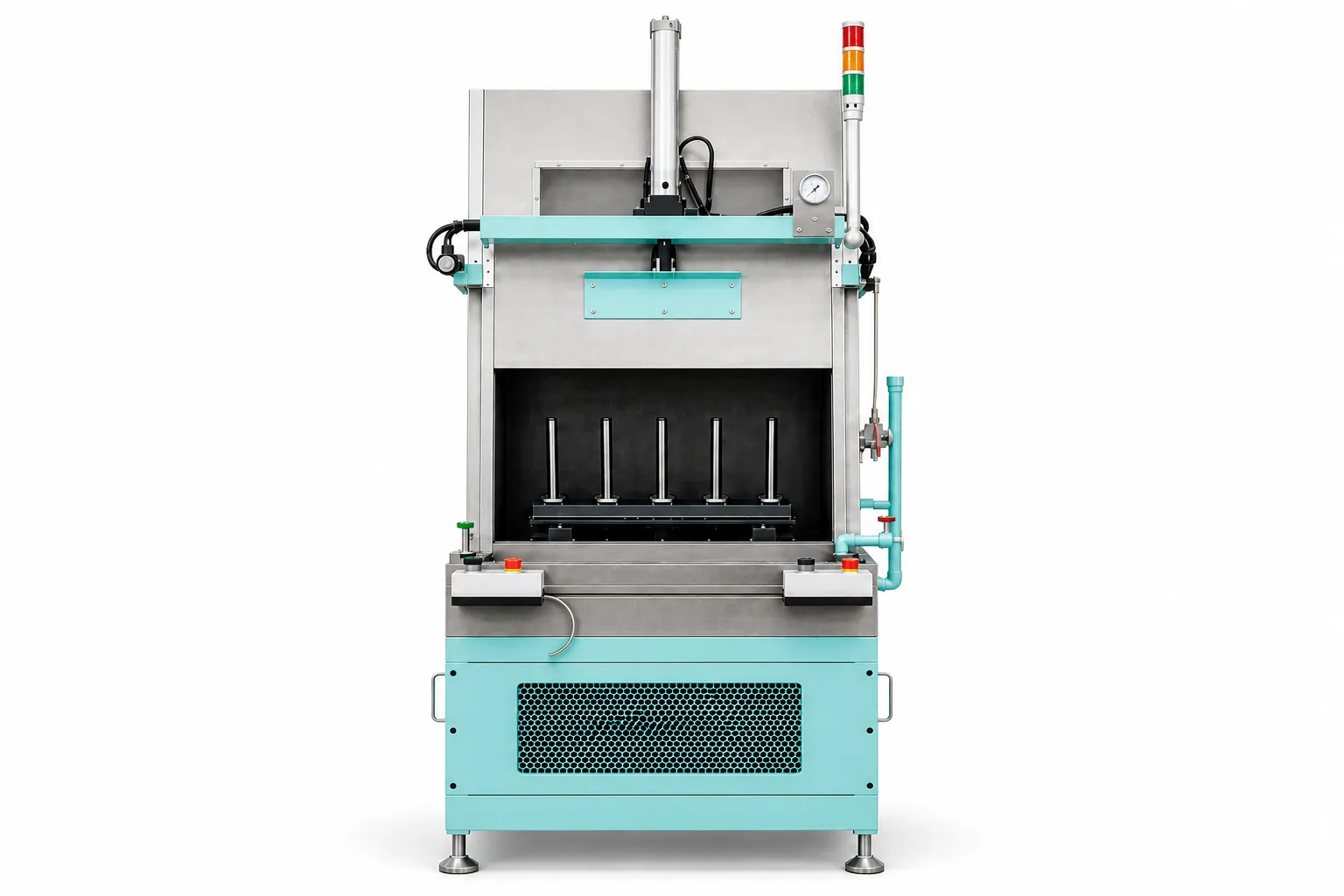
The motorcycle fork pipe washing machine consists of multiple mechanical, pneumatic, and control assemblies that work together to perform part feeding, air leak testing, cleaning, solution filtration, and drying.
Part feeding and positioning system
The conveyor transports parts to the receiving position inside the washing chamber. The fixture positions and holds the fork pipes during air leak testing and cleaning, preventing unwanted movement while the brushes or spray nozzles are operating. The fixture must be designed to suit the dimensions, shape, and handling requirements of the product.
Air leak testing system
The air testing assembly supplies compressed air to the component under predefined conditions to check its airtightness. The system may include clamping mechanisms, air supply connectors, control valves, and the necessary monitoring components. The selection of test pressure, air-holding time, and evaluation method depends on the product's technical requirements.
Brush cleaning and high-pressure spraying system
The brush assembly rotates and moves back and forth inside the pipe to help remove contaminants. High-pressure spray nozzles deliver the washing solution to the areas requiring cleaning. These two mechanisms work together to improve cleaning efficiency on both the internal and external surfaces of the component.
Washing solution heating system
The washing solution can be heated according to process requirements to help remove grease and contaminants from the surface. The operating temperature must be suitable for the component material, the type of cleaning solution, and operational safety requirements.
Circulating pump and filtration system
This assembly consists of a circulation pump, filter bags, and an oil skimmer. Used washing solution passes through the filtration system to remove contaminants and some floating oil before returning to the washing cycle. An appropriately designed filtration system helps maintain solution quality and reduce waste generation.
Air-blowing drying rack
The air-blowing rack uses compressed air to remove residual water and washing solution from the component surfaces after cleaning. The spray direction, nozzle positions, and drying time are selected according to the characteristics of the parts.
Oil mist collector and control system
The oil mist collector supports the collection of oil mist and other aerosol-like emissions generated during operation, depending on the machine configuration. The PLC, sensors, and control components work together to monitor operating conditions, control the mechanisms, and issue alerts when abnormal conditions, such as filter clogging, are detected.
Coordination between the systems
During operation, parts are fed to the working position and secured by the fixture. The air leak testing system performs the test according to the programmed sequence, after which the parts are cleaned using brushes combined with high-pressure washing solution.
During washing, the solution is collected and sent through the circulation pump and filtration system to remove contaminants and floating oil before being recirculated. Once the washing cycle is complete, the parts proceed to the compressed-air drying stage. The PLC coordinates the mechanisms based on sensor signals and operating conditions, helping prevent the process steps from occurring out of sequence.
According to the specified configuration, the machine can process five parts per washing batch. Actual throughput should be verified through testing, taking into account air leak testing time, washing time, drying time, and part loading and unloading time.
Operating procedure, operation, and maintenance of the motorcycle fork pipe washing machine
The motorcycle fork pipe washing machine operates through an integrated process combining part feeding, air leak testing, cleaning, and automatic air drying. Following the operating instructions and performing regular maintenance helps maintain cleaning efficiency, ensure safety, and extend the machine's service life.
Operating procedure of the motorcycle fork pipe cleaning machine
The motorcycle fork pipe washing machine follows these basic operating steps:
Step 1: Preparation and part loading
The operator checks the machine's condition, power supply, compressed air supply, washing solution, and fixture. Parts are positioned correctly or loaded onto the conveyor for transport into the working area according to the system sequence.
Step 2: Part positioning and air leak testing
The parts are secured in the designated position. The air supply system performs an airtightness test using the preset pressure and test duration. The results are evaluated using the machine's testing method or according to the approved operating instructions.
Step 3: Part washing
Once the conditions for proceeding to the next stage are met, the parts enter the washing cycle. The brushes rotate and move back and forth inside the pipes while the high-pressure spray system delivers the prepared washing solution according to process requirements. The washing time is configured to suit the level of contamination and the required quality standards.
Step 4: Washing solution filtration and circulation
Throughout the washing process, the solution is pumped through the filter bags and oil skimmer to remove contaminants and limit oil accumulation in the tank. The operator monitors filter alerts and takes appropriate action if signs of clogging appear.
Step 5: Product air drying
When the washing cycle is complete, the parts are transferred to the drying position. The air-blowing rack removes residual water and washing solution from the surfaces, helping prepare the products for the next production stage.
Step 6: Product unloading and cycle repetition
The processed parts are transferred to the unloading area for collection by the operator. The operator checks the cleanliness, dryness, and inspection results against the specified requirements before transferring the products to the next stage. The cycle then repeats according to the machine's control program.
Operating precautions
To ensure the motorcycle fork pipe washing machine operates reliably, operators must follow the technical instructions established by CNC VINA for the specific equipment configuration.
-
Check the power supply, compressed air pressure, washing solution level, and condition of the mechanisms before starting the machine.
-
Position the parts correctly and ensure that the fixture and clamping mechanisms are securely engaged.
-
Use the correct washing solution and follow the validated process parameters for temperature, pressure, and washing time.
-
Monitor filtration system alerts, washing solution circulation, and the operation of the air-blowing rack.
-
Do not place hands inside the operating area of the brushes, fixtures, or conveyor while the machine is running.
-
If abnormal noise, air leaks, reduced spray flow, or fault alerts occur, stop the machine according to the safety procedure before carrying out an inspection.
Periodic maintenance of the motorcycle fork pipe washing machine
Maintenance helps maintain cleaning efficiency, reduce machine downtime, and extend the service life of components.
-
Daily maintenance: Clean the working area, check the washing solution level, and inspect the spray nozzles, brushes, conveyor, and areas prone to contaminant buildup.
-
Periodic maintenance: Inspect the filter bags, clean the oil skimmer, and assess the condition of the circulation pump, pipelines, pneumatic valves, cylinders, and spray nozzles. Replace filter media when necessary to prevent reduced flow rates or compromised cleaning quality.
-
Electrical and control system maintenance: Check sensors, wiring, warning signals, and PLC operation according to the maintenance schedule. Emergency stop functions and safety interlocks must be tested in accordance with the factory's procedures.
-
During repairs or component replacement: Disconnect and isolate the electrical and compressed air supplies, and release any stored energy before beginning work. The machine must only be restarted after all safety checks have been completed.

Applications of the motorcycle fork pipe washing machine
The motorcycle fork pipe washing machine is used in factories that manufacture, process, and assemble motorcycle components, particularly in production stages that require cleaning tubular parts while maintaining consistent quality control.
Typical applications include:
-
Fork pipe cleaning: Removes machining oil, dust, and residue from the inner and outer surfaces before assembly or transfer to the next production stage.
-
Air leak testing: Supports the inspection of component airtightness according to specified testing standards and methods.
-
Cleaning machined components: Processes parts after turning, grinding, or other machining operations when oil and contaminants remain on the surfaces.
-
Integration into automated production lines: Connects with conveyors and upstream and downstream processes to standardize product movement throughout the production line.
-
Applications in the automotive and motorcycle component industries: Allows fixtures, cleaning brushes, spray nozzles, and control programs to be customized for components with similar shapes.
The equipment is designed according to product characteristics, contamination levels, target production capacity, and factory layout requirements. Selecting the appropriate configuration helps businesses improve cleaning quality, optimize washing solution consumption, and enhance overall production efficiency.
Frequently asked questions about the motorcycle fork pipe washing machine
Can the motorcycle fork pipe washing machine clean the inside of the pipes?
Yes. The machine uses brushes that rotate and move back and forth inside the pipes, combined with a high-pressure spray system. Cleaning effectiveness depends on pipe dimensions, contaminant types, operating parameters, and brush configuration.
Does the machine include an air leak testing function?
Yes. According to the described configuration, the machine includes an air testing system to help verify component airtightness. The test pressure, air-holding time, and evaluation criteria must be determined according to the product's technical requirements.
Can the washing solution be reused?
Yes. The circulating pump and filtration system, combined with filter bags and an oil skimmer, allow the washing solution to be collected, filtered, and returned to the washing process. However, the solution must be monitored for quality and replaced when it no longer meets cleaning requirements.
Can the machine wash and completely dry products within the same cycle?
The machine is designed to perform washing and air drying within the same equipment. The achievable level of dryness depends on the component geometry, residual washing solution, air nozzle direction, and drying time. Areas that may retain water should be tested under actual operating conditions to verify the results.
What is the production capacity of the motorcycle fork pipe washing machine?
According to the specified configuration, the machine can process five parts per batch. Hourly production capacity must be determined based on air leak testing time, washing time, drying time, and part loading and unloading time. Businesses should conduct trial runs using actual samples to establish a suitable cycle time.
Can CNC VINA design a washing machine to meet specific requirements?
CNC VINA can develop industrial washing solutions based on component characteristics, cleaning requirements, target production capacity, and the customer's production line layout. The proposed design should be finalized based on product information, component samples, acceptance criteria, and actual operating conditions.
The motorcycle fork pipe washing machine is a practical solution that helps businesses improve component cleaning efficiency and quality control during manufacturing. The equipment helps meet increasingly stringent requirements for product cleanliness and consistency in industrial environments. Implementing automated washing equipment also creates opportunities to improve workflows and optimize production resources. Depending on component characteristics and actual requirements, the machine configuration can be adjusted to suit individual production lines. In addition to operational efficiency, proper maintenance and control of technical parameters help ensure long-term machine performance. With experience in industrial machine design and manufacturing, CNC VINA aims to provide solutions tailored to each customer's needs. CNC VINA specializes in designing and manufacturing motorcycle fork pipe washing machines to order, supporting businesses in their production automation journey.
VIETNAM CNC & TECHNOLOGY APPLICATION JOINT STOCK COMPANY
Factory: Song Cung Industrial Site, Dong Thap Commune, Dan Phuong District, City. Hanoi Vietnam
Phone: +84.916 63 9355 / +84.915 74 4664
Website: https://cncvina.com.vn; https://cncvina.net; https://cncviname.com.vn
Email: Sales01@cncvina.com.vn | Sales03@cncvina.com.vn