 Tiếng
Việt
Tiếng
Việt
 Tiếng
Anh
Tiếng
Anh
 Tiếng
Nhật
Tiếng
Nhật




 Tiếng Anh


Automatic assembly and packaging machine
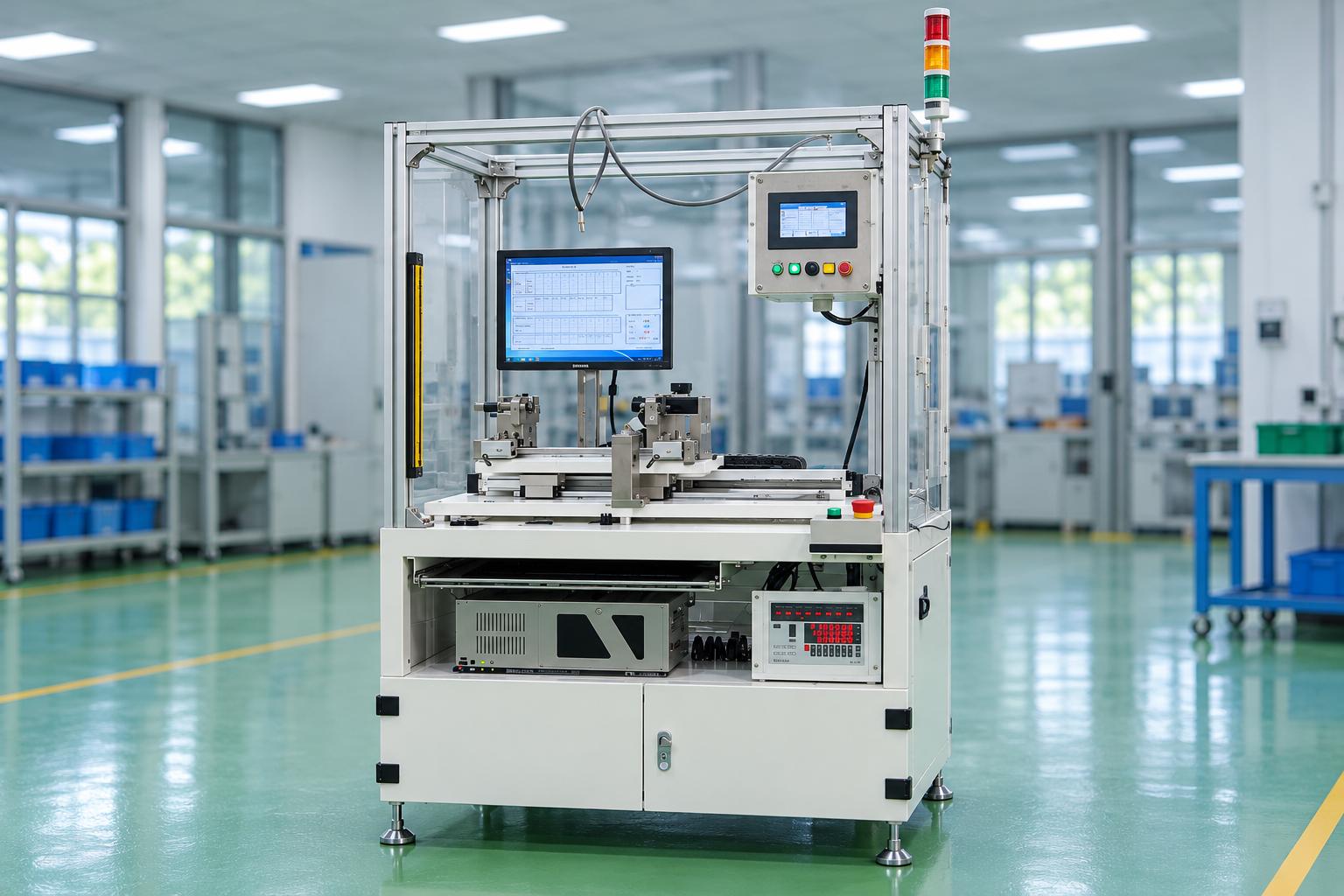
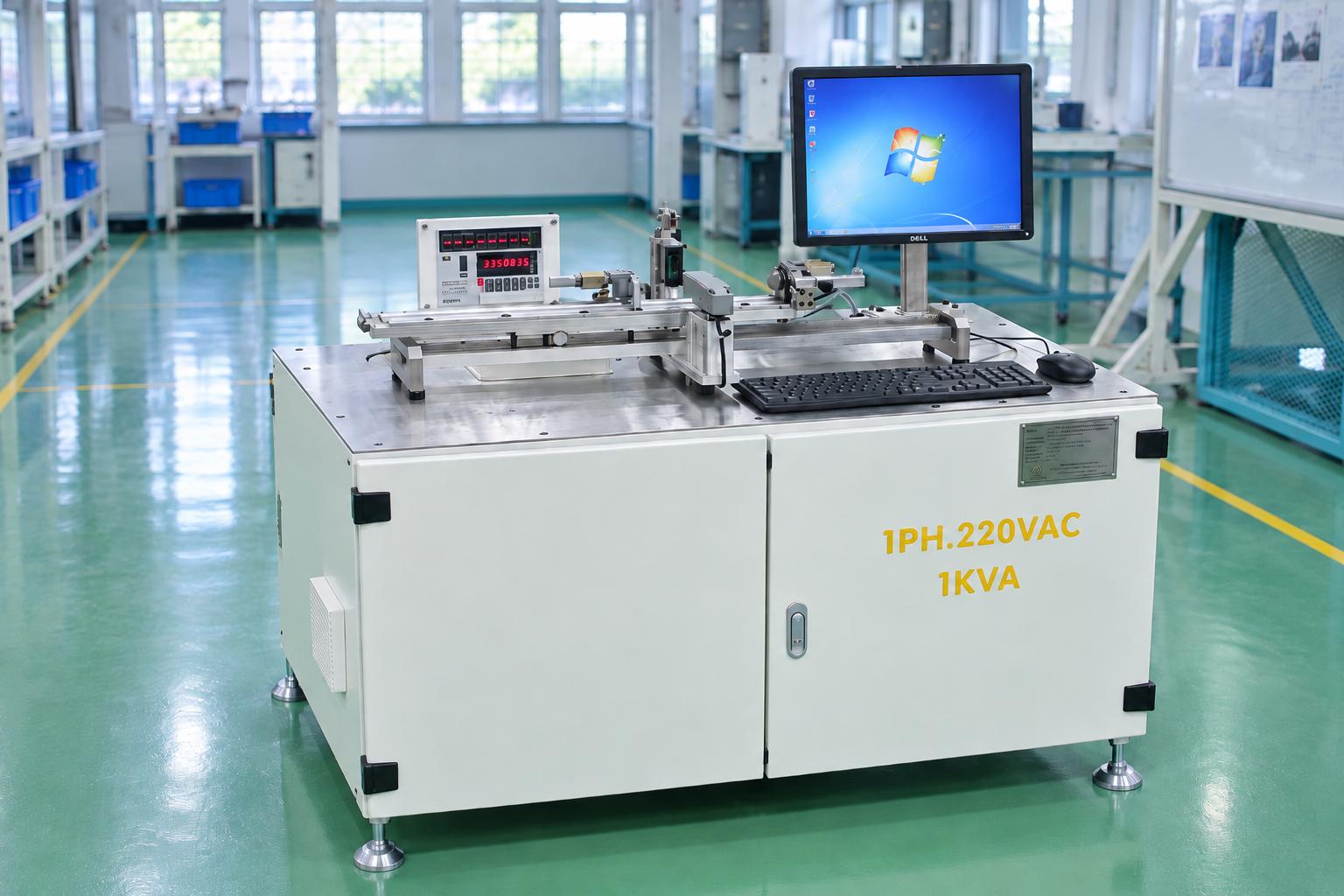
The automatic assembly and packaging machines from CNC VINA are designed and manufactured with advanced technology to meet the strict requirements of customers for accuracy, reliability, and production speed. We provide customized solutions to meet the specific needs of our customers.
Our automatic assembly and packaging machines feature advanced functionalities such as PLC control systems, touch screens, photoelectric sensors, pressure sensors, proximity sensors, automatic conveyor systems, automatic packaging and boxing systems, and many other features.
We are committed to providing customers with high-quality products and services, competitive prices, and fast delivery times. We ensure that our automatic assembly and packaging machines will help customers increase production efficiency, reduce costs, and enhance product quality.
VIETNAM CNC & TECHNOLOGY APPLICATION JOINT STOCK COMPANY
Hotline: +84.916 63 9355 / +84.915 74 4664
Email: Sales01@cncvina.com.vn / Sales03@cncvina.com.vn
Product description

Automatic Assembly and Packaging Machine is an automation solution used to continuously perform processes such as component feeding, assembly, inspection, and product packaging in manufacturing lines. The machine replaces many manual operations, improves productivity, and maintains high accuracy and consistency throughout the production process. Depending on the characteristics of the product, the machine can be integrated with automatic feeding systems, rotary tables, conveyors, robots, pressing mechanisms, inspection systems, and automatic packaging systems. Combining these processes into a single system helps businesses optimize their production workflow and reduce production time. The machine can be flexibly designed according to the size, shape, assembly process, and required production volume of each product. CNC VINA specializes in designing and manufacturing customized automatic assembly, inspection, and packaging machines based on customers' actual production requirements. The following content provides detailed information about the structure, operating principle, applications, and benefits of automatic assembly and packaging machines.
Technical Specifications of the automatic assembly and packaging machine manufactured by CNC VINA
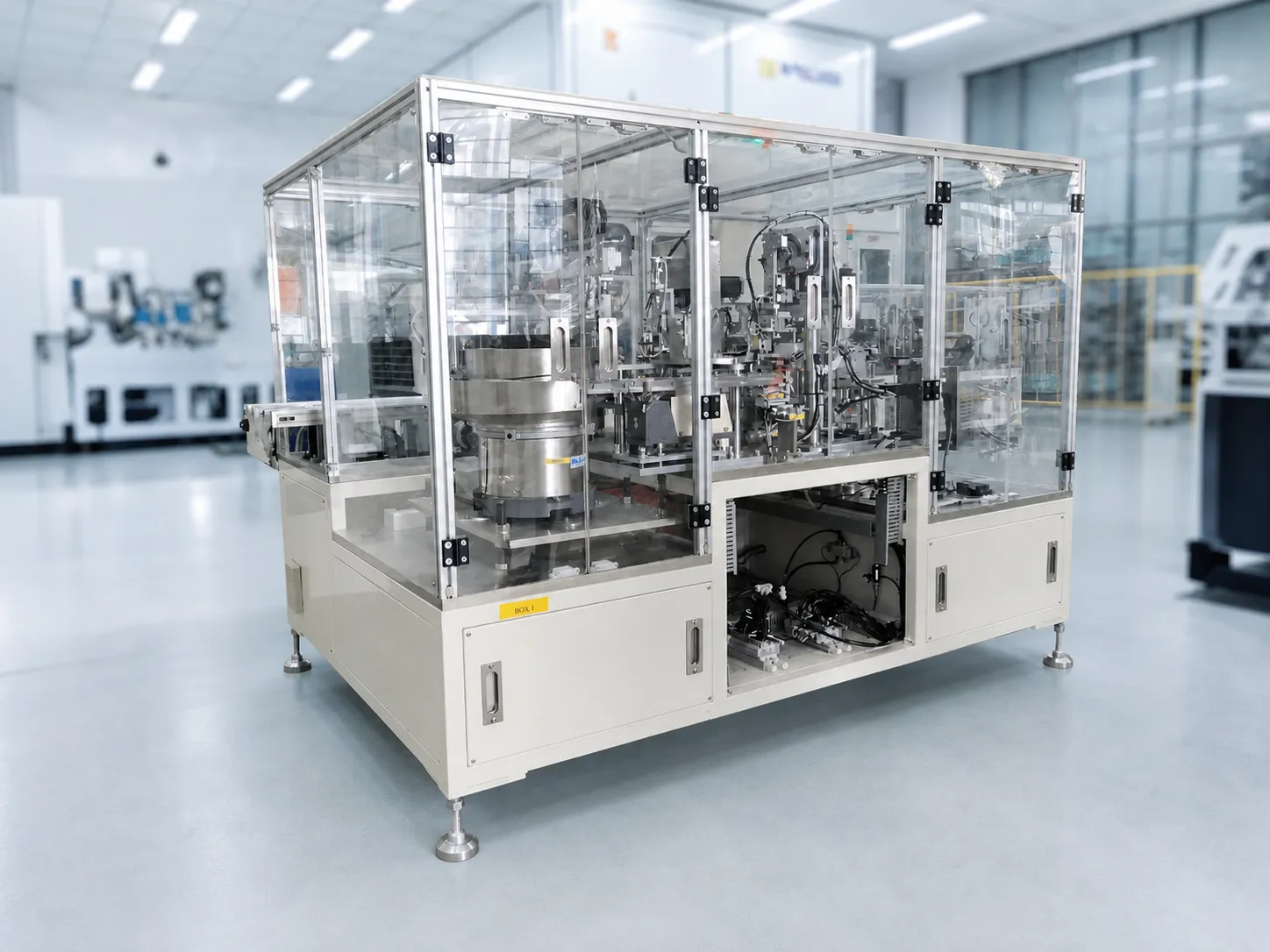
Different types of automatic assembly and packaging machines are custom-designed for each specific product. The reference specifications for some types of automatic assembly and packaging machines are as follows:
| Dimensions | L2770 x W1270 x H1650 mm |
| Power | 2.5 KVA |
| Voltage | 1 phase, AC 220 V - 50 Hz |
| Control voltage | DC 24 V, DC 5 V |
| Air pressure requirement | 0.4 - 0.6 MPa |
| Operating cycle | 2 seconds/product |
| Number of operators | 1 operator |
| Color | Optional |
Types of automatic assembly and packaging machines
There are various types of automatic assembly and packaging machines, each designed to meet specific production requirements:
- Conveyor-type automatic assembly machine: Uses a conveyor system to transport products throughout the assembly process.
- Rotary-type automatic assembly machine: Uses a rotary table to move products between different assembly stations.
- Flexible assembly machine: Capable of assembling different products through an automatic system that adjusts operating parameters.
- Robotic assembly machine: Uses industrial robots to replace manual labor in assembly operations.
- Automatic packaging machine: Performs the packaging and product wrapping processes after assembly.
Main components of automatic assembly machines manufactured by CNC VINA
A typical automatic assembly machine manufactured by CNC VINA consists of the following main components:
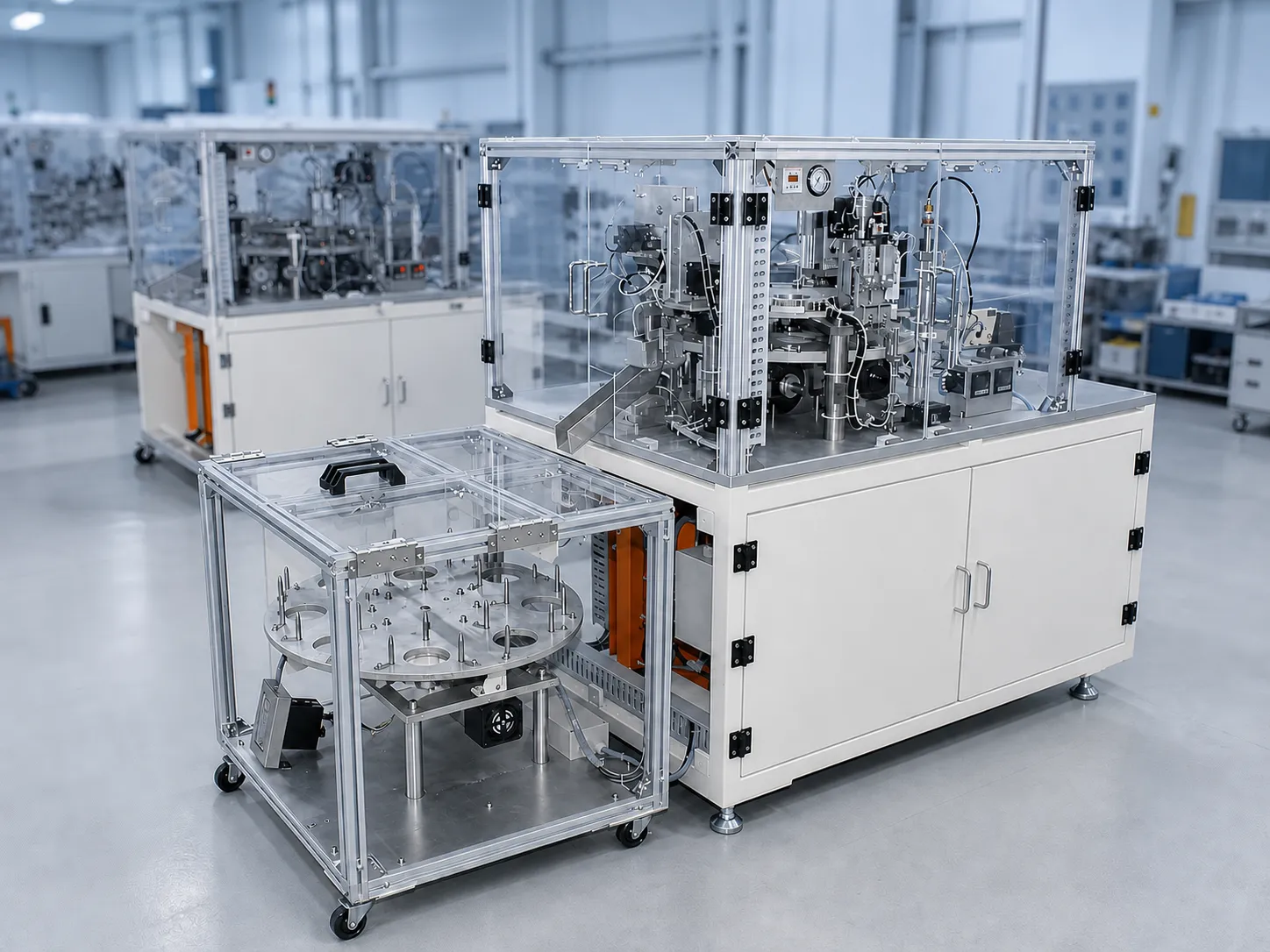
- Feeding system: Supplies the parts and components required for assembly using various types of feeding mechanisms, such as hopper feeders, linear feeders, step feeders, and others. Sensors and cameras are installed at the output of the feeding system to ensure that components are accurately supplied and positioned.
- Product transfer mechanism: Moves products between different workstations using mechanisms such as linear transfer systems, rotary tables, and assembly conveyors.
- Assembly stations: Perform the assembly of individual parts and components. Components are fed into the assembly station in a predetermined sequence and can be combined with pressing forces generated by cylinders, servo pressing heads, and other mechanisms.
- Control system: Controls the machine automatically according to the predefined assembly sequence and inspection process.
- Inspection system: Inspects product quality after assembly. Depending on the type and requirements of the product, different inspection methods and technologies can be applied.
- Defective product rejection unit: Defective or non-conforming products are automatically removed or picked out from the production line.
- Packaging unit: OK products are automatically packaged at the machine output. The packaging system can be integrated with a weighing system or product counter to control the quantity of packaged products.
In addition, the machine can be equipped with auxiliary systems such as cleaning, oil and grease dispensing, and automatic tool changing systems, helping the machine operate continuously, reliably, and stably.
Operating process of a typical automatic assembly and packaging machine
The typical operating process of an automatic assembly machine is as follows:
Step 1: The automatic feeding system uses a vibratory bowl feeder to supply components to the feeding chute. Through the vibration mechanism, the components are conveyed to the pick-up position.
Step 2: The pick-and-place unit picks up the components and places them onto the rotary table. The rotary table then rotates to the next position for the subsequent operation.
Step 3: At each assembly station, a robotic arm or automatic mechanism assembles the components together according to the predefined sequence.
Step 4: After assembly is completed, the product is transferred to the quality inspection system for inspection.
Step 5: If the product passes the inspection, the rotary table moves it to the next position, where a pick-and-place unit transfers the product to the packaging machine. If the product fails the inspection, it bypasses the subsequent processes and is removed from the system by an air blow-off mechanism.
Step 6: The rotary table returns to its initial position and repeats the process for the next products.
Applications of automatic assembly and packaging machines
Automatic assembly and packaging machines can be applied in a wide range of manufacturing industries:
- Mechanical engineering: Assembly of automotive components, mechanical parts, and machinery components.
- Electrical and electronics industry: Assembly of electronic devices and electronic components.
- Plastics industry: Assembly of household plastic products, children's toys, and other plastic products.
- Pharmaceutical industry: Assembly of medicines and medical supplies, followed by automatic packaging into boxes, bottles, or containers.
- Food industry: Packaging of food products and beverages.
- Consumer goods industry: Assembly of consumer products such as fans, washing machines, refrigerators, and other household appliances.
In general, automatic assembly and packaging machines can be applied across most manufacturing industries to replace manual labor where automation is technically feasible and economically viable in terms of return on investment.
Benefits of using automatic assembly and packaging machines

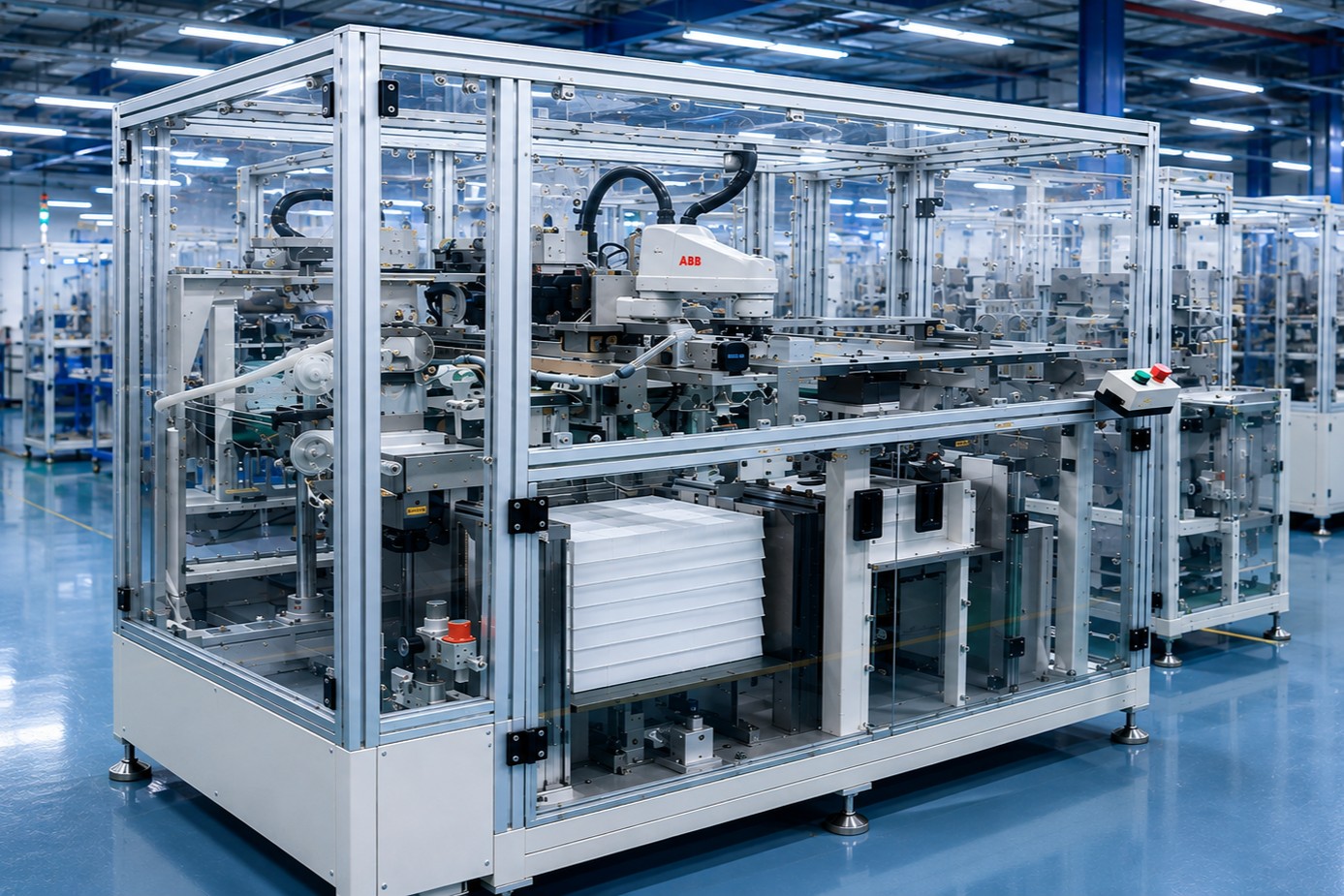
CNC VINA automatic assembly and packaging machine
Automatic assembly machines offer numerous benefits to manufacturing businesses:
- Increase productivity by 5–10 times compared to manual assembly.
- Minimize errors during the assembly process.
- Ensure high accuracy and consistent product quality.
- Reduce labor requirements and production costs.
- Operate continuously for extended periods without the need for breaks.
- Easily adapt or modify assembly processes when introducing new products.
- Minimize occupational safety risks.
Overall, investing in automatic assembly machines helps businesses improve their production capacity and enhance their competitiveness in the market.
Important notes for operating and maintaining automatic assembly and packaging machines
To ensure that automatic assembly and packaging machines operate safely, reliably, and maintain their performance over the long term, operators must strictly follow the proper operating and maintenance procedures. The following are some important operating precautions and key items that should be inspected and maintained periodically.
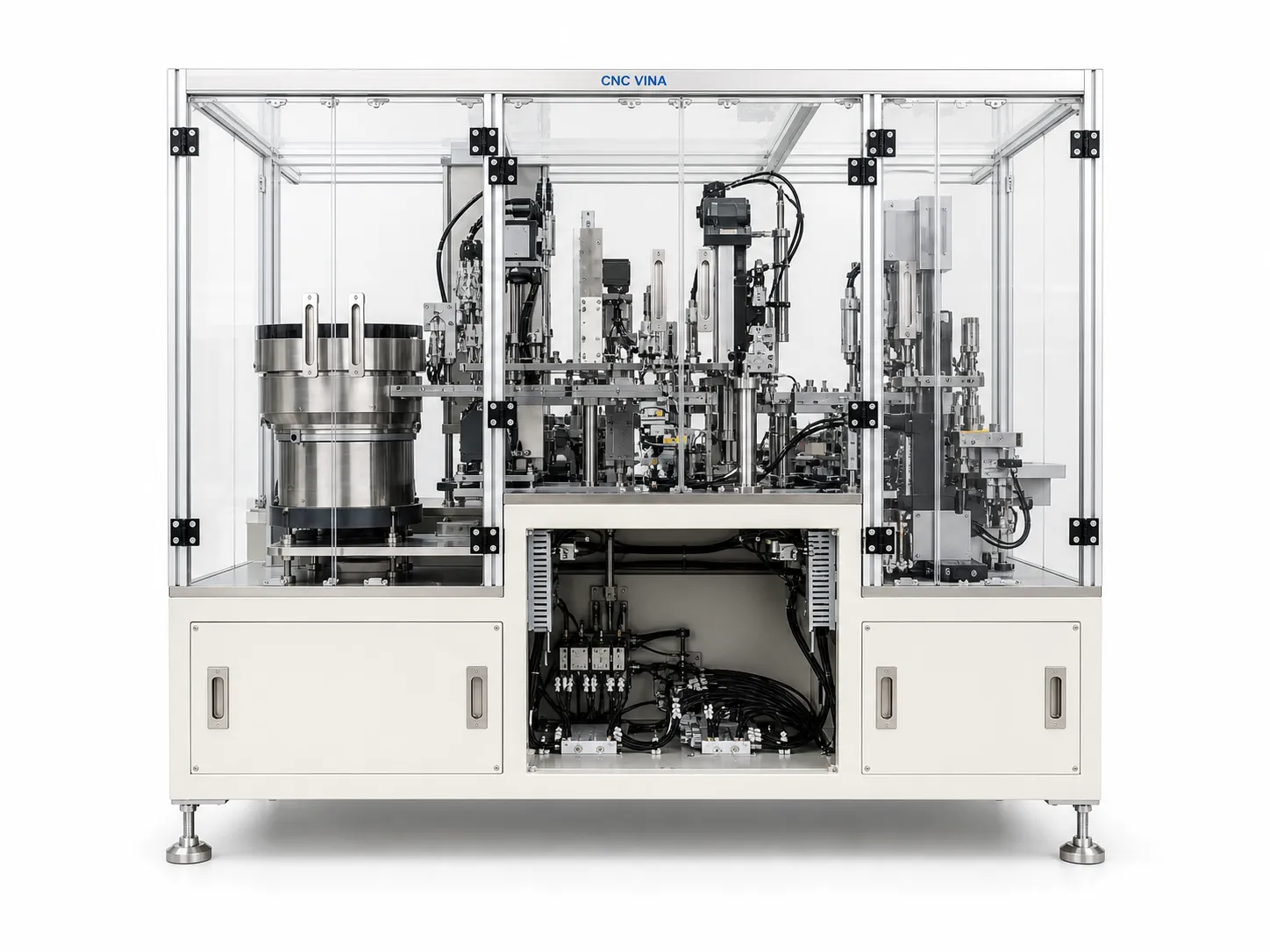
Important notes for operating automatic assembly and packaging machines
To ensure that the automatic assembly machine operates safely and reliably, operators should pay attention to the following:
-
Strictly follow the machine's operating and maintenance procedures and instructions.
-
Regularly inspect and perform periodic maintenance on the machine's components.
-
Use the required electrical and pneumatic operating parameters correctly.
-
Ensure that the machine installation area is clean, well-ventilated, and free of obstructions.
-
Only trained personnel are permitted to operate the machine.
-
Never operate the machine when required occupational safety conditions are not met.
-
Stop the machine immediately if any abnormality or malfunction is detected and carry out the necessary corrective actions.
Following these principles will help ensure that the automatic assembly machine operates efficiently and safely.
Maintenance guide for automatic assembly and packaging machines
For any type of machinery, proper maintenance is extremely important. Along with correct operation and regular use, effective inspection and maintenance help ensure stable and accurate machine performance while maximizing the machine's service life.
When performing maintenance on automatic assembly machines designed and manufactured by CNC VINA, operators must follow the procedures and instructions specified in the machine's operating manual and the accompanying catalogue provided upon delivery.
Note:
-
Before performing any maintenance, return the machine to its home position and disconnect all electrical power and pneumatic air supplies before starting maintenance work.
-
Always perform weekly and monthly inspections and maintenance on mechanisms and equipment such as motors, slides, cylinders, bearings, and other components.
-
Slide: Inspect the slide mechanism weekly to ensure that it is free from scratches, jamming, or obstructions.
-
Cylinder: Check the electrical system and air supply to the cylinders to ensure stable operation and prevent jamming.
-
Bearings: Always ensure that the bearings rotate smoothly without abnormal noise.
Automatic assembly and packaging machines help businesses automate multiple stages of the production process, from component feeding, assembly, and inspection to product packaging. Applying a suitable machine can help increase productivity, reduce labor requirements, improve product consistency, and minimize errors during operation. With the ability to flexibly integrate various mechanisms and equipment, these systems can accommodate production processes ranging from simple to complex, as well as production volumes ranging from small batches to mass production. In particular, machines can be custom-designed according to each company's specific product, production technology requirements, installation space, and desired level of automation. CNC VINA has extensive experience in designing and manufacturing automation machinery and can provide consultation and develop suitable solutions for specific production processes. If your business is looking for an automation solution for assembly and packaging processes, CNC VINA is ready to provide consultation and develop a suitable machine design and manufacturing solution.
Customers who are interested and need to order related lines please refer to:
VIETNAM CNC & TECHNOLOGY APPLICATION JOINT STOCK COMPANY
Factory: Song Cung Industrial Site, Dong Thap Commune, Dan Phuong District, City. Hanoi Vietnam
Phone: +84.915 74 4 664 / +84.915 740 880
Website: https://cncvina.com.vn; https://cncvina.net; https://cncviname.com.vn
Email: Sales01@cncvina.com.vn | Sales03@cncvina.com.vn