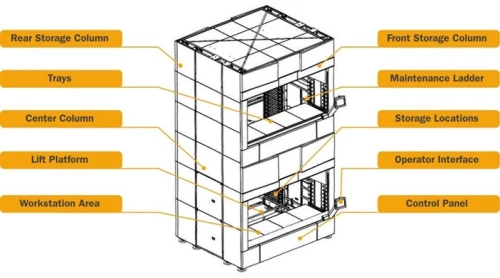
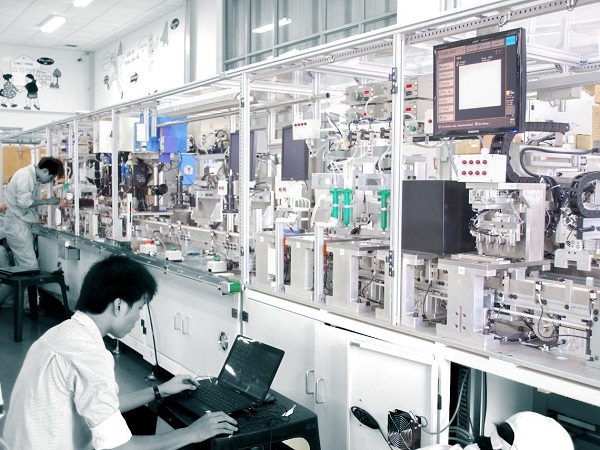
A Module smart warehouse is an automation solution used to store, manage and retrieve goods by designated storage locations. With a vertical storage structure, the system can make use of the warehouse height and organize multiple storage trays within the same area, making it particularly suitable for products with a large number of SKUs, components, spare parts and other production-related items.
One of the common configurations of a Module smart warehouse is the Vertical Lift Module (VLM). The system uses storage trays arranged vertically and an automated mechanism to bring the required tray to the access station when needed. Combined with management software, a VLM can help businesses control product locations, inventory quantities and inbound and outbound operations within a centralized system. The Vertical Lift Module (VLM) automated storage system can be applied in mechanical, electronics, automotive and industrial equipment manufacturing, as well as other environments where a large number of components need to be managed within limited floor space.
Module smart warehouse structure
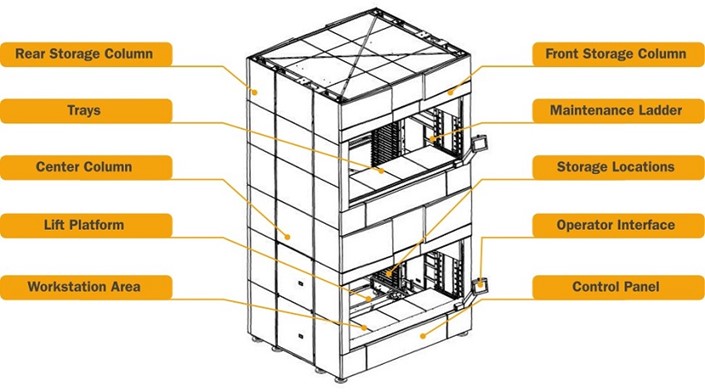
A Module smart warehouse consists of mechanical components, electrical and control systems, and software that work together to perform storage and retrieval operations. Depending on product dimensions, load capacity, building height and operational requirements, each system can be configured and designed differently.
Storage tray system
The tray is the component that directly holds goods in a VLM system. Trays are arranged across multiple levels within the storage structure and can be designed with dimensions and load capacities suitable for different types of products. Using individual trays for different storage positions allows businesses to organize goods by product code, component group, batch or other management criteria. Tray and product information can be linked to software data to support location identification during inbound and outbound operations.
Vertical storage structure
The storage structure is arranged vertically to make use of available overhead space rather than expanding only across the floor area. Storage positions are arranged at different levels, while the lifting mechanism retrieves the required tray when needed. Depending on the warehouse design, the system height can be selected based on the building height, storage requirements and product characteristics. This arrangement helps businesses make more effective use of available space while maintaining a suitable access and working area.
Lifting and tray retrieval mechanism
The lifting mechanism moves trays between storage levels and the access station. When the system receives an outbound request, the automated mechanism identifies the tray location and brings the tray to the access station according to the configured operating sequence. This allows operators to retrieve goods without having to move directly into the storage area to search for individual trays, while also supporting retrieval sequence control through the system software.
Goods access station
The access station is where operators place goods into or retrieve goods from the tray. The station can be designed at a suitable working height and may be equipped with supporting devices such as indicator lights, a control screen, sensors or safety mechanisms, depending on the system configuration. For systems with specific safety requirements, the access area can be equipped with devices such as emergency stop buttons, safety sensors or light curtains to help control the operating zone.
Control system and management software
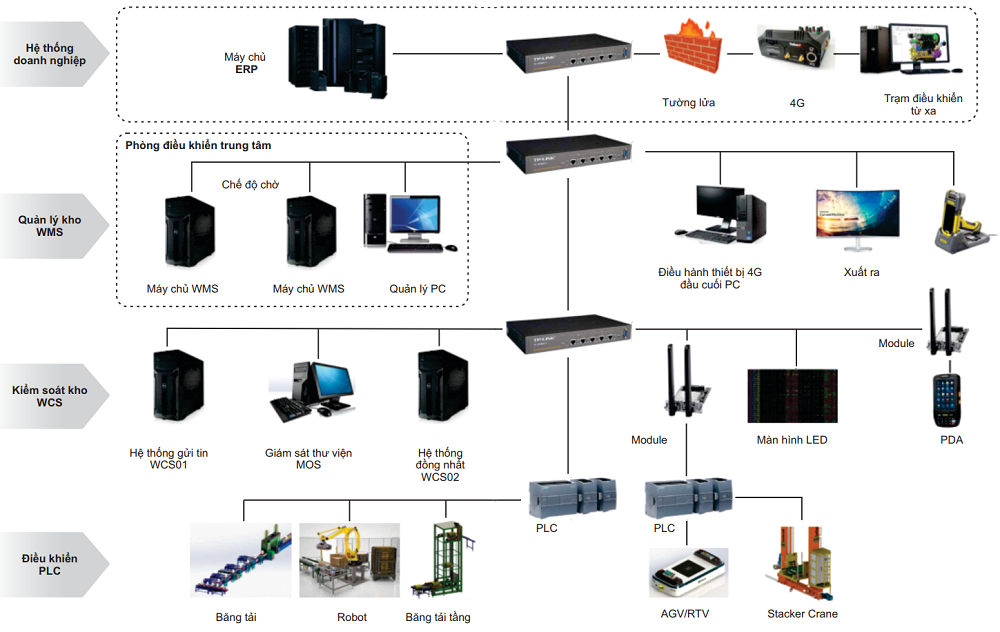
The control system receives commands, controls the lifting mechanism and coordinates equipment during operation. The management software stores information about goods, trays, storage locations and inbound/outbound status, while providing an interface for operators to monitor the system and perform required tasks. Depending on the system architecture, a Module smart warehouse can be connected to WMS, WCS or other management systems to exchange data with production and logistics operations within the factory.
How a Module smart warehouse works
The operating process of a Module smart warehouse may vary depending on the system configuration. In general, however, the system performs a sequence of operations from receiving goods and determining storage locations to storing and retrieving products when required.
Step 1: Goods receiving
Goods are delivered to the system's access station. The operator or a connected device can enter product information, quantities, product codes and other required data into the management software.
Step 2: Determining the storage location
Based on product data and predefined rules, the software determines the appropriate tray or storage location. Selection criteria may include product type, dimensions, load capacity, inbound and outbound frequency, or the current status of storage locations.
Step 3: Moving the tray to the storage location
After receiving the command, the lifting mechanism and tray handling system move the tray to the designated storage location. The storage status is then updated in the management system.
Step 4: Updating inventory data
Information about products, quantities, trays and storage locations is recorded in the software. When goods are retrieved or replenished, inventory data can be updated according to the actual operation.
Step 5: Receiving an outbound request
When a retrieval request is generated, the operator or management system sends the command to the warehouse. The software identifies the tray containing the required product based on the stored data.
Step 6: Retrieving the tray and bringing it to the access station
The automated mechanism moves to the tray location and brings the tray to the access station. The operator retrieves the required products, after which the system updates the status of the goods and tray. This process helps reduce product search time, minimize operator movement between storage locations and create centralized data for warehouse management.

Features of a Module smart warehouse
Real-time inventory management
A Module smart warehouse can connect data between goods, storage trays and management software. Information such as product codes, quantities, storage locations and inbound/outbound status can be recorded in the system, allowing operators to retrieve information without relying entirely on manual records. By updating data throughout inbound and outbound operations, businesses can monitor inventory status and identify the storage locations of different product groups more efficiently.
Automated storage and retrieval
The lifting mechanism and control system bring storage trays to the access station according to predefined commands. Operators primarily perform handling tasks at the access station instead of moving directly into the storage area to locate products. This level of automation is particularly useful for warehouses with a large number of SKUs, high inbound and outbound frequency, or strict requirements for controlling the storage locations of different components.
Optimized storage locations
The management software can use predefined allocation rules based on product characteristics and operational requirements. In properly designed systems, high-turnover products can be assigned to more accessible locations to support faster retrieval. This approach helps businesses organize storage space systematically while reducing product search time and unnecessary movement during picking operations.
System status monitoring and control
Through the control interface, operators can monitor system status, ongoing commands and equipment-related alerts. Depending on the configuration, the system can integrate sensors and safety devices to detect abnormal conditions and help control the operating area.
User access control
The management software can be configured with multiple access levels according to the requirements of each business. For example, operators can perform inbound and outbound operations, while supervisors or technical personnel can be granted additional access to management, configuration or maintenance functions. Role-based access control helps manage user permissions and limit operations that are not appropriate for each user's responsibilities.
Benefits of a Module smart warehouse in manufacturing
Efficient use of vertical space
One of the key benefits of a VLM is its ability to arrange goods vertically. Instead of expanding storage capacity across the floor area, the system uses multiple tray levels to make better use of the available vertical space.
Actual space utilization depends on factors such as warehouse height, tray dimensions, load capacity, product characteristics and system configuration. Therefore, the system should be designed based on the actual layout and storage requirements rather than applying a fixed utilization ratio to every project.
Reducing manual handling
Operators do not need to move throughout the entire storage area to locate products. Storage trays are automatically brought to the access station, reducing repetitive movement, lifting and searching tasks.
This allows personnel to focus more on product inspection, inbound and outbound requests, system monitoring and handling situations that require manual intervention.
Supporting inventory control and traceability
Each tray and storage location can be managed using an identification code within the software. By linking product data with location information, businesses can retrieve product details by product code, quantity or storage location, depending on the software configuration.
This supports inventory counting, product traceability and stock control, particularly in warehouses managing a large number of components or spare parts.
Suitable for various types of goods
Storage trays can be designed with different dimensions and load capacities according to the requirements of each system. As a result, VLMs can be used for various types of goods, including mechanical components, electronic components, spare parts, production tools and products that need to be managed by individual product codes.
For goods requiring specific temperature, humidity, load capacity or storage conditions, businesses should select an appropriate system configuration and equipment from the design stage.
Supporting operational safety
The storage area is separated from the operator's working area. Depending on the system configuration, safety devices such as light curtains, safety sensors, protective barriers and emergency stop buttons can be integrated to help control the operating area.
Specific safety devices should be selected based on machine design, applicable standards and the requirements of each project.
IoT and AI technologies in Module smart warehouses
IoT and data acquisition
IoT technology can be integrated to connect sensors, control equipment and management software. Depending on the system configuration, data collected from the system may include equipment status, tray locations, inventory information and other operational parameters. Centralizing this data allows operators to monitor the system through a unified interface and supports the detection and handling of abnormal operating conditions.
AI and data analytics
A smart warehouse can generate data from goods, inbound and outbound frequency and equipment operation. When sufficient data and an appropriate analytics system are available, AI and machine learning can be used to identify trends, support demand forecasting and analyze warehouse operations. AI is not a mandatory component of every VLM system. Its integration should be considered based on the business's operational objectives, data quality and specific warehouse management requirements.
Integration with other systems
A Module smart warehouse can be designed as a standalone system or integrated with other equipment and software used within the factory.
Integration with WMS and ERP
Data related to goods, inventory, orders and storage locations can be exchanged between the warehouse and relevant management systems. Integration should be designed based on the software architecture, communication protocols and data requirements of each business. Not every warehouse system can be directly connected to any ERP platform. Integration capabilities should therefore be assessed during the site survey and system design stages.
Integration with conveyors and material handling equipment
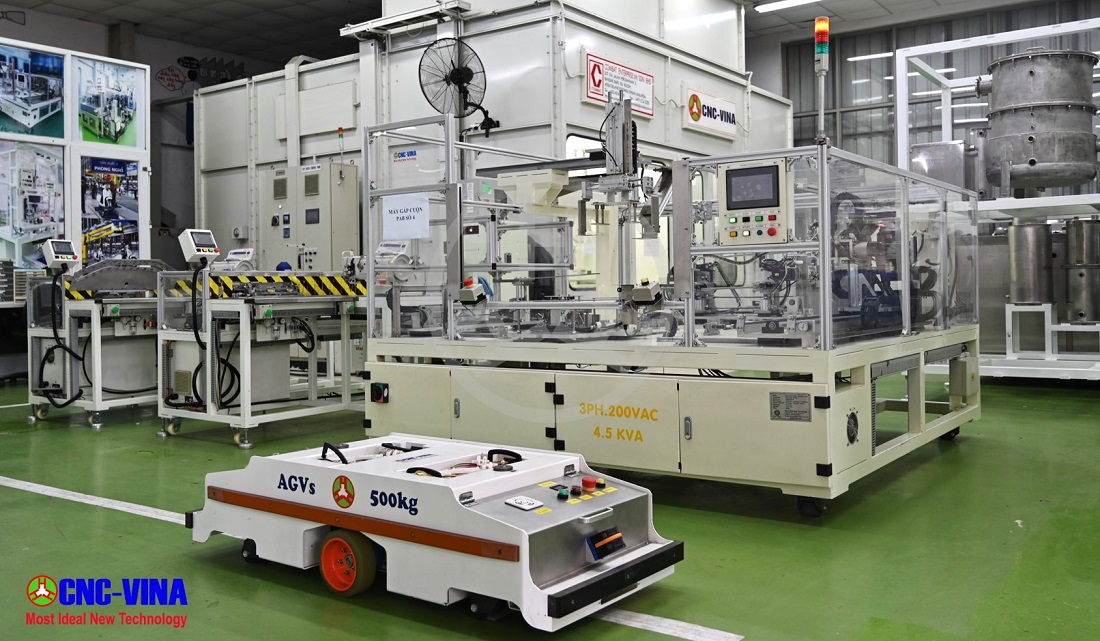
A VLM can be connected to conveyors or other material handling equipment to create a continuous material flow between the warehouse and production, packaging or shipping areas. Depending on the scale and layout of the factory, the system can also be integrated with AGVs/AMRs to transport goods between the warehouse and other operating areas.
Integration within a smart factory
When an automated warehouse is connected to production and logistics systems, data related to raw materials, components, inventory and material replenishment requests can be exchanged between different processes. This provides a foundation for developing more automated material management and material flow processes across the factory.
Key considerations when implementing a Module smart warehouse
Scalability and flexibility
When investing in a Module smart warehouse, businesses should consider both current storage requirements and potential future expansion. Key factors include the number of SKUs, inbound and outbound volume, product types, load capacity, product dimensions and the available installation area.
A modular design can facilitate future system adjustments or expansion. However, actual scalability still depends on the initial structure, available space, equipment and system configuration.
Compatibility with existing infrastructure
If a business already has a warehouse management system, storage racks or material handling equipment, its compatibility and potential integration with the new system should be assessed beforehand. Factors such as equipment condition, dimensions, load capacity, technical standards and data communication capabilities should be considered. In some cases, upgrading the existing system may be more appropriate than replacing it entirely. In other cases, a complete system upgrade may help overcome limitations associated with legacy infrastructure. The appropriate approach should be determined through a comprehensive site survey and technical assessment.
Data security and access control
An automated warehouse may store information related to goods, inventory, orders and operational activities. When connected to an internal network or other management systems, businesses should consider security requirements from the system design stage. Measures such as user access control, account management, connection security, data backup and system activity monitoring can be implemented according to the specific requirements of each project.
Personnel training and workforce management
Automation does not completely eliminate the role of personnel. Operators still need to be trained to use the control interface, inspect equipment, respond to alarms, follow emergency stop procedures and handle exceptional operating conditions. For systems involving multiple mechanical, electrical, control and software components, businesses should also establish an appropriate maintenance and technical support plan to maintain stable operation.
Maintenance and contingency planning
Components such as lifting mechanisms, control equipment, sensors and drive systems should be inspected and maintained according to equipment requirements and operating conditions. For systems requiring continuous operation, businesses should identify critical components, establish fault-handling procedures, prepare appropriate spare parts and develop data recovery measures when necessary.
CNC-VINA provides Module smart warehouse solutions
A Module smart warehouse combines vertical storage structures, storage trays, automated mechanisms, control systems and management software into an integrated storage solution. When designed according to product characteristics, load capacity, inbound and outbound volume and actual site conditions, the system can help businesses optimize storage space, reduce manual handling and improve inventory control.
Depending on operational requirements, a smart warehouse can be integrated with other automation solutions, including warehouse management systems, conveyors, loading/unloading equipment, lifting systems and AGVs to establish a coordinated material flow within the factory. With experience in automation solutions and factory systems, CNC-VINA provides customized automated warehouse solutions based on actual operational requirements, covering storage systems, material handling equipment, control systems and management solutions.
Some solutions include:
For automated warehouse solutions and automation systems for smart factories, please contact:
CNC VIETNAM TECHNOLOGY APPLICATION JOINT STOCK COMPANY
Factory: Song Cung Industrial Cluster, Dong Thap Commune, Dan Phuong District, Hanoi, Vietnam
Office: Rox Tower (Rox Center Goldmark City), 136 Ho Tung Mau Street, Bac Tu Liem District, Hanoi, Vietnam
Tel: +84.916 63 9355 / +84.915 74 4664
Website: www.cncvina.com.vn ; www.cncviname.com.vn
Email: Sales01@cncvina.com.vn | Sales03@cncvina.com.vn

 Tiếng
Việt
Tiếng
Việt
 Tiếng
Anh
Tiếng
Anh
 Tiếng
Nhật
Tiếng
Nhật




 Tiếng Anh