 Tiếng
Việt
Tiếng
Việt
 Tiếng
Anh
Tiếng
Anh
 Tiếng
Nhật
Tiếng
Nhật



 Tiếng Anh

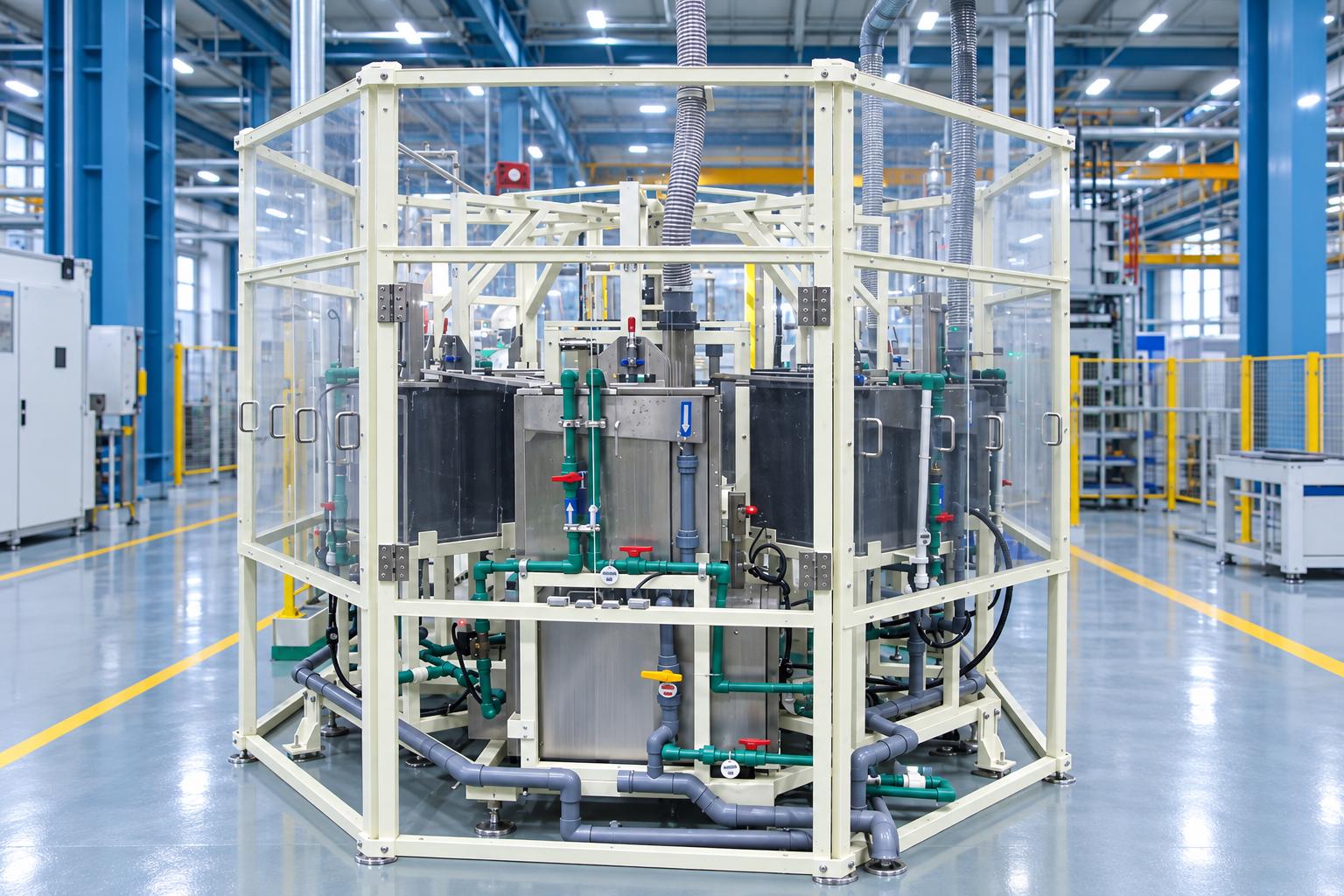
Automatic tin plating system
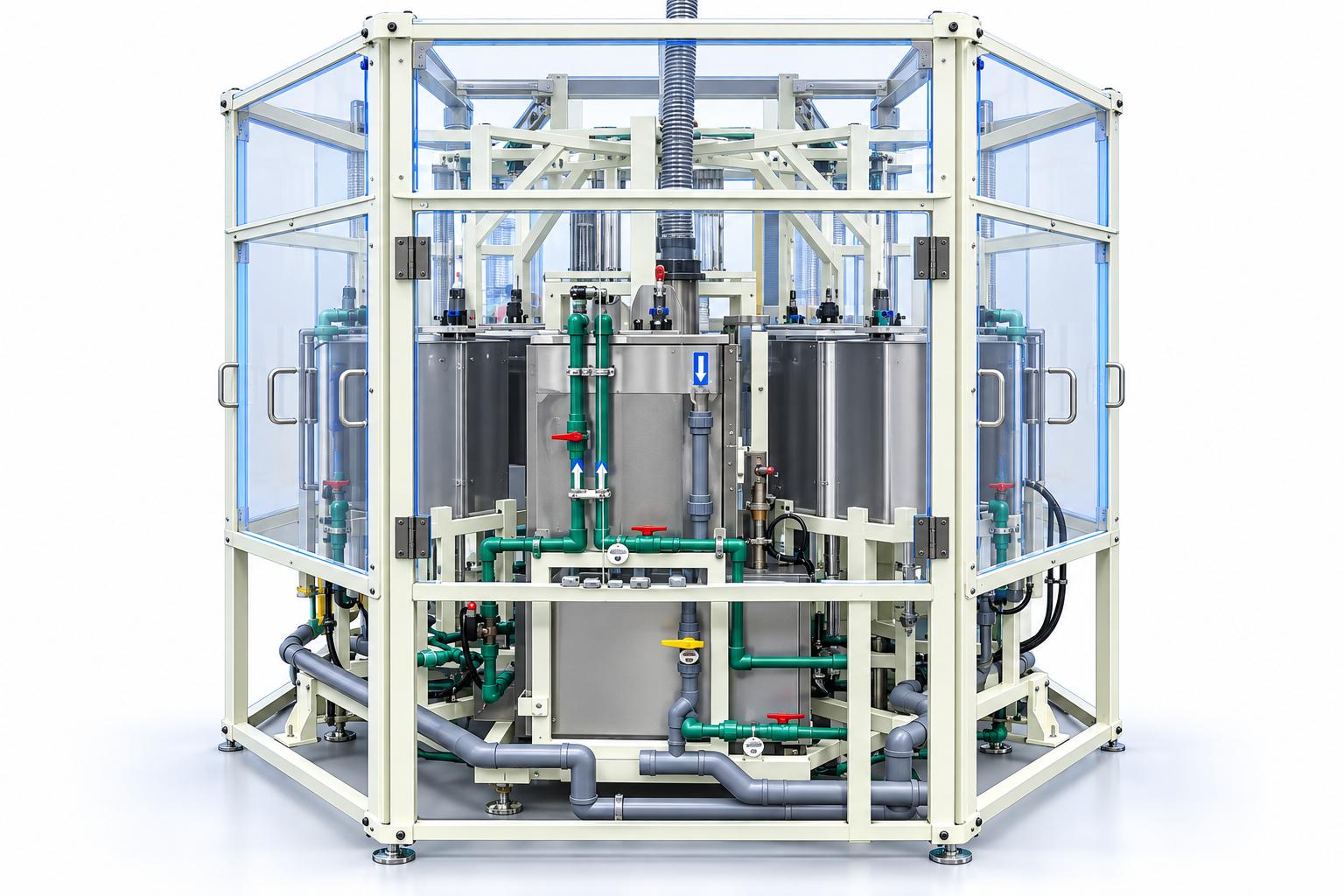
The CNC VINA automatic tin plating system uses an indexing rotary unit combined with a lifting mechanism to move product fixtures sequentially through the treatment tanks. The system configuration features eight working positions, including one product loading and unloading station and seven tanks arranged around the central rotary unit.
The operator loads products onto the fixtures and removes finished parts at the operating station. The system automatically performs indexing, lifting, lowering, and immersion according to preset timings while monitoring temperature, solution levels, and mechanism status. This solution is suitable for tin plating processes that require products to pass through multiple tanks in a predefined sequence.
VIETNAM CNC & TECHNOLOGY APPLICATION JOINT STOCK COMPANY
Hotline: +84.916 63 9355 / +84.915 74 4664
Email: Sales01@cncvina.com.vn / Sales03@cncvina.com.vn
Product description

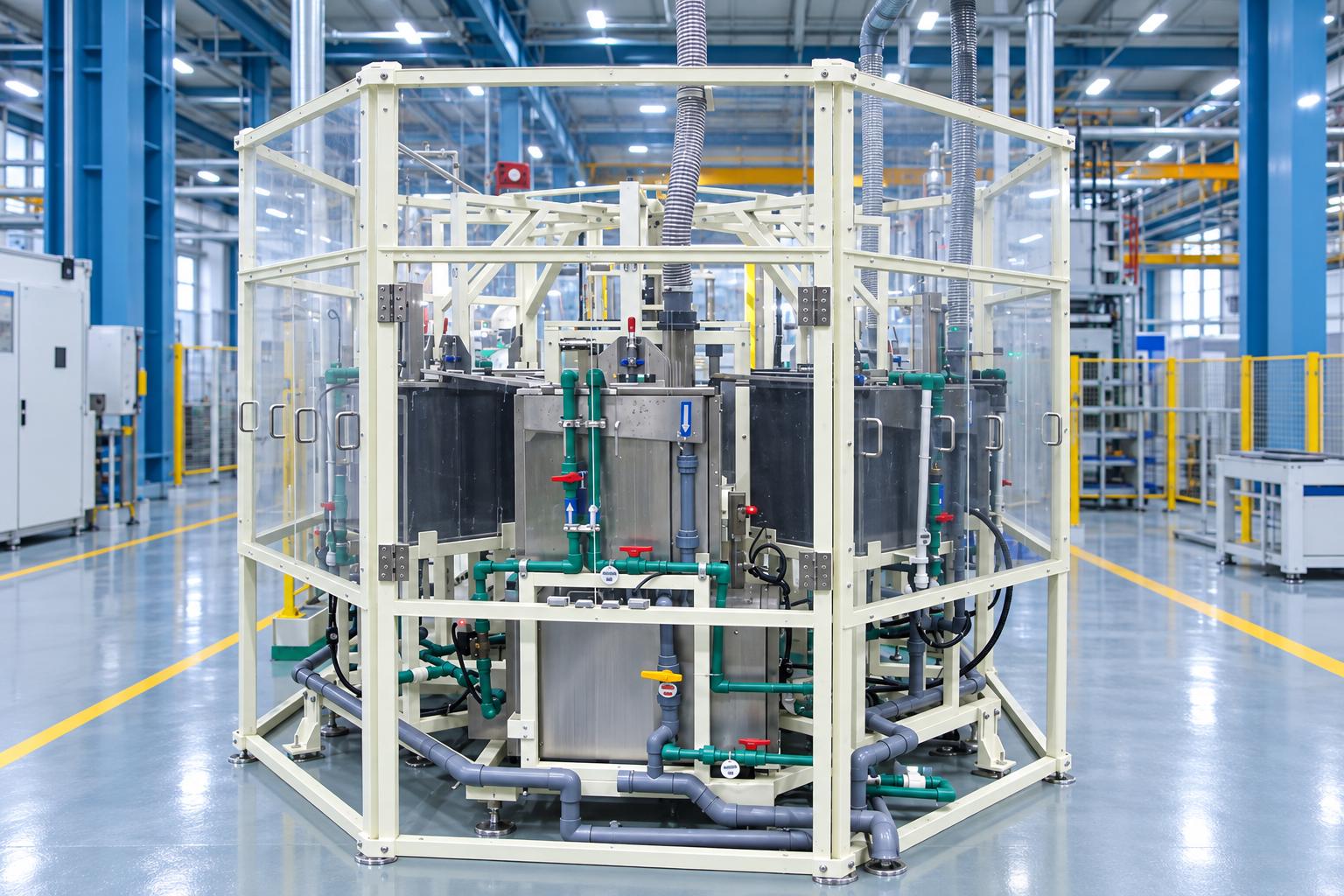
CNC VINA automatic tin plating system uses an indexing rotary unit combined with a lifting mechanism to move product fixtures sequentially through the treatment tanks. The system has eight working positions, including one position for loading and unloading products and seven tanks arranged around the central rotary unit.
The operator loads products onto the fixtures and removes finished parts at the operating station. The system automatically performs indexing, lifting, lowering, and immersion according to preset timings while monitoring temperature, solution levels, and mechanism status. The indexing rotary tin plating system designed by CNC VINA is suitable for tin plating processes that require products to pass through multiple tanks in a predefined sequence.
Role in the surface treatment process
When products are transferred manually between multiple tanks, operators must coordinate lifting, moving parts to the next tank, and monitoring immersion times. The automated system coordinates these movements through a shared rotary and lifting mechanism, helping establish a consistent treatment sequence for repetitive production.
Arranging the tanks around a central rotation axis keeps the product transfer path within a compact equipment unit. Operators load and unload products at a single station, while the fixtures automatically carry the parts through the successive processing stages.
Key features of the system
-
Eight-position layout: one product loading and unloading station and seven treatment tanks arranged around the rotary unit.
-
Servo-driven indexing rotation: a motor and transmission system move the fixtures to the next position in the cycle.
-
Pneumatic lifting and lowering: cylinders raise the entire fixture assembly out of the tanks and lower it for immersion.
-
Adjustable immersion time and rotation speed: settings support tank-to-tank transfer and product immersion.
-
Process condition monitoring: solution level, temperature, and mechanism status signals are integrated into the operating conditions.
-
PLC and HMI control: supports manual and automatic modes, homing, status display, and alarm history.
-
Cycle-based product handling: the access door at the operating station coordinates product loading and unloading. The system includes area sensors, door switches, and emergency stops.
System structure and integrated technologies
The CNC VINA automatic tin plating system integrates an indexing rotary unit, a lifting mechanism, dedicated product fixtures, treatment tanks, and a PLC–HMI control system. These components work together according to a predefined process sequence to automate product transfer, immersion, and treatment.
Indexing rotary unit and lifting mechanism
The central rotary unit carries the fixtures and is driven by a servo motor combined with a gearbox. After each processing stage, the lifting mechanism raises the products out of the tanks. The rotary unit then indexes to the next position before lowering the products for the next treatment stage.
All fixtures move together as part of a shared lifting assembly. Therefore, when configuring the system, the timing compatibility of processes operating simultaneously must be considered. The lifting stroke, clearance above the tank openings, and product orientation must also be checked to ensure accurate positioning during loading and unloading and to prevent collisions.
Product fixtures
The fixtures are installed at designated positions and secured with clamps. Their design must suit the shape of the parts, the areas requiring treatment, and the operator's loading and unloading procedures. Fixture orientation also affects contact with the solution and drainage when the parts are lifted out of the tanks.
When developing fixtures for a new product, it is advisable to manufacture and test one fixture before producing the full set. Testing with actual samples helps verify part retention, tank clearance, loading and unloading operations, and treatment results on the areas requiring evaluation.
Treatment tanks and solution piping
The tanks are arranged around the central rotation axis according to the processing sequence. The configuration includes PVC tanks, stainless steel tanks, heating and insulation components, a storage tank, and solution piping. For customized designs, tank and piping materials must be selected according to the chemical solutions, operating temperatures, and working conditions.
The number of process tanks must be determined based on the product's treatment procedure. Other considerations include usable tank volume, supply and drain locations, cleaning space, and maintenance accessibility. Requirements for solution collection, wastewater treatment, and ventilation are determined according to the factory's installation conditions.
Heating and solution level monitoring
The system includes heating elements, temperature sensors, and dedicated temperature controllers installed in the control cabinet. Operators can set and monitor temperatures through these controllers, while the HMI displays relevant operating conditions.
Float switches and level sensors monitor the solution levels at designated locations. Level and temperature signals are incorporated into the operating conditions, helping operators identify when a process is not ready to run. Operating values must be established based on the treatment procedure and product sample testing.
PLC and HMI control
The PLC coordinates the servo drive, pneumatic lifting cylinders, access door, and monitoring signals. The HMI allows operators to monitor position, rotation speed, preset immersion times, operating time, and alarm history. Operators can switch between manual and automatic modes and return the system to its home position according to the handover instructions.
The ready status displayed on the interface reflects the equipment's operating conditions. Product quality after treatment must be evaluated separately according to the agreed surface requirements and inspection methods established during acceptance testing.
Operating principle of the automatic tin plating system
The CNC VINA automatic tin plating system uses an indexing rotary mechanism combined with a lifting system to move products through the treatment tanks in a predefined sequence and according to preset timings. The PLC coordinates the servo drive, pneumatic cylinders, and monitoring sensors to automate the cycle while allowing operators to load and unload products at a fixed station.
Operating sequence of the indexing rotary tin plating system
The operating cycle coordinates product handling with simultaneous immersion at multiple tanks:
Step 1: Prepare operating conditions. Check the fixtures, solution levels, temperatures, and mechanism status. Initialize the system and return it to the home position.
Step 2: Load products. The operator installs the parts in the fixtures at the operating station and confirms the operation using the two Start buttons.
Step 3: Lift and index. The cylinders raise the entire assembly out of the tanks. The servo-driven rotary unit then indexes the fixtures to the next positions.
Step 4: Lower and immerse. The lifting mechanism lowers the parts into the tanks, beginning the preset immersion period.
Step 5: Load and unload at the operating station. During the permitted stage, the automatic door opens so the operator can remove finished products, load new parts, and confirm readiness.
Step 6: Continue the cycle. Once the preset time has elapsed and all required conditions are satisfied, the system raises the assembly and moves to the next stage.
The fixtures pass through each position over multiple indexing steps; a single indexing movement between tanks does not represent the complete treatment process for one part. Loading and unloading are coordinated with the immersion stage, allowing operations to be organized around a fixed handling station.
Operating and maintenance considerations
Before starting the system, operators should check the fixtures, solution conditions, temperature settings, and equipment status. Products must be loaded and unloaded at the operating station only during the stage permitted by the system. When an alarm occurs, its cause must be identified and addressed according to the handover instructions before the system is restarted.
Maintenance focuses on the rotary unit, gearbox, lifting cylinders, access door, fixture clamps, floats and level sensors, heating elements, temperature sensors, and piping. The electrical cabinet, wiring, pneumatic lines, and emergency stop and alarm functions should be inspected according to the maintenance schedule specified for the delivered configuration. Before cleaning tanks, changing fixtures, or adjusting mechanisms, stop the machine and isolate all energy sources. Access to the tanks must follow the factory's procedures for managing temperature and chemical solutions.
Applications in industrial manufacturing
The primary application is automating the transfer of products through multiple tanks during the tin plating process. This solution is suitable when parts can be securely mounted in fixtures, the tank sequence is clearly defined, and the treatment times are compatible with a shared lifting mechanism. The equipment handles movement and immersion timing, while the chemical solution process and quality criteria are established according to the product requirements.
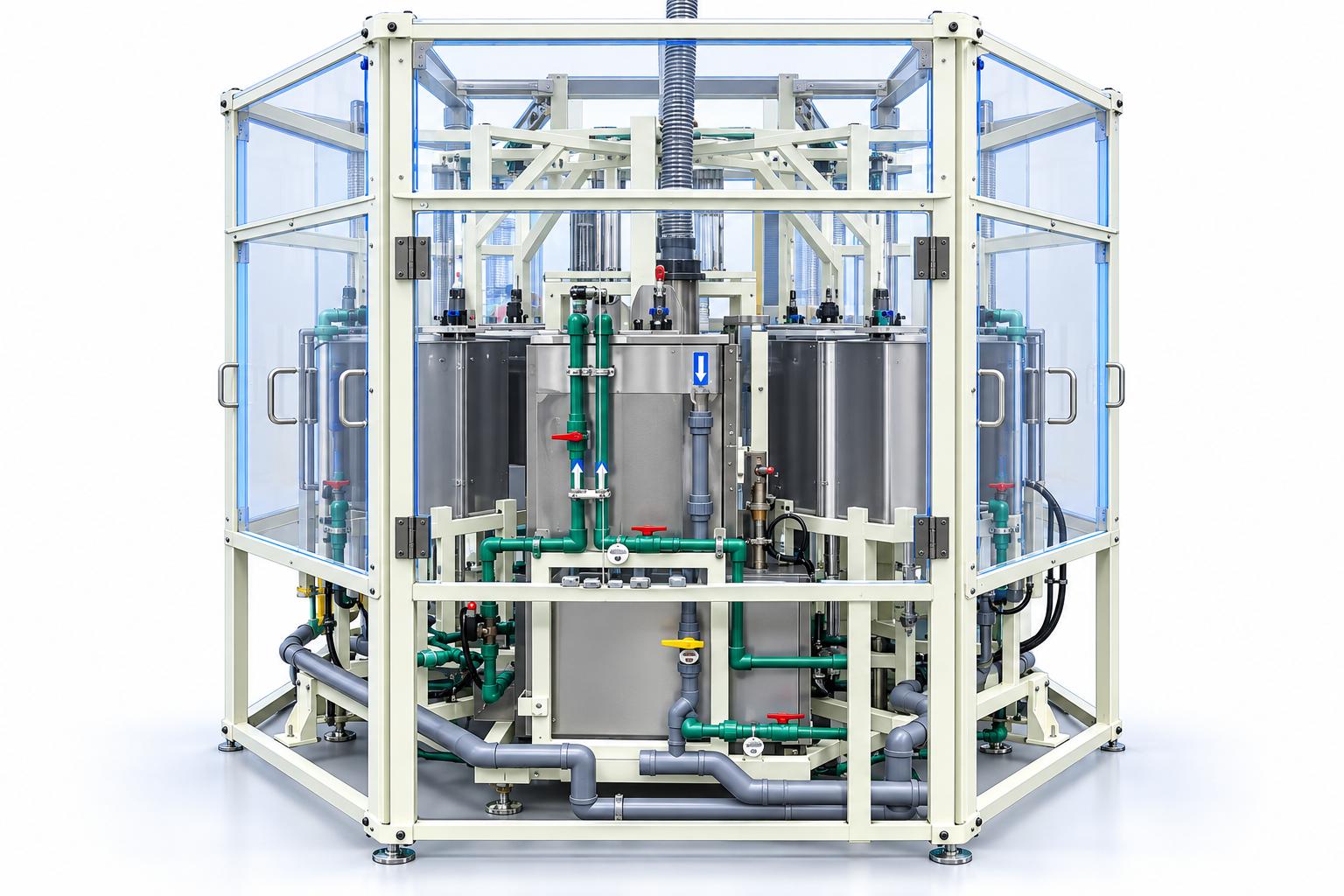
In projects aimed at improving manual immersion processes, manufacturers can evaluate the possibility of arranging the tanks around a rotary unit and organizing product handling at a single station. This requires a simultaneous assessment of installation space, fixture handling, and solution management conditions. The configuration is selected based on the actual process and the factory's production cycle.
The indexing rotary principle combined with a lifting mechanism can also be evaluated for multi-tank surface treatment processes, such as surface preparation or multi-stage rinsing before product finishing. Each additional application requires a reassessment of the solutions, contact materials, process sequence, and treatment times. Suitability is confirmed through engineering design and trial runs.
Technical specifications of the multi-tank immersion system
The following specifications describe the configuration presented. For a customized system, the final handover conditions are determined according to the customer's products and process requirements.
| Item | Specifications |
|---|---|
| Working position layout | 8 positions, including 1 product loading and unloading station and 7 treatment tanks |
| Main power supply | 3 phase, AC 200 V, 50 Hz |
| Configured power supply capacity | 25 kVA |
| Control voltage | DC 24V |
| Compressed air pressure | 0.4 - 0.6 MPa |
| Compressed air connection | Ø12 mm tubing |
| Rotary motion | Servo motor and gearbox with indexing rotation |
| Immersion motion | Entire assembly lifted and lowered by pneumatic cylinders |
| Control interface | PLC and HMI, with dedicated temperature controllers |
| Cycle settings | Rotation speed and shared immersion time |
| Product loading and unloading | Performed by the operator at the handling station |
The 25 kVA specification represents the required apparent power capacity of the power supply. Actual energy consumption must be evaluated under real heating and operating conditions. Production cycle time must also account for immersion time, indexing movements, loading and unloading operations, and the number of parts that can be accommodated on each fixture.
Key considerations when selecting the system
Product characteristics and treatment requirements
The shape, material, weight, and areas requiring treatment must be identified. Actual product samples help determine the fixture design, verify contact positions, and assess solution drainage. For multiple product types, it is advisable to group products that can share the same fixtures and identify those requiring fixture changes or configuration adjustments.
Tank sequence and immersion time
The tank sequence, temperature, solution level, and treatment time are essential data required before selecting the system configuration. Since all fixtures share a common lifting mechanism, the compatibility of processes operating during the same working step must be verified. If different tanks require different treatment times, the mechanical and control solutions should be evaluated from the initial design stage.
Factory conditions
The installation area must accommodate the control cabinet, product loading and unloading access, tank access areas, and maintenance space. The power supply, compressed air, solution supply and drainage lines, and auxiliary requirements must be coordinated with the factory. When determining the target production capacity, the process of replenishing products and maintaining solution conditions during operation should also be evaluated.
Sample testing and acceptance of the automatic tin plating system
Trial runs should use the actual product samples, fixtures, and intended treatment process. Evaluation may include the following:
Fixtures and movement: Verify product retention, clearance during lifting, fixture alignment with the tanks, and loading and unloading operations.
Immersion conditions: Check the contact areas, immersion depth, solution drainage, and the amount of solution carried by the parts and fixtures into the next tank. Evaluate whether the preset immersion times are suitable for the process stages.
Heating and level signals: Verify the system's ability to maintain the selected conditions and its response when a signal does not meet the required operating conditions.
Product results: Establish the appearance requirements, treatment areas, and plating layer criteria to be evaluated using methods appropriate for the product.
Cycle and operation: Run multiple consecutive cycles and check product handling, alarms, stopping and restarting procedures, and completed output under the agreed operating conditions.
Test results must be documented in relation to the product type, fixtures, solution, operating levels, temperature, and immersion times used. If any of these factors change, the samples should be reevaluated before production begins.
Frequently asked questions
What operations must the operator still perform?
The operator loads and unloads products at the handling station, confirms the cycle using the two Start buttons, and monitors operating conditions. Automating product loading and unloading entirely should be evaluated as an additional design scope.
Can different immersion times be set for each tank?
The reference configuration uses a shared immersion time and a common lifting mechanism for all fixtures. If the process requires different immersion times for individual tanks, the control and mechanical options must be evaluated before design.
Does one indexing step complete the treatment of a product?
A part requires multiple indexing steps to pass through all the tanks. Once the system is running steadily and the fixtures are loaded with products, finished parts can be removed at each handling step. Actual output depends on the duration of each step, the number of parts per fixture, and operator handling time.
Can the system be used for other products or processes?
The fixtures, working load, tank materials, solutions, and treatment parameters must be evaluated. Suitability for another process is determined through engineering design and trial runs using representative samples.
CNC VINA designs customized systems
CNC VINA designs and manufactures tin plating systems based on product characteristics and process organization requirements. The design scope may include fixtures, rotary and lifting assemblies, tank layout, contact materials, heating, condition monitoring, and coordinated control. Customers can provide product information and treatment process details for CNC VINA to recommend a suitable configuration.