 Tiếng
Việt
Tiếng
Việt
 Tiếng
Anh
Tiếng
Anh
 Tiếng
Nhật
Tiếng
Nhật




 Tiếng Anh

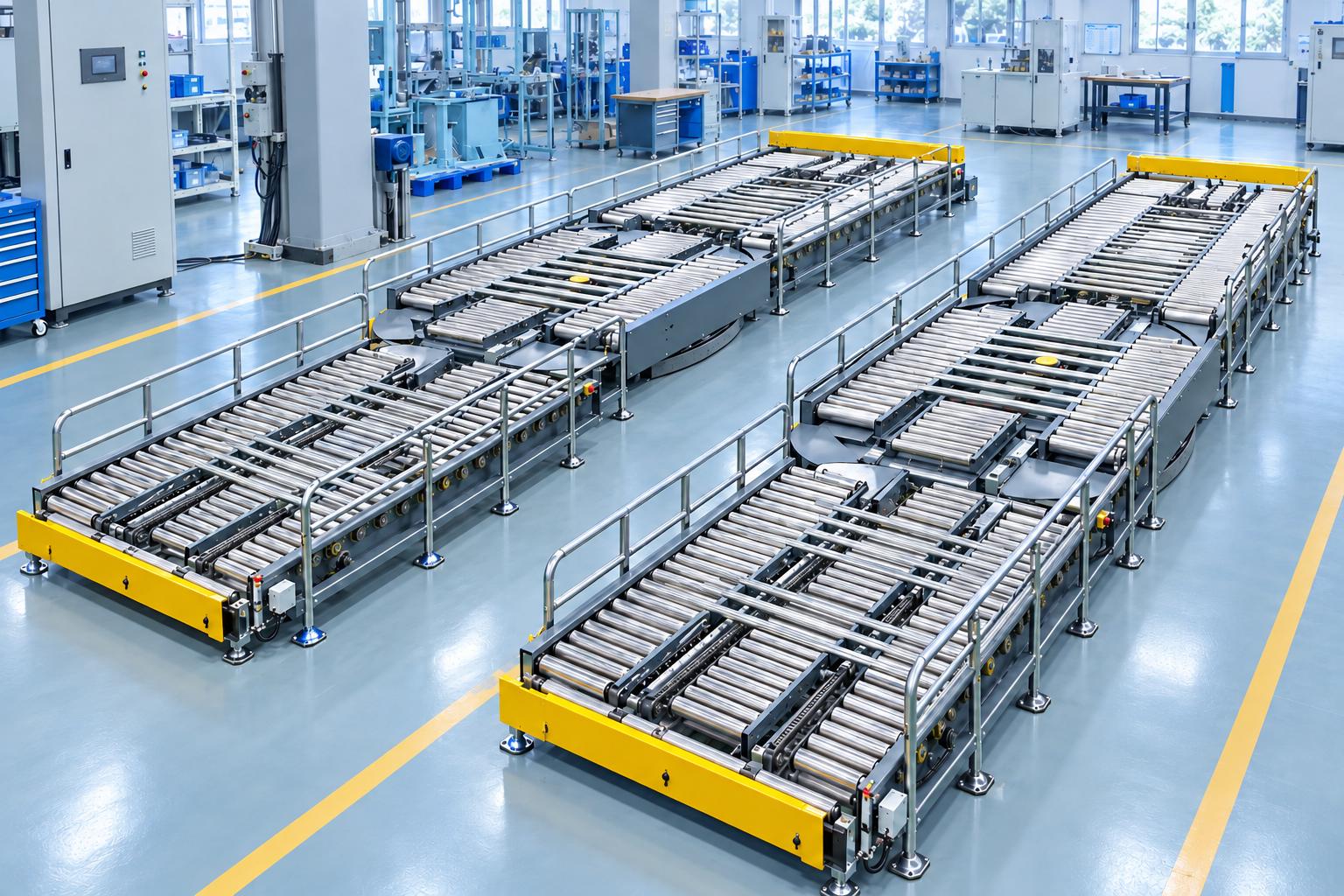
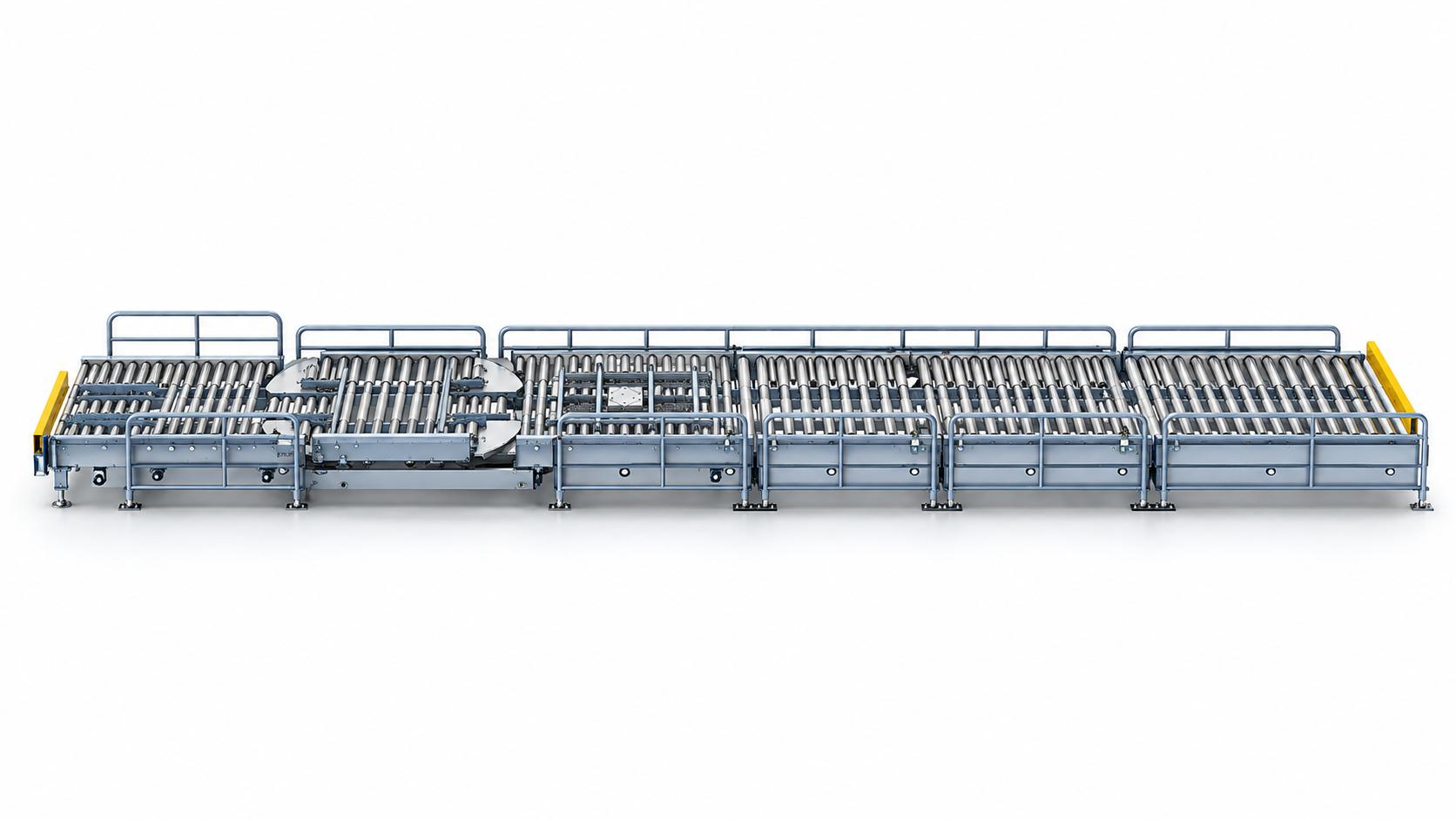
Automatic pallet transfer conveyor system
Automatic pallet transfer conveyor system is designed to transport loaded pallets between receiving, stretch-wrapping, direction-changing, and forklift pickup stations within a factory. The reference configuration consists of six roller conveyor sections, a pallet receiving mechanism for transferring pallets from a transport vehicle, a rotary table at the stretch-wrapping station, and a lifting and 90-degree turning table. The system uses a PLC, sensors, and an HMI to control the pallet transfer sequence according to the status of each station. In this configuration, stretch wrapping is still performed manually by an operator, while a forklift collects pallets at the end of the line. CNC VINA designs the conveyor line length, transfer mechanisms, pallet buffer positions, and control system according to pallet dimensions, load capacity, and the actual factory layout.
VIETNAM CNC & TECHNOLOGY APPLICATION JOINT STOCK COMPANY
Hotline: +84.916 63 9355 / +84.915 74 4664
Email: Sales01@cncvina.com.vn / Sales03@cncvina.com.vn
Product description

CNC VINA automatic pallet transfer conveyor system is designed to transport loaded pallets between receiving, stretch-wrapping, direction-changing, and forklift pickup stations within a factory. The reference configuration consists of six roller conveyor sections, a pallet receiving mechanism for transferring pallets from a transport vehicle, a rotary table at the stretch-wrapping station, and a lifting and 90-degree turning table. The system uses a PLC, sensors, and an HMI to control the pallet transfer sequence according to the status of each station. In this configuration, stretch wrapping is still performed manually by an operator, while a forklift collects pallets at the end of the line. CNC VINA designs the conveyor line length, transfer mechanisms, pallet buffer positions, and control system according to pallet dimensions, load capacity, and the actual factory layout.
What is an automatic pallet transfer conveyor system?
An automatic pallet transfer conveyor system connects pallet receiving, processing, and handover stations into a coordinated material handling line with a clearly defined control sequence. Depending on production requirements, the system can integrate roller conveyors, pallet transfer mechanisms, rotary tables, lifting and turning tables, and pallet buffer stations. An automatic pallet transfer conveyor system is a material handling system that moves loaded pallets between designated locations within a factory using roller conveyors and automated control mechanisms. It can incorporate pallet receiving, turning, and buffering functions to connect production, packaging, and shipping operations. In CNC VINA's reference configuration, pallets are received from a transport vehicle, conveyed to the stretch-wrapping station, reoriented, and transferred to a designated buffer area for forklift pickup. The PLC processes sensor signals to control the mechanisms according to predefined operating conditions. The level of automation at each stage depends on the scope of integration specified for the project.
Role in the factory material flow
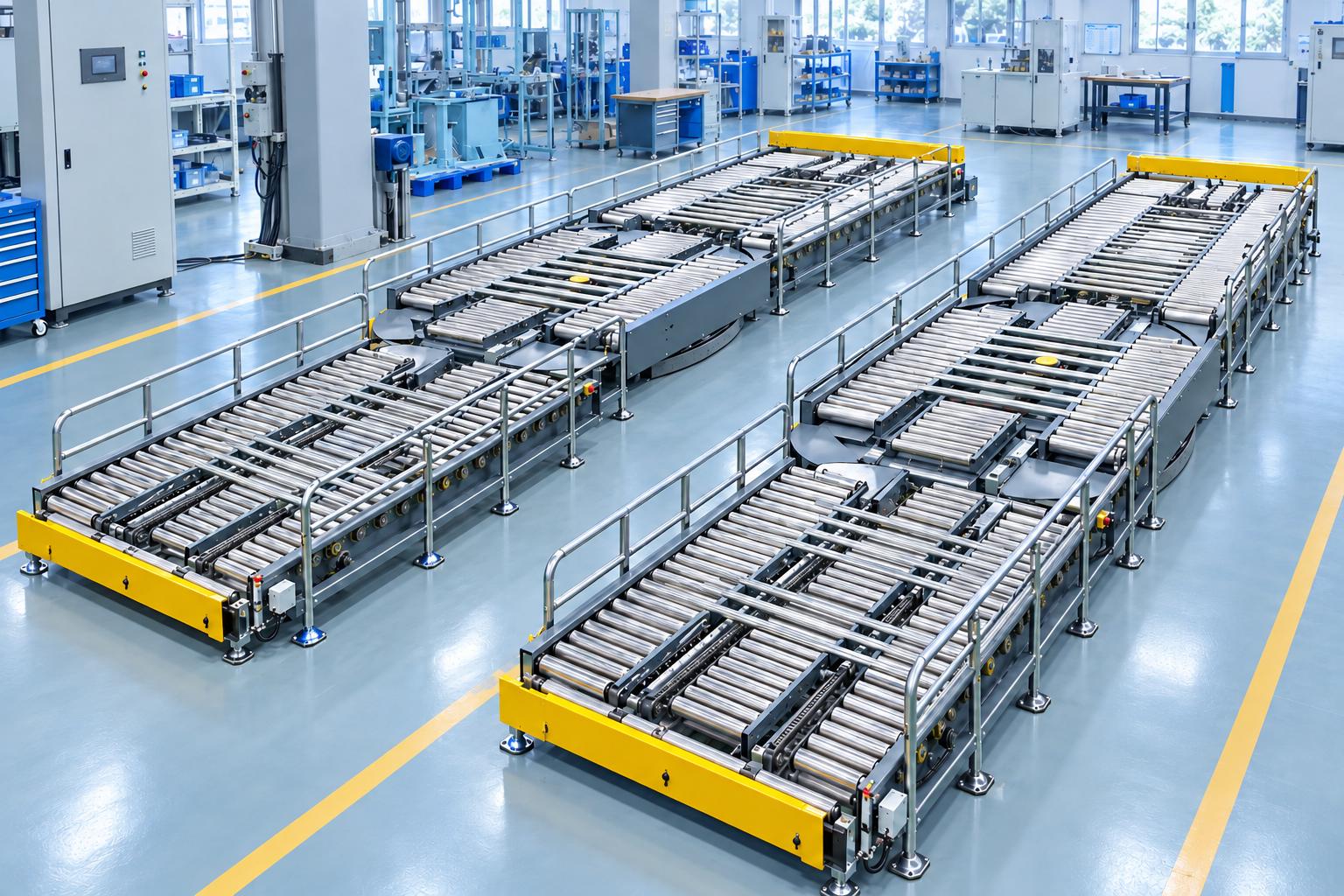
An automatic pallet transfer conveyor system establishes a continuous transport route between workstations, enabling manufacturers to organize pallet receiving, finishing, and handover operations in a consistent sequence. Operational efficiency depends on effective coordination between the conveyor system, the stretch-wrapping process, and forklift handling. After goods are loaded onto pallets, the factory typically needs to convey them to the stretch-wrapping station, change their orientation, and transfer them to a designated shipping buffer area. When these stations are located separately, pallet transfers require coordination among transport vehicles, operators, and forklifts. The pallet conveyor system arranges receiving, transfer, and buffering points along a single route. Pallets enter at the beginning of the line and move along roller conveyors to designated stations. They proceed to the next stage when the downstream station is ready to receive them. Sensors and the PLC work together to control conveyor movement, stopping, pulling, lifting, and turning according to the configured sequence.
An important function is to hold pallets at buffer positions when the next process is not ready. This arrangement helps prevent pallets from being transferred to occupied stations and improves coordination between processes. However, actual throughput depends not only on conveyor speed but also on stretch-wrapping time, pallet feeding intervals, and forklift pickup capacity. Therefore, when designing an automatic pallet transfer conveyor system, manufacturers need to define the material flow, handover conditions at each station, and coordination between operators and the control system. These factors provide the basis for selecting the number of conveyor sections, direction-changing mechanisms, and buffer positions to meet production requirements.
Key features of an automatic pallet transfer conveyor system
- Integration of multiple process stages: Combines pallet receiving, roller conveyor transport, transfer to the stretch-wrapping station, pallet turning, and buffering for forklift pickup.
- Status-based control: The PLC processes sensor signals to control movement and hold pallets when handover conditions have not been met.
- Adjustable conveying speed: A variable frequency drive (VFD) enables motor speed adjustment according to the conveyor line's operating requirements.
- Operation and adjustment support: The HMI and control buttons allow operators to select operating modes, check individual units, and perform operations according to the system design.
- Layout-specific installation: Conveyor sections are connected, aligned, and anchored to the floor, while moving mechanisms are fitted with guards in accordance with the system design.
Load capacity, pallet dimensions, and throughput must be determined based on the actual system configuration. Available automation functions also depend on the integration scope and interlocking conditions established for each project.
Construction and technologies used
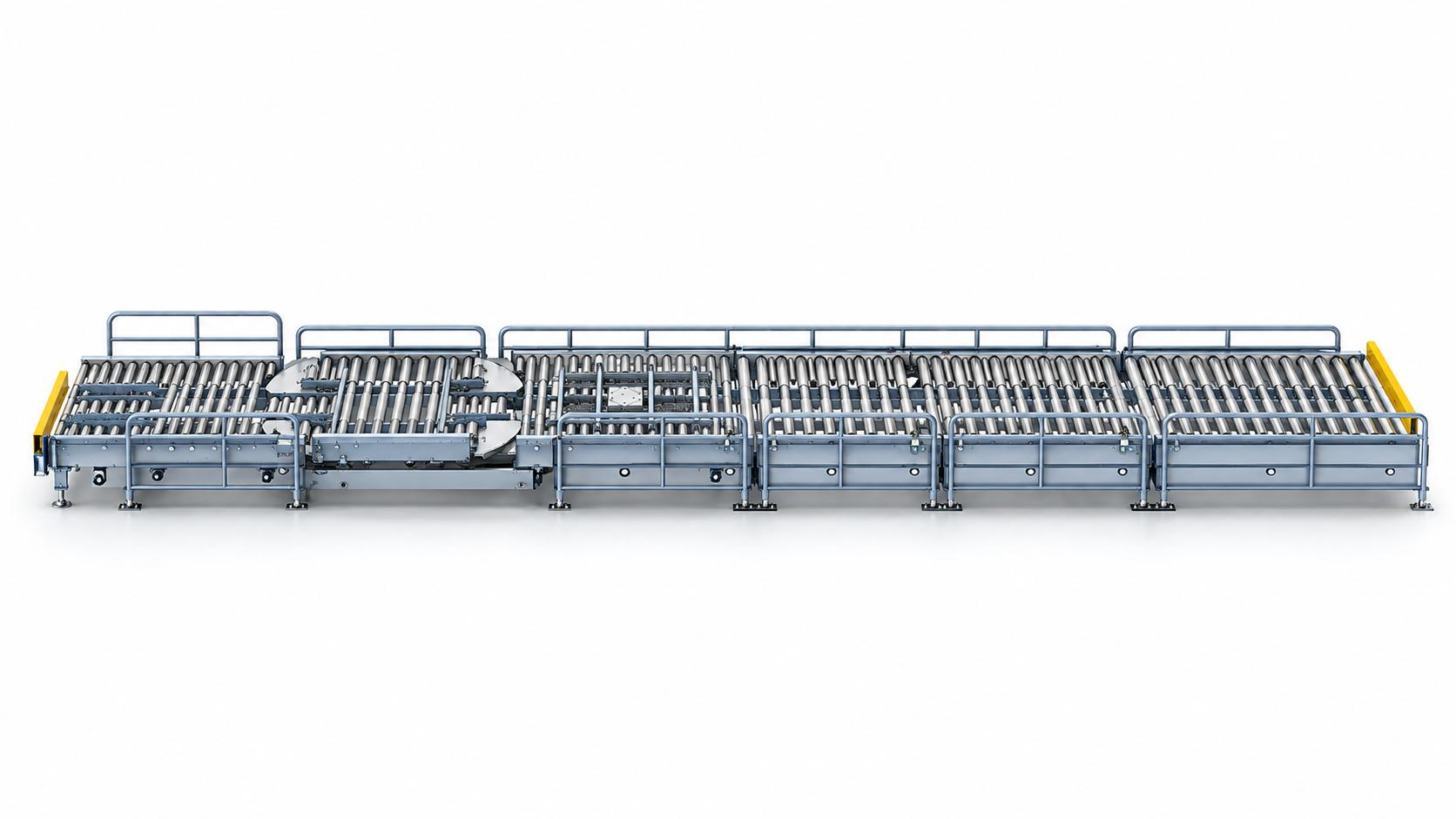
An automatic pallet transfer conveyor system consists of mechanical assemblies, drive systems, pneumatic components, and control equipment that work together to perform pallet receiving, conveying, turning, and handover operations. In CNC VINA's reference configuration, each unit performs a specific function and is selected according to pallet characteristics, load requirements, and conveyor line layout.
Pallet receiving unit for transfer vehicles
The receiving unit consists of vehicle guide rails, position detection sensors, a stopping mechanism, and a pneumatic cylinder that pulls the pallet onto the conveyor. When the vehicle reaches the designated position and the handover conditions are satisfied, the system activates the pulling mechanism to transfer the pallet onto the roller conveyor. The receiving unit must be designed to suit the vehicle type, transfer height, and pallet base structure.
Powered roller conveyor
The roller conveyor uses a motor, gearbox, and chain drive to transport pallets between process stations. The conveyor line is divided into multiple sections, allowing pallets to move or stop for buffering according to the status of each station. The conveyor structure and roller spacing are selected based on pallet dimensions, load capacity, and the characteristics of the pallet base.
Rotary table at the stretch-wrapping station
The rotary table receives the pallet at the stretch-wrapping station and is equipped with control buttons for operator use. Once wrapping is complete, the table returns to the required orientation so that the pallet can proceed to the next stage. The handover sequence is coordinated with the rotary table position and the downstream conveyor's ready signal.
Pallet lifting and 90-degree turning table
The lifting and turning table raises the pallet above the roller surface, rotates it 90 degrees, and lowers it back down for continued transport. This mechanism adjusts the pallet orientation to suit the forklift pickup position. The lifting and turning mechanism is designed according to the pallet load, dimensions, and center of gravity.
Forklift pickup buffer positions
The final conveyor sections provide buffer positions where pallets wait for forklift pickup. Once the position ahead is cleared, the system advances the next pallet according to the programmed control sequence. The number of buffer positions and conveyor length are determined by pallet dimensions, material flow, and forklift operating cycles.
PLC and HMI
The PLC processes sensor signals and controls the sequence for pallet receiving, conveying, lifting and turning, and handover. The HMI allows operators to select operating modes, control individual units, and monitor system status. Depending on the system design, the control buttons support initialization, start/stop, pallet pulling, rotary table homing, and pallet discharge operations.
Variable frequency drive and pneumatic mechanisms
The variable frequency drive adjusts conveyor motor speed according to transport requirements. Pneumatic mechanisms perform stopping, pulling, and lifting movements as specified in the system design. The operating speed and cycle time of each mechanism are selected to suit the load and operating sequence.
Sensors and safety mechanisms
Sensors detect vehicle and pallet positions and monitor mechanism status, allowing the PLC to control movements in the correct sequence. Emergency stop buttons, safety fencing, and protective guards are installed at designated locations in accordance with the system design. Interlocking conditions are checked to help prevent out-of-sequence movements and support safe operation.
Technical specifications of the automatic pallet transfer conveyor system
The CNC VINA automatic pallet transfer conveyor system is designed according to pallet dimensions, load requirements, and the material handling needs of each factory. The following table presents reference specifications for a configuration comprising six roller conveyor sections, a rotary table at the stretch-wrapping station, and a pallet lifting and 90-degree turning mechanism.
| Item | Reference specifications |
|---|---|
| Equipment type | Automatic pallet transfer conveyor system |
| Conveyor layout | 6 interconnected roller conveyor sections |
| Pallet width | 950–1,280 mm; adjustment required when changing pallet types |
| Overall dimensions (L × W × H) | Approximately 8,920 × 1,600 × 820 mm |
| System weight | Approximately 1,500 kg |
| Main power supply | AC 220 V, single-phase |
| Control voltage | DC 24 V |
| Compressed air pressure | 0.4–0.5 MPa |
| Conveying speed | 0.1–0.3 m/s, adjustable via VFD |
| Control system | PLC, HMI, and push buttons |
| Direction-changing mechanism | Pallet lifting and 90-degree turning table |
| Operating modes | Automatic and manual |
| Permissible pallet load | Determined by the design and actual load conditions |
Note: The approximate weight of 1,500 kg refers to the conveyor system and its associated equipment, not the permissible pallet load. Load capacity must be assessed separately based on the roller structure, pulling mechanism, lifting and turning table, and load distribution across the pallet. Dimensions, conveying speed, and power supply specifications must be verified against the technical documentation for the actual configuration before manufacturing or integration. The overall equipment height must also be distinguished from the roller transfer height at the pallet handover point.
Operating principle of the automatic pallet transfer conveyor system
The reference configuration operates through the following main steps:
- A transport vehicle brings the pallet to the beginning of the line. A sensor detects the vehicle, and the stopping mechanism secures it at the handover position. When the receiving section is clear and all handover conditions are satisfied, the pulling mechanism transfers the pallet onto the conveyor.
- When the stretch-wrapping station is clear and the rotary table is correctly oriented, the pallet is conveyed to the station. If the station is occupied, the pallet remains at the receiving section until the station becomes available.
- The operator performs the stretch-wrapping operation. Once wrapping is complete, the rotary table returns to the required orientation, and the pallet proceeds to the lifting and turning station when that station is ready.
- The pallet is lifted, rotated 90 degrees, and lowered onto the conveyor before moving through the final sections of the line.
- The pallet reaches the forklift pickup buffer area. Once the pallet ahead has been removed, the system advances the following pallet to the next position.
The rotary table's return to the correct orientation and the readiness of the downstream station are critical conditions for pallet transfer. When designing the conveyor line, both the control sequence and the operator's responsibilities must be clearly defined to ensure proper coordination between processes.
Applications in manufacturing and internal logistics
At the end of a packaging line. The conveyor system can connect the pallet receiving area to the stretch-wrapping station and the finished-goods shipping buffer. For boxed goods or products stacked on pallets, the conveyor line establishes clearly defined receiving, processing, and handover points. Product dimensions, stack stability, and wrapping requirements should be evaluated using actual product samples.
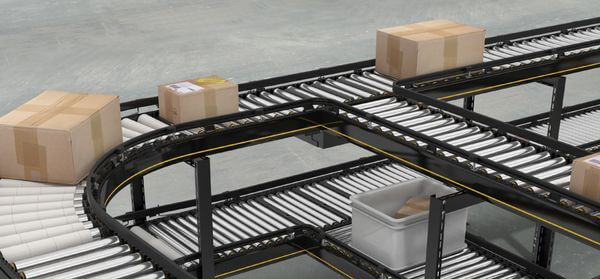
Connecting transport vehicles to the pallet finishing area. Factories using internal pallet transport vehicles can integrate guide rails, stopping mechanisms, and pallet pulling mechanisms to transfer loads onto the roller conveyor line. The solution must be compatible with the vehicle structure, stopping position, and transfer height of the existing system. Creating buffer zones for forklift pickup. The final conveyor sections can serve as buffer positions for pallets that have completed stretch wrapping. This application is suitable when there is a time gap between pallet delivery and forklift pickup. The number of buffer positions should be calculated based on actual material flow to prevent pallet accumulation from backing up into upstream processes. Changing pallet orientation to meet handover requirements. A lifting and turning table can adjust pallet orientation to suit forklift access or the requirements of downstream processes. When modifying the factory layout, the turning envelope, load overhang beyond the pallet edges, and forklift access routes must be checked rather than considering conveyor width alone.
Factors to consider when selecting an automatic pallet transfer conveyor system
To select a suitable automatic pallet transfer conveyor system, manufacturers need to determine pallet characteristics, load requirements, installation space, and required throughput. These factors provide the basis for CNC VINA to design the conveyor structure, pallet transfer mechanisms, and control system.
Pallet dimensions and actual load conditions
The pallet length, width, base structure, total weight of the loaded pallet, and center of gravity must be identified. These parameters affect roller load capacity, conveying stability, and the selection of the lifting and turning mechanism. For pallets with weak bases, loads extending beyond the pallet edges, or uneven load distribution, actual samples should be evaluated to determine a suitable solution.
Compatibility with multiple pallet types
The reference configuration accommodates pallet widths of 950–1,280 mm and requires adjustment when changing pallet types. Compatibility also depends on pallet length, base structure, and load capacity. When pallet dimensions change, the guide mechanisms, sensor positions, and handover conditions must be checked to ensure stable conveying.
Handover equipment and installation layout
The pallet supply vehicle type, forklift pickup direction, transfer height, and stretch-wrapping station location must be determined. The reference configuration has an approximate footprint of 8,920 × 1,600 mm. However, the actual installation area must also allow for operator access, pallet turning clearance, and maintenance access. The power supply, compressed air supply, and floor conditions should also be checked before implementation.
Conveying throughput and number of buffer positions
System throughput depends on the time required for pallet receiving, stretch wrapping, lifting and turning, and forklift pickup—not just conveyor speed. The number of buffer positions should be selected according to pallet flow and forklift operating cycles. Properly designed buffer zones help prevent pallet accumulation and maintain an orderly transfer sequence between processes.
CNC VINA designs automatic pallet transfer conveyor systems to order
The CNC VINA automatic pallet transfer conveyor system connects pallet receiving, stretch wrapping, direction changing, and handover operations within a factory. Each system is designed according to pallet dimensions, load capacity, and the material handling requirements of the production line. Drawing on its experience in machine design, manufacturing, and industrial automation solutions, CNC VINA can customize the roller conveyor structure, pallet receiving unit, lifting and turning table, and control system to meet specific operational requirements. Proposed solutions are evaluated based on the installation layout, connected equipment, and target operating throughput. Testing with sample pallets helps assess conveying performance and establish operating conditions before final handover.
Are you looking to design or integrate an automatic pallet transfer conveyor system into your production line? Send your pallet dimensions, load specifications, factory layout, and material handling requirements to CNC VINA for consultation on a suitable solution.
VIETNAM CNC TECHNOLOGY APPLICATION JOINT STOCK COMPANY
Factory: Song Cung Industrial Cluster, Dong Thap Commune, Dan Phuong District, Hanoi, Vietnam.
Office: Rox Tower Goldmark City, 136 Ho Tung Mau Street, Phu Dien Ward, Hanoi, Vietnam.
Phone: +84 916 639 355 / +84 915 744 664.
Website: www.cncvina.com.vn | www.cncvina.net