 Tiếng
Việt
Tiếng
Việt
 Tiếng
Anh
Tiếng
Anh
 Tiếng
Nhật
Tiếng
Nhật




 Tiếng Anh


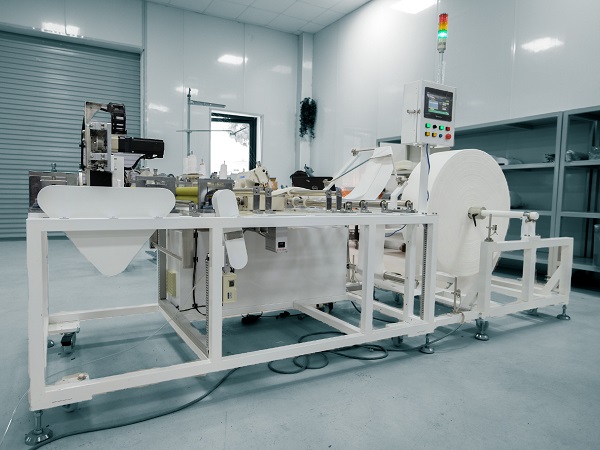
Automatic product folding and rolling machine
Automatic product folding and rolling machine is an automation solution developed to replace manual folding, rolling, and stacking operations in production lines. Instead of relying entirely on manual operations, the machine automatically performs product positioning, holding, folding, and rolling according to a pre-programmed sequence, helping reduce cycle time and maintain consistent product quality throughout the production process.
Depending on the characteristics and processing requirements of each product, the automatic product folding and rolling machine can be configured with suitable clamping, folding, rolling, and control mechanisms. The machine can store and switch between multiple product models and can be adapted to different products requiring folding and rolling operations, including paper, bags, garments, and various sheet-like or flexible materials.
VIETNAM CNC & TECHNOLOGY APPLICATION JOINT STOCK COMPANY
Hotline: +84.916 63 9355 / +84.915 74 4664
Email: Sales01@cncvina.com.vn / Sales03@cncvina.com.vn
Product description

Introduction to the Automatic product folding and rolling machine
The Automatic product folding and rolling machine is an automation solution developed to replace manual folding, rolling, and stacking operations in production lines. Instead of relying entirely on manual operations, the machine automatically performs product positioning, holding, folding, and rolling according to a pre-programmed sequence, helping reduce cycle time and maintain consistent product quality throughout the production process.
Depending on the characteristics and processing requirements of each product, the automatic product folding and rolling machine can be configured with suitable clamping, folding, rolling, and control mechanisms. The machine can store and switch between multiple product models and can be adapted to different products requiring folding and rolling operations, including paper, bags, garments, and various sheet-like or flexible materials.
In this article, CNC VINA will introduce the structure, operating principle, technical specifications, and important installation and operation considerations of the automatic product folding and rolling machine.
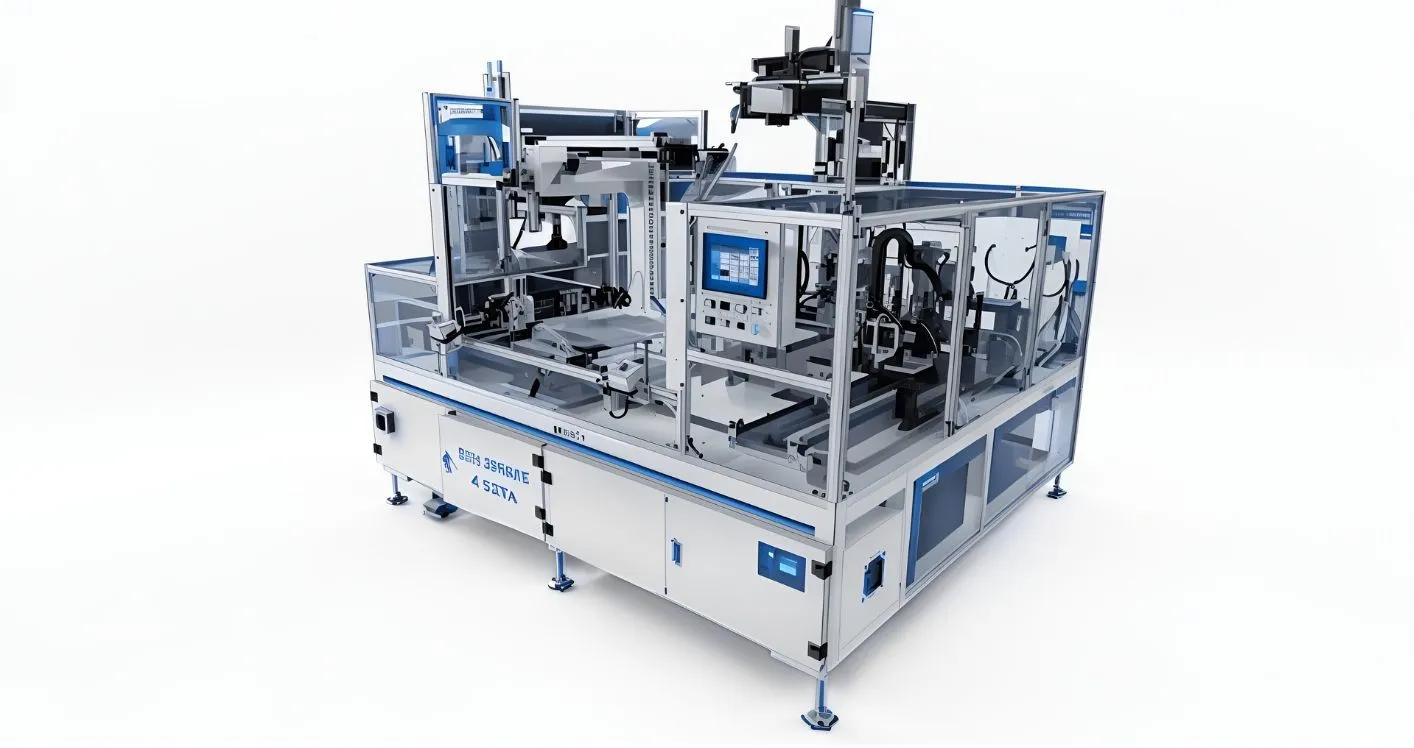
Technical specifications of the automatic product folding and rolling machine
| Specification | Details |
|---|---|
| Machine Dimensions | L2000 × W2200 × H1600 mm |
| Power Supply | AC 200 V – 50 Hz, 3 Phase |
| Control Voltage | DC 24 V |
| Machine Operating Height | 810 mm from floor level |
| Product Pickup Height | 1100 mm from floor level |
| Required Air Pressure | 0.4 – 0.6 MPa |
| Number of Product Models | 02 |
| Color | Customizable |
Structure of the automatic product folding and rolling machine
The Automatic Product Folding and Rolling Machine is designed by CNC VINA with integrated mechanisms that work together to perform product positioning, clamping, folding, rolling, and stacking operations in a continuous sequence. Depending on the product model and specific process requirements, the machine configuration can be customized to suit the characteristics and production conditions of each product.
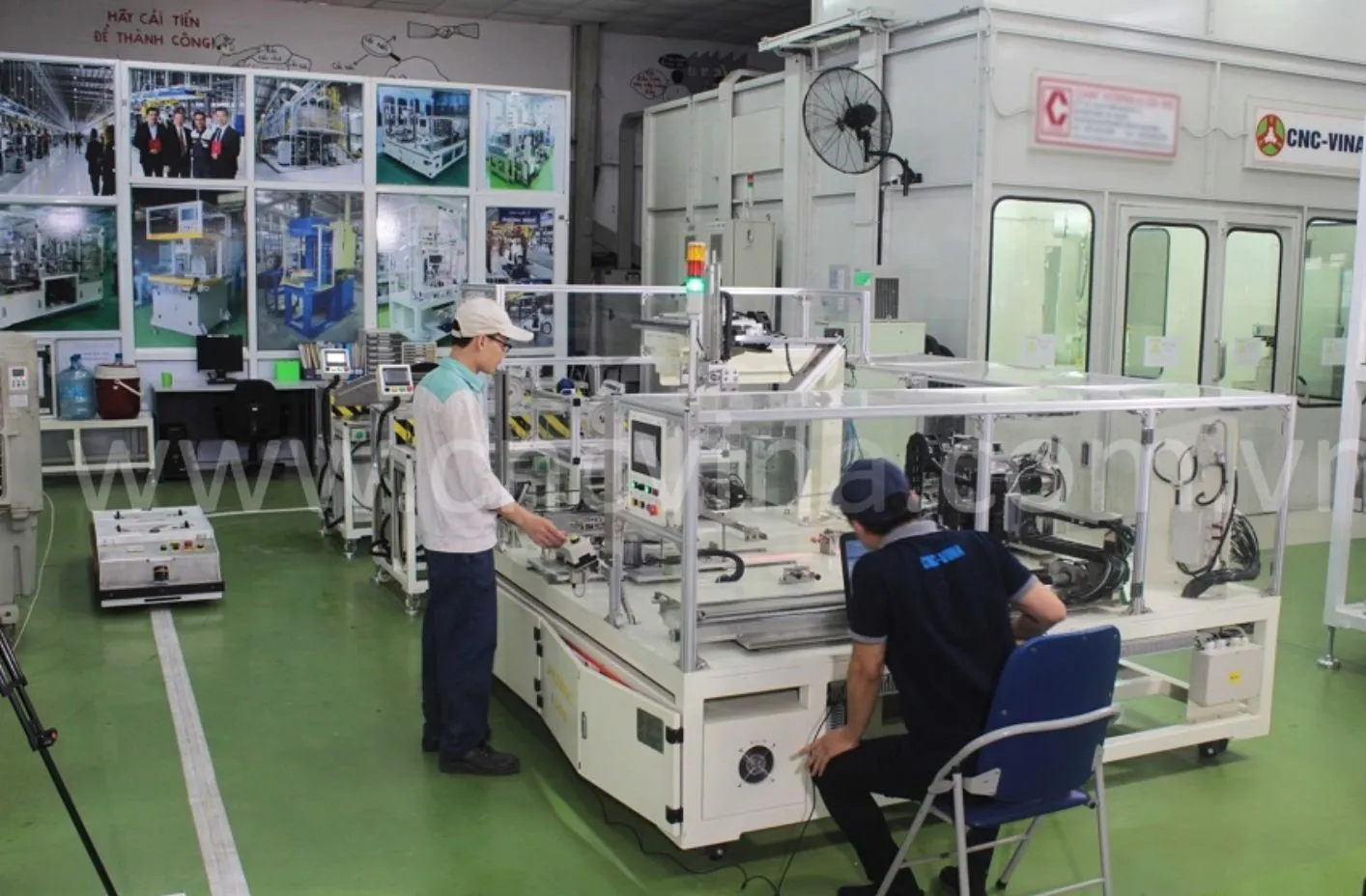
Product positioning and clamping unit: Positions the product accurately before the folding and rolling process and securely holds it in place throughout machine operation.
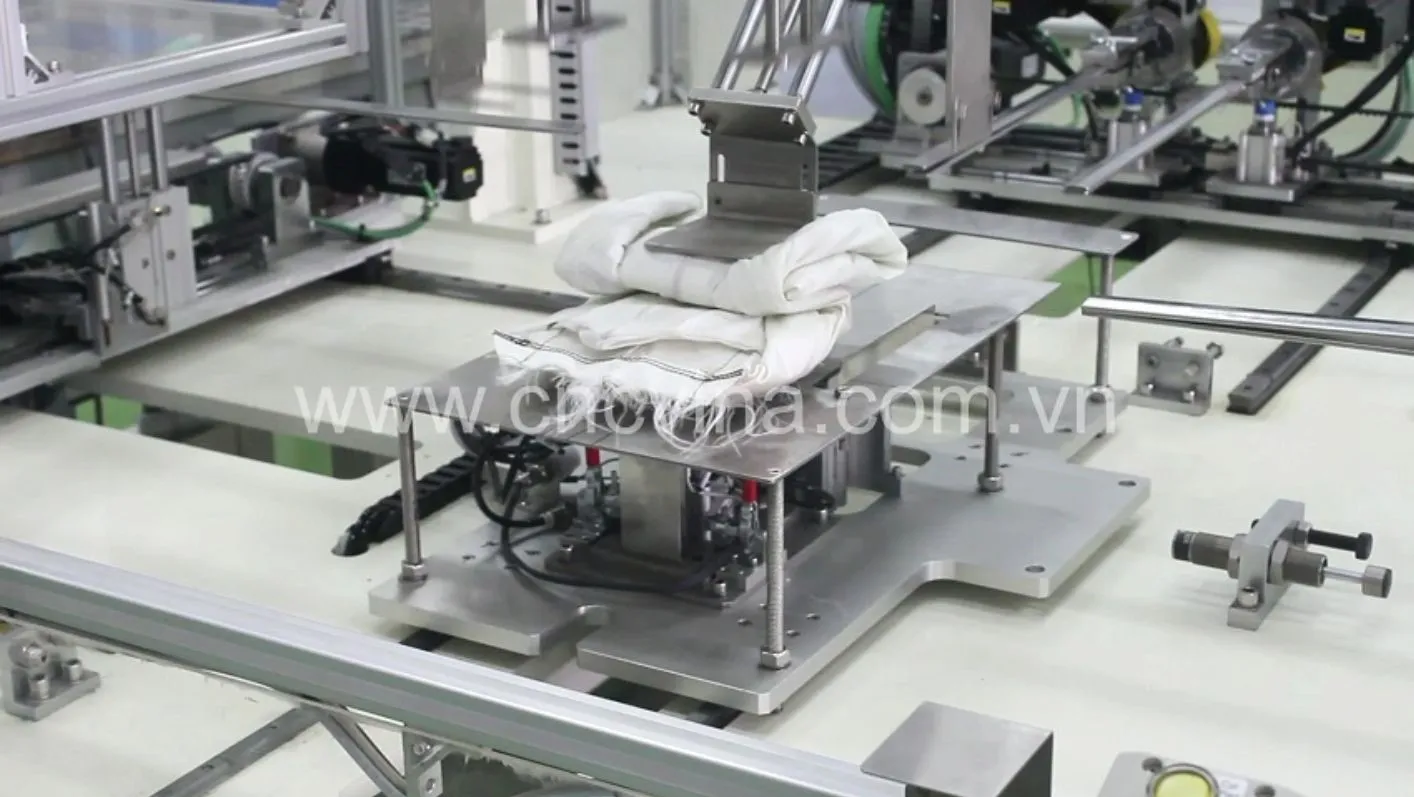
Product Clamping Arms: Secure and stabilize the product during each stage of the folding and rolling process, ensuring consistent positioning throughout the operation.
Laser Guide Light: Provides visual guidance for identifying and monitoring the folding lines, allowing operators to easily verify the required folding positions.
Folding and Rolling Mechanism: Performs the folding of both sides of the product and the subsequent rolling operation according to the programmed sequence for each product model.
Product Stacking Mechanism: Receives and arranges the products after the folding and rolling process is completed, preparing them for the next production stage.
PLC + HMI Control System: Controls the machine operating sequence, configures process parameters, and allows operators to select the required product model through the HMI touchscreen.
Dividing the machine into dedicated functional units allows the system to be easily adjusted when product models or process requirements change. This modular design also enables CNC VINA to customize the machine configuration for specific applications rather than applying a fixed configuration to different types of products.
Operating principle of the automatic product folding and rolling machine
The operating principle of the Automatic Product Folding and Rolling Machine is developed based on the actual manual operations performed by workers during the production process. These manual steps are then converted into coordinated mechanical movements and automated control sequences to improve process consistency and productivity. The basic operating sequence is as follows:
Step 1: Select the product model
The operator selects the required product model on the HMI touchscreen. Each model is assigned a predefined program containing the corresponding folding positions, movement sequence, and relevant operating parameters.
Step 2: Position the product
The operator places the product onto the positioning unit according to the specified position. The positioning and clamping mechanisms then secure the product, preventing unwanted movement during the folding process.
Step 3: Perform the folding and rolling process
Once the product has been correctly positioned, the operator presses the start button. The machine automatically performs the following sequence:
- The folding unit moves into position and folds both sides of the product.
- The holding unit moves to the required position to secure the product and form the folding lines according to the selected model.
- The folding and rolling unit then performs the rolling operation according to the programmed settings.
The entire sequence is controlled automatically, ensuring that products are processed according to the same predefined procedure and reducing variations caused by manual operations.
Step 4: Remove the finished product and continue the cycle
After the folding and rolling process is completed, the operator removes the finished product from the machine and loads the next product into the positioning unit. For production lines requiring a higher level of automation, the product loading and unloading processes can also be further developed and integrated with suitable automatic feeding and handling mechanisms.
Installation and power & air supply requirements for the automatic product folding and rolling machine
To ensure stable, accurate, and safe operation of the Automatic Product Folding and Rolling Machine, the installation conditions and utility supplies must meet the required technical specifications. During installation, the machine should be properly leveled and aligned with the floor surface to minimize vibration or positional deviations that could affect the operation of the folding, clamping, and positioning mechanisms. Power Supply: Before connecting the machine to the power source, the entire electrical system should be inspected, including the electrical control cabinet, wiring, protective devices, and the factory power supply. The main power supply required is 3 Phase, AC 200 V – 50 Hz, with a required power capacity of approximately 4.5 kW. The control system operates on DC 24 V.
Compressed Air Supply: The factory compressed air line is connected to the machine's regulator through quick-connect fittings at two designated points according to the machine design. The required air pressure is 0.4–0.6 MPa. A stable compressed air supply is necessary to ensure accurate operation of the pneumatic mechanisms and prevent interruptions during the machine cycle. Proper preparation of the electrical, compressed air, and installation conditions from the beginning not only ensures stable machine operation but also helps minimize potential issues during production.
Maintenance and servicing of the Automatic product folding and rolling machine
The Automatic Product Folding and Rolling Machine may perform numerous folding and rolling cycles continuously throughout the production day. Therefore, regular maintenance and servicing are essential to maintain the accuracy of the machine mechanisms, minimize unplanned downtime, and extend equipment service life. Manufacturers and operators should establish an inspection and maintenance schedule based on the actual operating frequency and working conditions of the machine. Key maintenance activities include:
Cleaning after each shift: Remove dust, material residues, and other contaminants that may affect moving mechanisms, product positioning, or contact surfaces.
Pre-shift inspection: Check the operating condition of mechanical components, electrical systems, and pneumatic systems, including shafts, bearings, cylinders, motors, slides, ball screws, and other relevant components.
Ensure safety before maintenance: Return the machine to its home position and completely disconnect the electrical power and compressed air supply before performing any inspection, cleaning, or repair work. Maintenance should only begin after confirming that the machine is in a safe state.
Perform scheduled maintenance: Inspect, clean, lubricate, adjust, or replace components according to their operating hours, service condition, and the technical requirements of each mechanism.
Follow the maintenance documentation: All maintenance activities should be carried out in accordance with the technical and maintenance documentation supplied with the machine, particularly for mechanical systems, motion mechanisms, electrical systems, and pneumatic components.
Following a proper maintenance schedule enables manufacturers to identify potential abnormalities at an early stage, reduce the risk of unexpected machine downtime, and maintain stable performance throughout the equipment's service life.
The integration of an Automatic Product Folding and Rolling Machine into a production line helps reduce repetitive manual operations, improve product consistency, and provide better control over the cycle time of the folding and rolling process. For high-volume production lines, automating this process can also help optimize labor requirements and improve overall production efficiency.
With experience in the design and manufacturing of industrial automation equipment, CNC VINA provides customized automation solutions based on the actual characteristics of each product and production process. The machine configuration can be customized in terms of positioning mechanisms, clamping units, folding and rolling mechanisms, control systems, and integration with other processes within the production line.
For customers interested in or requiring the design and manufacturing of custom automatic machines, please contact:
VIETNAM CNC & TECHNOLOGY APPLICATION JOINT STOCK COMPANY
Factory: Song Cung Industrial Cluster, Dong Thap Commune, Dan Phuong District, Hanoi, Vietnam
Office: Rox Tower (Rox Tower Goldmark City), No. 136 Ho Tung Mau Street, Bac Tu Liem District, Hanoi, Vietnam
Tel: +84.916 63 9355 / +84.915 74 4664
Website: https://cncvina.com.vn; https://cncvina.net; https://cncviname.com.vn