 Tiếng
Việt
Tiếng
Việt
 Tiếng
Anh
Tiếng
Anh
 Tiếng
Nhật
Tiếng
Nhật




 Tiếng Anh


Programmable sewing machine
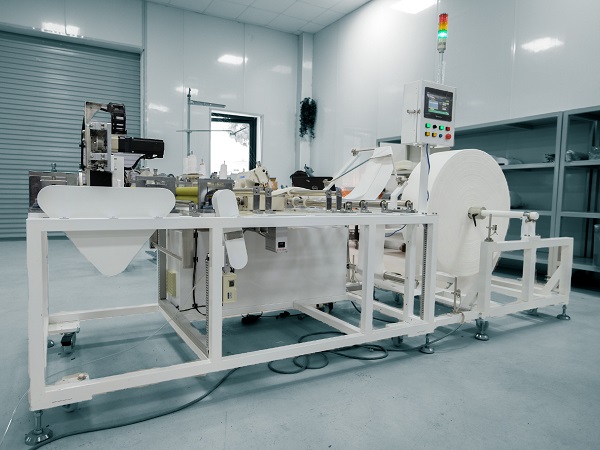
CNC VINA Programmable Sewing Machine is an automated solution for sewing operations, designed and manufactured according to the specific requirements of each product and production process. The machine is suitable for a wide range of applications, including filter bags, airbags, towels, automotive seat covers, and textile products with special contours or specific sewing requirements. The PLC control system combined with an intuitive HMI touchscreen allows operators to easily select programs, configure operating parameters, and monitor the machine’s operating status.
For customers looking to invest in a CNC VINA programmable sewing machine or a customized sewing automation solution, please contact us for consultation and a suitable machine configuration tailored to your products and production processes.
VIETNAM CNC & TECHNOLOGY APPLICATION JOINT STOCK COMPANY
Hotline: +84.916 63 9355 / +84.915 74 4664
Email: Sales01@cncvina.com.vn / Sales03@cncvina.com.vn
Product description

A programmable sewing machine is an automated piece of equipment used in various production processes within the garment and textile industry, particularly for products that require repetitive sewing operations, high precision, and consistent quality across products. Instead of relying entirely on manual operations, the machine is programmed to perform sewing patterns according to predefined contours, lengths, and production sequences. Depending on production requirements, the equipment can be integrated with Jigs, fixtures, sensors, fabric feeding mechanisms, automatic thread trimming, product cutting, or automatic product stacking systems.
Programmable sewing machines are used for a wide range of products, including filter bags, airbags, towels, automotive seat covers, and customized textile products. Equipped with a PLC control system, motion controller, or CNC solution depending on the configuration, the machine can precisely coordinate the sewing head with various motion mechanisms throughout the production process. The ability to modify sewing programs and accommodate multiple product models also provides manufacturers with greater flexibility when producing different product variants.
In the following article, CNC VINA explores the structure, operating principle, types of automatic programmable sewing machines, and their applications in industrial manufacturing.
What is a Programmable Sewing Machine?
A programmable sewing machine is a sewing system designed to perform one or more sewing processes according to a predefined program. Depending on its configuration, the program can control the product's movement, sewing position, stitch length, operating speed, and the sequence in which different mechanisms work together.
The key difference between a programmable sewing machine and a conventional industrial sewing machine lies in its ability to automatically control the sewing process according to a programmed sequence. The product is positioned and secured on a Jig or fixture, after which the control system coordinates the movements of the machine table, Jig, and sewing head to produce a sewing pattern that accurately follows the designed contour.
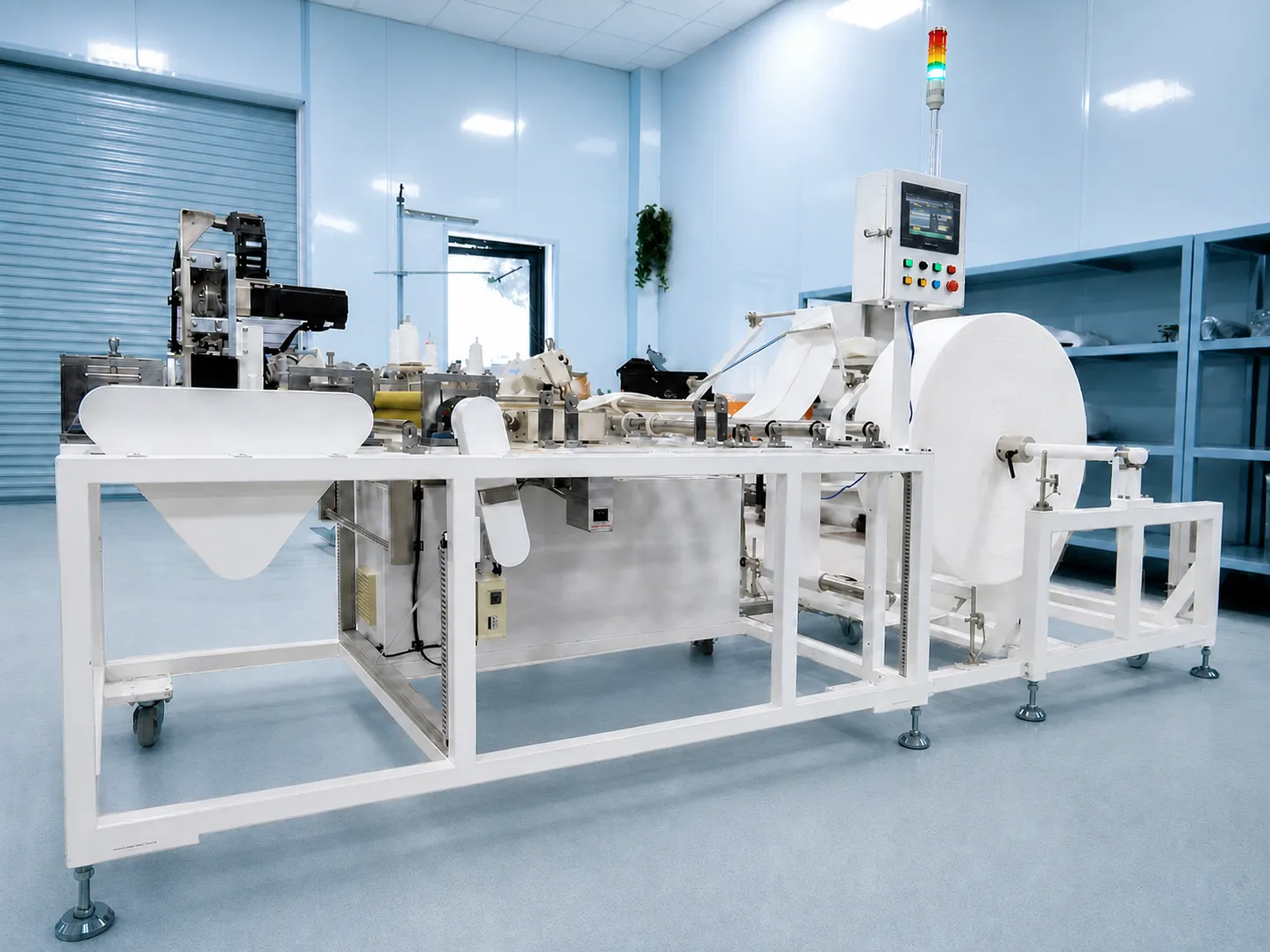
For products with straight sewing lines or simple sewing processes, the machine can be configured with a fixed program. For products featuring curved, spiral, zigzag, or multiple sewing patterns, an XY-axis motion system can be used to control the relative position between the product and the sewing head.
Operating principle of a programmable sewing machine
Before operation, the sewing program is configured based on the product's contours and technical requirements. The operator then places the product onto the Jig or positioning fixture, selects the corresponding program on the control screen, and starts the sewing cycle. During operation, the control system receives signals from sensors and coordinates the machine mechanisms according to the programmed sequence. The sewing head performs the sewing operation while the motion system adjusts the product's position according to the required contour. Once the sewing process is completed, depending on the machine configuration, the system can proceed with additional operations such as thread trimming, Jig release, product ejection, product cutting, or product stacking. This automated process reduces reliance on manual operator intervention while maintaining consistent performance and quality across production cycles.
Control and Programming System
Depending on the requirements of each project, a programmable sewing machine can use a PLC, motion controller, or CNC system to control its various mechanisms. The HMI (Human-Machine Interface) is used to select programs, adjust operating parameters, and monitor the machine's operating status. For systems handling multiple product models, manufacturers can create dedicated programs for each model and select the required program directly through the control interface. This provides a significant advantage for production lines that handle multiple product variants or frequently switch between different models.
Technical specifications of a Programmable Sewing Machine
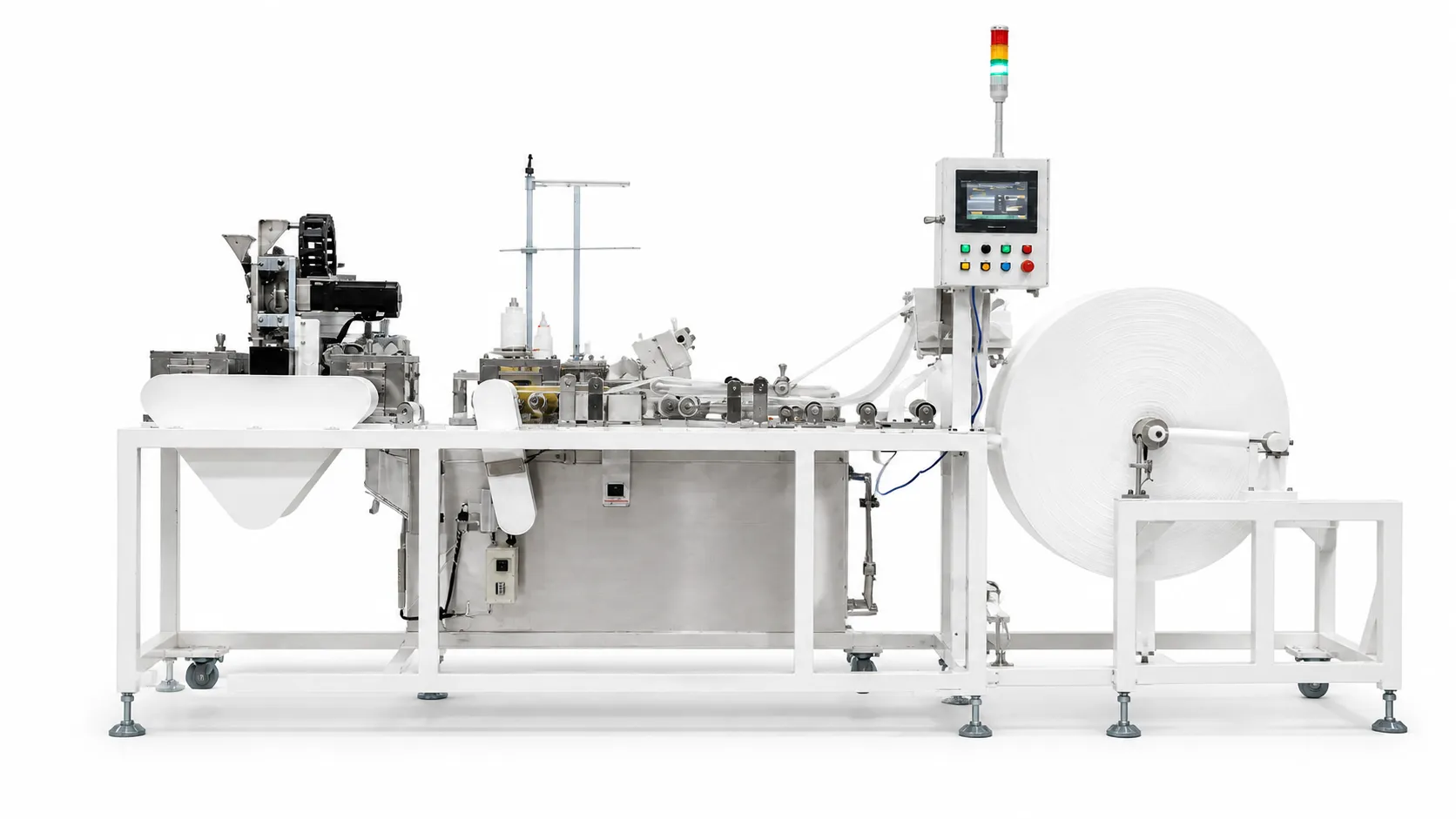
| Machine Dimensions | L2550 × W1250 × H1600 mm |
|---|---|
| Power Supply | AC 200 V - 50 Hz, 1 phase |
| Control Voltage | DC 24 V |
| Operating Height | 810 mm from floor level |
| Air Pressure Requirement | 0.4 - 0.6 MPa |
| Cycle Time | 5 - 7 m/min |
| Product Length Tolerance | ± 2 mm |
| Color | Optional |
Key features of the CNC VINA Programmable Sewing Machine
CNC VINA designs and manufactures automatic programmable sewing machine systems according to the characteristics of each product and specific production requirements. From straight-line sewing systems for bags and towels to machines designed for XY contours, spiral patterns, or products requiring multiple complex sewing operations, the machine configuration can be developed based on the actual production process of each business.
For products requiring straight-line sewing, the machine can be designed to perform repetitive sewing operations with a predefined sewing length. Meanwhile, for products such as airbags, garments, automotive seat covers, and components with curved contours, the XY motion system enables the machine to follow the product's contours accurately during the sewing process.
For products with more complex shapes, such as spiral patterns, zigzag patterns, divided compartments, or multiple consecutive sewing lines, the control system can coordinate multiple movements simultaneously. Jigs and fixtures are designed to securely hold the product throughout the sewing cycle, helping minimize deviations in sewing position. Depending on the machine configuration, an automatic thread trimming function can also be integrated after the sewing operation is completed. For systems equipped with an overlock sewing head, this function helps reduce manual thread-cutting operations and shorten post-sewing processing time. The material feeding system can also be automated. Products can either be individually loaded by an operator or fed directly from a fabric roll through a fabric feeding roller, pulling mechanism, and folding mechanism. The appropriate feeding method depends on the product shape, material type, and required production volume.
After the sewing operation is completed, the system can automatically release the Jig, eject the finished product, or integrate an additional cutting mechanism for length-based cutting. For production lines requiring a higher level of automation, the cut products can be blown, clamped, and stacked on a designated rack. Jigs, fixtures, and clamping templates are designed specifically for each product and can be replaced when the manufacturer needs to produce a different model. This allows the machine to better accommodate production lines handling multiple product variants rather than being limited to a single fixed product.
In terms of mechanical construction, the machine features a rigid and robust frame to ensure stability during operation. The dimensions and arrangement of individual mechanisms are optimized for convenient installation, maintenance, and relocation within the production facility. The control interface can be configured in Vietnamese, English, or Japanese, allowing operators to easily select programs and monitor the machine's operating status. The system supports both Manual mode for inspection and adjustment and Auto mode for automatic operation according to the programmed sequence. With a team of experienced engineers specializing in the design of automatic sewing machines, CNC VINA can provide a complete solution from product assessment and Jig design to mechanism selection, programming, and control system integration based on the actual requirements of each manufacturer.
Automatic overlock machine - programmed sewing according to profile and automatic thread cutting
Types of Automatic Programmable Sewing Machines
Depending on the product shape and the requirements of each production process, programmable sewing machines can be designed in various configurations. Some of the typical solutions developed by CNC VINA include automatic filter bag sewing machines, automatic XY programmable sewing machines with automatic Jig release, and programmable sewing machines for spiral contours.
Automatic Filter Bag Sewing Machine
The automatic filter bag sewing machine is designed to continuously perform processes including fabric feeding, fabric folding, sewing, cutting, and post-sewing product handling. The equipment is suitable for filter bag production processes using material supplied from a roll, where the product is formed and cut according to a predefined length. The process begins with feeding the fabric from the roll through a roller feeding system. The material is then passed through a folding mechanism to form the required shape before entering the sewing head. Pulling and tensioning rollers help control the material's feeding direction and maintain stable material tension throughout the sewing process. Once the sewing operation is completed, the machine can automatically trim the thread and continue transferring the product to the cutting unit. The filter bag length is controlled according to the programmed settings, after which the finished products are clamped and transferred to a rack or stacked in batches, depending on the configuration of the production line.
Structure of an Automatic Filter Bag Sewing Machine
An automatic filter bag sewing machine consists of multiple mechanical units working together:
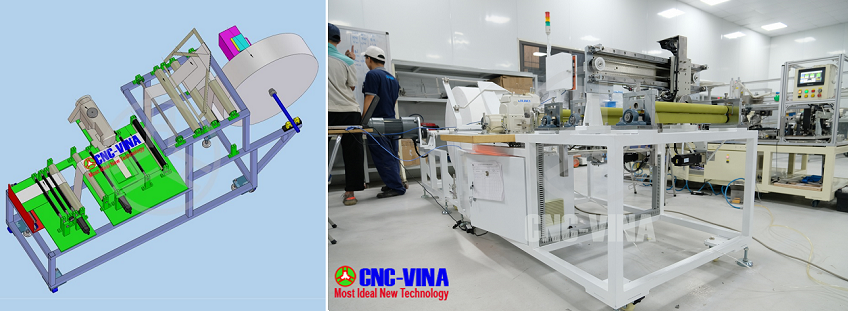
Components of an Automatic Filter Bag Programmable Sewing Machine
The automatic filter bag programmable sewing machine consists of the following main mechanical units:
-
Fabric feeding roller unit – A fabric roller driven by a stepper motor or servo motor, depending on the configuration, allowing flexible material feeding according to the diameter of the fabric roll. The system also facilitates quick and convenient roll replacement.
-
Fabric folding unit – The folding mechanism folds the fabric web in half along the length of the filter bag before it enters the sewing head.
-
Fabric tensioning, alignment, and pulling roller units – These rollers maintain sufficient fabric tension before and after the sewing machine, preserve the required fold, and ensure the straightness and accurate positioning of the folded edge to be sewn.
-
Sewing head unit – The sewing machine receives signals from the control system and fabric detection sensors to perform overlock stitching and automatically trim the thread at the end of each programmed sewing length. The machine automatically stops sewing when the sensor detects that the fabric has run out.
-
Product cutting unit – Positioned after the sewing machine, this unit cuts the filter bag according to the programmed bag length.
-
Product clamping and stacking unit – The palletizing unit clamps the finished bag and uses an air-blowing mechanism to transfer and stack the bags onto a rack after the cutting process.
The fabric feeding roller can be equipped with either a stepper motor or servo motor, depending on the machine configuration. Sensors are used to detect the material status and send signals to the control system. When the material runs out, the machine can receive the sensor signal and stop the production cycle, allowing the operator to replace the fabric roll before resuming operation.
Technical Specifications of the Filter Bag Programmable Sewing Machine
| Machine Dimensions | L2250 × W1250 × H1600 mm |
|---|---|
| Operating Height | 810 mm from floor level |
| Main Power Supply | AC 220 V - 50 Hz, 1 phase |
| Control Voltage | DC 24 V |
| Air Supply | 0.4 - 0.6 MPa |
Automatic XY Programmable Sewing Machine with Automatic Jig Release
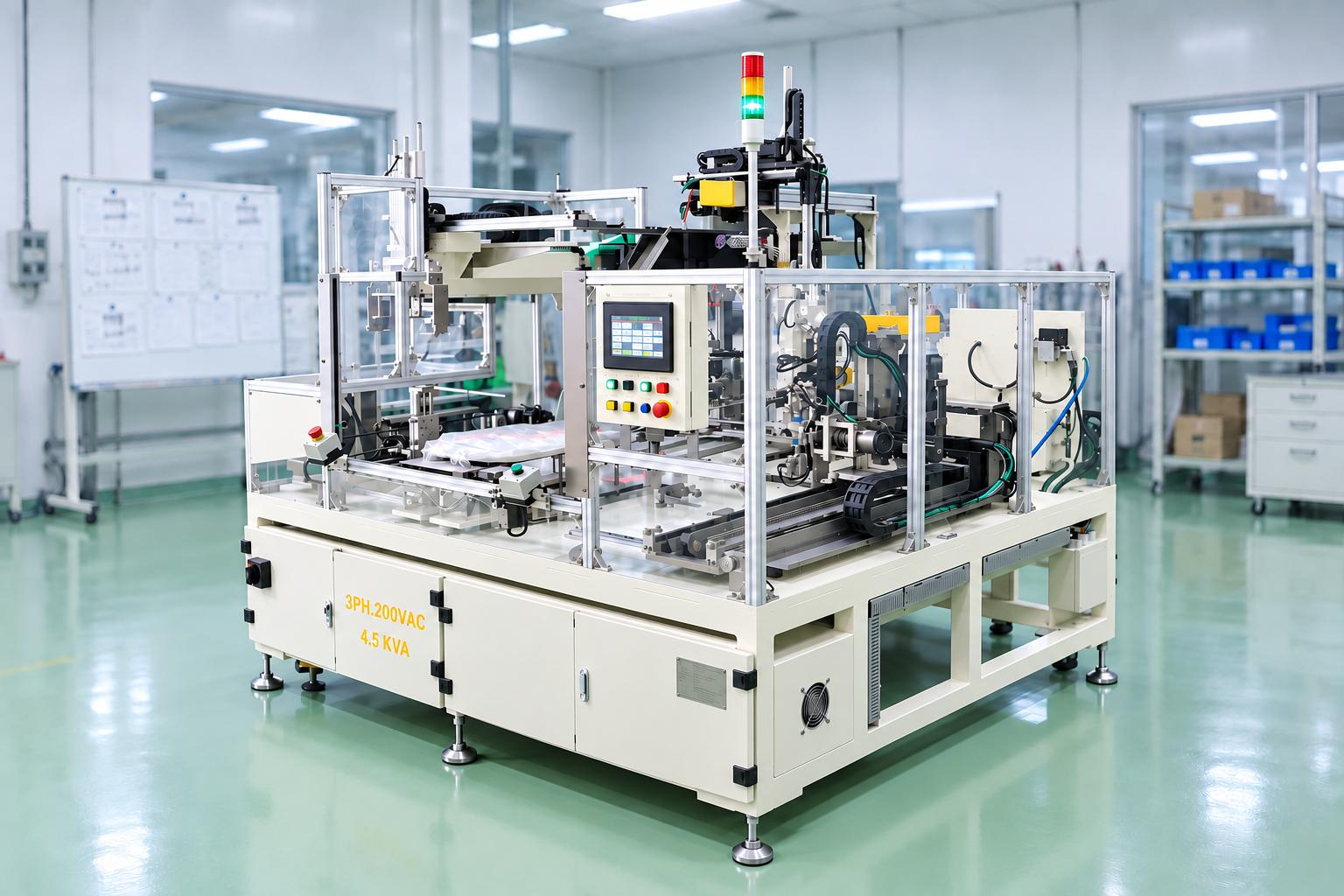
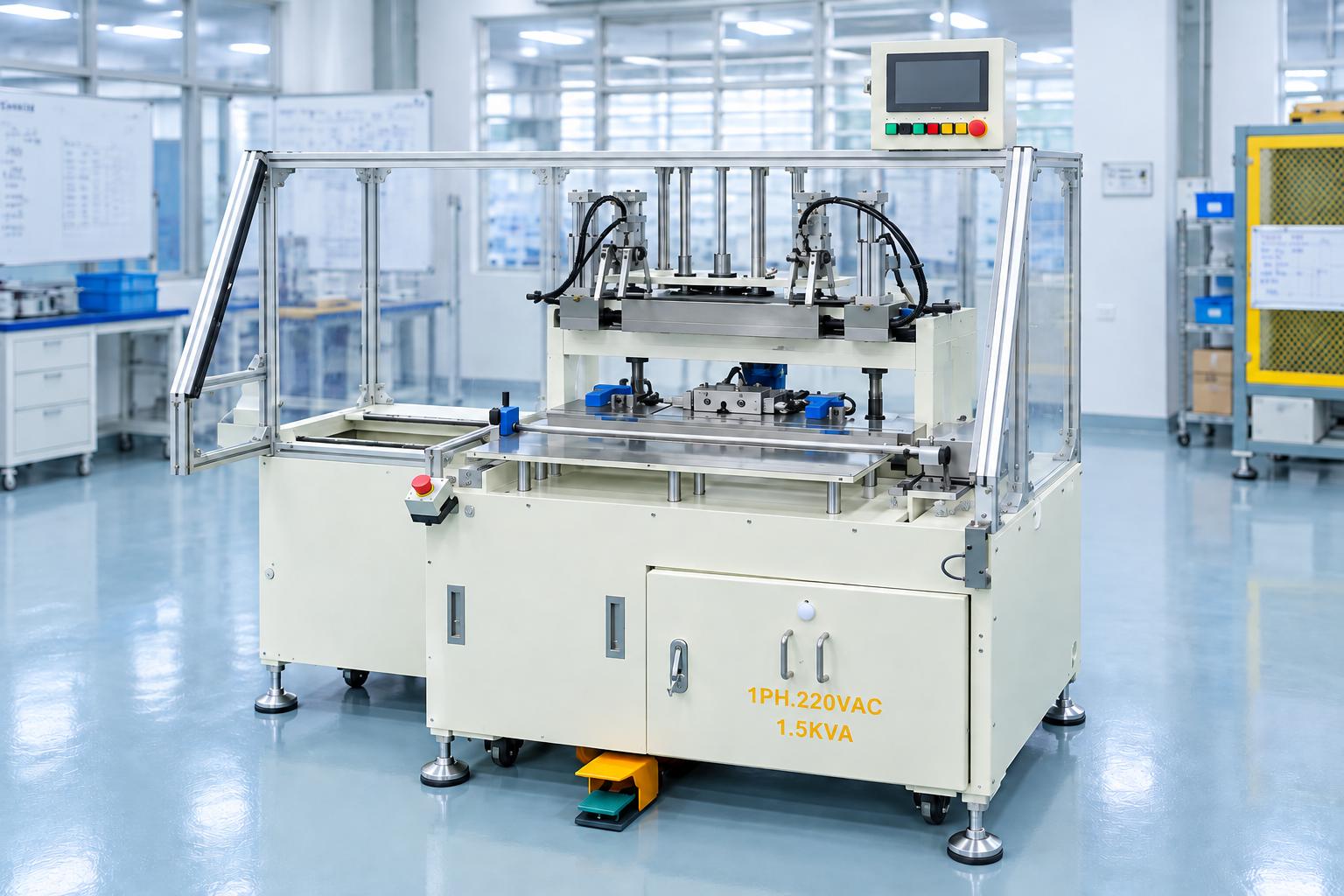
The automatic XY programmable sewing machine with automatic Jig release is designed to perform sewing operations along product contours using a two-axis X/Y motion system. The machine can be integrated with a Jig mechanism to accurately position and secure the product during the sewing process, then automatically release the Jig once the sewing cycle is completed. The XY motion system enables the machine to handle products with sewing patterns that are not limited to straight lines, but also include curved, angled, or complex contours according to the programmed sewing path. The automatic Jig release function reduces operator intervention and shortens the time between production cycles. The system can also be integrated with warning and interlock functions to help prevent the machine from starting when the Jig has not been properly closed or positioned.
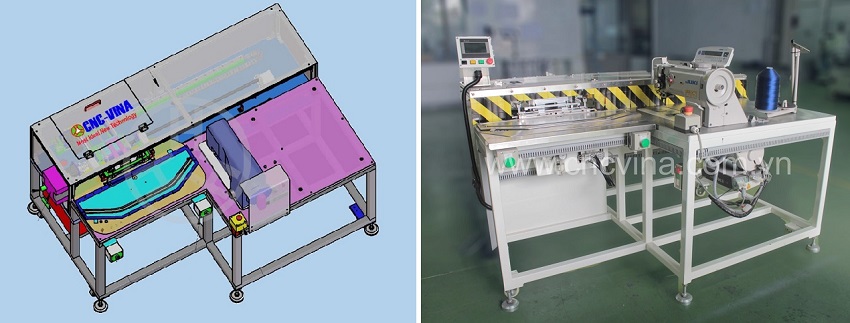
Technical Specifications of the Automatic Programmable Sewing Machine with Automatic Jig Release
| Machine Dimensions | L1780 × W1150 × H1100 mm |
|---|---|
| Operating Height | 810 mm from floor level |
| Main Power Supply | AC 200 V - 50 Hz, 1 phase |
| Control Voltage | DC 24 V |
| Air Supply | 0.4 - 0.6 MPa |
| Warning Function | The machine issues a warning when the Start button is pressed while the Jig is not closed |
See more details about the XY Programmable Sewing Machine.
Automatic Programmable Sewing Machine for Spiral Contours
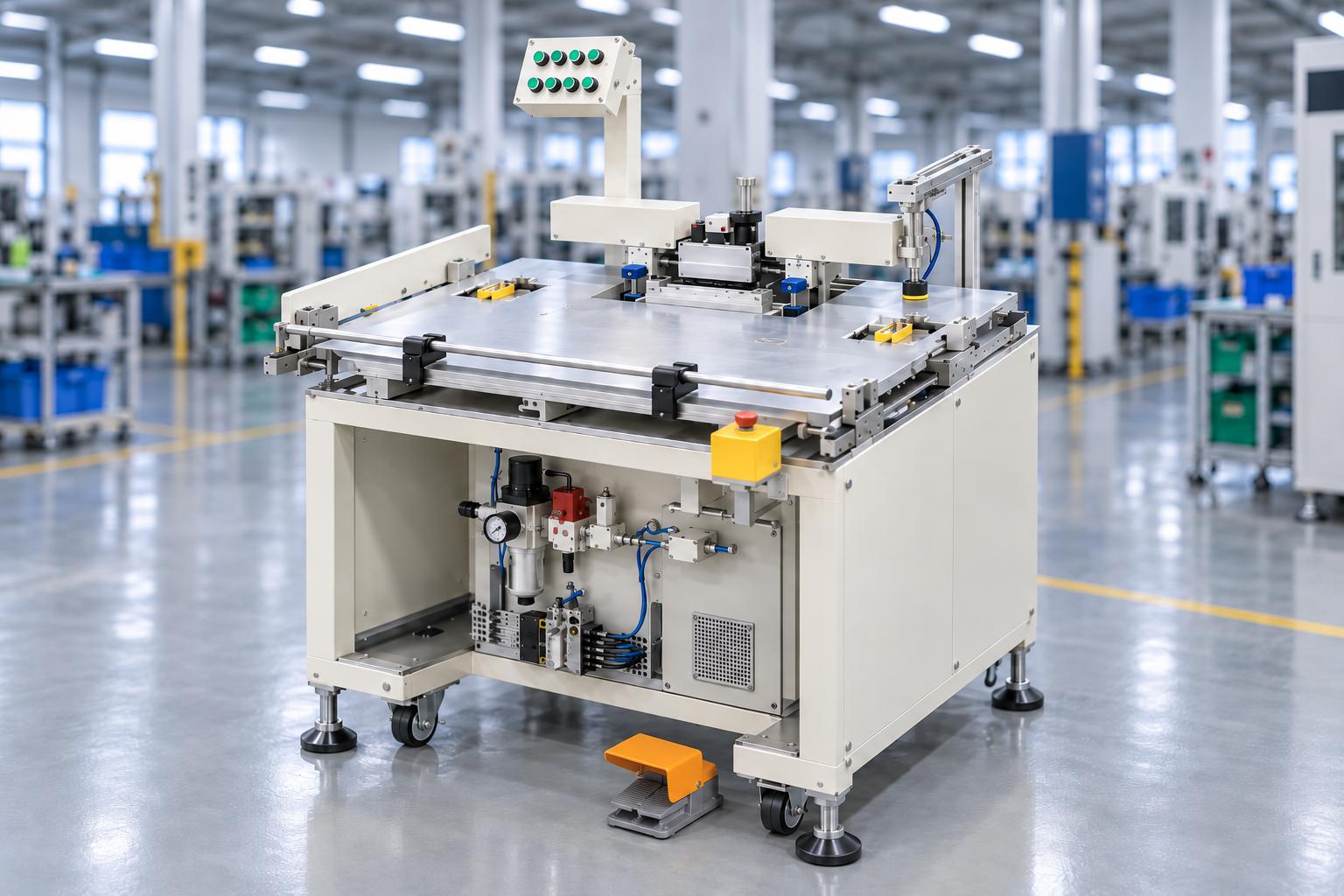
For products requiring multiple sewing lines with specialized contours, an automatic programmable sewing machine for spiral contours can be designed to execute different sewing programs on the same system. The machine uses Jigs and positioning mechanisms to securely hold the product, while the control system coordinates the movement of various mechanisms according to the programmed sequence. This configuration is suitable for products with specific sewing requirements where consistent quality needs to be maintained across products within the same production batch.
The machine can be configured with multiple programs corresponding to different product models. The current configuration supports two product models, including a 2-line sewing program and a 3-line sewing program.
Technical Specifications of the Automatic Spiral-Contour Sewing Machine
| Machine Dimensions | L1600 × W1150 × H1550 mm |
|---|---|
| Control Voltage | DC 24 V |
| Air Supply | 0.4 - 0.6 MPa |
| Operating Height | 850 mm from floor level |
| Models | 2 models (2-line sewing program and 3-line sewing program) |
Applications of Programmable Sewing Machines in Manufacturing
Automatic programmable sewing machines are widely used in production processes that require highly repetitive sewing operations or precise control over sewing positions. Instead of relying entirely on the skills of individual operators, manufacturers can configure appropriate programs and Jigs to control the production process. In the automotive supporting industry, the machines can be used for products such as airbags, automotive seat covers, and textile components with complex contours. For roll-fed products, an automatic filter bag sewing machine can integrate fabric feeding, folding, sewing, and cutting into a continuous production process.
In addition, the equipment can be designed for products such as towels, bags, and various customized textile products. The machine configuration is selected based on the material, product dimensions, sewing pattern, target production volume, and desired level of automation.
Benefits of Using Automatic Programmable Sewing Machines
Integrating a programmable sewing machine into a production line helps manufacturers reduce reliance on manual operations in highly repetitive processes. When the sewing program, Jig, and operating parameters are properly configured, consistent sewing quality can be maintained across products.
The machine can also increase productivity and reduce processing time by automating operations such as product positioning, sewing, thread trimming, product cutting, and post-sewing handling. Operators can then focus on material loading, inspection, or other processes that have not yet been automated. Another important benefit is the ability to switch between different product models. For systems designed with multiple programs, manufacturers can select the appropriate program for each product code or model. When combined with replaceable Jigs, a single machine system can accommodate a wider range of production requirements.
For high-volume manufacturers, program-based control and process automation can also help minimize errors caused by inconsistent manual operations, thereby improving the stability and consistency of finished product quality.
CNC VINA – Customized Programmable Sewing Machine Manufacturer
Automatic programmable sewing machines are an effective solution for manufacturers looking to automate sewing operations, particularly for products requiring repetitive sewing patterns, high precision, or complex contours. The integration of the sewing head, Jig, motion system, sensors, and programmable control system enables manufacturers to achieve greater control over production quality and efficiency.
Depending on the specific product requirements, CNC VINA can design machine configurations ranging from semi-automated systems to highly automated solutions integrating multiple processes, including material feeding, positioning, sewing, thread trimming, product cutting, and product stacking. The ability to design Jigs, develop control programs, and integrate automated mechanisms allows each system to be customized according to actual production requirements rather than being limited to a fixed machine configuration.
With 20 years of experience in automatic machine design and manufacturing, CNC VINA has served numerous FDI customers and businesses operating in the garment industry, supporting-product manufacturing, and industrial production. CNC VINA provides automated machine solutions tailored to specific production requirements, balancing operational performance with investment costs. Customers interested in programmable sewing machines, automatic sewing machines, industrial sewing lines, or customized automation equipment can contact CNC VINA for product assessment, configuration consultation, and a solution tailored to their actual production process.
Customers interested in investing in automatic sewing machines, industrial sewing lines, and customized automation equipment are welcome to contact us for consultation and support:
VIETNAM TECHNOLOGY & CNC APPLICATION JOINT STOCK COMPANY
Factory: Song Cung Industrial Cluster, Dong Thap Commune, Dan Phuong District, Hanoi, Vietnam
Office: Rox Center Ho Tung Mau Building (Rox Tower Goldmark City), No. 136 Ho Tung Mau Street, Bac Tu Liem District, Hanoi, Vietnam
Phone: +84.916 63 9355 / +84.915 74 4664
Website: https://cncvina.com.vn; https://cncvina.net; https://cncviname.com.vn