 Tiếng
Việt
Tiếng
Việt
 Tiếng
Anh
Tiếng
Anh
 Tiếng
Nhật
Tiếng
Nhật




 Tiếng Anh


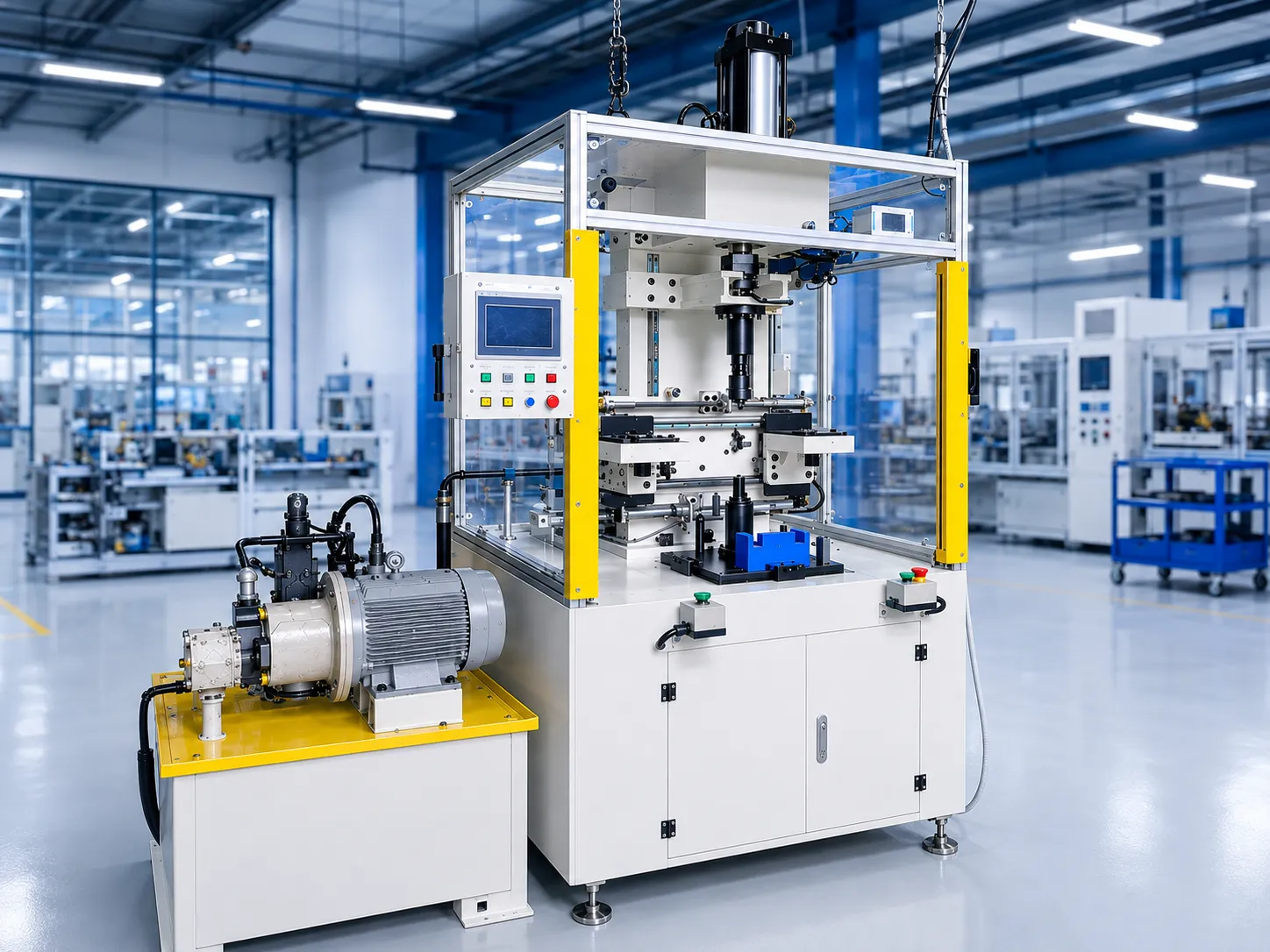
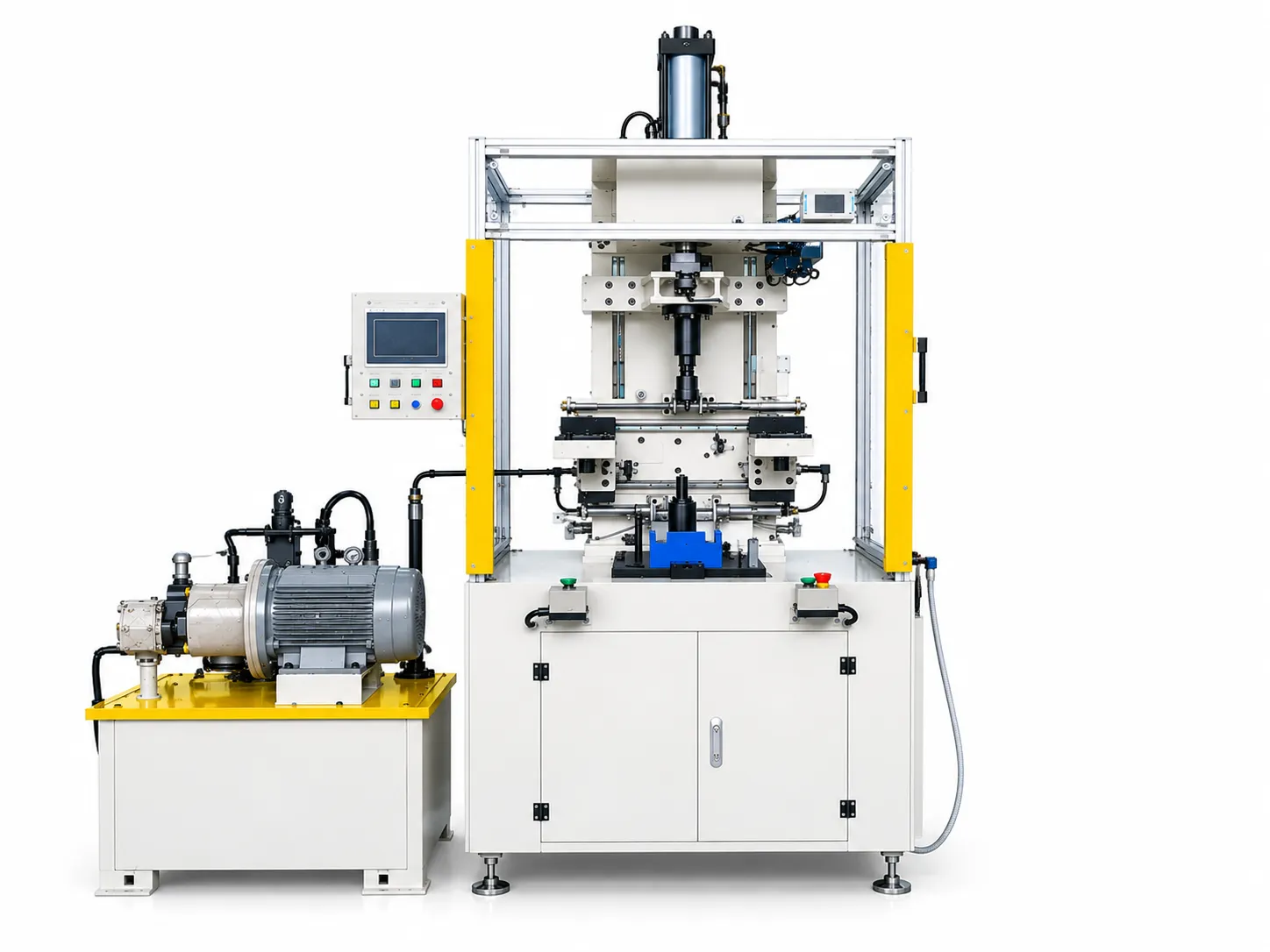
10T hydraulic press
Hydraulic press with load capacity of 10 tons, hydraulic press according to customer requirements.
Pressing process monitoring system (Force sensor + Journey sensor
The machine operates simply, safely and effectively, with high productivity with the ability to adjust pressure and pressing stroke automatically.
Applying hydraulic presses in assembling mechanical assemblies for cars and motorbikes, assembling high-precision electronics.
Customers who are in need of CNC-VINA's automatic hydraulic presses and automation solutions in assembly and processing, please contact us for advice and support:
VIETNAM CNC & TECHNOLOGY APPLICATION JOINT STOCK COMPANY
Hotline: +84.916 63 9355 / +84.915 74 4664
Email: Sales01@cncvina.com.vn / Sales03@cncvina.com.vn
Product description

The 10T Hydraulic Press is an industrial pressing solution designed and manufactured by CNC VINA to meet various requirements, including press fitting, forming, bearing pressing, straightening, and machining of mechanical components. With a maximum pressing capacity of 10 tons, the machine delivers stable pressing force while allowing the pressing force and speed to be adjusted according to the characteristics of each product.
The system is equipped with a load sensor (Loadcell) and a stroke sensor to monitor the pressing process, control product quality, and detect abnormalities during production. In addition, the machine features a robust SS400 steel structure combined with a guiding mechanism and dedicated pressing Jig to ensure stability and accuracy during operation. The machine is suitable for production lines in the mechanical engineering, automotive and motorcycle, component assembly, and other industrial applications that require precise control of pressing force.
Technical Specifications of the 10T hydraulic press
| Power supply | 3 phase, 380V - 50 Hz |
| Air pressure | 0.4 - 0.6 MPa |
| Hydraulic pump power | 5.5 kW |
| Pressing capacity | 10 tons |
| Number of operators | 1 person |
| No-load speed | 100-120 mm/s |
| Pressing speed | 50 mm/s |
Structure of the hydraulic press
Operating principle of the hydraulic press
The operating principle of an automatic hydraulic press is to use pressure from a hydraulic cylinder (supplied from a hydraulic power supply with a high-pressure pump) to press into shape and assemble the product together correctly. body.
The principle of creating huge pressure for hydraulic presses on objects is because the machine is built according to the law of pressure transmission in liquids based on the principle of Pascal's law. In particular, when pressure is generated and acts on the fluids in a closed system, the pressure throughout the closed system is always constant. Presses that use hydraulic cylinders are equipped with two cylinders of different capacities. At the same time, the two cylinders have pipes connected to each other. In each cylinder there is a piston that fits tightly.
Pascal's law is applied in the manufacture of hydraulic presses, lifting machines, and hydraulic brakes.
Suppose we have a hydraulic compressor composed of 2 cylinders with cross-sections S and s. These 2 cylinders are filled with fluid and usually oil, sealed by 2 pistons.
When we apply a force f to the small piston s, this force causes a pressure p=f/s and this pressure is transmitted intact to the large piston with cross section S and causes a lifting force F on the piston according to recipe:
F=pS=fS/s and F/f=S/s
This means that no matter how many times S is greater than s, F is greater than f, so we can lift very heavy objects with just enough force.
In addition, if we calculate the height after each compression, H is the height gained after 1 compression, creating F in cross section S and h is the height after pressing the piston down to a height h to cause force. f at cross section s, we have:
F/f=S/s=h/H
Working process of the hydraulic press
Step 1: The operator places the product into the pressing Jig on the machine.
The operator places the product or the components to be assembled into the pressing Jig. The Jig is used to position and securely hold the components in the correct position before starting the cycle.
Accurate positioning from the beginning helps minimize misalignment during the pressing process and ensures that the components are assembled correctly.
Step 2: Press the two Start buttons simultaneously; the pressing head moves downward to press the two components together.
After the product has been correctly positioned, the operator presses both Start buttons simultaneously. The control system verifies the safety conditions and then activates the hydraulic power unit. Hydraulic oil is supplied to the cylinder, causing the piston to move downward and bringing the pressing head into contact with the product.
The pressing head continues to apply force according to the preset parameters to bring the two components into the required position. During this process, the sensor system can monitor the pressing force and stroke, helping control the cycle and evaluate the pressing results.
Step 3: After the cylinder moves upward and the pressing process is completed, the operator removes the product from the Jig.
Once the preset pressing conditions have been achieved, the cylinder retracts to its original position. When the cycle is completed, the operator removes the finished product from the Jig.
The next product is then loaded into the machine, and a new cycle begins.
For automated production lines, the processes of loading parts, unloading products, and transferring products between processes can be integrated with robots or an automatic parts feeding system, helping reduce manual operations and increase productivity.
Note:
The hydraulic press is designed with the flexibility to be customized according to each product and production requirement. Key features include:
- Pressing force adjustment: performed through the pressure adjustment valve of the hydraulic system.
- Pressing speed adjustment: using an automatic throttle valve.
- Two-speed operation: high speed during no-load operation and an appropriate speed when the pressing head comes into contact with the product.
- Pressing force monitoring: integrated Loadcell to measure the force during the pressing process.
- Stroke monitoring: using a stroke sensor to control the position of the pressing head.
- Machine frame: made of SS400 steel.
- Jig: SKD11 steel can be used for positions requiring high hardness and wear resistance.
- Mechanical and electrical equipment: components sourced from Japan and the EU, depending on the machine configuration.
- Product-specific customization: the Jig, stroke, pressing force, speed, and operating method can be designed according to actual production requirements.
By combining a hydraulic force-generating system, a robust mechanical structure, precision positioning Jig, monitoring sensors, and safety mechanisms, the hydraulic press can effectively meet press-fitting and assembly requirements in industrial production, particularly for applications that require precise control of pressing force and stroke in each cycle.
Maintenance Procedures for the 10T hydraulic press
To ensure that the machine can operate reliably over a long period while maintaining optimal production efficiency, regular maintenance is extremely important. The following are some key points that operators should pay attention to during machine operation:
- Check the pressure gauge daily to ensure that the oil pressure and air pressure are within the required range.
- Check the oil level in the hydraulic oil tank.
- Inspect and clean the oil tank. Open the tank cover and visually inspect the inside of the tank.
- For the air-cooled oil cooling system, check and add lubricating oil to the cooling fan when necessary.
- For the water-cooled oil cooling system, check the cooling pipes and cooling water tank.
- Inspect the oil piping system supplying hydraulic oil to the cylinder. Visually check the condition of the pipes.
- Take corrective action if any oil leakage is detected in the piping system.
- Perform regular overall maintenance of the machine.
- Clean the entire machine regularly.
- Inspect the drive and transmission assemblies.
The 10T Hydraulic Press is an important and versatile piece of equipment used across various industrial fields, from material processing to machinery component assembly. With the ability to generate large and stable pressing force, the machine delivers high working efficiency and excellent precision, effectively meeting demanding production requirements. In addition, the machine helps reduce processing time and improve labor productivity, contributing to the optimization of production processes. Thanks to its flexibility and durability, the 10T Hydraulic Press is increasingly used across a wide range of industries. The 10T Hydraulic Press is an ideal solution for businesses looking to improve product quality and reduce long-term operating costs. If you would like to learn more about this machine, please feel free to contact CNC VINA for professional consultation.
Customers who need servo presses and hydraulic presses for the electronic and mechanical assembly industry, please contact:
VIETNAM CNC & TECHNOLOGY APPLICATION JOINT STOCK COMPANY
Factory: Song Cung Industrial Site, Dong Thap Commune, Dan Phuong District, City. Hanoi Vietnam
Phone: +84.916 63 9355 / +84.915 74 4664
Website: https://cncvina.com.vn; https://cncvina.net; https://cncviname.com.vn
Email: Sales01@cncvina.com.vn | Sales03@cncvina.com.vn