 Tiếng
Việt
Tiếng
Việt
 Tiếng
Anh
Tiếng
Anh
 Tiếng
Nhật
Tiếng
Nhật




 Tiếng Anh

Automatic component bending and assembly machine
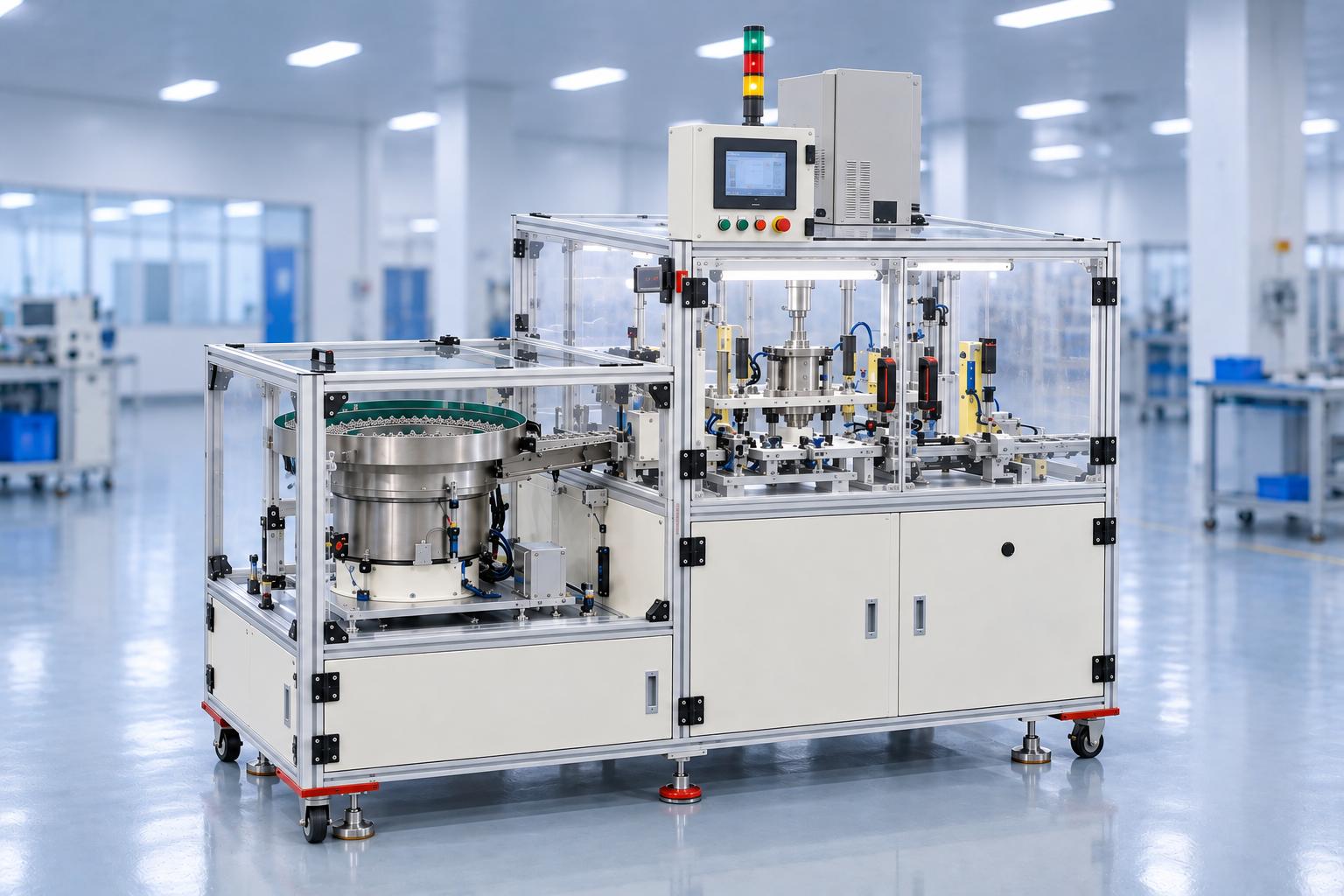
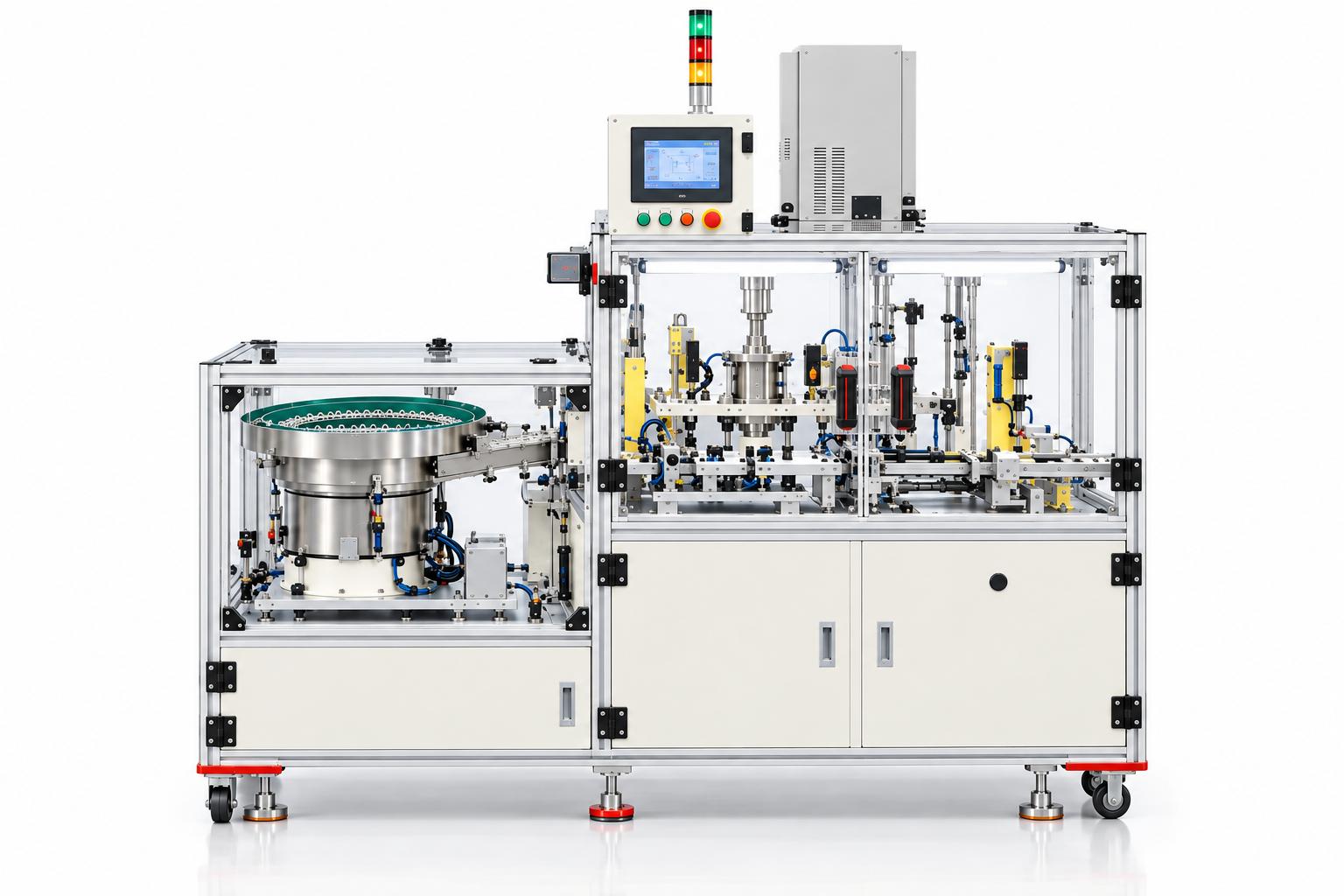
An automatic component bending and assembly machine is a specialized system designed for products that require automatic part feeding, forming, and sequential assembly. The machine integrates multiple processes into a single automated cycle, including automatic part feeding, adhesive dispensing, vision inspection, component feeding and bending, press-fitting components into the main part, post-assembly height measurement, and automatic sorting of qualified and defective products.
The equipment is custom-designed according to the specific requirements of each product. The shape of the main part, dimensions of the components to be bent, adhesive dispensing positions, pressing force and stroke, inspection criteria, fixtures, and product transfer methods can all be customized to suit the manufacturing process of each production line.
VIETNAM CNC & TECHNOLOGY APPLICATION JOINT STOCK COMPANY
Hotline: +84.916 63 9355 / +84.915 74 4664
Email: Sales01@cncvina.com.vn / Sales03@cncvina.com.vn
Product description

An automatic component bending and assembly machine is a specialized system designed for products that require automatic part feeding, forming, and sequential assembly. The machine integrates multiple processes into a single automated cycle, including automatic part feeding, adhesive dispensing, vision inspection, component feeding and bending, press-fitting components into the main part, post-assembly height measurement, and automatic sorting of OK/NG products. The equipment is custom-designed according to the requirements of each product. The shape of the main part, dimensions of the components to be bent, adhesive dispensing positions, pressing force and stroke, inspection criteria, fixtures, and product transfer methods can all be adjusted to suit the manufacturing processes of each production line. So, which industries use integrated automatic component bending and assembly machines, and how do they work? In this article, let’s explore these aspects with CNC VINA.
What benefits does an automatic component bending and assembly machine bring to industrial manufacturing?
This machine is suitable for assembly lines that require strict control over component positioning, assembly sequences, and post-assembly quality. It is particularly suitable for high-volume production, where multiple small processes need to be integrated into a single, fully automated cycle.
-
Bending and assembling components into main parts or electromechanical assemblies that require precise positioning.
-
Assembling parts that require adhesive application before pressing, positioning, or mechanical fastening.
-
Applications in mechanical engineering, electromechanical systems, industrial components, and assembly units that require post-assembly inspection.
-
Automating part feeding, positioning, press-fitting, and OK/NG inspection processes for mass-produced components.
-
Connecting with upstream and downstream machines through control signals to form a continuous automated assembly line.

Main components and functional units of the component bending and assembly machine
Automatic part feeding unit
The main part is automatically fed from a vibratory feeder through a guide rail to the loading position. Product detection sensors confirm the presence and position of the part, allowing the system to proceed to the next step only when the part is correctly positioned.
Product transfer unit
Linear transfer and lifting mechanisms move the parts through intermediate positions, adhesive dispensing, inspection, and component assembly stations. The movement sequence is interlocked with position sensors to minimize collisions between mechanisms.
Adhesive dispensing unit
After the part is positioned, it is transferred to the adhesive dispensing station. The adhesive volume, dispensing position, and rotational movement can be configured according to process requirements to create a bonding layer before the component is assembled.
Camera inspection unit
After adhesive dispensing, the product is transferred to the camera inspection station. The vision system can verify the product status and confirm the required conditions before the product proceeds to the component assembly stage.
Component feeding and bending unit
Components are fed to the working position by a dedicated mechanism. Two bending mechanisms work together to form the components into the required profile before they are transferred to the pressing position. Sensors monitor component presence and mechanism status throughout the cycle.
Component press-fitting unit
After forming, the component is positioned and press-fitted into the main part. The pressing unit operates according to preset stroke and timing parameters, working in coordination with the lifting and clamping mechanisms to ensure product stability during assembly.
Industrial robot and height measurement unit
After pressing, the product is transferred to an industrial robot. The robot moves the product to the height measurement station, where a precision sensor measures the height and compares it with the preset reference value and tolerance before the product is sorted.
OK/NG sorting unit
Products that meet the requirements are transferred to the next process, while defective products are diverted to a separate tray. This arrangement allows defective products to be separated directly within the machine, preventing them from being mixed with qualified products.
Control and safety system
The machine uses an industrial HMI combined with a Keyence, Mitsubishi, Siemens, or equivalent PLC, depending on the customer's standards. The system manages manual and automatic operating modes, sensor status, product counts, cycle time, fault alarms, and configurable operating parameters.
Moving areas are enclosed with a frame and transparent protective panels. Safety doors, emergency stops, air pressure monitoring, and a tower signal light are integrated to monitor and control operating conditions.
Key features
The machine integrates multiple processes into a single system, including part feeding, adhesive dispensing, inspection, component bending, press-fitting, measurement, and sorting.
-
Automatic part feeding using a vibratory feeder, reducing the need for manual part loading by operators.
-
An industrial robot transfers products between the assembly and inspection stations.
-
Camera inspection before assembly and height measurement after press-fitting.
-
Real-time monitoring of cycle time, product counts, and sensor status through the HMI.
-
Manual operation mode for checking individual mechanisms during maintenance, adjustment, or product changeover.
-
Integrated alarms for component shortages, missing parts, air pressure faults, sensor errors, robot errors, and safety door faults.
-
Communication capability with downstream machines for integration into an automated assembly line.
Operating principle
The machine operates through a closed-loop automated cycle. When automatic mode is enabled and all safety conditions are satisfied, the functional units operate sequentially according to the control program:
-
The main part is automatically fed from the vibratory feeder to the loading position.
-
The transfer mechanism moves the part to the adhesive dispensing station.
-
After adhesive dispensing, the part is transferred to the camera inspection station.
-
The part is then moved to the standby position of the product-holding transfer mechanism.
-
The transfer mechanism moves the part to the press-fitting station.
-
The component is fed into the bending unit and formed to the required shape.
-
The bent component is positioned and press-fitted into the main part.
-
After pressing, the assembled product is transferred to the industrial robot.
-
The robot moves the product to the height measurement station for post-assembly dimensional inspection.
-
Qualified products are transferred to the next process, while defective products are diverted to the NG tray.

Process control and monitoring
In automatic mode, the HMI displays cycle time, production count, measured values compared with reference standards, and the status of key sensors. The operator can initiate a controlled stop, allowing the machine to complete the processing of products currently at the stations before shutting down.
Parameters such as rotation speed, number of rotations, pressing time, robot positions, reference measurement values, and tolerances can be configured through the settings screen according to access permissions. Parameter changes are made based on the actual product requirements and manufacturing processes.
Technical specifications of the automatic component bending and assembly machine
| Item | Reference specifications |
| Machine type | Automatic component bending and assembly machine |
| Part feeding method | Vibratory feeder + automatic feeding rail |
| Integrated processes | Part feeding, adhesive dispensing, camera inspection, component bending and press-fitting, measurement, and sorting |
| Power consumption | Single-phase, AC 200–220 V, 50 Hz |
| Power consumption | Approximately 1.5 kW |
| Control voltage | DC 24 V |
| Compressed air pressure | 0.4 - 0.6MPa |
| Cycle time | 6 seconds/product |
| Feeder capacity | 600 parts |
| Component replenishment interval | Once every 10 minutes |
| Machine weight | 700kg |
| Machine dimensions | L1900 x W900 x H1350 mm |
| Working height | 900mm |
| Quality inspection | Camera + height measurement sensor + OK/NG sorting |
| Control system | HMI + Keyence, Mitsubishi, Siemens, or equivalent PLC |
| Safety protection | Transparent safety enclosure, interlocked doors, emergency stop, and tower signal light |
Note: The dimensions shown in the instruction documents and general arrangement drawings may differ due to the positioning of the HMI, tower signal light, and auxiliary units. The final dimensions will be confirmed based on the layout of each project.
Maintenance of main components
Regular maintenance should cover cylinders, sliding mechanisms, the robot, motors, vibratory feeder, electrical cabinet, push buttons, wiring, pneumatic lines, and sensors. The electrical cabinet and processing area should be cleaned regularly. Air leaks, mechanical play, abnormal temperatures, sensor signals, and the condition of safety doors should also be checked.
Frequently asked questions
Does the machine automatically feed parts?
Yes. The specified configuration uses a vibratory feeder and feeding rail to automatically deliver parts to the loading position.
What processes does the machine perform?
The machine performs part feeding, adhesive dispensing, camera inspection, component feeding and bending, press-fitting components into the main part, height measurement, and OK/NG sorting.
Does the machine inspect products after press-fitting?
Yes. The robot transfers the product to the height measurement station, where the measured result is compared with the preset reference value and tolerance before sorting.
Can the machine be integrated into an automated production line?
Yes. The system can exchange signals with upstream or downstream machines to transfer products and synchronize production line operations.
Which PLC brands does the machine use?
The PLC is selected according to project requirements. CNC VINA typically uses Keyence, Mitsubishi, Siemens, or equivalent equipment.
What is the approximate cycle time?
The reference configuration shown in the drawings has a cycle time of approximately 6 seconds per product. The actual cycle time depends on the number of processes, product characteristics, and inspection requirements.
Can the dimensions of the components or main parts be changed?
Yes, provided the changes fall within the design scope. Fixtures, feeding units, bending and pressing mechanisms, control programs, and measurement criteria will be designed according to the actual product requirements.
CNC VINA automatic component bending and assembly machine
CNC VINA designs and manufactures custom automatic assembly machines for industrial production. For automatic component bending and assembly systems, the feeding, adhesive dispensing, inspection, bending and press-fitting, robotic handling, and measurement units are arranged according to the actual product requirements to create a synchronized automated cycle that meets the productivity and quality requirements of each production line.