 Tiếng
Việt
Tiếng
Việt
 Tiếng
Anh
Tiếng
Anh
 Tiếng
Nhật
Tiếng
Nhật




 Tiếng Anh


Automatic bar feeding system for lathes
The automatic bar feeding system for lathes is an automation solution designed to optimize the processes of material feeding, part unloading, and workpiece transfer between machines within a production line. In addition to performing Loading & Unloading operations for CNC lathes, the system can integrate multiple machining processes such as turning, gear rolling, gear grinding, broaching, thread rolling, and more, creating a fully automated production line from raw blanks at the input stage to finished products at the output stage. In particular, for mass-produced components such as gear shafts, gears, and shaft-type parts, automating the loading and unloading processes helps shorten cycle times, reduce dependence on manual operations, and improve the overall stability of the production process. With a loading and unloading time of only approximately 6 seconds, the system is capable of meeting the requirements of continuous, high-volume production. This is one of the key automation solutions in the mechanical manufacturing industry, attracting increasing interest from manufacturers seeking to improve productivity, optimize labor costs, and gradually develop smart production lines. So, how is an automatic material loading system for CNC lathes structured? How does it operate, and what benefits can it bring to manufacturing businesses? Let’s explore the details with CNC VINA in the following sections.
VIETNAM CNC & TECHNOLOGY APPLICATION JOINT STOCK COMPANY
Hotline: +84.916 63 9355 / +84.915 74 4664
Email: Sales01@cncvina.com.vn / Sales03@cncvina.com.vn
Product description

The automatic bar feeding system for lathes is an automation solution designed to optimize the processes of material feeding, part unloading, and workpiece transfer between machines within a production line. In addition to performing Loading & Unloading operations for CNC lathes, the system can integrate multiple machining processes such as turning, gear rolling, gear grinding, broaching, thread rolling, and more, creating a fully automated production line from raw blanks at the input stage to finished products at the output stage. In particular, for mass-produced components such as gear shafts, gears, and shaft-type parts, automating the loading and unloading processes helps shorten cycle times, reduce dependence on manual operations, and improve the overall stability of the production process. With a loading and unloading time of only approximately 6 seconds, the system is capable of meeting the requirements of continuous, high-volume production. This is one of the key automation solutions in the mechanical manufacturing industry, attracting increasing interest from manufacturers seeking to improve productivity, optimize labor costs, and gradually develop smart production lines. So, how is an automatic material loading system for CNC lathes structured? How does it operate, and what benefits can it bring to manufacturing businesses? Let’s explore the details with CNC VINA in the following sections.
Technical specifications of automatic bar feeding system for lathes
| Machine dimensions | L8087 × W2347 × H3400 mm |
| Operating height | 1000–1100 mm from floor level |
| Main power supply | 3 phase, AC 200V, 50Hz |
| Control voltage | DC 24V |
| Required air pressure | 0.4–0.6 MPa |
| Cycle time | 28 sec/product |
| System cycle | CNC lathe cycle time + 6 sec for material loading |
| Basic product dimensions | L178 × D28 mm |
In automated manufacturing, material loading, workpiece positioning, alignment, and clamping on fixtures and JIGs are critical processes. These operations can also account for a significant portion of the production cycle time required to manufacture a product.
As modern mechanical manufacturing continues to develop, production automation has become increasingly important. Recognizing this need, many customers in Vietnam, Japan, and India have contacted CNC VINA to seek automatic material loading solutions for their existing conventional machining systems. These solutions include loading and unloading systems for shaft counter lathes, camshaft machining lines, and other automated loading and unloading applications.
Structure and operating principle of a typical automatic bar feeding system
The automatic material loading system for CNC lathes plays an important role in connecting machining processes, ensuring that workpieces are transferred and loaded into each machine accurately and continuously. The following section describes the structure and operating principle of a typical automatic material loading system, designed to meet the requirements of mass production and optimize overall production line efficiency.
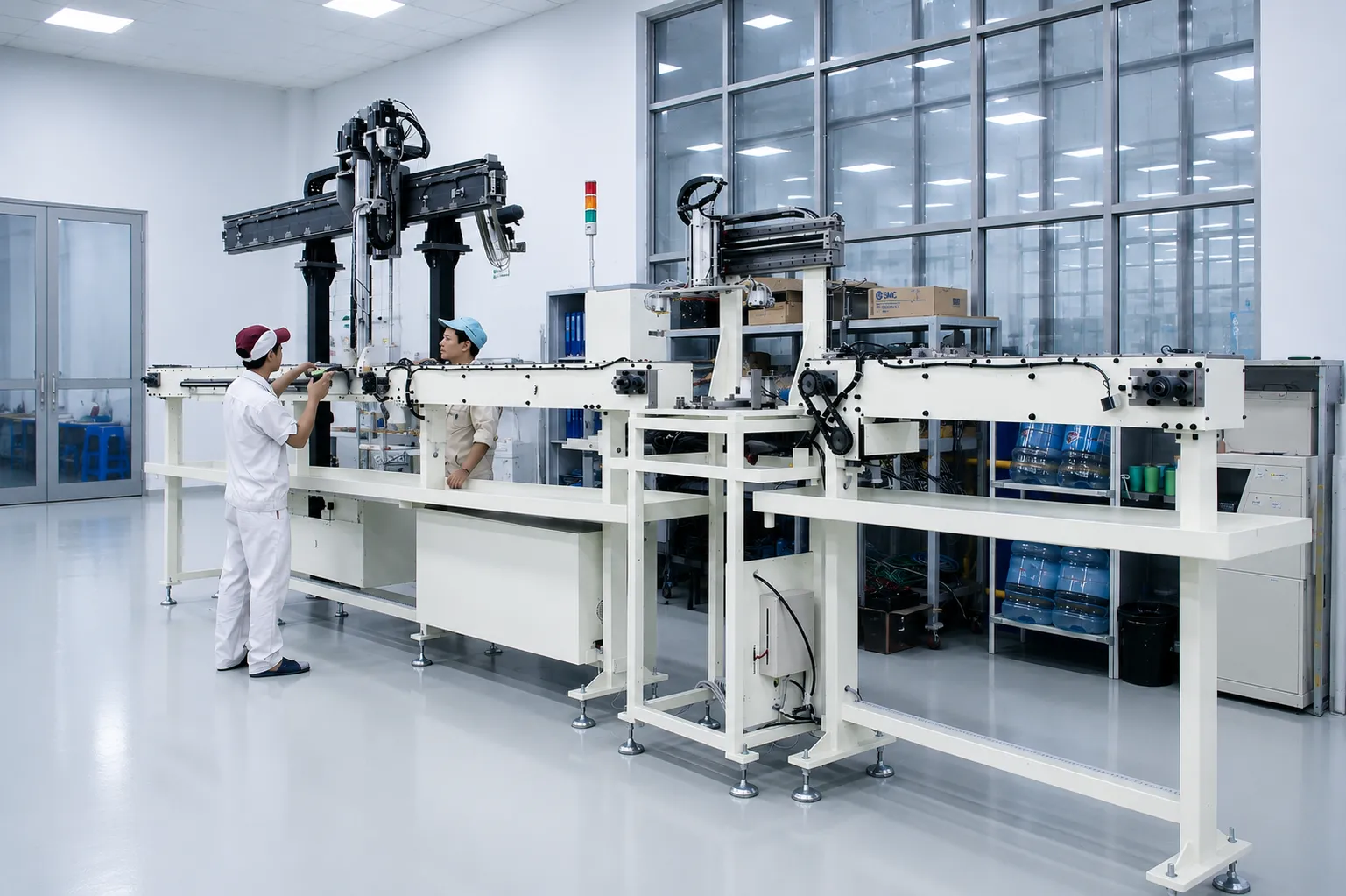
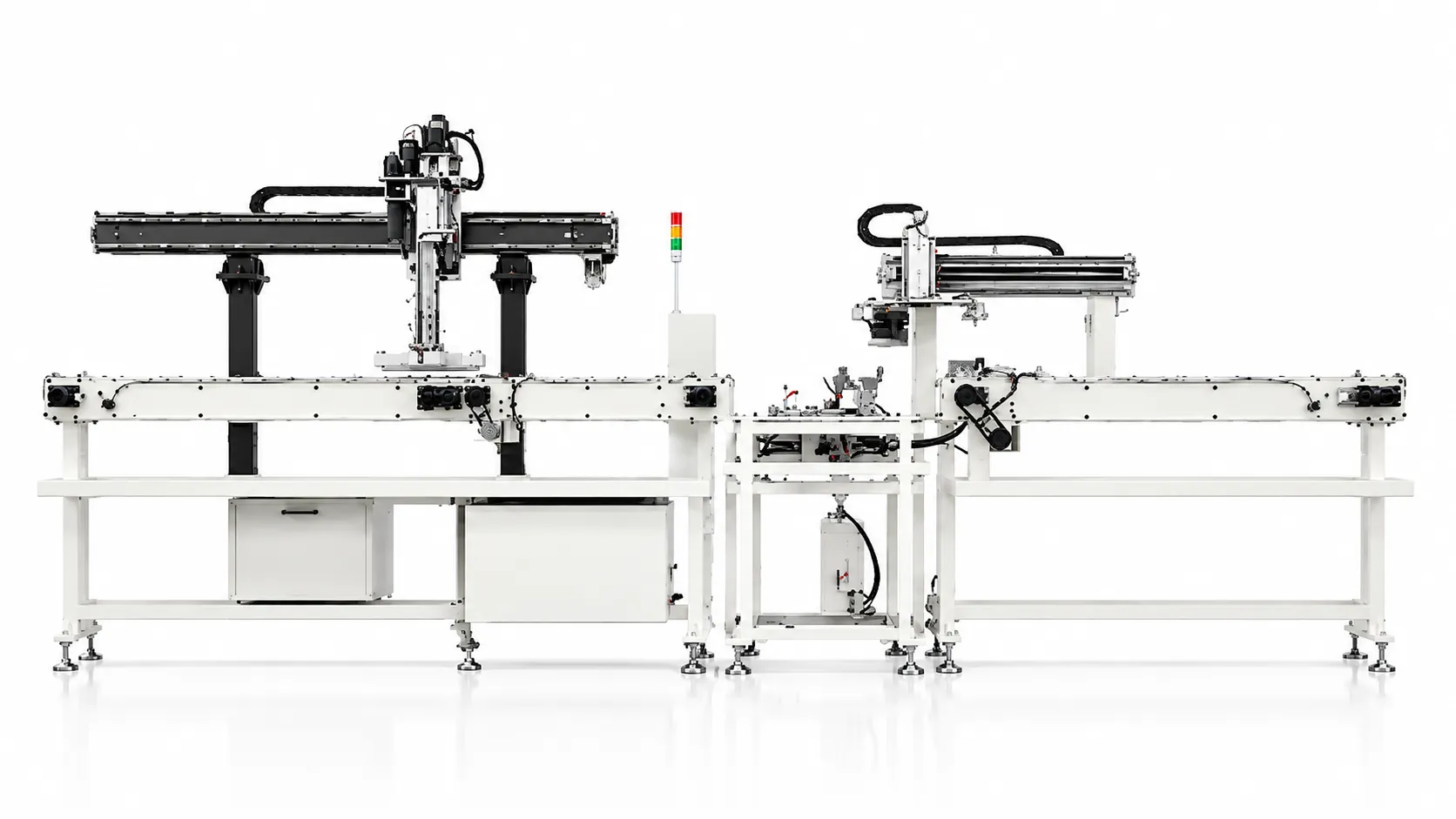
Structure of the automatic material loading system for shaft lathes
Production line includes
Lathe No. 1 – Lathe No. 2 – Tooth roller – Tooth grinding machine
The load & Unload system includes the following clusters
- Product Input Cluster (Capacity of 45-50 products depending on size and customer requirements)
- Hand transfer for lathe number 1
- Intermediate assembly between lathes 1 and 2
- Hand transfer to lathe 2
- Intermediate cluster between lathe 2 and tooth roller
- Hand transfer to tooth roller
- Intermediate assembly between tooth roller and grinder
- Hand transfer to grinding machine
- Product Output Cluster (Capacity of 45-50 products depending on size and customer requirements)
- Counter system counts the number of finished products.
- Safely covers moving positions.
- Product level input conveyor assembly
- Transfer cluster (cluster 1 and cluster 2): product supply cluster for the lathe + product pick-up cluster combined with automatic robot.
- Intermediate cluster
- Upper and lower cover clusters
- Output cluster
Operating sequence of lathe bar feeding system
Below is a description of the general operating principle of the automatic bar feeding mechanism. For example, with the machine model for customer MUSASHI.
- First, workers place the product on the Input conveyor. The number of products placed on the conveyor belt is designed depending on the customer's requirements.
- Transfer cluster 1 picks up products from the Input Conveyor to the waiting position of Lathe 1. At the same time, Transfer cluster 2 picks up the product from the intermediate cluster into Lathe No. 2.
- When Lathe 1 and Lathe 2 finish turning, the pick-up arm on the Transfer 1 cluster comes down to pick up the turned product, then place the workpiece in. At the same time, the pick-up arm on the Transfer 2 cluster also picks up the product from Lathe 2 and places the new workpiece in.
- The pick-up arm on the Transfer 1 cluster carries the product into the intermediate cluster. The gripper on the Transfer 2 assembly carries the product into the Jig on the lathe.
- The cycle is repeated for the next products.
Outstanding features of the automatic bar feeding system for lathes
The advantage of an automatic bar feeding system is that it can replace humans in one or more production stages. Among them, the process of feeding blanks and mounting jigs to jigs on the machine. And removing products from the machine after processing are the most feasible automation steps to reduce cycle time
- Automatic bar feeding brings economic efficiency in mass production with identical or similar details. Changing the automatic bar feeding solution according to each predetermined product is quite simple with quick jig and dandory replacement.
- The system's time for feeding workpieces and retrieving products is very short, only about 6 seconds, helping to increase machining productivity for machine tools. The above time, with one or a few single-unit products, is insignificant.
- However, let's try multiplication for product batches with a quantity of several tens of thousands of parts/month. Or simply mass production (mass product) on one machine shift. You will clearly see the productivity and absolute benefits of an automated system.
- The Load Unload system is designed to reduce labor costs, 1 worker can operate 3 to 4 automatic lines.
- The material of the machine is made from steel and painted in a color consistent with the factory.
- Mechanical and electrical equipment are sourced from Japan and the EU.
Compare system efficiency
| Comparison criteria | Without Load & Unload system | With Load & Unload system |
| Number of operators | 4 operators | 1 operator |
| Material loading into the machine | Manual | Automatic |
| Product unloading after machining | Manual | Automatic |
| Product transfer between processes | Performed by operators | Automatic transfer |
| Intermediate product storage racks | Required | Can be reduced or eliminated |
| Production line continuity | Dependent on operator actions | Automatic and continuous |
| Mass production capability | Limited by labor availability | Suitable for high-volume production |
| Automation expansion capability | Limited | Can integrate additional processes |
Operating instructions and dandory
Always comply with the operating procedures in the CNC VINA documents provided for each machine, including:
- System initialization (turn on the circuit breakers in sequence, supply electrical power and compressed air to the machine).
- Manual operation according to the instructions: switch to Manual mode. Control the cylinders, motors, and robot operations on the HMI screen. Return the machine to the home position using the Return function, etc. Always pay attention to checking the lathe conditions before running: tailstock center retracted to the home position / chuck opened / main door closed / select Auto mode.
Automatic operation by switching the machine to Automatic mode and operating the machine to run.
Note: When switching to Auto mode for the first time, the lathe does not send a feedback signal to the Loader system. The Loader will pick up the product and remain above the lathe waiting for a signal. To activate the operation, press and hold the “TIỆN 1 SẴN SÀNG” button (for Loader 1) or the “TIỆN 2 SẴN SÀNG” button (for Loader 2) until the Loader starts moving down into the lathe.
- When an error occurs, the system stops immediately, the STOP light turns on, and the START light turns off. At this time, check the errors displayed on the screen. Troubleshoot and correct the error, then press the RESET button to clear the error. The STOP light will remain on. Press and hold START for 2 seconds to continue the cycle. Example: The clamping cylinder is stuck while the cylinder is clamping the product. After adjusting the cylinder and the limit switch (LS), press Reset to clear the error. Then press and hold START for 2 seconds to continue the operation.
- In case the cylinder error cannot be corrected by the normal method and it is necessary to adjust the components in Manual control mode or switch to MANUAL mode, the machine must be returned to the home position and then restarted.
- If a Robot error occurs, turn off the power, restart the Robot, and check the cause of the Robot error or overload. Then perform Return and restart the operation.
Pay attention when maintaining and maintaining the automatic bar feeding system
Because the machine is designed to operate continuously for long periods of time, maintenance is very important. Below are some points for workers to pay attention to during maintenance of the automatic loading system for the lathe:
- Always perform weekly and monthly inspections and maintenance of the mechanisms and equipment, including motors, cylinders, guide bushings, supporting bearings, chain mechanisms, conveyor sprockets, grippers, transfer units, sliding slides, power supply systems, electrical cabinets, sensors, etc.
- Apply grease periodically to the moving mechanisms.
- Periodically inspect the equipment, including motors, cylinders, sprockets, chains, slide rails, etc.
- If the chain becomes loose, adjust it accordingly.
- If the motor mounting flange bolts become loose, tighten them. If the motor is damaged, replace it.
- Check whether the cylinders operate smoothly.
- Check the air filter periodically. If it is dirty, clean it.
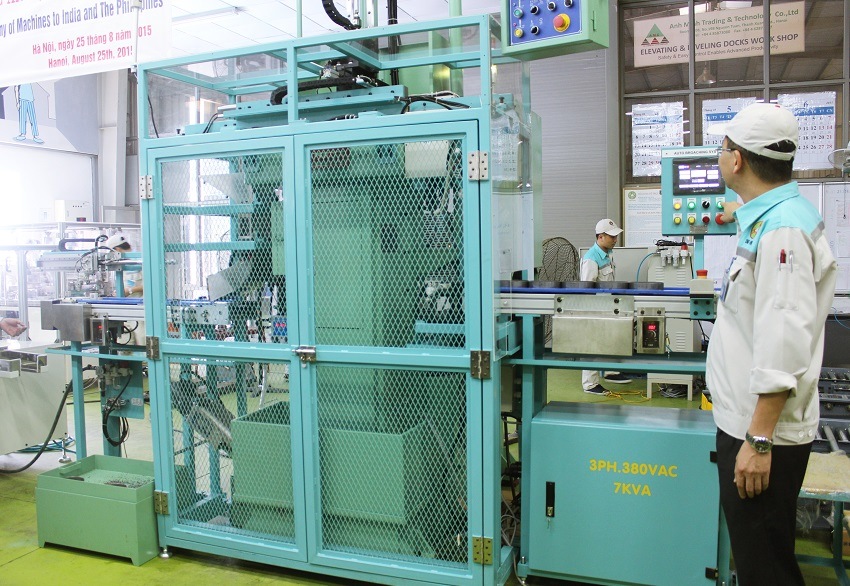
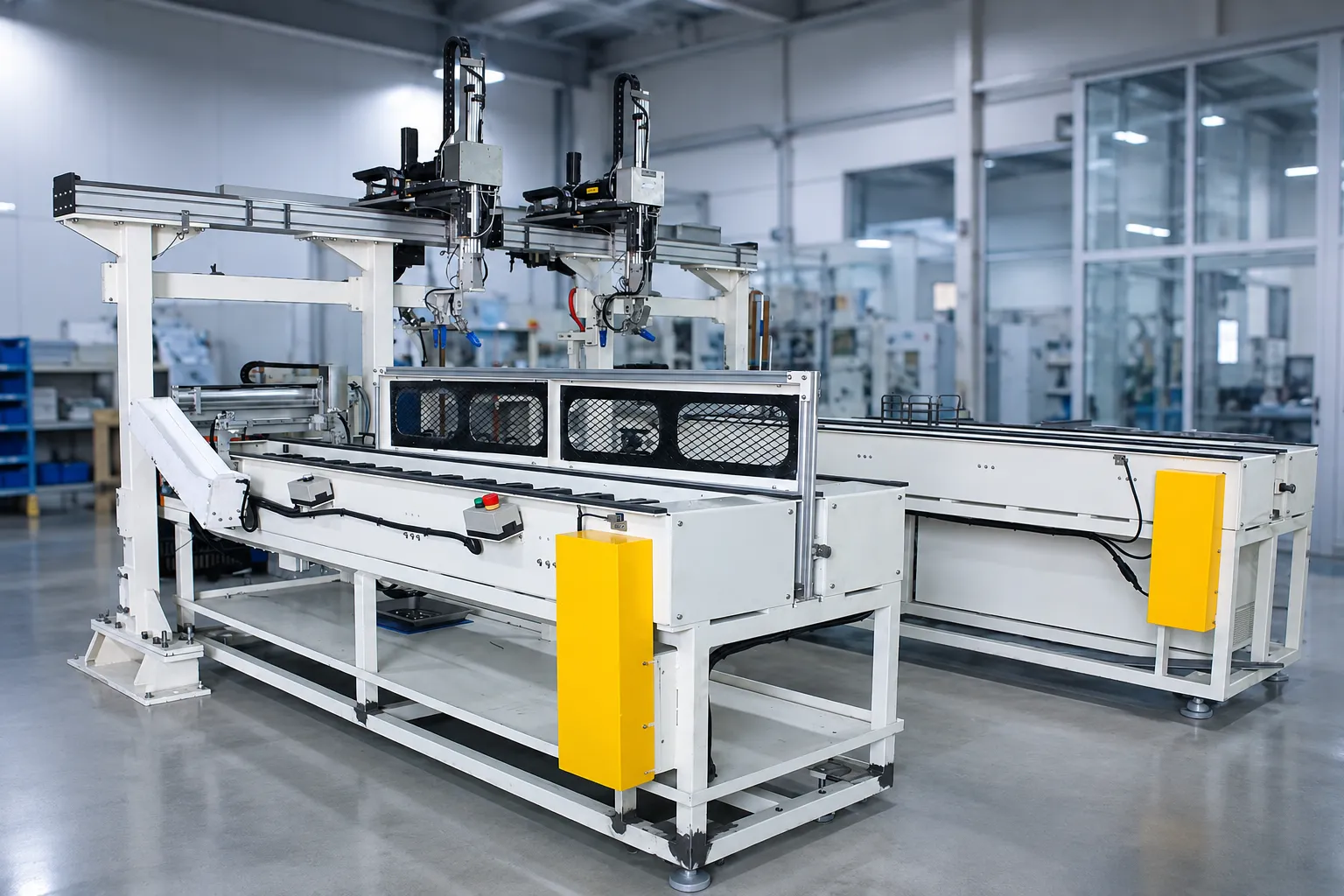
Image: application of automatic bar feeding system for broaching machine. The system has been successfully integrated and commercially produced by CNC VINA for export to Indian and Philippine customers since 2015.
Automatic bar feeding systems (Loading & Unloading) always bring productivity in production and high profits for businesses. Automatic systems and automatic machines can be designed, manufactured and integrated by CNCVina on many lines with many different applications such as turning, thread rolling, broaching, etc. If you really want to keep up and break through. In the 4.0 industrial revolution, come to us to have the most reliable companion.
The automatic bar feeding system for lathes is not simply a solution to replace workers’ loading and unloading operations, but also a solution for connecting processes throughout the entire machining line. From feeding workpieces into the machine, positioning and clamping, removing finished products after machining, to transferring them to the next process, the entire process is carried out automatically, continuously, and according to the programmed sequence. In particular, for mass-production lines of gear shafts, gears, and other mechanical components with short cycle times, the Loading & Unloading solution helps maximize machine operating time, reduce direct labor, and improve the overall productivity of the production line.
With the ability to design and integrate automation systems according to product characteristics, the number of processes, and actual production requirements, CNC VINA can provide workpiece loading, Load & Unload, and production line automation solutions for various types of machine tools, such as lathes, gear hobbing machines, grinding machines, broaching machines, thread rolling machines, etc. This is a suitable investment direction for businesses transitioning from manual production to automated production, with the goal of reducing operating costs, increasing productivity, and improving the stability of product quality. If your business is looking for an automation solution suitable for its existing production line or wants to build a complete automated machining line, CNC VINA is ready to support you from consultation, automatic machine design and manufacturing to system integration and operation.
Customers who need an automatic bar feeding system please contact:
VIETNAM CNC & TECHNOLOGY APPLICATION JOINT STOCK COMPANY
Factory: Song Cung Industrial Site, Dong Thap Commune, Dan Phuong District, City. Hanoi Vietnam
Phone: +84.916 63 9355 / +84.915 74 4664
Website: https://cncvina.com.vn; https://cncvina.net; https://cncviname.com.vn
Email: Sales01@cncvina.com.vn | Sales03@cncvina.com.vn