 Tiếng
Việt
Tiếng
Việt
 Tiếng
Anh
Tiếng
Anh
 Tiếng
Nhật
Tiếng
Nhật




 Tiếng Anh

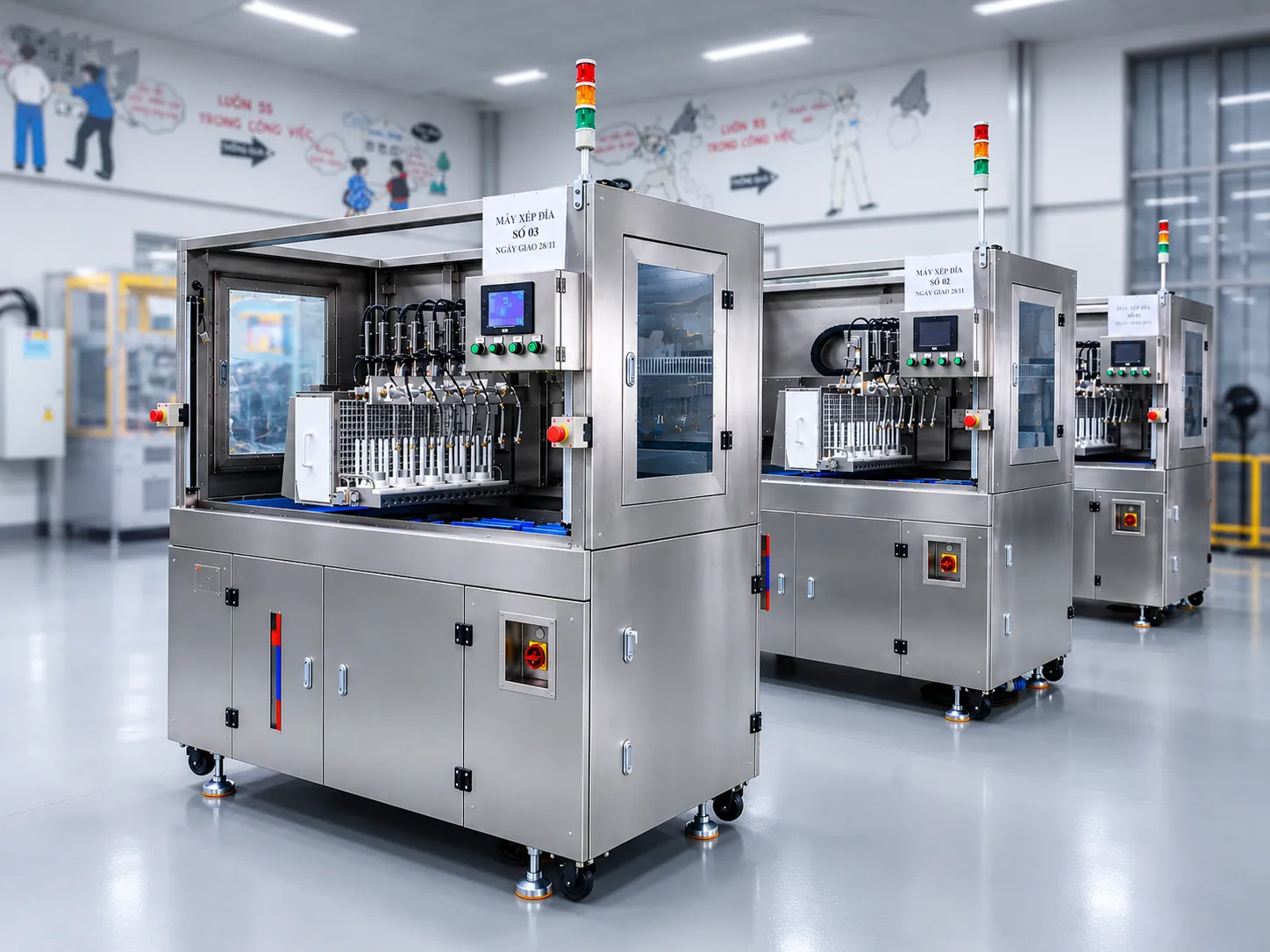
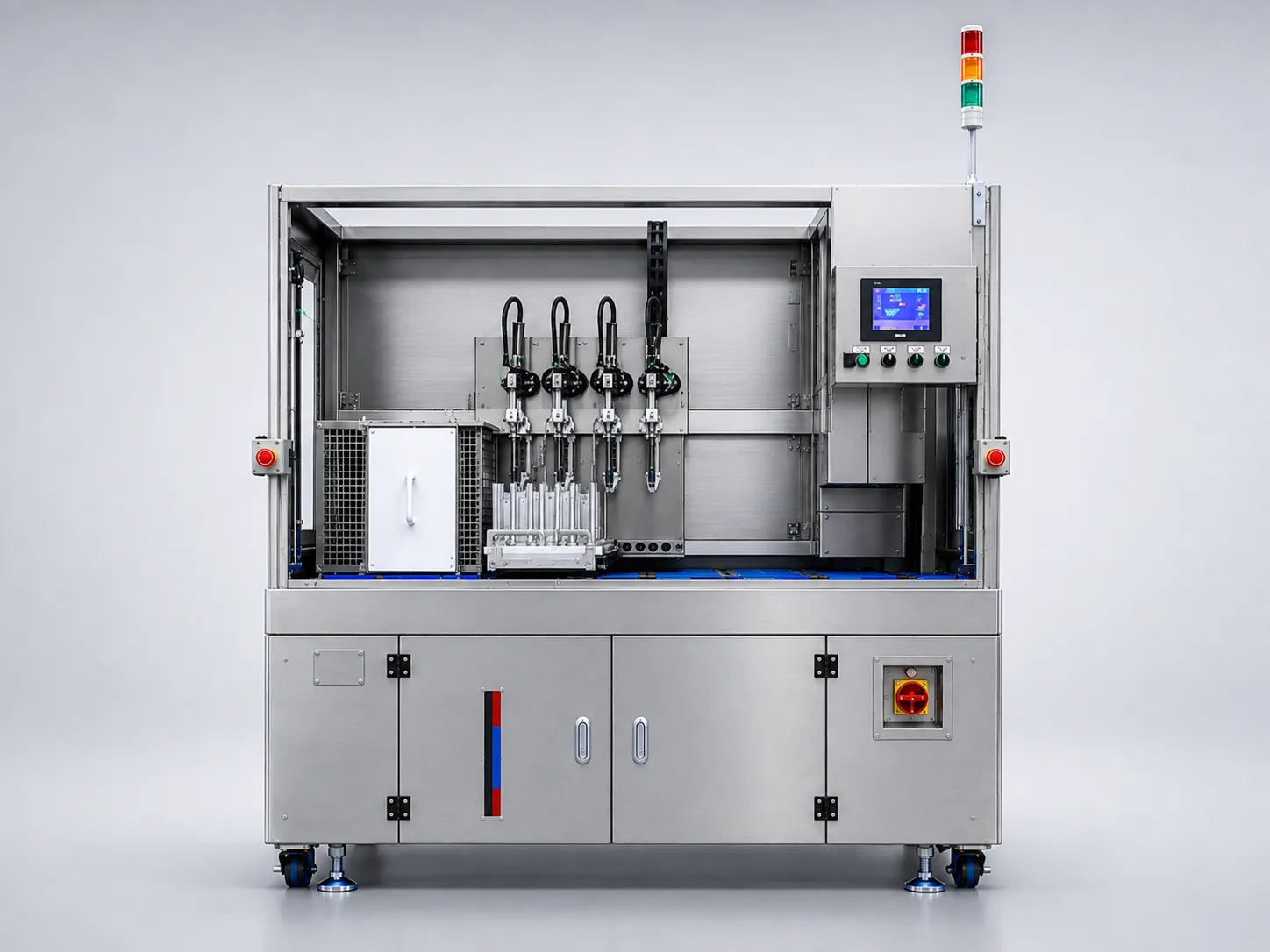
Automatic optical disc splitter machine
The Automatic Optical Disc Separator is designed to automatically separate individual optical discs from a stacked batch, remove the interleaving paper between discs, and transfer each disc to a designated tray according to a predefined sequence. Instead of manually picking up and separating the discs, the machine uses a multi-axis motion system combined with a gripping mechanism, air-blowing system, and sensors to perform the entire process automatically and consistently. This automated solution helps reduce manual handling, improve separation accuracy, and ensure stable operation for production processes requiring continuous and repetitive optical disc handling.
The Automatic Optical Disc Separator designed and manufactured by CNC VINA is developed according to the actual requirements of each production line. The system utilizes an IAI Robot Cylinder combined with an X-Y-Z motion system, gripping mechanism, and dedicated air-blowing mechanism. This configuration enables the automatic separation of individual discs, removal of interleaving paper, and organized product placement, thereby improving the stability and efficiency of the production process.
VIETNAM CNC & TECHNOLOGY APPLICATION JOINT STOCK COMPANY
Hotline: +84.916 63 9355 / +84.915 74 4664
Email: Sales01@cncvina.com.vn / Sales03@cncvina.com.vn
Product description

Introduction to the Automatic Optical Disc Separator
The Automatic Optical Disc Separator is designed to automatically separate individual optical discs from a stacked batch, remove the interleaving paper between discs, and transfer each disc to a designated tray according to a predefined sequence. Instead of manually picking up and separating the discs, the machine uses a multi-axis motion system combined with a gripping mechanism, air-blowing system, and sensors to perform the entire process automatically and consistently. This automated solution helps reduce manual handling, improve separation accuracy, and ensure stable operation for production processes requiring continuous and repetitive optical disc handling.
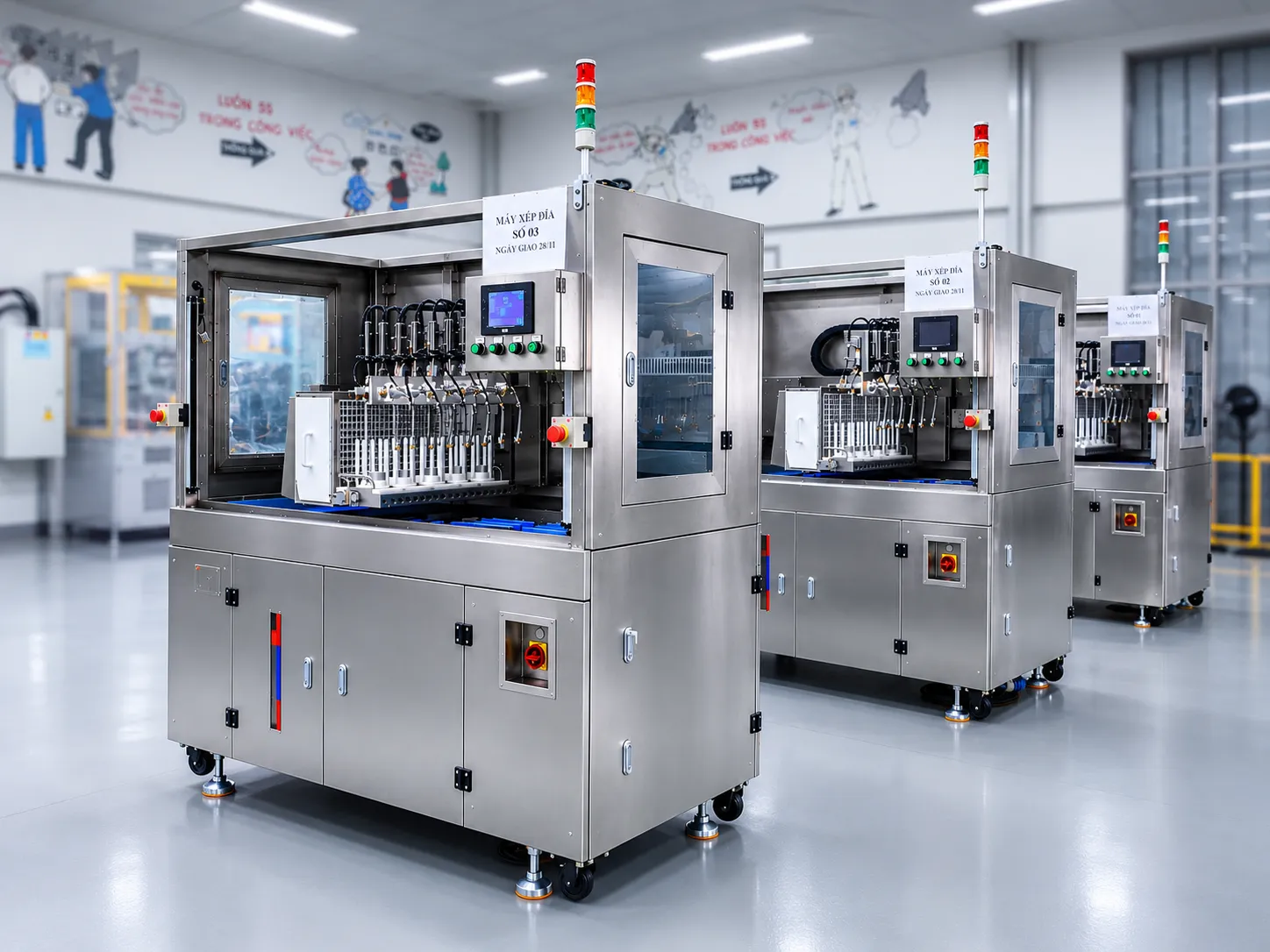
In production lines for optical product manufacturing and assembly, or in processes that require disc-shaped workpieces to be fed individually, picking a single product from a stack may seem straightforward, but it actually requires a highly precise feeding mechanism. This is particularly important when the discs are stacked with interleaving paper between each disc, as the separation process must be carefully controlled to prevent multiple discs from being picked up at once or the stack from becoming misaligned. The Automatic Optical Disc Separator designed and manufactured by CNC VINA is developed according to the actual requirements of each production line. The system utilizes an IAI Robot Cylinder combined with an X-Y-Z motion system, gripping mechanism, and dedicated air-blowing mechanism. This configuration enables the automatic separation of individual discs, removal of interleaving paper, and organized product placement, thereby improving the stability and efficiency of the production process.
What is an Automatic Optical Disc Separator?
The Automatic Optical Disc Separator is an automation system specifically designed to separate individual optical discs from a stack and feed them to a designated position. During the process, the machine also handles the interleaving paper placed between the discs to ensure that only the required product is transferred during each operating cycle.
In principle, the incoming products are arranged in a stack with a predetermined quantity. The control system identifies the position of the disc stack, after which the motion mechanism moves the gripping head to the designated position. The gripping mechanism picks up one disc per cycle, while the pneumatic system assists in separating the interleaving paper. Once the disc has been picked, it is transferred to a tray or receiving position according to the production line configuration.
The key function of the equipment lies not only in its ability to pick individual discs, but also in its ability to precisely control the separation process between each product layer. When the gap between discs is minimal and interleaving paper is present, the combination of a precision gripping mechanism, controlled motion, and an appropriately directed airflow helps ensure more stable disc feeding compared with manual handling.
Main components and systems of the machine
The machine configuration can be customized depending on the product specifications and production line requirements. For the CNC VINA Automatic Optical Disc Separator, the main functional systems include:
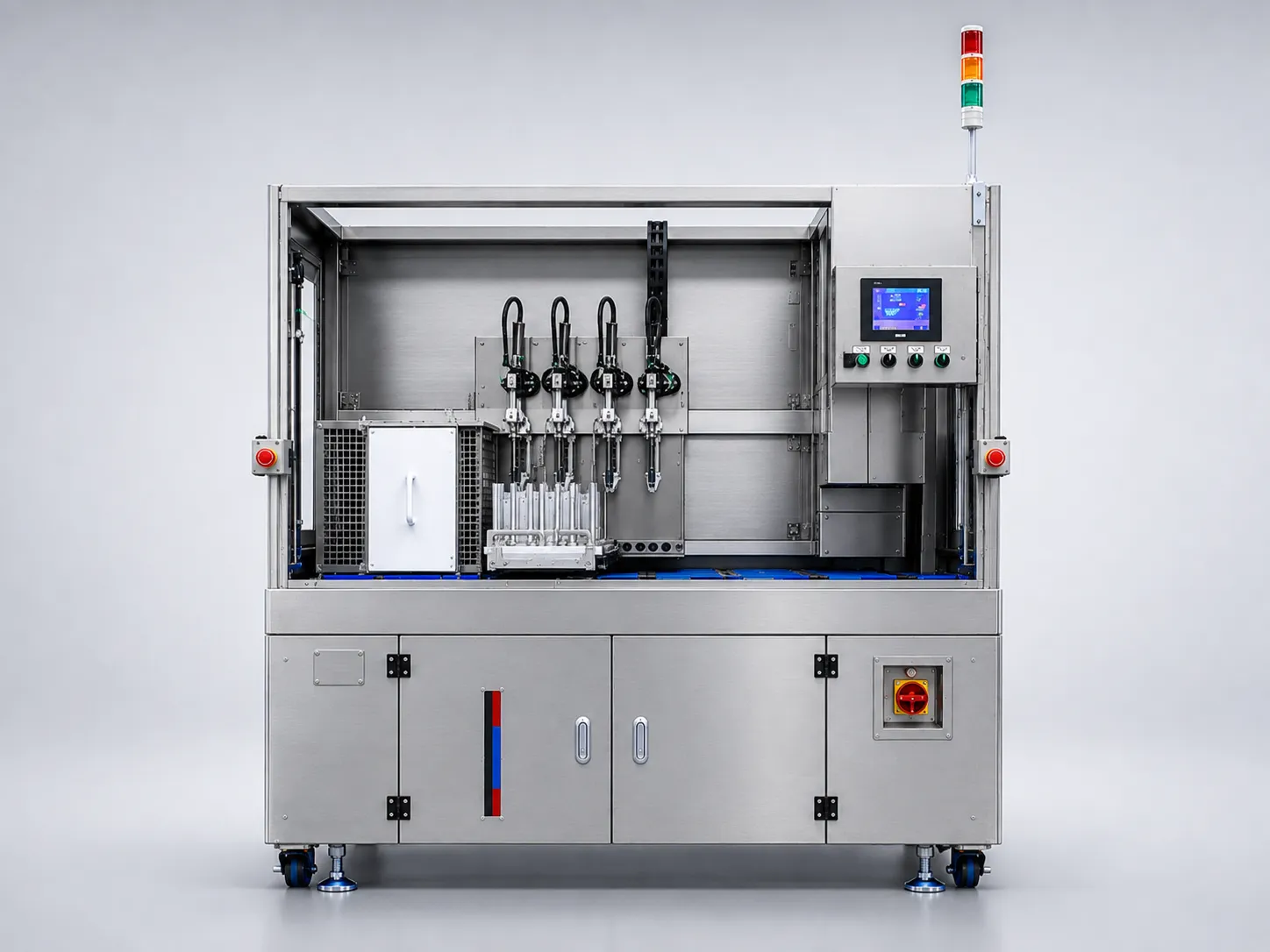
X-Y-Z motion system
The three-axis X-Y-Z motion system is responsible for moving the gripping mechanism to the precise position of the disc stack and the designated product placement position. The use of independent motion axes allows the equipment to adjust its travel according to the actual size and position of the products. The Z-axis performs vertical movement to approach and pick up the disc, while the X- and Y-axes provide horizontal movement. The coordinated motion of all three axes is programmed according to the machine's operating cycle, enabling the gripping mechanism to follow a stable trajectory while minimizing unnecessary movements.
IAI robot cylinder
The machine utilizes an IAI Robot Cylinder from Japan as the motion mechanism for operations requiring high positioning accuracy and stable control. It is one of the key components that enables the system to perform disc feeding and picking operations according to the programmed cycle. Selecting an appropriate drive mechanism is critical for this type of equipment, as the gripping head must accurately approach the product while maintaining smooth and stable movement during continuous machine operation.
Disc gripping mechanism
The gripping mechanism is designed based on the shape, dimensions, and material characteristics of the discs. The gripping head must securely hold the product during movement while avoiding unnecessary force or contact that could affect the disc surface. Depending on the product requirements, the gripping mechanism can be customized and adjusted to accommodate the disc diameter, thickness, and arrangement within the production line.
Air-blowing system for interleaving paper separation
The air-blowing system is one of the key functional units of the machine. When the discs are stacked, the interleaving paper between individual discs can make the separation process more challenging if only a gripping mechanism is used. The machine is equipped with dedicated air nozzles that generate an airflow directed toward the interleaving paper. This airflow helps separate the paper layer from the disc and remove it from the working area according to the programmed operating cycle. By controlling the airflow direction and volume, the separation process can be performed more efficiently while minimizing the possibility of the interleaving paper remaining attached to the product.
Sensor and control system
Sensors are used to detect product status, mechanism positions, and operating conditions throughout each stage of the process. Sensor signals are transmitted to the control system to monitor the operating cycle and handle abnormal conditions when necessary. The machine is equipped with an HMI (Human-Machine Interface) as the operator interface, allowing users to monitor equipment status, configure operating parameters, and control the necessary functions during operation.
Operating principle of the Automatic Optical Disc Separator
The machine operates according to a continuous cycle in which disc feeding, interleaving paper separation, and product placement are coordinated with one another. First, the operator loads the stack of discs into the machine's feeding position. The disc stack is positioned using an appropriate fixture or positioning mechanism to ensure that the products remain securely aligned throughout the operating process.
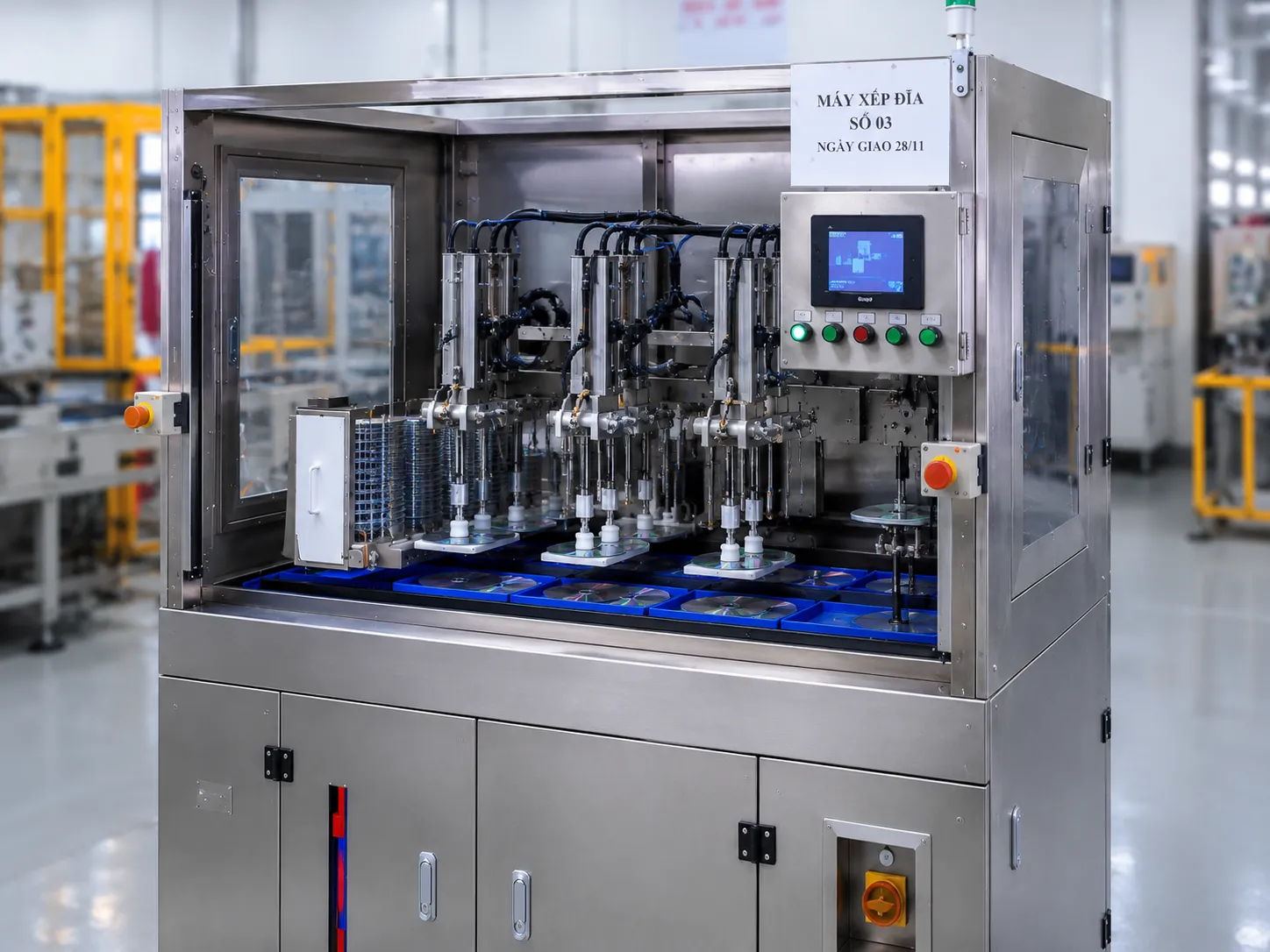
Operating principle of the Automatic Optical Disc Sorting Machine
When the machine starts a cycle, the control system moves the handling mechanism to the position of the disc stack. The gripping mechanism approaches the product and picks up one disc according to the programmed sequence. When separator paper is placed between the discs, the air-blowing system is activated to assist in separating the paper layer. The airflow is directed at the separator paper to reduce the possibility of the paper being carried along with the disc or multiple layers being picked up simultaneously.
Once the disc has been separated from the stack, the motion mechanism transfers the product to the designated tray or receiving position. The disc is placed at the programmed coordinates, after which the gripping mechanism returns to its initial position or proceeds directly to the next cycle. Sensors continuously monitor the machine status. If the system detects an incorrectly positioned product or an incomplete cycle, it can issue an alarm or stop the operation depending on the control configuration.
Through this process, operations that would otherwise be performed manually, such as picking individual discs, separating the separator paper, and arranging products in trays, are converted into a controlled automated cycle.
Applications of the Automatic Optical Disc Sorting Machine
The automatic optical disc sorting machine has a wide range of applications in the manufacturing and assembly of optical products.
The machine is used in manufacturing and assembly processes that require automated feeding and separation of disc-shaped products. It is particularly suitable for production lines where products must be processed individually while maintaining stable positioning before being transferred to the next operation.
In optical product manufacturing and assembly lines, the machine can handle the process of feeding individual discs from a stacked supply to the next processing position. Automating this operation helps connect the product storage or feeding area with subsequent assembly, inspection, or processing stations.
The equipment can also be integrated into existing automated production lines. In this configuration, the disc sorting machine functions as a feeding module that works in coordination with conveyors, robots, assembly mechanisms, inspection equipment, and other automation systems according to the requirements of the overall production line.
For manufacturers with high production volumes, automating the disc feeding process can reduce dependence on manual handling while maintaining a more consistent operating cycle.
Key Advantages of the Automatic Optical Disc Sorting Machine
The automatic optical disc sorting machine is designed to replace manual operations such as disc picking, separator paper removal, and product arrangement with a controlled automated process. By combining an X-Y-Z motion system, IAI Robot Cylinder, gripping mechanism, air-blowing system, and sensors, the machine provides the accuracy, stability, and continuous operation required in industrial production environments.
Fully automated disc sorting process: The machine continuously performs operations including picking individual discs from the stack, separating the separator paper, and transferring the discs to the designated position or tray according to the programmed sequence. This significantly reduces manual operations in the product feeding and arranging process.
High positioning accuracy and process stability: The X-Y-Z motion system combined with the IAI Robot Cylinder enables the gripping mechanism to move according to programmed coordinates and maintain stable pick-and-place positions throughout each cycle. This is particularly important for products that require precise handling and minimal displacement during the feeding process.
Effective separator paper separation: The dedicated air-nozzle system generates an airflow directed at the separator paper between the discs, helping separate the paper from the product during the sorting process. The combination of air blowing and mechanical gripping helps minimize the risk of separator paper being picked up together with the disc or multiple layers being picked simultaneously.
Improved production efficiency: The machine can perform continuous disc sorting cycles according to the programmed control sequence, making it suitable for production lines that handle large quantities of products. Reducing manual handling time helps increase productivity and maintain a more consistent production rhythm.
Reduced dependence on manual labor: Repetitive operations such as disc picking, paper separation, and product placement are performed automatically. Operators primarily need to load the disc stack, monitor the equipment status, and intervene when necessary, thereby reducing the amount of manual work required.
Reduced risk of handling errors: The programmed operating sequence and sensor-based monitoring help minimize common errors associated with manual handling, such as picking multiple discs at once, placing products in the wrong position, or skipping the separator paper removal step.
Intuitive operation and monitoring: The HMI provides an interface for operators to monitor machine status, configure parameters, and control necessary functions. Signals from the sensors are transmitted to the control system to monitor each operation and detect abnormal conditions during machine operation.
Designed for continuous operation: The machine structure and control system are designed for industrial production environments, allowing the equipment to perform multiple consecutive cycles while maintaining stable disc sorting performance. This is particularly beneficial for production lines with high requirements for productivity and continuous operation.
Product-specific design: The gripping mechanism, feeding position, motion travel, and air-blowing configuration can be designed according to the dimensions, thickness, and characteristics of each type of disc. This allows the machine to be customized to meet the actual requirements of individual production lines.
Enhanced operational safety: The machine can be enclosed within a protective frame and working area, with emergency stop buttons, sensors, and status indicator lights. This configuration helps control access to the moving mechanisms and allows operators to clearly identify the operating status of the equipment.
Easy maintenance and line integration: Mechanical assemblies, the control cabinet, and motion systems can be arranged as separate functional units, facilitating inspection, maintenance, and troubleshooting. The machine can also be designed to communicate and interface with upstream and downstream processes within an automated production line according to customer requirements.
By combining precise motion mechanisms, a dedicated gripping system, air separation, and automated control, the automatic optical disc sorting machine not only replaces manual handling but also creates a stable, continuous, and controllable disc feeding process. It is a suitable solution for production and assembly lines that require automation of disc separation and feeding operations.
Key technical specifications
The automatic optical disc sorting machine is designed with technical features that directly support the requirements of disc feeding and separation:
-
X-Y-Z motion system: Provides positioning and movement of the gripping mechanism according to programmed coordinates.
-
IAI Robot Cylinder: Utilizes a motion mechanism from IAI, Japan, for disc feeding and gripping operations requiring high positioning accuracy.
-
Air-blowing system: Uses dedicated air nozzles to assist in separating separator paper between individual discs.
-
Large disc-stack handling capacity: The system can be designed to handle a stack of approximately 100 discs, depending on project requirements.
-
HMI control: Provides an intuitive interface for machine operation, status monitoring, and parameter configuration.
-
Sensor system: Monitors product position and machine status throughout the operating process.
-
Customized design: The gripping mechanism, fixtures, motion travel, and loading/unloading positions can be designed according to the actual product and production requirements.
Parameters such as cycle time, product dimensions, axis travel, number of tray positions, and communication method with the production line should be determined based on the specific requirements of each project. This is why automatic systems of this type are typically designed and manufactured around the actual product and process requirements rather than based on a single fixed configuration for every production line.
Automatic optical disc dividing machine designed and manufactured by CNCVina for customers
Customers can refer to the types of automatic machines in the fields of electronics, assembly and packaging and please contact company information:
VIETNAM CNC & TECHNOLOGY APPLICATION JOINT STOCK COMPANY
Factory: Song Cung Industrial Site, Dong Thap Commune, Dan Phuong District, City. Hanoi Vietnam
Phone: +84.9166 393 55 / +84.915 74 4 664
Website: https://cncvina.com.vn; https://cncvina.net; https://cncviname.com.vn
Email: Sales01@cncvina.com.vn | Sales03@cncvina.com.vn