 Tiếng
Việt
Tiếng
Việt
 Tiếng
Anh
Tiếng
Anh
 Tiếng
Nhật
Tiếng
Nhật




 Tiếng Anh

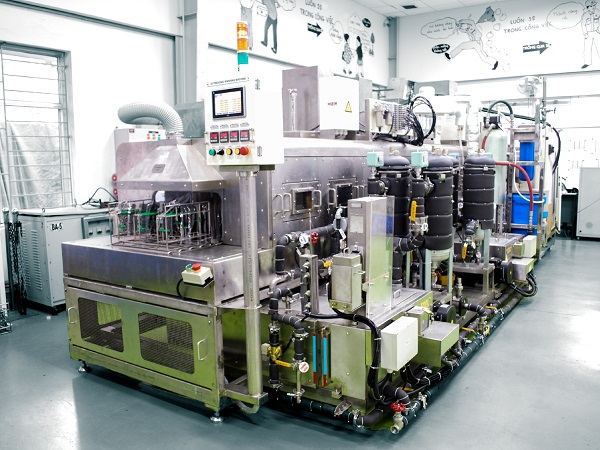
Ultrasonic washing machine for washing small parts of cars (Model: UWM-V3)
An ultrasonic washing machine for washing parts of cars is an industrial cleaning system specially designed to remove oil, grease, dirt, metal chips, and other contaminants from the surface of components during automotive parts machining and manufacturing processes. CNC VINA designs and manufactures the machine by combining high-pressure cleaning solution spraying technology with ultrasonic cleaning technology, improving cleaning efficiency on both external surfaces and hard-to-reach areas such as drilled holes, threaded holes, gaps, grooves, and complex edges. The system operates automatically using a conveyor, incorporating multiple cleaning stages, including rough washing, fine washing, air blow-drying, and natural cooling. The cleaning solution is continuously circulated through a filtration and oil separation system, helping maintain cleaning performance while reducing water and cleaning solution consumption. With a design suitable for various types of components and production requirements, the ultrasonic washing machine helps manufacturers increase productivity, maintain consistent cleaning quality, and reduce dependence on manual cleaning methods. In the following article, let’s explore with CNC VINA why ultrasonic waves are used to clean small automotive parts and how the machine is constructed.
VIETNAM CNC & TECHNOLOGY APPLICATION JOINT STOCK COMPANY
Hotline: +84.916 63 9355 / +84.915 74 4664
Email: Sales01@cncvina.com.vn / Sales03@cncvina.com.vn
Product description

An ultrasonic washing machine for washing parts of cars is an industrial cleaning system specially designed to remove oil, grease, dirt, metal chips, and other contaminants from the surface of components during automotive parts machining and manufacturing processes. CNC VINA designs and manufactures the machine by combining high-pressure cleaning solution spraying technology with ultrasonic cleaning technology, improving cleaning efficiency on both external surfaces and hard-to-reach areas such as drilled holes, threaded holes, gaps, grooves, and complex edges. The system operates automatically using a conveyor, incorporating multiple cleaning stages, including rough washing, fine washing, air blow-drying, and natural cooling. The cleaning solution is continuously circulated through a filtration and oil separation system, helping maintain cleaning performance while reducing water and cleaning solution consumption. With a design suitable for various types of components and production requirements, the ultrasonic washing machine helps manufacturers increase productivity, maintain consistent cleaning quality, and reduce dependence on manual cleaning methods. In the following article, let’s explore with CNC VINA why ultrasonic waves are used to clean small automotive parts and how the machine is constructed.
Technical specifications of the ultrasonic washing machine for washing small parts of cars (Model: UWM-V3) – CNC VINA

| Machine dimensions | L840 × W580 × H1640 mm |
| Working height | 950 mm |
| Machine material | SUS201 |
| Power supply | 3-phase, 380V, 50 Hz |
| Required air pressure | 0.4–0.5 MPa |
| Air flow rate | 30 m³/min |
| Cycle time | 5 sec/set |
| Number of models | 5 |
| Cleaning solution | 15% W80 oil + 85% water, temperature: 60°C |
| Number of operators | 2 operators |
Structure and washing principle of ultrasonic washing machine :
An ultrasonic washing machine for small automotive parts is an industrial cleaning system designed to remove oil, grease, dirt, metal chips, residues, and other contaminants from component surfaces during machining, manufacturing, and assembly processes. The machine combines high-pressure spray cleaning technology with ultrasonic cleaning technology. This combination enhances cleaning performance, particularly for parts with complex shapes, multiple edges, drilled holes, threaded holes, and other hard-to-reach areas that are difficult to clean using conventional washing methods.
Construction of the Ultrasonic Washing Machine for Small Automotive Parts
Depending on the product requirements and cleaning process, the machine can be designed with different cleaning stages. A typical ultrasonic washing machine for small automotive parts consists of the following main components:
- Conveyor system: Transfers parts into the machine, transports them through each processing stage, and delivers the cleaned parts to the machine outlet. The conveyor speed can be adjusted according to the required washing time and production capacity.
- Washing tank: Contains the cleaning solution and serves as the main cleaning area. The tank can be equipped with a heating system to maintain the cleaning solution at a suitable temperature according to the type of oil, contaminants, and material of the parts.
- Ultrasonic generation system: Consists of an ultrasonic generator and ultrasonic transducers installed in the washing tank. The system generates high-frequency vibrations and transfers ultrasonic energy into the cleaning solution, helping loosen and remove contaminants from the surface of the parts.
- High-pressure spray system: Uses pumps and spray nozzles to generate a high-pressure flow of cleaning solution that directly impacts the surface of the parts. The spray helps remove oil, grease, dirt, metal chips, and other contaminants from the surface.
- Rinsing system: After the main washing process, the parts can pass through a rinsing stage using clean water or a specialized solution to remove residual cleaning solution and remaining contaminants.
- Air blow-off system: Uses high-speed air flow to remove water from the surfaces, gaps, holes, and recessed areas of the parts. This process helps reduce the amount of residual water before the parts leave the machine.
- Cleaning solution filtration and circulation system: The used cleaning solution can be filtered to remove dirt, metal chips, and other contaminants before being circulated back into the washing tank. This helps reduce cleaning solution consumption and maintain consistent cleaning performance.
- Electrical control cabinet and control system: Controls the conveyor, pumps, ultrasonic generator, heating system, air blowers, and other equipment. Parameters such as washing time, solution temperature, conveyor speed, and operating modes can be configured according to specific production requirements.
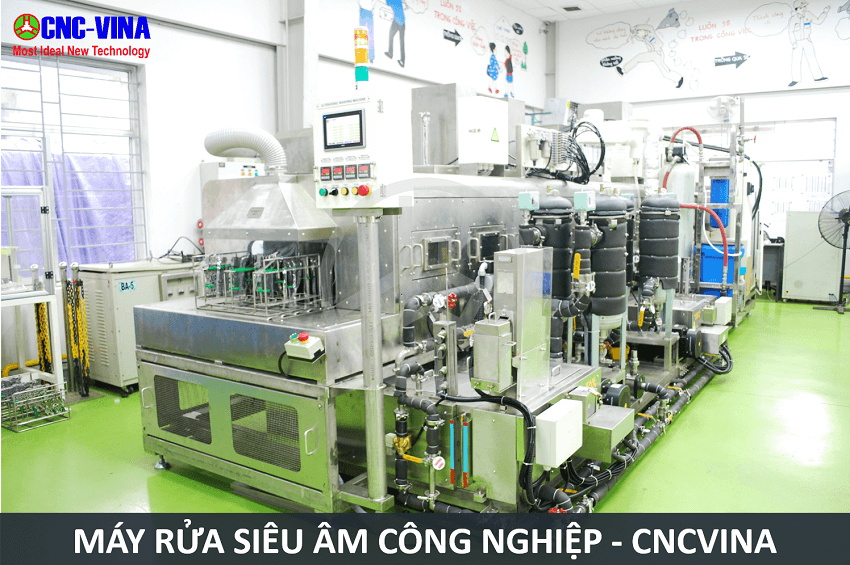
The principle of ultrasonic cleaning is simply understood as follows
Ultrasound is sound with a frequency higher than the maximum frequency that the human ear can hear. This maximum frequency depends on each person, but usually it is around 20,000 Hz. In contrast to ultrasound, sounds with frequencies lower than the threshold of hearing by the human ear (usually around 20 Hz) are infrasound.
Why do ultrasonic waves have a cleaning effect? Due to the effect of emitted ultrasonic waves, the cleaning liquid solution is affected and changes state continuously. Sometimes it is compressed to become thicker, sometimes it is stretched to become thinner. Because the liquid solution containing detergent could not withstand the pulling force, when it was pulled out, it became thinner and created voids. Those locations produce a lot of small air bubbles. These bubbles will immediately burst in a very short time. The foam rupture process generates small but very powerful shock waves. It is called “vacuum creation phenomenon”.
Because the frequency of ultrasonic waves is very high, the small air bubbles mentioned above appear and disappear very quickly. The shock waves they produce are like invisible "small brooms" that spread very quickly and strongly, sweeping every surface, nook, and corner of the detail. Therefore, even if the part has many complex surfaces, deep threaded holes, drilled holes, stiffeners... it can be cleaned quickly.
Outstanding features of the ultrasonic cleaner:
- The product is thoroughly cleaned including corners, deep holes, threaded holes...
- Continuous circulatory washing provides high efficiency, washing speed is 58 seconds/1 detailed tray.
- Filter pump system: 10mm filter, oil skimmer. For products and small car parts with a lot of grease that need to be cleaned, the filter system helps separate grease mixed in the tank to ensure clean water when washing. There is a filter clogged warning system to change the filter.
- Using circulating filtration should save water.
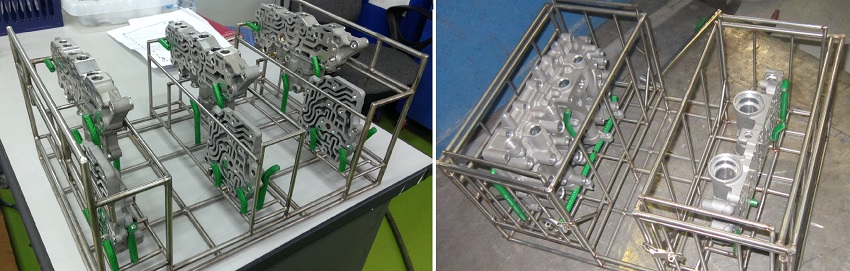
Some products with complex structures are cleaned on an ultrasonic washing machine designed and manufactured by CNCVina
Ultrasonic washing machine operating process:
The parts to be cleaned are placed in a loading tray at the inlet of the conveyor system. When the machine is operating, the conveyor automatically transports the trays containing the parts through each processing area inside the machine. After completing the entire cleaning, drying, and cooling process, the parts are delivered to the conveyor outlet for operators to collect or transfer to the next production stage.
The cleaning process consists of four main stages: rough washing, fine washing, air blow-drying, and natural cooling.
Step 1: Rough Washing
Rough washing is the first stage, designed to remove most of the oil, grease, dirt, metal chips, and other contaminants adhering to the surface of the parts.
Pass 1 – High-pressure cleaning solution spraying: The parts are directly sprayed with the cleaning solution at high pressure. The strong flow of cleaning solution acts on the surface to quickly remove oil, grease, dirt, and larger deposits.
Pass 2 – Ultrasonic cleaning: After high-pressure spraying, the parts continue to the ultrasonic cleaning area. Ultrasonic waves travel through the cleaning solution, creating a cavitation effect that helps loosen contaminants remaining on the surface, particularly in hard-to-reach areas such as drilled holes, threaded holes, gaps, grooves, and corners of the parts.
Step 2: Fine Washing
After rough washing, the parts are transferred to the fine washing area. The purpose of this stage is to remove any remaining oil, grease, and contaminants and further improve the cleanliness of the parts.
Pass 1 – Ultrasonic cleaning: The parts are further cleaned in the solution using ultrasonic waves. The cavitation effect helps remove fine particles and thin layers of oil remaining on complex areas of the parts.
Pass 2 – High-pressure cleaning solution spraying: After ultrasonic cleaning, the cleaning solution is sprayed at high pressure over the entire surface of the parts. This process helps wash away contaminants loosened during ultrasonic cleaning and further cleans the surface before the drying stage.
Step 3: Air blow-drying
After completing the two washing stages, the parts are transferred to the air blow-drying area. High-speed air is blown directly onto the surfaces of the parts to remove residual water and cleaning solution. In particular, the air flow helps remove liquid remaining inside drilled holes, threaded holes, gaps, and recessed areas. The air blow-drying process helps reduce residual moisture on the parts before they leave the machine.
Step 4: Natural cooling
After air blow-drying, the parts are transferred to the final section of the system for natural cooling. Here, the parts are exposed to ambient conditions, allowing their temperature to gradually decrease to a suitable level before operators collect them or transfer them to the next production stage. Natural cooling helps prevent the parts from remaining excessively hot after the washing process while facilitating subsequent inspection, packaging, or further machining.
The combination of high-pressure spraying and ultrasonic cleaning in two washing stages enhances the removal of oil, grease, dirt, and other contaminants from the parts while improving cleaning performance in complex areas that are difficult to reach using conventional spray washing alone.
Applications of the ultrasonic washing machine for washing small parts of cars
Ultrasonic cleaners are used to clean mechanical parts, components and products in many different industries. Ultrasonic washing machines are not only used to clean small parts, car and motorbike parts, but are also used in:
Medical: Removes stains, rust and chemicals on the surface of medical tools and equipment.
Food: Cleaning objects, barrels, boxes, food trays, vegetables and fruits for factories.
Industry and mechanics: Removes grease, dirt, and rust on machine parts and mechanical products. Especially small products with complex surfaces and many ridges and grooves. Improve industrial product cleaning productivity of production lines.
VIETNAM CNC & TECHNOLOGY APPLICATION JOINT STOCK COMPANY
Factory: Song Cung Industrial Site, Dong Thap Commune, Dan Phuong District, City. Hanoi Vietnam
Phone: +84.916 63 9355 / +84.915 74 4664
Website: https://cncvina.com.vn; https://cncvina.net; https://cncviname.com.vn
Email: Sales01@cncvina.com.vn | Sales03@cncvina.com.vn